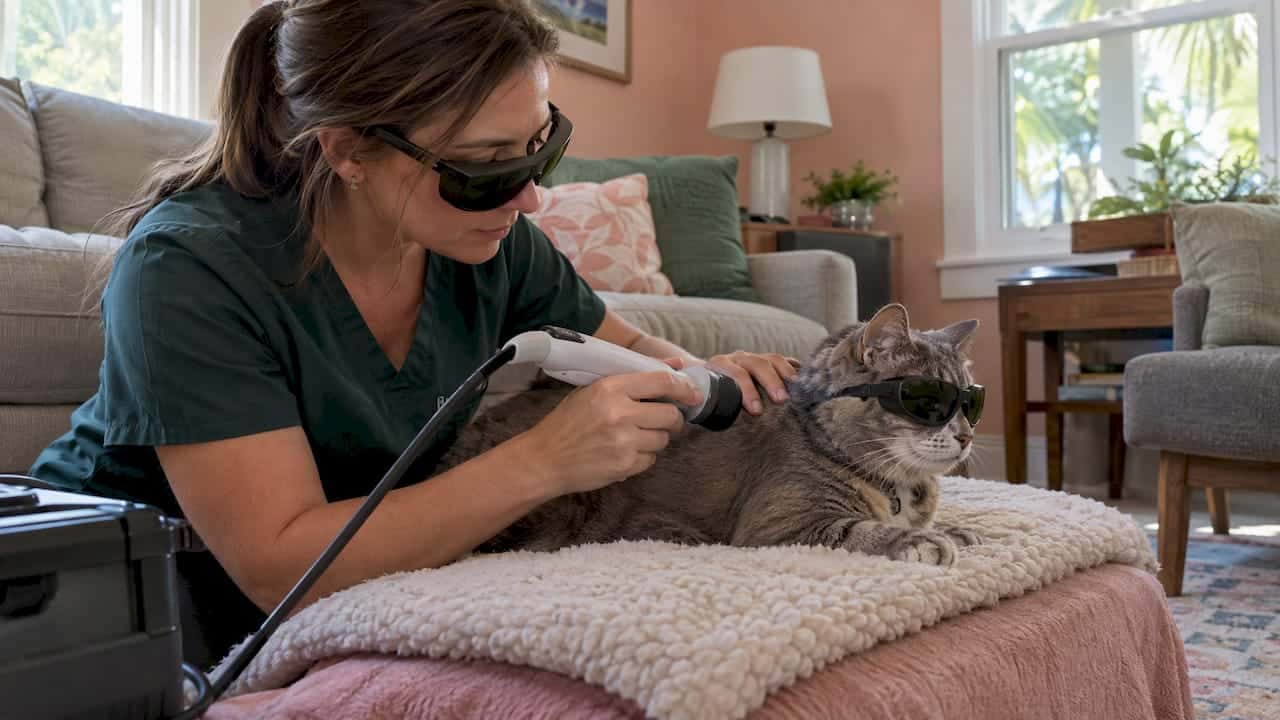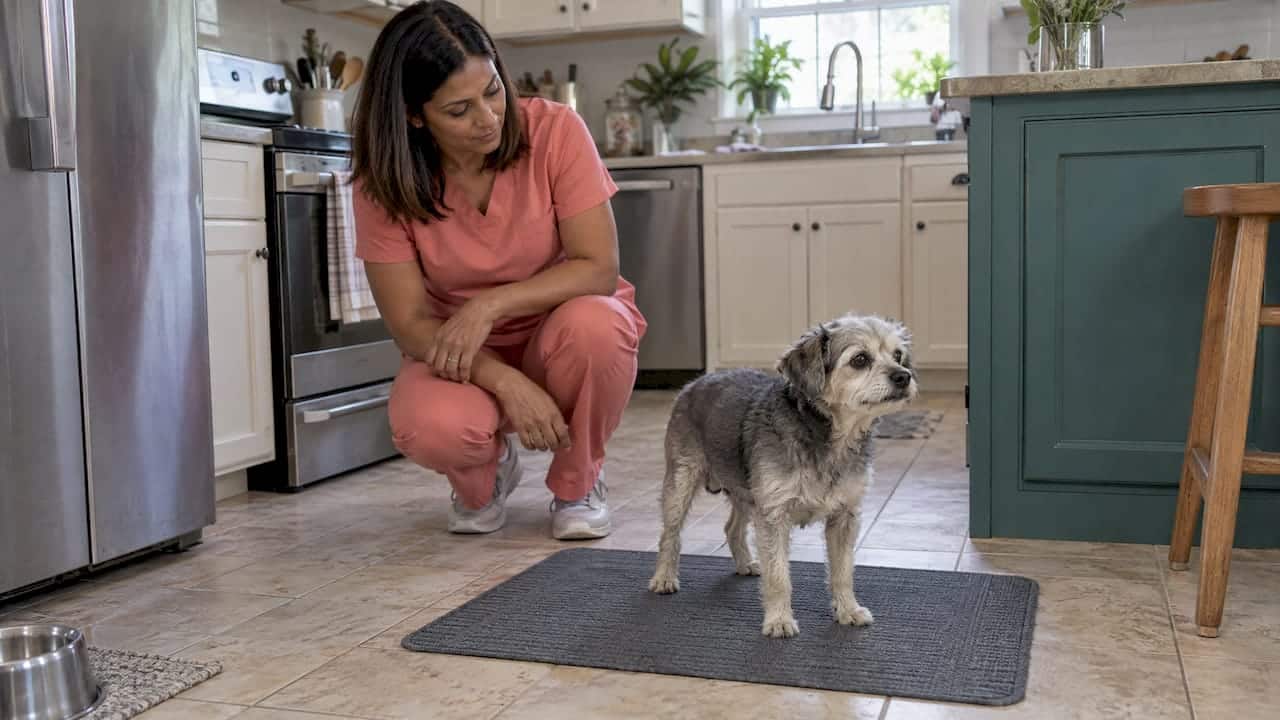
Spondylosis can’t be reversed, but a dog living with it can often be kept comfortable and moving. The most useful natural approach is a combination: acupuncture, gentle rehabilitation, weight and diet management, and a home set up for easy footing, all guided by your regular veterinarian. For a senior or anxious dog, much of that can happen on the living room rug instead of in a car and a waiting room. That is how we practice in South Tampa.
If you have just seen “spondylosis” on an X-ray report for your dog, or you have noticed slower mornings and a reluctance to jump onto the couch, this guide walks you through what the condition is, what natural and integrative care can realistically do, and how to start.
TL;DR
- Spondylosis deformans is age-related bone spurring along the spine. It is often found by accident on X-rays, and many dogs never need treatment.
- When it causes stiffness or pain, a multimodal plan works best: rehabilitation, acupuncture, weight control, omega-3 fatty acids, and home changes, alongside any medication your vet prescribes.
- Supplements and herbs need your vet’s sign-off, especially if your dog takes pain medication.
- Sudden weakness, loss of bladder control, crying out when the back is touched, or refusing to walk needs a veterinary exam promptly.
- In-home integrative visits spare senior, disabled and anxious dogs the stress of travel.
Table of Contents
- What spondylosis actually is
- Signs your dog may be hurting
- What the evidence says about natural and integrative options
- How natural care works with medication
- Setting up your home
- A sample plan for a senior dog
- What a visit with us looks like
- Our perspective
- Getting started in South Tampa
- FAQ
- Sources
What spondylosis actually is
Think of your dog’s spine as a stack of vertebrae cushioned by discs and held together by tough fibers. As dogs age, those fibers at the edges of the discs wear down. The body responds by laying down new bone to steady the weakened joint. Those bony spurs are spondylosis deformans.
Researchers describe it as a non-inflammatory reaction of bone that develops to restore stability to weakened intervertebral joints, mainly because of age-related breakdown of those outer disc fibers. On X-rays it is graded from 0 (no spur) to 3 (bony bridges joining neighboring vertebrae).
Two things are worth knowing right away:
- It is common in older dogs and often silent. It is typically found incidentally on X-rays taken for another reason.
- It progresses slowly, like arthritis. The spurs themselves do not go away, so the goal of treatment is comfort, strength and mobility, not a cure.
That is a hopeful message as much as a sober one. The bone changes are not the same as the pain. A dog with a grade 2 spur and a strong, supple body can be happier than a dog with a mild spur and weak, tight muscles.
Signs your dog may be hurting
A dog won’t say “my back aches.” You will see it in small shifts. According to PetMD’s veterinary review, signs of painful spondylosis include:
- Crying out when the back is touched
- A hunched posture
- Reluctance to walk, or lameness
- Trouble lying down or getting up
- Stiffness and restricted movement
- Lower appetite and lethargy
In everyday life, that looks like a dog who hesitates at the bottom of the stairs, circles longer before lying down, or no longer meets you at the door. If you notice any of these, book a veterinary exam. Pain that seems like “just age” often has a treatable component, and an exam also rules out other spinal problems that look similar.
When it is more urgent
Sudden hind-leg weakness, dragging or knuckling of the paws, incontinence, or severe pain are not signs to manage at home. Call your regular veterinarian or an emergency clinic the same day. Spondylosis can sit alongside disc disease and nerve compression, and those need a diagnosis first.
What the evidence says about natural and integrative options
There is no single natural remedy for spondylosis. Veterinary pain guidance is consistent on this point: the MSD Veterinary Manual notes that chronic pain treatment is rarely a single approach. It lists acupuncture, rehabilitation, nutraceutical supplements, low-level laser, massage, and herbal supplements among the options, alongside medications.
Here is how the main natural tools fit in.
Rehabilitation therapy
The American Animal Hospital Association (AAHA) 2022 pain management guidelines say rehabilitation should be considered part of a comprehensive plan for dogs with acute or chronic pain. That includes manual techniques like massage, stretching and passive range of motion, modalities such as laser and electrical stimulation, and therapeutic exercise.
Why this matters for spondylosis: a stiff spine makes the muscles around it work harder, and tight, weak muscles make the dog stiffer still. Gentle strengthening and mobility work breaks that cycle. The same AAHA guidance notes that a trained rehabilitation specialist can often plan creative at-home alternatives to fitness equipment, which is exactly why this kind of care travels well to your house. Our at-home physical therapy guide covers what a session looks like, and our rehabilitation therapy page outlines what we offer.
Acupuncture
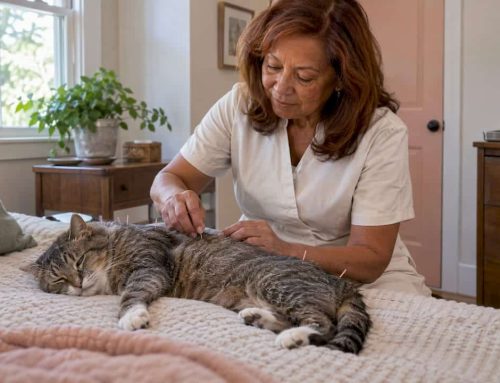
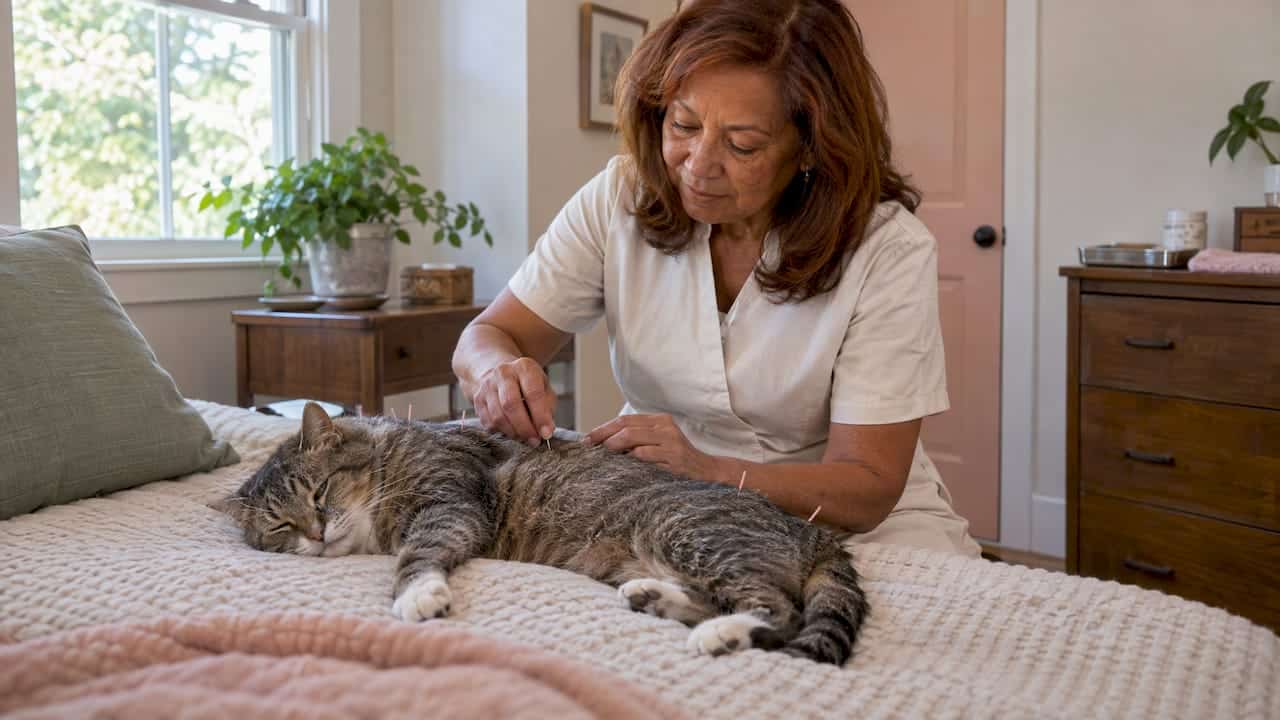
Acupuncture is one of the best-known integrative tools for back pain in dogs. A veterinary pain lecture from the World Small Animal Veterinary Association (WSAVA) states that acupuncture is generally considered safe and cites a study in which electroacupuncture combined with spinal surgery eased back pain more than surgery alone. A 2022 review of complementary canine orthopedic medicine concluded that there is growing evidence for acupuncture as part of multimodal management of canine joint disease.
An AAHA article on lumbosacral conditions goes further, reporting that with medical acupuncture and physical rehabilitation, outcomes for some back conditions in the right hands can be similar to surgery, without the cost and invasiveness.
In Traditional Chinese Veterinary Medicine (TCVM), the spine is a main “highway” for Qi, the body’s vital energy. When traffic backs up along the highway, you see stiffness and pain. Acupuncture is meant to clear the congestion. Whatever lens you prefer, TCVM or modern neurophysiology, the practical question is the same: does your dog move more comfortably? We track that visit by visit.
If you are wondering about the schedule, we explain it in how often your dog should get acupuncture, and our guide to acupuncture for degenerative disc disease and dog back pain acupuncture at home go deeper on the spine.

Laser therapy and electroacupuncture
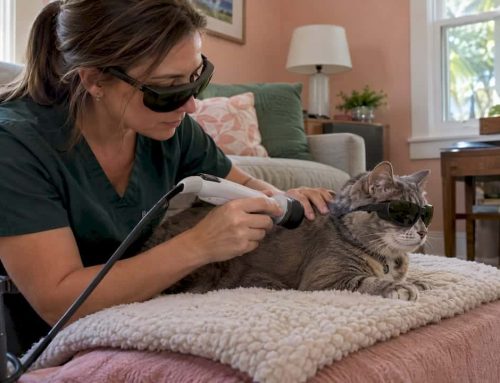
Laser (photobiomodulation) is named in the AAHA guidelines as one of the rehabilitation modalities. It is painless, which makes it a good fit for dogs who flinch at being handled. Electroacupuncture adds a gentle electrical pulse to acupuncture needles, and it is the form used in the surgical study above. Both can be done at your home.
Omega-3 fatty acids and diet
When the AAHA panel looked at nutraceuticals, omega-3 fatty acids had the strongest evidence in dogs, and the other supplements had lower evidence strength. PetMD advises talking with your veterinarian about the right balance of essential fatty acids, since they are associated with reduced inflammation and less need for pain relief.
That is why we start with food before a shelf of bottles. Our food therapy service builds a diet around your dog’s needs, and our article on which nutrients move the needle explains what matters most in an arthritic dog’s bowl.

Weight control
Extra pounds load every joint in the spine. Conservative care for spondylosis typically includes weight reduction, controlled exercise and physiotherapy when a dog is overweight. Of everything on this list, it costs the least and often helps the most. We lay out why in your dog’s weight as the biggest lever.
Herbs and supplements
Herbal medicine is a core part of TCVM, and some natural products have been studied in dogs. In a Swiss open trial of 29 dogs with chronic joint and spinal disease, Boswellia resin extract given for six weeks was linked to a significant reduction in lameness, local pain and stiff gait. Five dogs had brief, reversible diarrhea or gas. It was a small study without a placebo group, so it points to promise rather than proof.
The practical rules matter more than any single ingredient:
- Ask your veterinarian before starting anything, especially if your dog takes an NSAID, gabapentin or other pain medication.
- An AAHA article advises a basic blood panel before dispensing medications, botanicals or supplements, so the liver and kidneys are checked first.
- Start one product at a time so you can tell what is helping and what is upsetting a stomach.
If you are comparing supplement options for joint support, pet vitamins and supplements deals can help you see what is on the market before you talk it through with your vet. Our own herbal therapy service is built around choosing herbs for the individual dog.
A note on spinal manipulation
You will see chiropractic mentioned in many “natural” lists. A 2021 Norwegian study found monthly chiropractic care in Boxer puppies lowered spondylosis at one year of age, 25.0% versus 46.5%, but the sample was small and the authors say it is unknown whether it works at later life stages. For an adult or senior dog who already has spurs, the Merck Veterinary Manual cautions that some manipulation advocated for spondylosis may actually be contraindicated. Before any hands-on spinal technique, get your veterinarian’s approval. Gentle massage, stretching and range-of-motion work from a rehabilitation-trained veterinary team are a different matter, and are part of what we do.
How natural care works with medication
A frequent worry is whether natural care means giving up the pain medication your vet prescribed. It doesn’t. Current veterinary guidance leans on combinations. The WSAVA 2024 neuropathic pain protocol describes multimodal analgesia, meaning an anti-inflammatory plus another pain drug, as likely to give the greatest benefit in spinal conditions like disc disease. It also lists acupuncture, stretching, massage and exercise among the physical approaches used.
For your dog, that can mean a lower or steadier medication need as strength and comfort improve, decided by your veterinarian, never by you on your own. We work alongside your dog’s regular veterinarian, so the plan complements what they already prescribe. If your vet’s records are not yet with us, ask them to send the X-ray report before our first visit.
Setting up your home
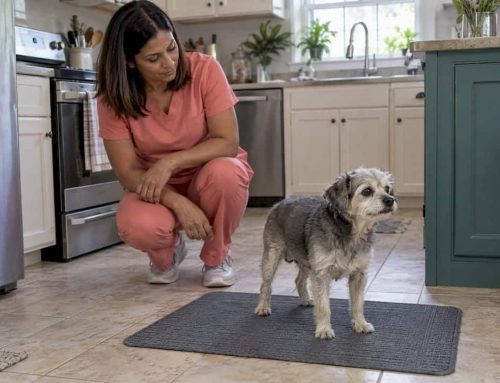
The cheapest natural treatment is a house your dog can move around in without slipping. AAHA’s guidelines recommend secure footing such as carpet runners, ramps or steps to otherwise inaccessible places, and quiet, protected resting areas at a manageable distance from food and water so your dog keeps walking.
A starter checklist for a Tampa home with tile or hardwood floors:
- Runners or yoga mats along the paths your dog walks most: bed to bowl, bowl to door.
- A ramp for the car or the couch, so jumping stops being a daily event.
- An orthopedic bed on the floor, away from drafts and the air conditioner vent.
- Raised bowls, if your vet agrees, to reduce neck and back strain.
- Short, frequent walks instead of one long one. Controlled exercise is the goal, not rest alone.
- Warmth after cooling off. Gentle warmth on stiff muscles can feel good, and the WSAVA lecture notes cold therapy, passive range of motion and massage can be done by owners at home. Ask your vet to show you the technique for your dog first.
A sample plan for a senior dog
Every dog is different, so this is an illustration, not a prescription. Picture a 12-year-old Lab mix named Maggie whose X-ray shows spurs between several lower-back vertebrae. She is a little overweight, slips on the kitchen tile, and growls when she is loaded into the car.
A plan for her could look like this:
- Veterinary exam and bloodwork with her regular vet to confirm the diagnosis and check organ function.
- A home visit for an assessment and acupuncture, with a plan for how often to repeat it.
- Rehabilitation exercises she can do on her own rug, such as slow weight shifts and gentle stretches, taught to her owner.
- Food therapy to bring her to a lean weight, with omega-3 fatty acids discussed with her vet.
- Home changes: runners on the tile, a ramp for the car, and shorter walks twice a day.
- A recheck to see whether she is rising more easily and walking more freely, then adjust.
None of this requires Maggie to ride in a car, wait in a lobby near other dogs, or climb onto an exam table. For a dog like her, and for owners who find travel difficult too, that is a big part of the benefit.
What a visit with us looks like
We bring care to you in South Tampa. Your dog stays in the place where they feel safest, and you stay in the room. We tailor the plan to your dog’s health needs and to your home, from the flooring to where they sleep.
Our published prices, as listed on our cost of services page in 2026, include:
| Service | Published price |
|---|---|
| Initial assessment and acupuncture with a technician | from $430 |
| Technician mobile fee | $60 |
| Laser treatment | $45 to $120 per treatment |
| Electroacupuncture | $30 |
| At-home rehabilitation packages | $85 to $918 |
Acupressure, herbal therapy, food therapy and telemedicine are also available. Check the page for the latest details.
Our perspective
When someone calls us about spondylosis, they usually describe a change, not a diagnosis: a dog who no longer jumps up, or who sighs getting down. We think the best response to that change is gentle, steady and close to home.
Spondylosis is slow, so the care that works is slow too. We would rather see your dog every so often in their own living room, where they are relaxed and their muscles are not braced against a strange floor, than ask them to endure a stressful trip for each appointment.
Our formula is simple. We combine acupuncture, laser, rehabilitation, food therapy and herbs in a plan fitted to your dog, and we work with your regular veterinarian so everyone is moving in the same direction. In Traditional Chinese Veterinary Medicine we think of the spine as a highway for Qi, and our job is to keep traffic moving, whatever the vocabulary you prefer.
If your dog is a senior, disabled or anxious, you do not have to choose between good care and a calm day. We built our practice so you do not have to.
Pet Acupuncture & Wellness
Getting started in South Tampa
If your dog has been diagnosed with spondylosis, or you suspect a sore back, we can bring an integrative plan to your door. We offer acupuncture, rehabilitation, laser, herbal therapy and food therapy at home for senior, disabled and anxious dogs and cats.
Start at pawvetpractice.com to request a visit. If you are unsure whether your dog needs an in-person visit first, our telemedicine consultations are a quick way to talk it through, and our guide to telemedicine for senior pets explains how that decision works.
FAQ
Can spondylosis in dogs be cured naturally?
No. The bone spurs are permanent and tend to progress slowly. The aim of natural and integrative care is to ease pain, build strength and keep your dog moving. Many dogs with spondylosis never need treatment at all, particularly when the spurs are found by accident.
Is acupuncture safe for a dog with spondylosis?
Veterinary literature generally considers acupuncture safe when it is performed by a trained veterinary professional. Because spurs can sit alongside other spinal conditions, your dog should have a veterinary exam and diagnosis first, and your regular vet should know about the plan.
What supplements are best for dogs with spondylosis?
Omega-3 fatty acids have the strongest evidence among nutraceuticals in the AAHA 2022 guidelines. Other joint products, herbs and Boswellia have some support, but dose and safety depend on your dog’s medications and bloodwork. Ask your vet before you begin and add one product at a time.
What can I do at home to help my dog’s back?
Keep your dog lean, put non-slip runners on slick floors, add ramps for cars and furniture, and offer short, regular walks. Provide a supportive bed near where the family spends time. Ask your vet or rehabilitation provider to show you safe stretching or massage techniques.
How do I know if it is spondylosis or something more serious?
Only an exam and imaging can tell. Sudden weakness, dragging paws, loss of bladder control, or crying out when touched are reasons to call your veterinarian or an emergency clinic the same day.
Sources
- Frontiers in Veterinary Science: detection of spondylosis deformans
- The Spruce Pets: Spondylosis in Dogs
- PetMD: Spondylosis Deformans in Dogs
- MSD Veterinary Manual: Chronic Pain in Animals
- AAHA 2022 Pain Management Guidelines: Nonpharmacologic Modalities
- WSAVA: Pain Management for Spinal Disease
- PubMed: Evidence-based complementary and alternative canine orthopedic medicine
- AAHA Trends: Lumbosacral Conditions in Dogs
- PubMed: Boswellia resin in canine inflammatory joint and spinal disease
- PMC: Veterinary chiropractic treatment to prevent spondylosis
- Merck Veterinary Manual: Manual Therapy in Veterinary Patients
- WSAVA: Neuropathic pain protocol