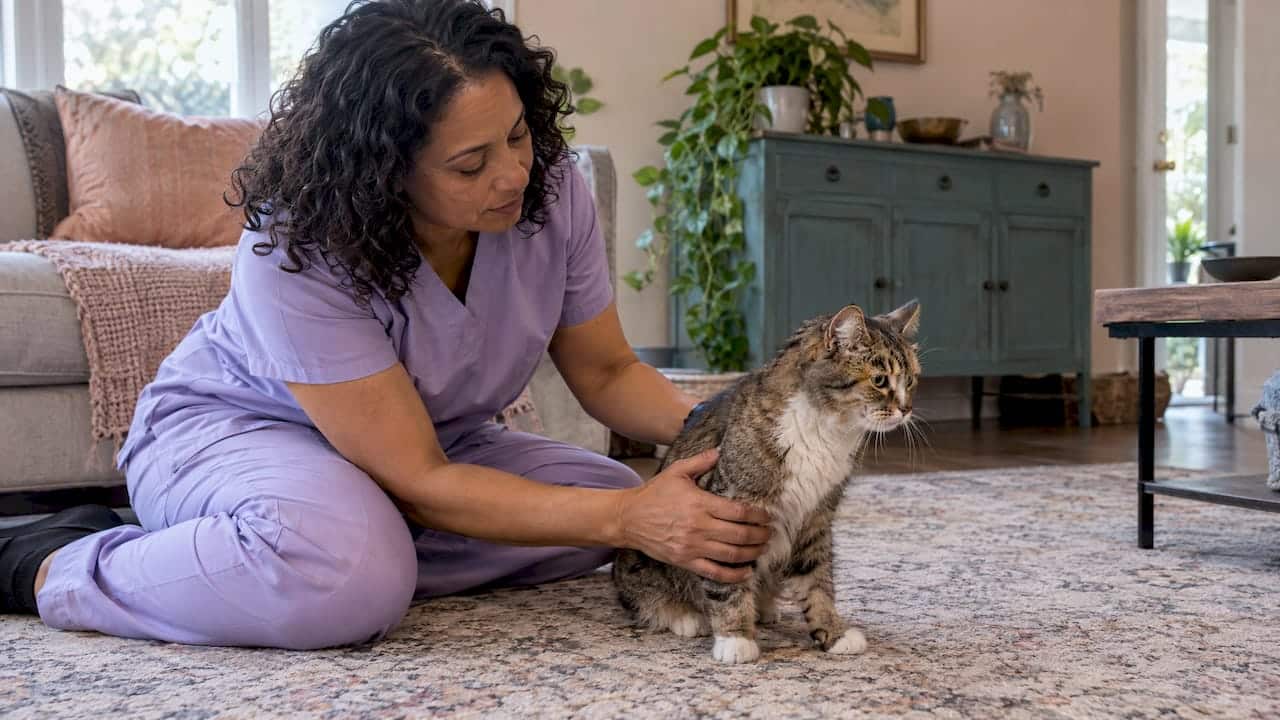
Laser therapy is considered safe for most cats when a trained veterinarian uses the right settings, but a few situations call for avoiding it or changing the plan: a beam aimed at the eyes, areas with cancer, a pregnant uterus, active bleeding and an overactive thyroid. Because those details depend on your cat’s exact diagnosis, the safest way to use laser is after an exam by a veterinarian who knows your cat’s history. For our South Tampa families, we bring that exam and the treatment to your living room.
TL;DR
- The one absolute rule is to keep the beam out of the eyes. Everyone in the room, including your cat, wears protective eyewear.
- Areas with known or suspected cancer, a pregnant uterus, active bleeding and an overactive thyroid are the main places to avoid.
- Some old warnings, such as implants and photosensitizing medications, are now considered precautions or have been disproved.
- Dark fur, thick coats and tattoos change how heat builds up, so settings need to match your cat.
- Home devices are not a substitute for an exam. Get a diagnosis first, especially to rule out a tumor.
Table of Contents
- What laser therapy does for cats
- The one absolute contraindication: the eyes
- Cancer and suspicious lumps
- Other places and situations to avoid or approach carefully
- Old warnings that no longer hold
- Burns, fur and skin color
- What the evidence says about results
- Questions to ask before the first session
- Why not use a home device?
- Laser therapy at home in South Tampa
- Our perspective
- FAQ
- Sources
What laser therapy does for cats
Therapeutic laser, also called photobiomodulation (PBMT), delivers light to tissue to ease pain and inflammation. The American Animal Hospital Association (AAHA) says it may be used for chronic arthritis, surgical incisions, tendon and ligament injuries and traumatic injuries, and notes it is especially useful in cats because so few pain medications are approved for them.
A 2025 review of feline rehabilitation adds that PBMT can be beneficial for osteoarthritis, fractures, chronic wounds and stomatitis. For many senior cats, that is the appeal: a quiet, drug-free session that adds to what your regular veterinarian already prescribes.
The same power that helps tissue heal is the reason for the cautions below. Light changes how cells behave, so where and when it is used matters.
The one absolute contraindication: the eyes
Across sources, the point of agreement is the eyes. A professional chapter on the topic states that direct eye exposure is the only absolute contraindication for providers, patients and owners. A 2019 review specifies exposure directly or reflected through the pupil onto the retina.
The Merck Veterinary Manual adds that laser light can damage the retina even when it reflects off a shiny surface. Practical safeguards include:
- Wavelength-specific safety glasses for everyone in the room. A feline rehabilitation review notes Class IIIb and IV lasers ship with their own eyewear.
- A “laser in progress” sign.
- Keeping the beam away from the face and angled away from mirrors, steel bowls and other reflective surfaces.
- Treating only with a practitioner trained on that specific laser.
Invisible infrared light above 760 nm is a special case. Without a visible finder beam or an audible signal, inadvertent exposure becomes easy. That is one more reason to leave the work to someone who uses a device daily.
Cancer and suspicious lumps
This is the contraindication owners most often ask about, and it matters most for senior cats. Light improves blood-vessel growth, so irradiating a tumor or a wound that may contain cancer cells is generally contraindicated. The Merck Veterinary Manual lists areas of neoplasia, and says laser is contraindicated in patients with lymphoma.
The feline rehabilitation review notes one narrow exception: where no other tumor treatment exists, a caregiver who understands that growth could speed up may choose it for comfort. That is a decision for you and your veterinarian together, never something to try on your own.
What this means in daily life: an unexplained lump, a sore that does not heal, or new swelling in an older cat needs a diagnosis before any light is applied. Mention every lump, even one you think is old.

Other places and situations to avoid or approach carefully
The Merck Veterinary Manual lists these areas to avoid or treat with care:
- A pregnant uterus. Laser should not be aimed over it.
- Active bleeding.
- A hyperactive thyroid gland. This matters in older cats, where an overactive thyroid is common, so tell your veterinarian if your cat has this diagnosis.
- Long bones in kittens under one year. The growth plates call for caution.
- Cats on immunosuppressive medication. The manual notes laser’s immune-stimulating effects may counteract these drugs.
- The testicles. A 2019 review says excessively high doses should not go directly into the testicle.
If your cat takes medication that makes skin more sensitive to light, the manual advises lowering the intensity. The practical takeaway is to bring a complete list of medicines and supplements to every laser visit.
Old warnings that no longer hold
Some advice you may read online is out of date. The chapter by Godbold and Riegel describes historical contraindications as inconsistent and outdated, with many now precautions or shown to be false. The 2019 review states that laser wavelengths do not harm metal or synthetic implants, sutures or tissue adhesives, so a cat with a plate or screws is not excluded. The beam is simply angled away from metal to reduce reflection. The same review notes a 2014 review found no reported adverse effects in patients on photosensitizing drugs.
If a previous clinic told you no because of an implant, ask your veterinarian whether it still applies to your cat.
Burns, fur and skin color
When laser is applied incorrectly, the main risks are eye injury and thermal burns, according to the Merck Veterinary Manual. AAHA says laser is safe when performed correctly with proper settings and durations, and that higher-powered units can cause burns if misused.
Cats add some quirks:
- Fur. The feline rehabilitation review says up to 70 to 90 percent of laser energy can be absorbed by fur, so the coat may be clipped, and dark hair or pigmented skin absorbs more heat. Black and dark tabby cats need settings that account for this.
- Tattoos. The Merck Veterinary Manual notes tattooed skin can cause intense pain through pigment absorption. Many cats have identification tattoos, so mention yours.
- Laser class. Class IV lasers use shorter time protocols than Class IIIb to cover the same area, so the same minutes on a different device is not the same dose.
During a session, watch for your cat flinching, pulling away, or the skin feeling warm. Tell the practitioner immediately. We keep sessions calm, with your cat on a favorite blanket, which also makes it easier to notice small signs.
What the evidence says about results
Planning honestly means knowing what to expect. Evidence for feline laser is still developing: a systematic review by Millis and Bergh explains that results vary because protocols differ in wavelength, laser class, dose and frequency. For joint disease, a veterinary practice journal suggests daily treatment for flare-ups, then twice weekly for two to three weeks, with 4 to 6 treatments typically needed to see improvement, and more for severe or multi-joint disease. Cats often show pain through hiding, less grooming, flattened ears or going outside the litter box, as AAHA’s pain guidance lists. Those are the changes to track in a journal.

The feline rehabilitation review recommends informing the referring veterinarian if no effect appears after four to five treatments, so the plan can change.
Questions to ask before the first session
- Has my cat had an exam and a diagnosis, including any lumps checked?
- Which laser is used, and is the practitioner trained on it?
- Will everyone, including my cat, wear eye protection?
- Does my cat’s medication list or thyroid status change the settings?
- How will we measure progress, and when do we reassess?
Our companion article on laser therapy for cats in Florida walks through pain relief in more depth. If your cat has a wound, see laser therapy for cat wounds.
Why not use a home device?
Consumer red light products are marketed for pets, but they cannot tell you whether a lump is benign. Our guide explains why a vet check before home red light therapy can rule out tumors first. Settings, eye safety and the diagnosis are exactly what a veterinarian handles.
Laser therapy at home in South Tampa
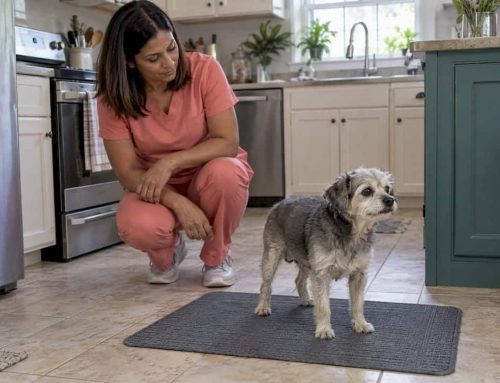
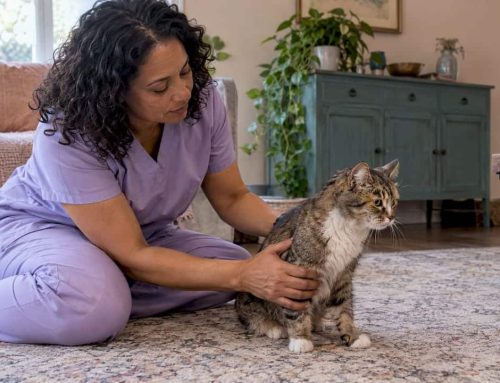
For a senior cat who hates the carrier, a car ride can cause more stress than the condition itself. We treat cats in their own homes in South Tampa, where an examination, a plan and laser treatments happen on the couch rather than in a waiting room. Our treatments complement what your regular veterinarian provides, and our plans are tailored to each pet’s needs and home.
Our published prices: laser treatments are $45 to $120 per treatment, and the initial assessment and acupuncture with a technician starts from $430, with a technician mobile fee of $60. See the full cost of services or visit our home page to book.

Laser often sits alongside acupuncture, herbal therapy and rehabilitation therapy in our integrative plans.
Our perspective
We think of laser the way we think of any good tool: powerful when it is matched to the right cat. A senior cat with stiff hips does not need a long drive, bright lights and strangers. She needs a careful exam, a clear diagnosis and a gentle plan in the place where she feels safest.
That is why we look at the whole picture first: lumps, medications, thyroid health, coat color and comfort. Laser is one part, and may be combined with acupuncture, rehabilitation, herbal therapy or food therapy, always alongside your regular veterinarian.
Treating at home also lets us see how your cat moves on her own floors, which shapes the plan in ways a clinic room cannot.
Pet Acupuncture & Wellness
FAQ
Can any cat have laser therapy?
Most cats can, when a trained veterinarian chooses the settings. The main exclusions are direct eye exposure, areas of cancer, a pregnant uterus, active bleeding and an overactive thyroid, per the Merck Veterinary Manual. Your cat’s exam decides the rest.
Is laser therapy painful for cats?
Sessions are generally comfortable and many cats relax. If the skin gets too warm, a cat may flinch, which is why the practitioner watches closely and adjusts. Dark fur and tattoos are the usual reasons for extra care.
Can I use a laser device at home on my cat?
Get an exam and diagnosis first, because a lump or condition that should not be irradiated may not be obvious. Eye safety and dosing also need training. Ask your veterinarian before buying any device.
How many sessions will my cat need?
It depends on the condition. For joint disease, 4 to 6 treatments are typical, and 8 to 10 for severe cases. Your veterinarian reassesses along the way.
Sources
- AAHA: Veterinary Laser Therapy for Pets
- AAHA: Pain Management for Pets
- Physical rehabilitation of cats: treatment therapies (PMC, 2025)
- Merck Veterinary Manual: Photomedicine in Veterinary Patients
- Contraindications, Special Considerations, and Precautions (Wiley, 2017)
- Laser therapy: indications and contraindications (Veterinary Practice News, 2019)
- Vetlexicon: Laser therapy delivery in cats
- Systematic literature review of complementary therapies (PMC, 2023)
- Today’s Veterinary Practice: Laser therapy for joint disease