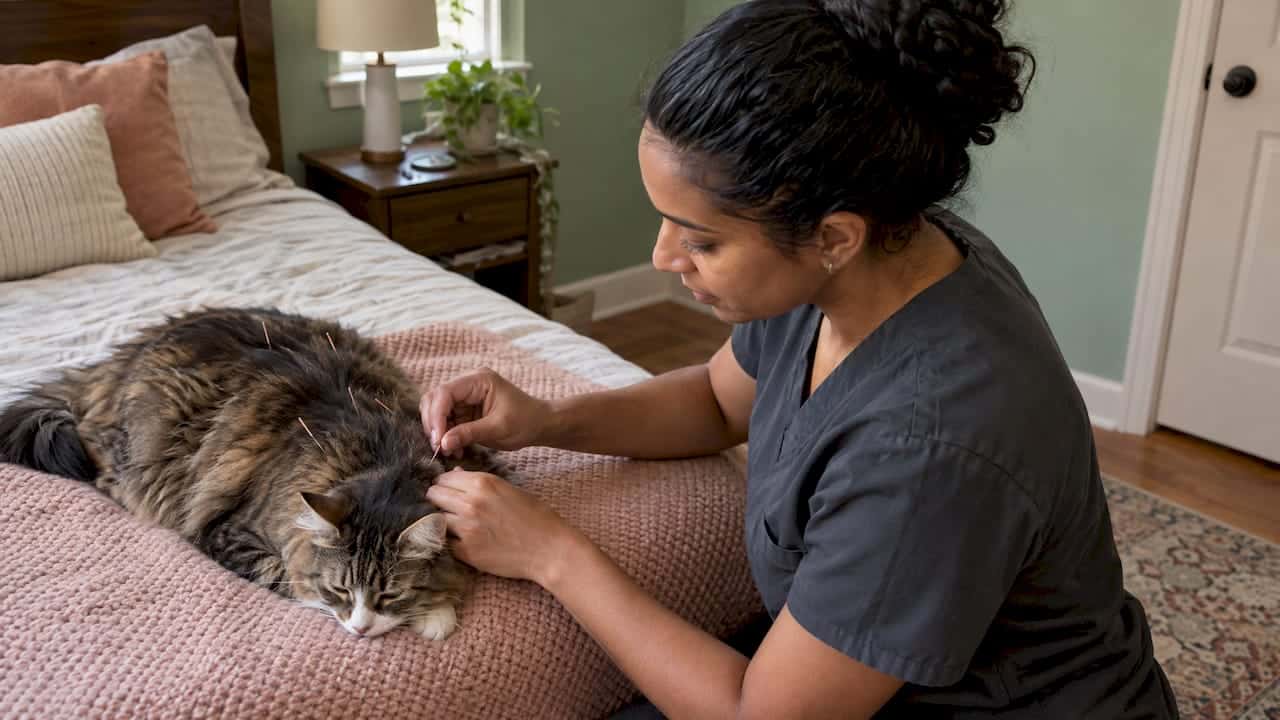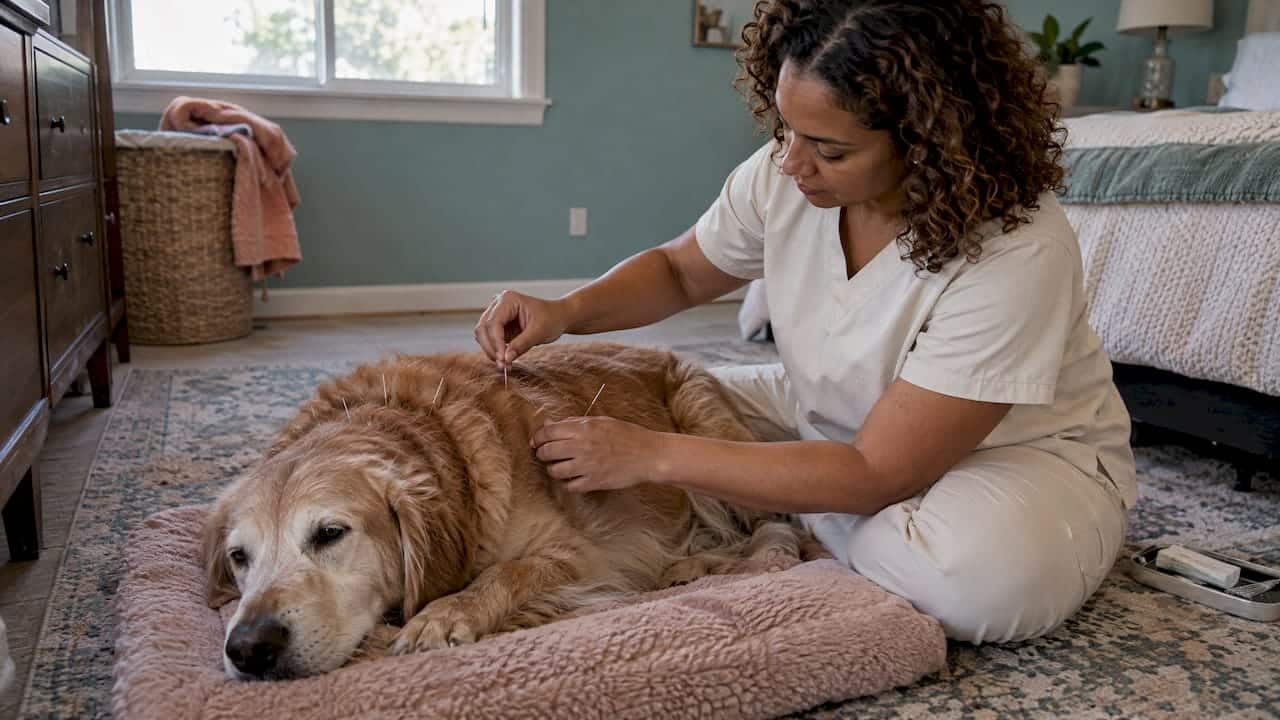
Acupuncture can be a supportive part of caring for a dog with a collapsing trachea, but it works alongside your veterinarian’s diagnosis and treatment and never in place of it. One small 2022 study found that dogs with tracheal collapse had lower coughing scores during a five-week acupuncture period added to their usual care. If your dog is struggling to breathe right now, skip this article and go to an emergency clinic.
That honking cough, the worry every time your dog gets excited, the car ride to the clinic that sets off another coughing fit: we know how much of this condition is about stress for both of you. Below is what the research says, what an acupuncture visit looks like, how to keep your dog calmer at home, and when to call for help.
TL;DR
- Tracheal collapse is progressive and incurable, so the goal is comfort and fewer coughing episodes. Your regular vet leads diagnosis and medical care.
- A 2022 study of 20 dogs found lower coughing scores when weekly acupuncture was added to standard care. The sample was small, so treat it as promising, not settled.
- Acupuncture is used as a complementary therapy. It does not replace medication, weight management or, in severe cases, a stent.
- Blue-tinged gums, fainting or labored breathing are emergencies. Call an emergency vet right away.
- A home visit spares an anxious, coughing dog the car ride and the waiting room, which are common triggers.
Table of Contents
- What a collapsing trachea is, and why it is so hard to live with
- Does acupuncture help a dog with a collapsing trachea?
- How acupuncture works alongside standard veterinary care
- What happens during a visit
- Safety: what to ask before you book
- Why treating at home suits dogs with airway disease
- What you can do at home between visits
- When to treat it as an emergency
- What we believe about integrative care for tracheal collapse
- Care at your door in South Tampa
- FAQ
- Sources
What a collapsing trachea is, and why it is so hard to live with
The trachea, or windpipe, is held open by rings of cartilage. In tracheal collapse, that supportive cartilage degenerates and softens, and the condition is progressive and incurable. The airway flattens, and air has a harder time getting through.
The classic sign is a dry, goose-like honking cough. According to PetMD, the cough tends to get worse with exercise, heat and humidity, excitement, stress, eating, drinking, or pressure on the throat. That list explains why so many owners notice flare-ups at the door when the leash comes out, or in the car on the way to a vet visit.
There is also a vicious cycle. The University of Tennessee’s veterinary college notes that coughing causes airway inflammation and trauma, which stimulates more coughing. Anything that interrupts that cycle helps your dog. That is where calm surroundings, the right equipment and supportive therapies come in.
Does acupuncture help a dog with a collapsing trachea?
The honest answer: there is encouraging evidence, and it is still early.
The best-known study is a 2022 paper in Veterinary Sciences from Thailand. Twenty dogs with tracheal collapse received acupuncture once a week for five weeks on top of their normal veterinary care. Their coughing scores were lower during the acupuncture period than during the period without it. The authors suggest acupuncture may serve as an adjunct treatment by improving heart rate variability, reducing oxidative stress, and supporting exercise tolerance and quality of life.
Older case-level work points the same way. A 2006 report in the Veterinary Record described injection acupuncture (aquapuncture) used to treat two dogs diagnosed with tracheal collapse.
Here is the context that keeps expectations realistic:
- The studies on tracheal collapse are small. They suggest benefit as an add-on to standard care. They do not show acupuncture reverses the cartilage changes.
- A scoping review of acupuncture in companion animals noted ongoing scientific debate about overall efficacy, given how complex the therapy is.
- The MSD Veterinary Manual points out that medical acupuncture research is challenging and that the level of evidence varies by condition. It also describes acupuncture as a common part of integrative veterinary medicine.
So what can you reasonably hope for? Based on the research so far, the realistic goals are a calmer dog, fewer or milder coughing episodes, and better comfort and stamina, alongside the care your veterinarian already prescribes. Every dog responds differently, and no one can promise an outcome.
How acupuncture works alongside standard veterinary care
Tracheal collapse needs a proper diagnosis first. Conditions like laryngeal paralysis, heart disease and airway infections can look similar, so the first step is always your regular veterinarian, who may use x-rays, fluoroscopy or other imaging to grade the collapse.
From there, the standard toolbox includes cough suppressants and other medications, weight loss, avoiding triggers, and, in severe cases, placement of a tracheal stent. Cornell’s veterinary college notes that many patients respond well to medical management.

Acupuncture sits next to all of that. The AKC’s guidance is that acupuncture is best used as a complementary therapy alongside standard medical care, not as a replacement. That is exactly how we approach it. We work with your dog’s regular veterinarian, share what we see at home, and build a plan around the medications and recommendations already in place.
A simple way to picture the team
| Who | Role |
|---|---|
| Your regular veterinarian | Diagnosis, imaging, medications, decisions about stents or surgery |
| Integrative home-care veterinary team | Acupuncture and related therapies, comfort care, quality-of-life tracking |
| You | Daily observation, trigger management, weight and harness routine |
What happens during a visit
Acupuncture involves inserting thin, sterile needles into specific sites on the body. In Traditional Chinese Veterinary Medicine (TCVM), those sites sit along meridians, which you can picture as a highway system carrying Qi, or vital energy, through the body. When traffic is blocked or sluggish, the thinking goes, the body struggles. For a dog with a collapsing trachea, TCVM practitioners often focus on supporting the lungs and calming the whole animal.
A typical first visit looks like this:
- History and review. We go over your dog’s diagnosis, medications, triggers and what a bad day looks like.
- Gentle exam. We look at breathing pattern, comfort, mobility and temperament.
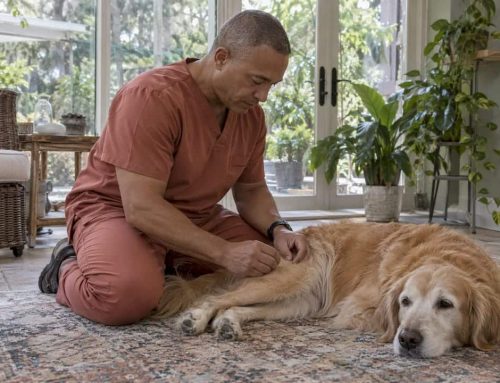
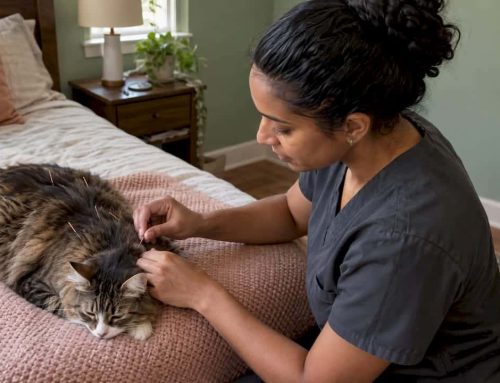
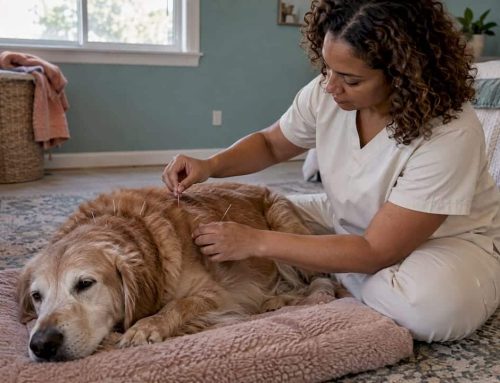
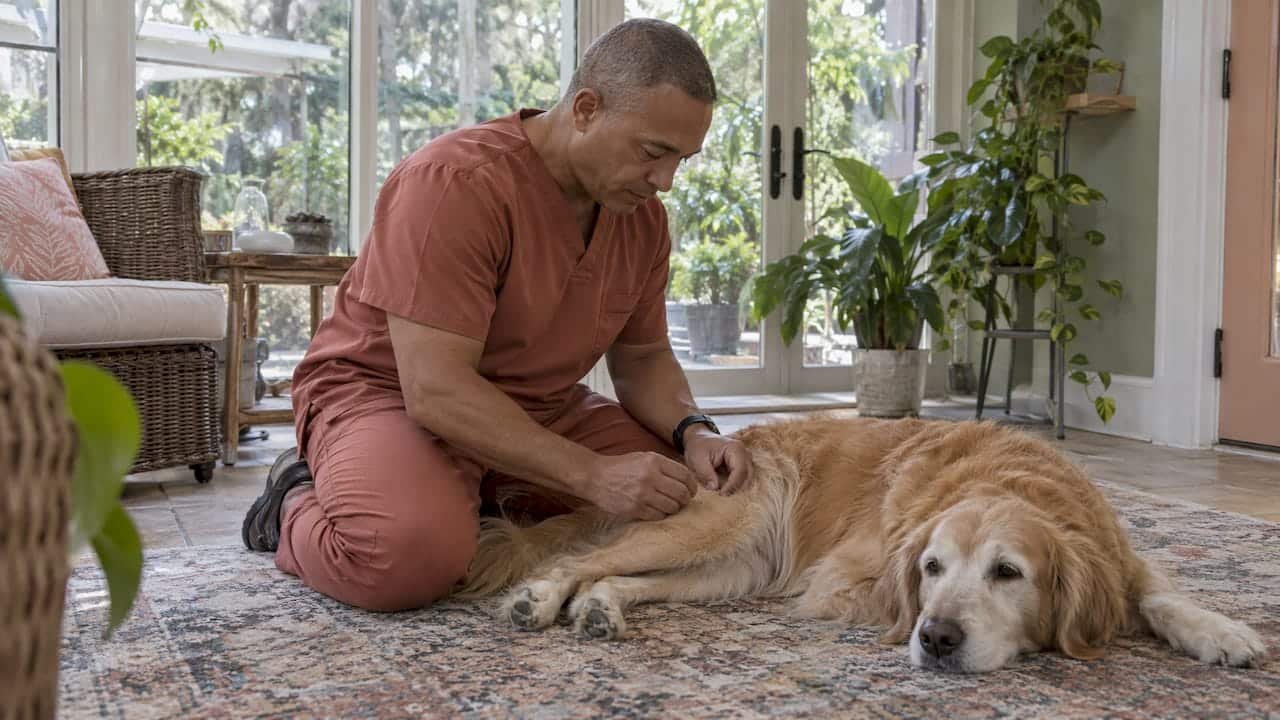
- Treatment. Fine needles are placed for a short session. Some dogs doze through it. Electroacupuncture or acupressure may be added when they suit your dog.
- Home plan. We talk through harness, weight, environment, and, where appropriate, food therapy or herbal support, coordinated with your veterinarian.
If you want to know more about the electrical option, our guide to electroacupuncture for dogs covers the evidence and what to expect. For session timing, see how often a dog should get acupuncture. The Thai study used weekly sessions over five weeks, but your dog’s schedule should come from the treating veterinarian.
Safety: what to ask before you book
Acupuncture is generally described as low-risk and minimally invasive, but safety depends on who is holding the needles. The MSD Veterinary Manual says safety depends on the skill of the acupuncturist, and that caution or avoidance is warranted if a patient cannot stay still, has severe anxiety, or has a bleeding disorder such as a coagulopathy.
Before a first session, tell the veterinarian about:
- Any bleeding or clotting problems, and any immune-compromising condition or medication
- How your dog handles being touched and held still
- Every medication and supplement your dog takes, including cough suppressants and steroids
- Recent changes in coughing, stamina or gum color
Also ask about training. The AKC advises looking for a certified veterinary acupuncturist (CVA) with deep knowledge of pain physiology, neuroanatomy and myofascial assessment. Our guides to veterinary acupuncture certification and choosing a certified veterinary acupuncturist in South Tampa walk through the credentials in plain language.
Anxious dogs are a special case. Many are calmer in a familiar room than on a clinic table, which is one reason we treat them at home. If stress is a big part of your dog’s picture, our article on acupuncture for dogs with anxiety is a good next read.
Why treating at home suits dogs with airway disease
The triggers for tracheal collapse read like a description of a vet trip: excitement, stress, heat, humidity, pulling against a leash and car rides. A dog who coughs in the lobby is not misbehaving. Their airway is reacting.
Treating at home removes several of those triggers at once. There is no car ride in Tampa humidity, no waiting room with barking dogs, and no slippery floor. Your dog stays on their own bed, with their own smells, and you stay beside them. For senior dogs who also have arthritis or trouble getting into the car, it removes a second obstacle too.
Home visits also let us see the real environment: where your dog sleeps, whether the harness fits, how hot the house gets, and where stairs or smooth floors add strain.

What you can do at home between visits
Whatever treatment path you choose, daily habits matter a great deal. These are widely recommended for dogs with tracheal collapse:
- Use a harness, not a collar. Pressure on the throat can set off coughing. Veterinary hospital guidance recommends removing the collar and walking with a harness only.
- Keep your dog at a healthy weight. The University of Tennessee lists weight loss as part of treatment, because extra weight adds pressure on the airway.
- Keep the house cool. Heat and humidity worsen breathing difficulty, which matters in Florida summers. Walk early or late and keep walks short.
- Keep life calm. Excitement at the door, rough play and barking can all start a cough. Quiet routines and a predictable schedule help.
- Reduce irritants. Smoke, strong sprays and dusty air can aggravate a sensitive airway.
- Track the cough. A short note each day on cough frequency, walk tolerance and sleep helps your veterinarian judge whether the plan is working.
Our team can also talk with you about food therapy and herbal therapy, both used in TCVM, and we coordinate them with your dog’s other medications.
When to treat it as an emergency
This is the question many owners search for in the middle of the night. If your dog is having any trouble breathing, PetMD says it is a medical emergency and your dog should be seen by a veterinarian immediately. Cornell’s veterinary college lists wheezing on inhaling, blue gums or tongue and fainting as signs of a respiratory emergency.
If that is your dog:
- Stay as calm as you can. Your tension travels down the leash.
- Take off any collar and keep your dog cool and still.
- Call an emergency veterinary clinic on the way, so the team is ready. A veterinary hospital’s advice is to call before transporting your pet and confirm they can handle a breathing emergency.
- Go now. Acupuncture, herbs and home remedies are not for an acute breathing crisis.
Once your dog is stable, acupuncture can return to its proper role: helping with comfort and resilience over the long term.
What we believe about integrative care for tracheal collapse
We meet many families who feel stuck. Their dog has been diagnosed with a collapsing trachea, the medications help but do not feel like enough, and every trip out of the house sets off another coughing fit.
Our view is that these dogs are best served by combining conventional care with gentle, integrative support, delivered where they feel safest. Acupuncture, laser therapy, herbal therapy and food therapy are tools we use to support comfort and quality of life, always in cooperation with your dog’s regular veterinarian.
We treat only in the home, so your dog is not asked to cope with the car, the lobby or the exam room. We build each plan around your dog’s health needs and your household, and we think that calm, familiar setting is part of the treatment, not just a convenience.
Pet Acupuncture & Wellness
Care at your door in South Tampa
We bring integrative veterinary care to dogs and cats in South Tampa, including senior, disabled and anxious pets. For a dog with a collapsing trachea, that can mean acupuncture, electroacupuncture, acupressure, laser therapy, herbal therapy, food therapy and telemedicine check-ins, all coordinated with your own veterinarian.

Our published prices: an initial assessment and acupuncture with a technician starts from $430, electroacupuncture is $30, laser treatments run $45 to $120 per treatment, and the technician mobile fee is $60. You can see the full list on our cost of services page. If you are not sure a visit is needed yet, a telemedicine consultation can be a first step, and our overview of what telemedicine cannot do explains where it fits. When you are ready, start at pawvetpractice.com to request a home visit.
FAQ
Can acupuncture cure a collapsing trachea in dogs?
No. Tracheal collapse is a progressive, incurable condition because the cartilage softens over time. Acupuncture is used to support comfort, coughing and quality of life alongside veterinary care. A 2022 study found lower coughing scores in dogs receiving it as an add-on.
How long will my dog live with a collapsing trachea?
It varies with the grade of collapse, age, weight and other conditions, so your veterinarian is the right person to ask. PetMD notes that while the condition gradually gets worse, many dogs live full lives with proper medical management.
What can be mistaken for a collapsed trachea?
Other causes of coughing and noisy breathing, such as laryngeal paralysis, heart disease or airway infections, can look similar. That is why a veterinary exam and imaging should come before any complementary therapy. Your veterinarian can tell you which condition is behind your dog’s signs.
Is acupuncture safe for a dog with breathing problems?
In trained hands it is generally considered low-risk and minimally invasive. Tell the veterinarian about clotting problems, immune issues, severe anxiety or trouble staying still, since those call for caution. Choose a certified practitioner and keep your regular vet informed.
How many sessions will my dog need?
That depends on your dog’s response and your veterinarian’s plan. The 2022 study used one session a week for five weeks. Our guide to acupuncture frequency for dogs explains how schedules usually change over time.
Sources
- Acupuncture Improves Heart Rate Variability, Oxidative Stress and Quality of Life in Dogs with Tracheal Collapse (Veterinary Sciences, 2022)
- Treatment of tracheal collapse in two dogs by injection acupuncture (Veterinary Record, 2006)
- A scoping review of the evidence for efficacy of acupuncture in companion animals
- Acupuncture in Veterinary Patients, MSD Veterinary Manual
- Acupuncture in Veterinary Patients, Merck Veterinary Manual
- Tracheal Collapse, University of Tennessee College of Veterinary Medicine
- Tracheal Collapse, Cornell University College of Veterinary Medicine
- Acupuncture for Dogs: Everything You Need to Know, AKC
- Collapsing Trachea in Dogs, PetMD
- Tracheal Collapse in Dogs: Recognizing Urgent Signs