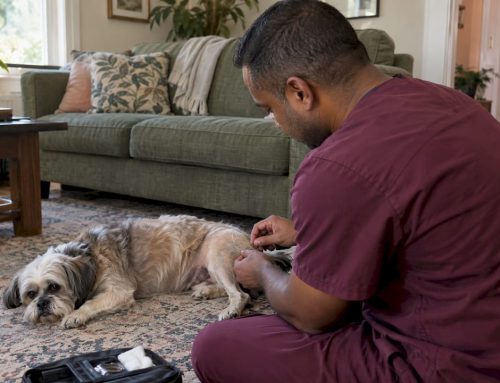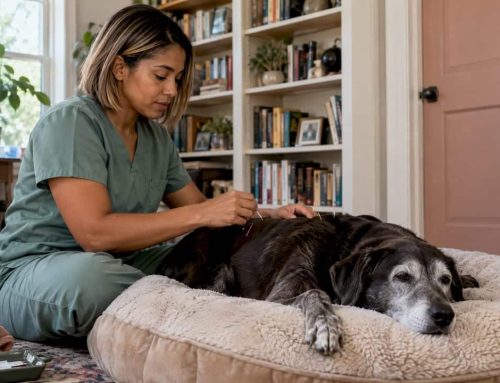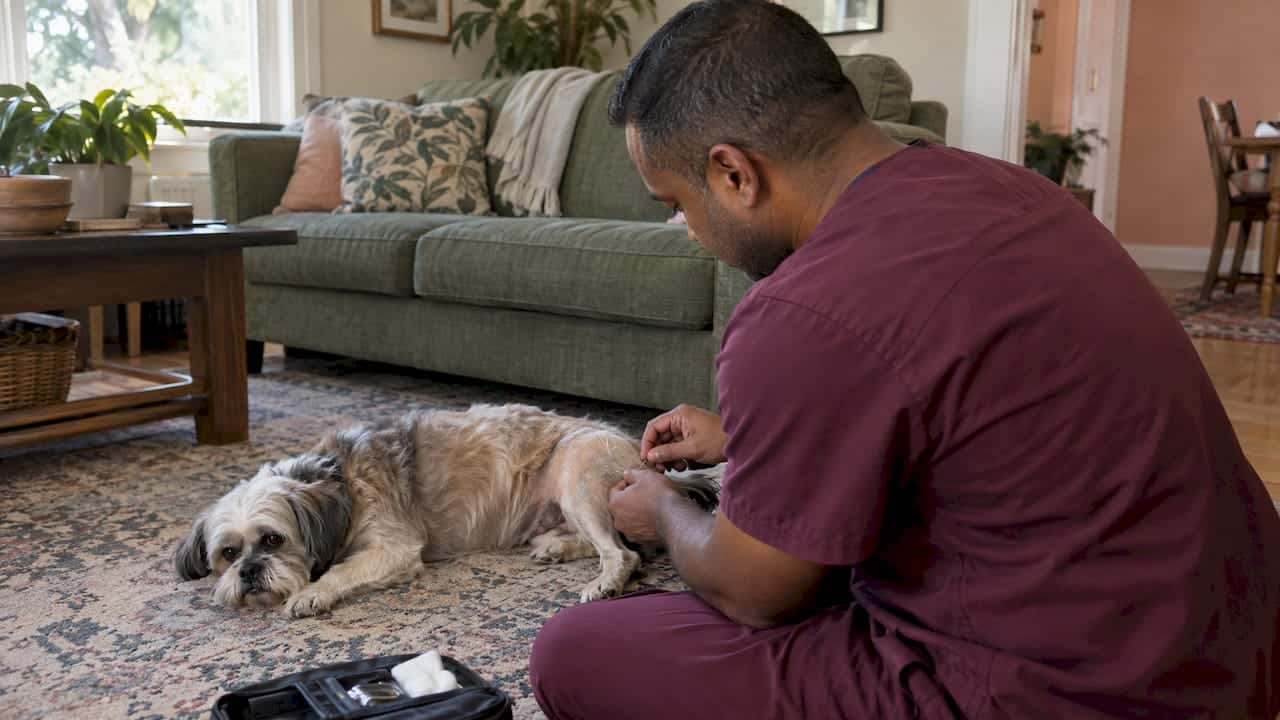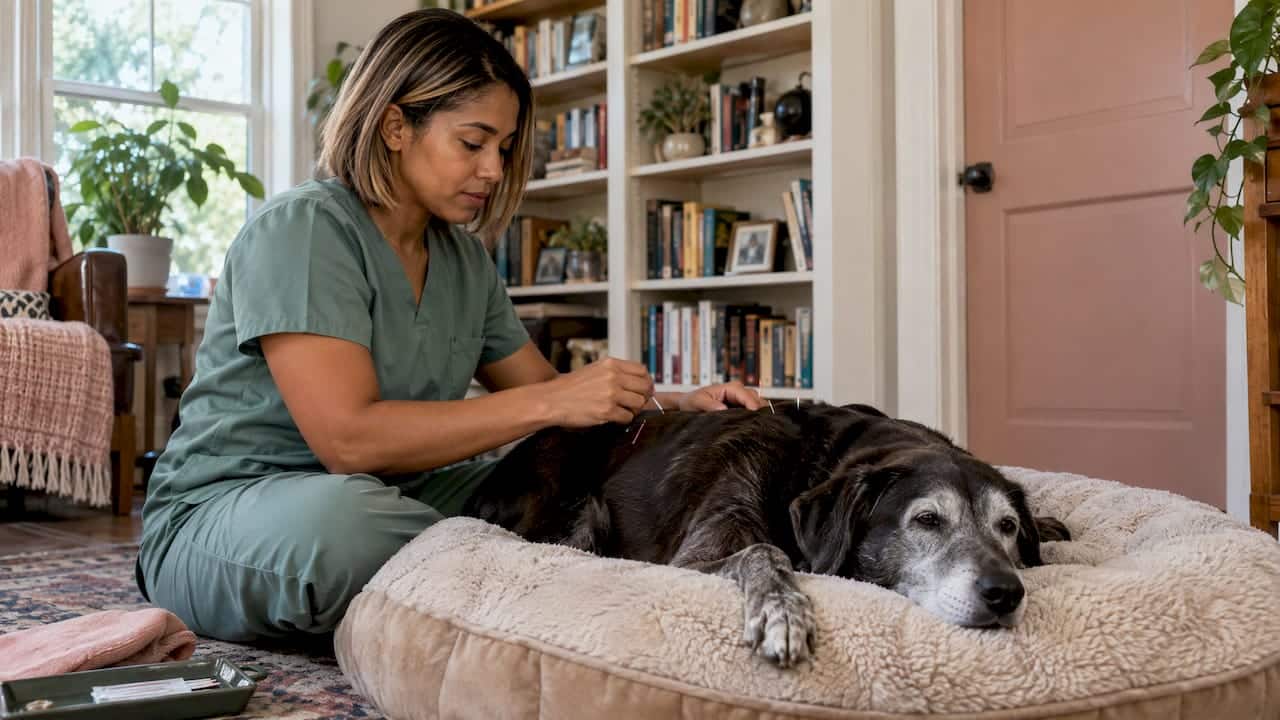
Acupuncture is best understood as a gentle support for a hyperthyroid cat, not a replacement for thyroid treatment. Your cat’s veterinarian treats the thyroid itself. We use acupuncture, at home, to help with comfort, calm, appetite and the aches that often come with an older cat’s body. If your cat dreads the carrier and the clinic, bringing the care to the living room can make the whole journey easier for both of you.
TL;DR
- Hyperthyroidism needs veterinary treatment. AAHA’s 2023 guidance says untreated cases are eventually fatal.
- The four standard options are radioiodine, antithyroid medication, surgery and an iodine-restricted diet. Acupuncture is not one of them.
- Acupuncture can sit beside your cat’s treatment as supportive care, with your regular veterinarian kept in the loop.
- Correctly performed acupuncture is generally regarded as safe, but your cat’s health and temperament shape how it is done.
- In South Tampa, we bring acupuncture and related therapies to your home, so your cat never has to travel.
Table of Contents
- What hyperthyroidism does to a cat
- What the standard treatments are, and why they come first
- Where acupuncture fits
- What acupuncture can support in a hyperthyroid cat
- Why stress matters for these cats
- What an at-home acupuncture visit looks like
- Safety: who needs extra care
- Acupressure points for thyroid health
- Herbs and food therapy: talk first
- What it costs at home in South Tampa
- Is your cat a good fit for home acupuncture?
- Our perspective
- Booking an at-home visit
- FAQ
- Sources
What hyperthyroidism does to a cat
The thyroid glands sit in your cat’s neck and set the pace of the body’s metabolism. In hyperthyroidism they produce too much thyroid hormone, and everything runs too fast. It is common in older cats.
The signs are often easy to mistake for “just getting old” at first. Veterinary literature lists weight loss despite increased appetite, more thirst and urination, vomiting, hyperactivity and soft stools. Diagnosis rests on those clinical signs plus a blood test showing raised total thyroxine (T4), the main thyroid hormone.
You might notice a cat who eats everything yet looks thinner each month, yowls at night, or cannot settle on the sofa the way she used to. Any of these deserves a call to your veterinarian, because the condition also strains the heart and kidneys over time.
What the standard treatments are, and why they come first
The FelineVMA and AAFP client guidance names four common treatments:
- Radioiodine (I-131): a single injection of radioactive iodine that targets the overactive thyroid tissue.
- Antithyroid medication: a daily pill or gel that controls hormone production.
- Surgery: removal of the affected thyroid tissue.
- Iodine-restricted therapeutic diet: a prescription food fed exclusively.
The guidance says the choice depends on your cat’s age, other illnesses, cost, availability and your veterinarian’s recommendation. AAHA calls radioiodine the treatment of choice and reports it cures more than 95% of cases, without anesthesia, ongoing medication or a restrictive diet. AAHA also notes that hyperthyroidism affects several organ systems, and that other conditions cannot be accurately assessed until the thyroid is under control.
So the first step is a diagnosis and a treatment plan from your veterinarian. Everything we describe below is built on top of that plan.
Where acupuncture fits
Acupuncture is not listed among the standard thyroid treatments, and we do not present it as one. What it can do is support the cat living with the condition.
Acupuncture is a core part of Traditional Chinese Veterinary Medicine (TCVM). In TCVM, we think of Qi as the body’s flow of energy, and of meridians as a kind of highway system that carries it. When traffic backs up or races out of control, the body shows it. A hyperthyroid cat is often described as running “hot and fast”, with restlessness, a big appetite and a thinning body. Our aim with acupuncture is to bring more balance and calm to that picture while your veterinarian manages the thyroid itself.
On the wider science, a 2017 scoping review mapped 843 companion-animal acupuncture citations, including 179 experimental studies and 175 case reports or case series. Dogs dominated the literature and musculoskeletal conditions were the most common reason for treatment. The authors called for more high-quality randomized trials, which is a fair goal for the whole field.

For hyperthyroid cats specifically, the published material is small. One case series of four cats used individualized homeopathic remedies in all four, and three of the cats also received acupuncture and/or herbal medicines. A review of complementary therapies for feline hyperthyroidism says such therapies belong under veterinary supervision, alongside evidence-based medicine. That is exactly how we practice: as a complement, working with your cat’s regular veterinarian.
What acupuncture can support in a hyperthyroid cat
We look at the whole cat, not only the thyroid. Depending on your cat, sessions may focus on:
- Calm and stress: hyperthyroid cats are often jumpy. A quiet, familiar room and a gentle session suit them far better than a waiting room.
- Aches and mobility: many hyperthyroid cats are seniors, and senior cats commonly have stiff joints too. Our page on acupuncture for senior cats explains what mobility support looks like.
- Appetite and digestion: vomiting and loose stools can accompany the condition. Our article on acupuncture for cat nausea covers one approach to queasiness.
- Other senior conditions: hyperthyroidism often shares a household with kidney disease. We have written about keeping a CKD cat eating with acupuncture and home care.
We do not promise that acupuncture will lower your cat’s T4, and we never suggest it replaces medication, radioiodine, surgery or the prescribed diet. Your veterinarian’s bloodwork remains the measure of how the thyroid is doing.
Why stress matters for these cats
Owners often ask whether stress causes hyperthyroidism. We are not aware of evidence that it does. What stress clearly does is make the cat’s life, and your veterinary visits, harder.
A 2022 randomized trial of 47 confirmed hyperthyroid cats found that a single dose of gabapentin given an hour before leaving home reduced transport stress and made the cats easier to handle than placebo. That study concerned travel, not acupuncture, and any such medication is a decision for your veterinarian. It does show how real the burden of travel is for these cats.
That is the heart of why house calls help. A cat who is already racing internally does not need a car ride, a carrier, strange smells and a cold exam table on top. At home she stays on her own bed, her own scent, and her own territory, and we work at her pace.
What an at-home acupuncture visit looks like
Every cat is different, but here is the general shape of a first visit.
- Conversation first. We talk through your cat’s history, her current treatment, her appetite, sleep and mobility, and what you hope to ease. Please have your veterinarian’s latest bloodwork and medication list handy.
- A gentle exam. We watch how she moves and settles in her own space before touching her.
- Choosing a plan. Treatment is tailored to your cat’s needs and your home environment. Some cats do best with fine needles, others with acupressure, electroacupuncture or laser, which uses light rather than needles.
- Short, calm sessions. We follow your cat’s lead and stop if she is not comfortable.
- Coordination. We work collaboratively with her regular veterinarian so everyone is working from the same picture.
An at-home visit is not the same as an emergency. If your cat is breathing hard, collapsing, or suddenly cannot use her back legs, call your veterinarian or an emergency hospital right away.
Safety: who needs extra care
The Merck Veterinary Manual states that correctly performed acupuncture is generally regarded as safe. It also says appropriate training is required and that results depend on the practitioner’s skill, the patient’s health and how long the problem has lasted, and the type of stimulation chosen.
It lists situations that call for avoidance or caution:
- A patient who cannot remain still safely
- Marked anxiety, fear or aggression
- A bleeding disorder (coagulopathy)
- Immune compromise
- Needling over tumors
- Needling through infected skin
For a hyperthyroid cat, tell us about every diagnosis, every medication and any lumps in the neck or elsewhere. A cat who is very agitated may do better with acupressure or a short, light session than with needles, and that is a judgment we make with you, in the room, on the day. Your veterinarian should know about the plan before it starts.
Acupressure points for thyroid health
Owners often search for acupressure points they can press at home. We know of no established point protocol for hyperthyroidism in cats, and pressing on the neck of a cat with an enlarged thyroid is something to leave alone. Points in TCVM are chosen for the individual cat after an exam, because two cats with the same lab result can look very different. If you want to learn gentle touch for comfort, ask us during a visit and we will show you what suits your cat. Our acupressure service page describes what we offer.
Herbs and food therapy: talk first
TCVM also uses herbal therapy and food therapy, and both are part of what we offer in South Tampa. See our pages on herbal therapy and food therapy.
If your cat is on an iodine-restricted prescription diet for her thyroid, that diet only works when it is the only food she eats, so any change to her bowl must be cleared with your veterinarian first. The same goes for herbs: your cat’s medications, kidney values and thyroid plan all matter, and we plan with your veterinarian rather than around them.
What it costs at home in South Tampa
Our published prices, as listed on our cost of services page:
| Service | Published price |
|---|---|
| Initial assessment and acupuncture with a technician | from $430 |
| Technician mobile fee | $60 |
| Electroacupuncture | $30 |
| Laser treatments | $45-$120 per treatment |
| Vitamin B12 injection | $31.50 |
| At-home rehabilitation packages | $85-$918 |
The prices are one-time fees for each service. Acupressure, herbal therapy, food therapy and telemedicine do not have published prices, so please ask us. If you are unsure whether home visits fit your cat, a telemedicine consultation is a way to talk it through first.
Is your cat a good fit for home acupuncture?
Home care tends to suit cats who:
- Hide, yowl or lash out at the carrier and the car
- Are seniors with stiff joints or reduced mobility
- Live with a second condition such as kidney disease
- Are already under veterinary care for the thyroid and need extra comfort support
It may be less suitable for a cat who is newly diagnosed and has not yet started treatment. Start there with your veterinarian, then add supportive care. If pain is part of your cat’s picture, our article on acupuncture for cat pain is a good next read.
Our perspective
We meet many cats whose owners are worried that they are “not themselves”. With a hyperthyroid cat, the first priority is always the thyroid, and that belongs with your veterinarian and the treatment plan you choose together.
What we add is comfort. Our practice is built around the home: personalized, integrative care delivered exactly where your cat feels safest, so that she and you are spared the travel and the clinic anxiety. We tailor each plan to the cat and her surroundings, and we work with her regular veterinarian to complement existing care.
In TCVM terms, we think of Yin and Yang like shade and sunlight. A hyperthyroid cat often seems to be living in too much sun, restless and burning through her reserves. Acupuncture, acupressure, laser and thoughtful home care are ways we try to bring back a little shade, so she can rest and enjoy her days.
Pet Acupuncture & Wellness
Booking an at-home visit
If your cat is already being treated for hyperthyroidism and you want to add a calm, supportive layer, we come to you in South Tampa. Our mobile service offers acupuncture, rehabilitation, laser therapy, herbal and food therapy, and telemedicine, all delivered at home. Start with the initial assessment and acupuncture visit, or reach us through our main site.
FAQ
Can acupuncture cure hyperthyroidism in cats?
No. The standard treatments are radioiodine, antithyroid medication, surgery and an iodine-restricted diet, and AAHA reports that radioiodine cures more than 95% of cases. We use acupuncture to support comfort, calm, appetite and mobility alongside your veterinarian’s plan.
Can acupuncture be used with methimazole or radioiodine?
Yes, as supportive care under veterinary supervision. Bring your cat’s medication list and recent bloodwork, and let your regular veterinarian know the plan. We work with your cat’s veterinarian so that care stays coordinated.
Is acupuncture safe for a hyperthyroid cat?
Correctly performed acupuncture is generally regarded as safe, according to the Merck Veterinary Manual. Extra care applies to cats that cannot stay still, are very fearful, have bleeding disorders or immune compromise, or have lumps or infected skin where needles would go. We adjust the approach to your cat’s temperament and health.
What are the signs of thyroid problems in cats?
Common signs are weight loss with a hearty appetite, more drinking and urinating, vomiting, restlessness and soft stools. A blood test for total thyroxine confirms it. Call your veterinarian if you see these signs.
Can stress cause hyperthyroidism in cats?
We are not aware of evidence that it does. Stress does make travel and exams harder for a hyperthyroid cat, which is why a quiet visit at home can help.
Sources
- Feline Hyperthyroidism, FelineVMA and AAFP (2024)
- Feline Hyperthyroidism Therapy, AAHA (2023)
- Acupuncture in Veterinary Patients, Merck Veterinary Manual
- A scoping review of the evidence for efficacy of acupuncture in companion animals (2017)
- Homeopathic and integrative treatment for feline hyperthyroidism: four cases
- Complementary therapies for feline hyperthyroidism, IVC Journal (2025)
- Percutaneous ethanol injection for feline hyperthyroidism, clinical signs and diagnosis
- Randomised clinical trial of gabapentin in hyperthyroid cats (2022)