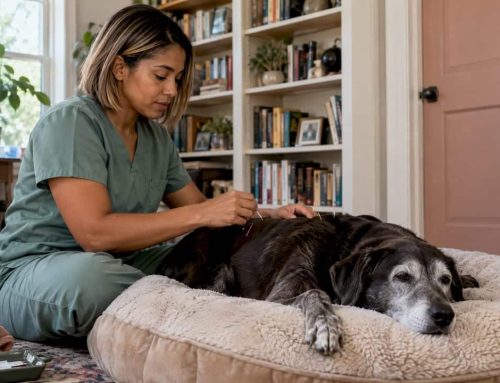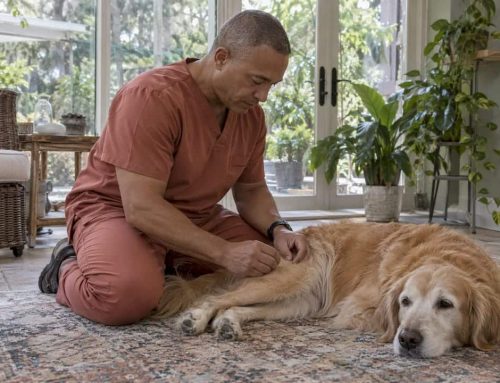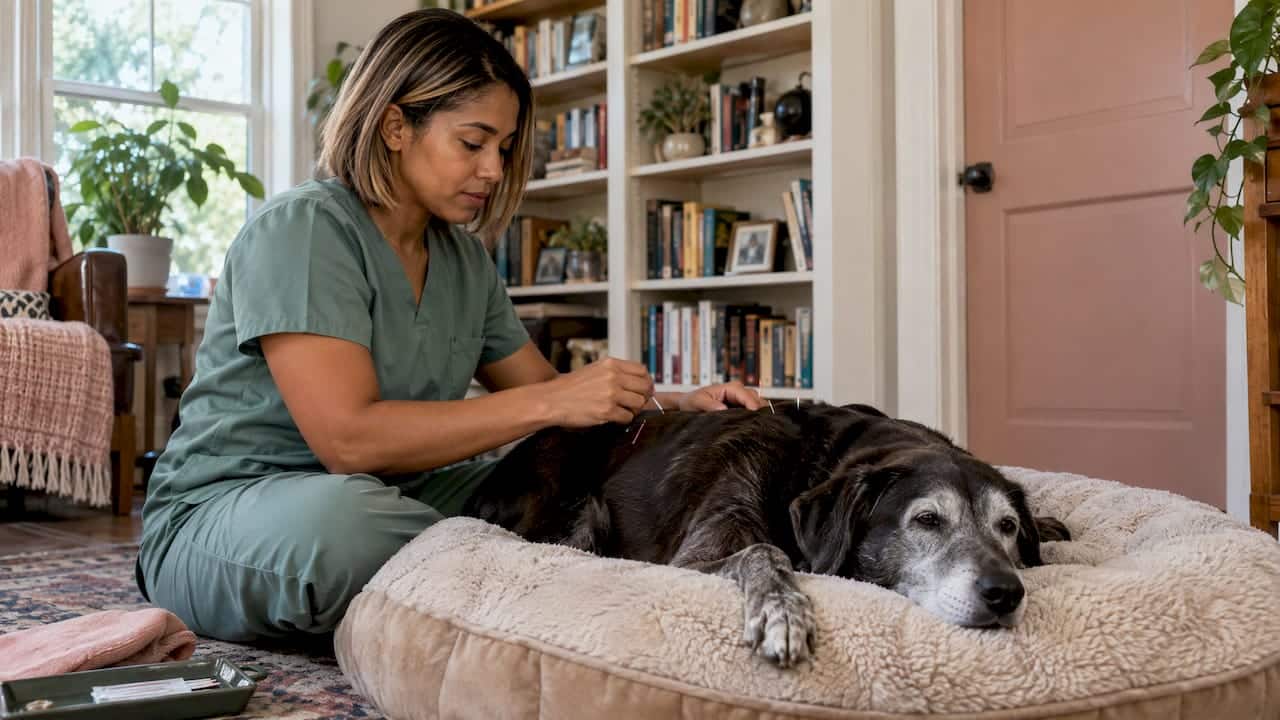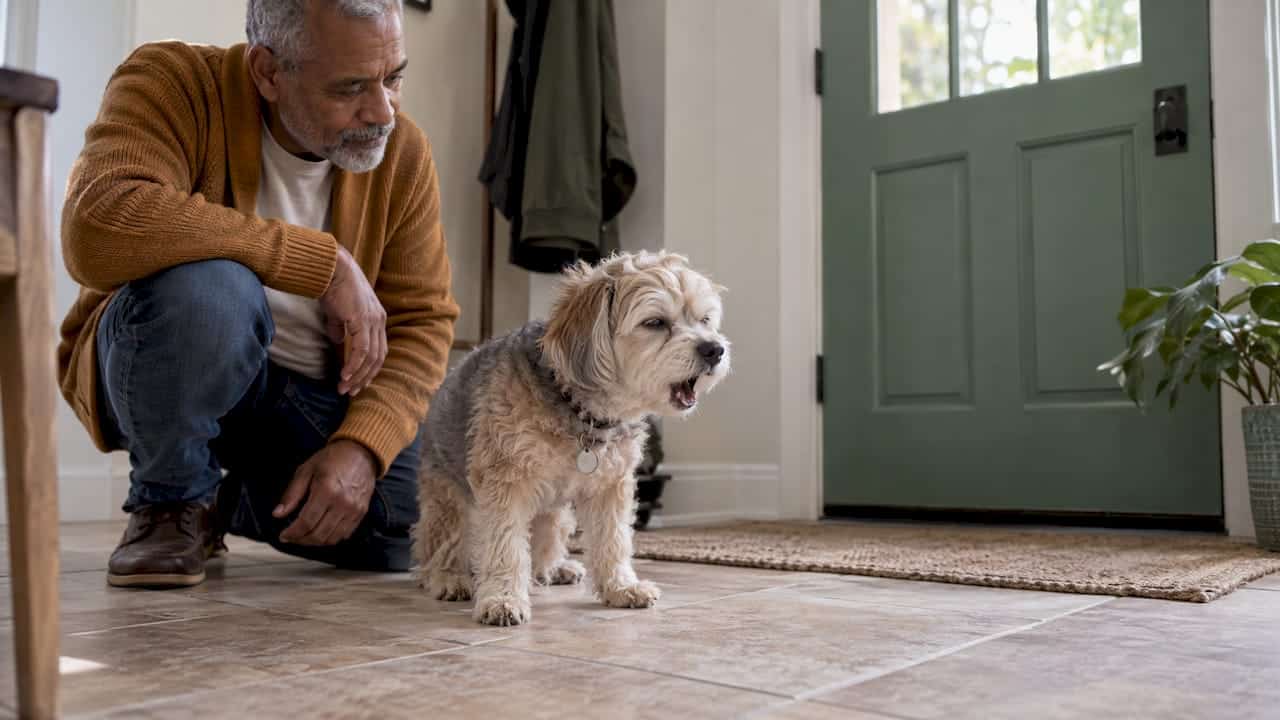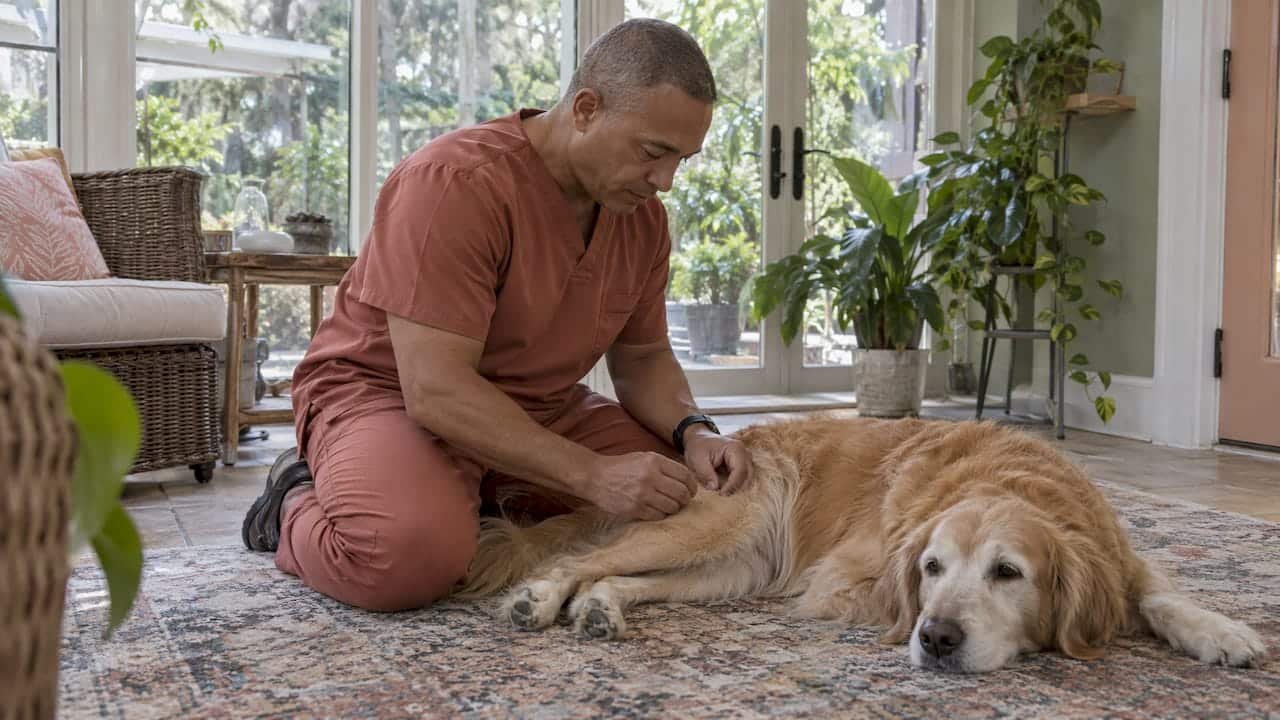
Acupuncture can be a gentle, well-supported part of caring for a dog with a luxating patella (a kneecap that slips out of its groove). It is used to ease pain, relax tight muscles and help your dog move more comfortably, alongside the weight management, controlled exercise and rehabilitation your regular veterinarian recommends. For a dog who hates the car or the clinic, it can be done on the living room rug. That is how we practice in South Tampa: mobile acupuncture, laser and rehabilitation visits in your home, coordinated with your dog’s own vet.
TL;DR
- Patellar luxation is graded 1 to 4 by your vet. Acupuncture is most often used for comfort and mobility, together with rehab, weight control and pain relief your vet advises.
- A published case of a toy poodle with luxating kneecaps on both sides improved by 80% in four months with monthly acupuncture and daily herbs.
- Studies in dogs with lameness report better walking, trotting, jumping and stair use after acupuncture combined with manual therapy.
- Grades 2 to 4, marked lameness or worsening signs call for a conversation with your veterinarian about surgery. Acupuncture can support your dog before and alongside that decision.
- Home visits suit anxious, senior and disabled dogs, because a calm dog can be needled safely and comfortably.
Table of Contents
- What a luxating patella is, and why it hurts
- Why acupuncture is used for a luxating patella
- What the evidence shows
- Where acupuncture fits with the rest of your dog’s care
- What a South Tampa home visit looks like
- Safety: who should be careful
- What it costs
- How to prepare your dog, and what to look for in a practitioner
- Our perspective
- Booking a visit in South Tampa
- FAQ
- Sources
What a luxating patella is, and why it hurts
The patella sits in a groove at the end of the thigh bone. In patellar luxation it slips out of that groove, most often toward the inside of the leg. According to the Merck Veterinary Manual, it is a developmental orthopedic disorder, and lameness is the main sign.
The classic sign is the skip. Cornell’s veterinary college describes a dog who suddenly holds up one hind leg for a few steps, then walks normally again. You may notice it when your dog gets up from a nap, climbs stairs or gets going on a walk.
The four grades
Your veterinarian diagnoses and grades the luxation with a hands-on exam. Cornell notes that X-rays may be recommended to look at related orthopedic problems, and CT or MRI are used in some cases. The Merck Veterinary Manual lays out the grades:
| Grade | What it means |
|---|---|
| 1 | The kneecap returns on its own after your vet luxates it by hand |
| 2 | It slips out on its own or with manipulation, and can be returned by hand or by extending the leg |
| 3 | It is out most of the time but can be put back by hand |
| 4 | It is permanently out and cannot be put back by hand |
The grade matters because it shapes the whole plan. Knowing it also helps us tailor each acupuncture session to what your dog’s leg can comfortably handle.
Why acupuncture is used for a luxating patella
A slipping kneecap is not only a joint problem. Dogs compensate: they shift weight, tighten muscles and guard the leg. Therese Castillo, writing in Veterinary Practice News, notes that in dogs with a medial luxation, hands-on palpation may find tension and shortening in muscles on the inner side of the hind leg, particularly the vastus medialis and sartorius. She lists medical acupuncture among the methods that may help reduce that tension, along with massage, photomedicine and stretching.
There is also a pain pathway story. Huntingford and Petty, in a 2022 review of acupuncture for pain, describe acupuncture as effective for analgesia at the local, segmental and suprasegmental levels, and note that pain from stifle (knee) disease is modulated through the nerves at the L4 to L6 spinal segments. In plain terms, needles placed near the knee, along the back and in the hind leg can quiet pain signals and loosen the muscles around the joint.
In Traditional Chinese Veterinary Medicine, we describe this as helping Qi and blood move freely along the meridians, the body’s “highway system.” When a road is blocked, traffic backs up and the surrounding area aches. Acupuncture is meant to clear the way. Both views, the neurological and the traditional, point to the same goal: a dog who is more comfortable on four legs.

What the evidence shows
The research on luxating patellas specifically is mostly case reports, and we think owners deserve to see what exists.
- A toy poodle with luxation in both knees. A one-year-old, 5 kg Toy Poodle with lateral patellar luxation in both hind legs was treated with acupuncture and Chinese herbal medicine. According to the published case, clinical signs improved by 80% within four months with monthly acupuncture and daily herbal therapy.
- A small mixed-breed dog with grade 1 to 2 medial luxation. A January 2026 case report by Dr. Adrianna Sage describes four sessions of dry needling and electroacupuncture followed by massage, with laser therapy added at the last visit. The dog’s hind-limb range of motion improved significantly. Points included GV20, GV14, Bai Hui, ST36 and several along the bladder channel and hip.
- Dogs with naturally occurring lameness. In a study of 47 client-owned dogs, Lane and Hill found that acupuncture combined with manual therapy gave immediate short-term gains in comfort and mobility, with significant improvement in walking, trotting, jumping, going down stairs, rising from lying down and stiffness after rest or exercise.
- A larger group. A prospective study of 181 dogs with neurological and musculoskeletal disease found success rates of 79% on the Helsinki chronic pain index, 84% for quality of life and 78% for pain and locomotion scores, using acupuncture alone or with analgesics for up to 24 weeks.
Huntingford and Petty add that acupuncture fits well into a multimodal approach to acute and chronic pain and is a safe complementary modality in the hands of trained practitioners. That is how we use it too: as one thread in a plan, not a lone fix.
Where acupuncture fits with the rest of your dog’s care
Patellar luxation care is a team effort. The AAHA/AAFP Pain Management Guidelines say there is more to pain relief than medication, and list cold compression, therapy lasers, acupuncture, physical therapy, weight optimization and changes to the home environment as complementary options. The MSD Veterinary Manual adds that combining drug and non-drug approaches typically provides better pain relief and allows lower medication doses.
Conservative management of luxation, meaning weight control, controlled exercise, physical therapy and pain relief, aims to reduce inflammation and improve comfort, according to the Merck Veterinary Manual. That same source says surgery is typically recommended for moderate to severe luxation (grades 2 to 4), marked lameness, or signs that keep getting worse. So the sensible first step is a hands-on exam and grade from your regular veterinarian, who also decides whether and when a surgical consult makes sense.
Many owners then ask how acupuncture fits. A “rehab first” outlook, as Narda Robinson describes it in Veterinary Practice News, holds that surgery should not be the only option clients hear about. The modern conservative toolbox she and Castillo outline includes acupuncture, electrotherapy, underwater treadmill work, massage, trigger point therapy, stretching and more. Our visits sit in that toolbox and stay in touch with your dog’s own veterinarian.
What a South Tampa home visit looks like
Our work is built around your dog’s own space. We practice integrative care in the home, and each plan is tailored to the pet’s health needs and home environment. For a dog with a luxating patella, a visit can combine several tools:
- Assessment. We review your vet’s diagnosis and grade, how your dog walks, where the muscles are tight, and what the floors and stairs at home look like.
- Acupuncture. Fine needles are placed at points chosen for your dog. Our guide to how vets choose acupuncture points explains the thinking in more detail.
- Electroacupuncture. A gentle current across needles can add to the effect for muscle tension and pain. See our guide to electroacupuncture for dogs for a typical protocol.
- Laser therapy. Our laser therapy option is another comfortable, needle-free tool.
- Rehabilitation. At-home rehabilitation can address hip and pelvic strength, which Castillo notes may be a first priority in some luxating patellas.
- Herbs and food therapy. Herbal therapy and food therapy round out the plan, in the same spirit as the herbs used in the toy poodle case above.
If your dog also has sore hips or arthritis, which often travel with a bad knee, our guides to acupuncture for arthritis and acupuncture for hip dysplasia cover those conditions.
Why home matters for needling
The Merck Veterinary Manual’s acupuncture chapter says needling requires a patient who can stay still enough to be treated safely, and that high levels of anxiety, fear or aggression can counteract the calming nervous system changes acupuncture generates. A dog who shakes in a waiting room is not in the best state to benefit. A dog on her own bed, with you beside her, usually is. That is the reason we treat at home, and it is a big help for small dogs, seniors and dogs who find the car painful.
Safety: who should be careful
Acupuncture delivered by a trained veterinary professional has a strong safety record. Huntingford and Petty note that trained practitioners generally cause few adverse effects, and that serious injury to organs or vessels is limited when the practitioner knows the anatomical landmarks. The WSAVA pain guidelines describe the risks as very low, and name accidental puncture of vital structures such as the lungs and infection, especially when sterile single-use needles are not used.
The same review lists situations that call for extra care:
- A dog who cannot stay still enough for safe needling.
- Bleeding disorders or a weakened immune system, where needling could cause bleeding or local infection.
- Infected skin or areas with a tumor, which are not needled.
- Pregnancy, often treated as a reason to avoid acupuncture.
Tell us about every diagnosis and medication before the first visit. Your regular veterinarian should also know your dog is getting acupuncture so the whole team works from the same picture.
What it costs
Our published prices are listed on our cost of services page:
- Initial assessment and acupuncture with a technician: from $430
- Technician mobile fee: $60
- Electroacupuncture: $30
- Laser treatments: $45 to $120 per treatment
- At-home rehabilitation packages: $85 to $918
Other services, such as acupressure, herbal therapy and food therapy, do not have a published price. The page above is the place to confirm current fees before you book.
How to prepare your dog, and what to look for in a practitioner
A few easy steps help the first visit go well:
- Gather records. Bring your vet’s diagnosis and grade, any X-ray reports, and a list of medications and supplements.
- Film the skip. A short phone video of your dog walking, climbing stairs and getting up shows us what an exam table may not.
- Set up a calm spot. Choose a quiet room with a soft bed and non-slip footing. The AAHA/AAFP guidelines note that soft bedding, easy access to food bowls, gates to limit stairs and nonslip rugs can make a big difference for dogs in chronic pain.
- Keep routines normal. Offer water, a light meal and a short, easy potty break beforehand, and keep treats on hand.
- Ask about training. Our guides on veterinary acupuncture certification and what a certified veterinary acupuncturist is explain the credentials owners can ask about.
The AAHA/AAFP guidelines describe you as the eyes and ears of the veterinarian at home. Keep a simple log of good days and bad days, how your dog does on stairs and how many skips you see in a walk. It makes every plan sharper.
Our perspective
When owners call us about a luxating patella, they are usually worried about two things: their dog’s pain, and the thought of a stressful trip to a clinic. Both can be addressed at home.
We see acupuncture, electroacupuncture, laser therapy and rehabilitation as a set of tools that work well together, because a slipping kneecap affects the whole hind end: the muscles, the hips, the back and the way a dog carries herself. Treating in the home lets us watch how your dog moves on her own floors and adjust the plan to what she actually faces each day.
We work alongside your dog’s regular veterinarian, not in place of that care. Our aim is a dog who gets up more easily, climbs with less hesitation and enjoys her walks, and an owner who feels supported along the way.
Pet Acupuncture & Wellness
Booking a visit in South Tampa
If your dog skips, hesitates on stairs or flinches at the car, an in-home visit may be the easiest way to start. Our mobile veterinary service brings acupuncture, laser therapy, rehabilitation, herbal therapy and food therapy to dogs and cats in South Tampa, with plans shaped around each pet’s health and home.
You can see the services and published fees on our cost of services page, or reach us through our main site to ask about your dog’s situation.
FAQ
Can acupuncture fix a luxating patella?
Acupuncture is used to ease pain, relax tight muscles and improve how a dog moves, not to reposition the kneecap permanently. Your veterinarian grades the luxation and advises on the full plan, including whether surgery should be discussed for grades 2 to 4 or worsening lameness. We work alongside that plan.
How many acupuncture sessions does a dog with a luxating patella need?
It depends on the grade, your dog’s age and how long the problem has been there. The toy poodle case received monthly acupuncture, and the grade 1 to 2 case described above had four sessions. We set a schedule after the first assessment and adjust it as your dog responds.
Is acupuncture painful for dogs?
Most dogs tolerate the fine needles well, and many relax during treatment. A calm dog is also safer to needle, which is why we treat at home on your dog’s own bed. Dogs who cannot stay still enough may need a different approach, and we will tell you if that applies.
Is acupuncture safe for senior dogs?
When performed by a trained veterinary professional, acupuncture is generally regarded as safe, and many of our patients are seniors. Tell us about bleeding problems, a weak immune system, skin infections, tumors or medications so we can plan safely.
What does dog acupuncture for patellar luxation cost in South Tampa?
Our initial assessment and acupuncture with a technician starts at $430, plus a $60 technician mobile fee. Electroacupuncture is $30, and laser treatments range from $45 to $120 each. See our cost of services page for current details.
Sources
- Patellar Luxation in Dogs and Cats, Merck Veterinary Manual
- Patellar luxation, Cornell University College of Veterinary Medicine
- Evidence-Based Application of Acupuncture for Pain Management in Companion Animal Medicine
- Rehab first for patellar luxation, Veterinary Practice News
- Management of a Dog with Atlantoaxial Instability and Lateral Patellar Luxations
- Medical Acupuncture for Medial Patellar Luxation in Dogs, CuraCore
- Effectiveness of combined acupuncture and manual therapy, Lane and Hill
- Effect of acupuncture on pain and quality of life in canine neurological and musculoskeletal diseases
- AAHA Pain Management Guidelines overview
- Pain Management in Small Animals With Lameness, MSD Veterinary Manual
- Acupuncture in Veterinary Patients, Merck Veterinary Manual
- WSAVA Guidelines for Recognition, Assessment and Treatment of Pain