Valerian will not reliably calm an anxious cat, and for many cats it does the opposite. Roughly half of cats react to it, and the reaction is usually playful excitement, much like catnip, not relaxation. If your cat hides, overgrooms, or panics at the carrier, there are steadier places to start, and this guide walks through them.
We make house calls for senior, disabled, and anxious pets in South Tampa, so we hear this question often. Owners are tired of watching a worried cat and want something gentle. That instinct is right. The tool is where it gets complicated.
TL;DR
- Valerian is a stimulant for many cats. A study of cat-attracting plants found that valerian often triggers a catnip-like, euphoric response, which makes it unpredictable for fear or anxiety.
- There is no standardized veterinary dose for valerian root in cats, and cats process plant compounds differently from people, so do not dose it yourself.
- Start with the cause: boredom, a lack of vertical space, a medical problem, or a stressful routine often sits behind anxious behavior.
- If you want an herbal or integrative option, work with a veterinarian who can pick a product and a protocol for your cat and your cat’s medications.
- For cats who dread the clinic, care at home removes the biggest trigger of all.
Table of Contents
- Why Valerian Has a Reputation as a Cat Calmer
- What Valerian Actually Does to Cats
- What the Research Says About Valerian and Stress
- Is Valerian Safe for Cats?
- Why Many Veterinarians Look Elsewhere First
- Calming Herbs for Cats: A Fair Look
- Travel and Vet Visit Anxiety
- Our Perspective on Herbs and Anxious Cats
- When an Anxious Cat Needs Professional Integrative Care
- Care at Home in South Tampa
- FAQ
- Sources
Why Valerian Has a Reputation as a Cat Calmer
In people, valerian root is a traditional remedy for restlessness and poor sleep. One veterinary explainer notes that the herb is believed to work by raising GABA, a calming chemical messenger in the brain. That is the logic behind the pet supplements you see online, many of them labeled for “stress relief” in dogs and cats.
The trouble is that a cat is not a small person. The idea travels from human herbal medicine to pet-store shelves faster than the cat-specific evidence does. PetMD points out that very little cat-specific research exists on calming herbs, so claims about effectiveness are often extrapolated from other species.
What Valerian Actually Does to Cats
Picture your cat meeting a valerian-scented toy. You might hope for a sleepy cat curled in a sunny spot. What many owners see is rolling, cheek-rubbing, chasing, and sometimes a burst of wild energy.
The reason is a compound called actinidine. Researchers studying cat-attracting plants and their volatile compounds found that valerian, silver vine, and Tatarian honeysuckle can all produce euphoric responses in cats, and that actinidine may work by a different mechanism than catnip’s nepetalactone. CatHealth describes the same stimulant effect, noting that it can look like the hyper-excitability some cats show with catnip.
The numbers matter here. In the responsiveness study, only a portion of cats responded to valerian at all, and the response was euphoric, not sedating. So there are really three outcomes:
- Your cat ignores it. Nothing happens, and you have spent money.
- Your cat gets playful. That is enrichment, not anxiety treatment, and it can overstimulate a nervous cat.
- Your cat gets calm afterward. Some cats do mellow after the play burst, much as with catnip, but you cannot count on it.
That unpredictability is the core problem if the goal is a calmer cat in the car or at the clinic.
What the Research Says About Valerian and Stress
The evidence is thin and mixed, so it helps to be exact about what exists.
- A Belgian team at Ghent University studied olfactory enrichment for shelter cats, using valerian and catnip and scoring stress with the Cat Stress Score. Shelter cats are a specific group, and a scent used as enrichment in a kennel is not the same as a supplement for a cat with a long-standing anxiety problem.
- A 2023 rescue centre study of Pet Remedy, a calming product that blends valerian with other ingredients, looked at stress-related behaviors in cats. A calibrated, formulated product is a different thing from sprinkling raw root.
- A 2017 paper examined standard extracts of passionflower and valerian for anxiety in cats. Extracts with a standard composition are the sort of thing a veterinarian can reason about. A bag of dried root from the grocery shelf is not.
None of this proves that valerian is a dependable anxiety treatment for your individual cat. It shows that scent exposure and formulated blends deserve more study, and that the form of the product matters a great deal.
Is Valerian Safe for Cats?
The honest answer: probably low-risk in a small scent exposure for a healthy cat, but not something to experiment with by feeding it. Dr. Zubair Khalid’s veterinary overview states that valerian root is not approved as a food for cats and lacks established dosing for sedative use. It lists possible stomach upset and paradoxical reactions.
There are a few reasons we ask owners to hold off on home dosing:
- No standard dose. Without a veterinary dosing guideline, any number on a label or a forum is a guess.
- Feline metabolism. Cats have a limited ability to break down certain compounds in the liver, so supplements cannot safely be scaled from human doses. “Natural” does not mean mild.
- Variable products. Raw or minced root can vary wildly in strength from one batch to the next.
- Hidden medical causes. If anxiety is really pain, nausea, or thyroid or kidney trouble, an herb can mask the signal while the problem grows.
- Medication interactions. Senior cats often take other drugs. Anything with sedative activity should be cleared by the veterinarian who knows the full list.
If your cat has eaten a large amount of a valerian product, is vomiting, is wobbly, or seems very lethargic, call your veterinarian or an emergency clinic right away. In Florida, an after-hours emergency hospital can also advise you on the spot.
Why Many Veterinarians Look Elsewhere First
The veterinary guidance we trust puts the environment first. Cornell experts quoted in a Cornell alumni feature on cat behavior say that owners need to provide what cats would get outdoors, such as a chance to express prey drive through dedicated playtime and food-chasing feeders. A cat acting out is often a cat whose needs for climbing, hunting, and territory are not being met.

That changes the question. Instead of asking what to give your cat, ask what your cat is missing or afraid of.
A starting checklist for an anxious cat
- Rule out pain and illness. Cats hide discomfort. Hiding, hissing, litter box changes, and overgrooming deserve a medical look first.
- Add vertical space. Cat trees, wall shelves, and window perches give a nervous cat a safe vantage point.
- Make food a hunt. Puzzle feeders and scattered kibble use energy that might otherwise turn into worry.
- Protect resources. One litter box per cat plus one more, in quiet spots, and separate water and food stations in multi-cat homes.
- Keep routines steady. Predictable meal times and play sessions lower background stress.
- Consider a synthetic pheromone diffuser. Veterinarians commonly pick these before herbal supplements, and the research summary we reviewed describes them as an established, evidence-based tool for feline anxiety.
If valerian is part of that plan at all, treat it as enrichment, a scented toy your cat may enjoy, and not as medicine.
Calming Herbs for Cats: A Fair Look
Owners searching for natural relief usually bump into a handful of herbs. PetMD’s overview of calming herbs and supplements covers the commonly used ones and is frank that effectiveness and mechanisms are often poorly documented for cats specifically.
A few honest rules of thumb:
- Formulated beats raw. A product made for cats, with a consistent composition, is easier to judge than a loose herb. The Pet Remedy study above involved a blend, not a sprinkle of root.
- Scent is not the same as swallowing. Smelling an herb is a different exposure from eating it.
- One change at a time. If you add a new product, change nothing else for a couple of weeks, so you can tell whether it helped.
- Watch your cat, not the label. Excited and wired is not calm. Calm looks like a loose body, a relaxed tail, and normal eating and grooming.
Travel and Vet Visit Anxiety
This is the situation that sends most owners looking for valerian: the carrier comes out and the cat vanishes under the bed. Some owners online sprinkle dried root in the carrier. The cat may well pile in, but excited is not calm, and a keyed-up cat in a moving car is not an improvement.
What tends to work better is training. Leave the carrier out as a bed, feed treats inside it, and build up to short car rides over weeks. We lay out a step-by-step approach in our guide on reducing your cat’s fear of car rides.

Some cats, especially seniors with arthritis or cats with severe fear, find even good training too much. For them, the kindest option is to skip the trip.
Our Perspective on Herbs and Anxious Cats
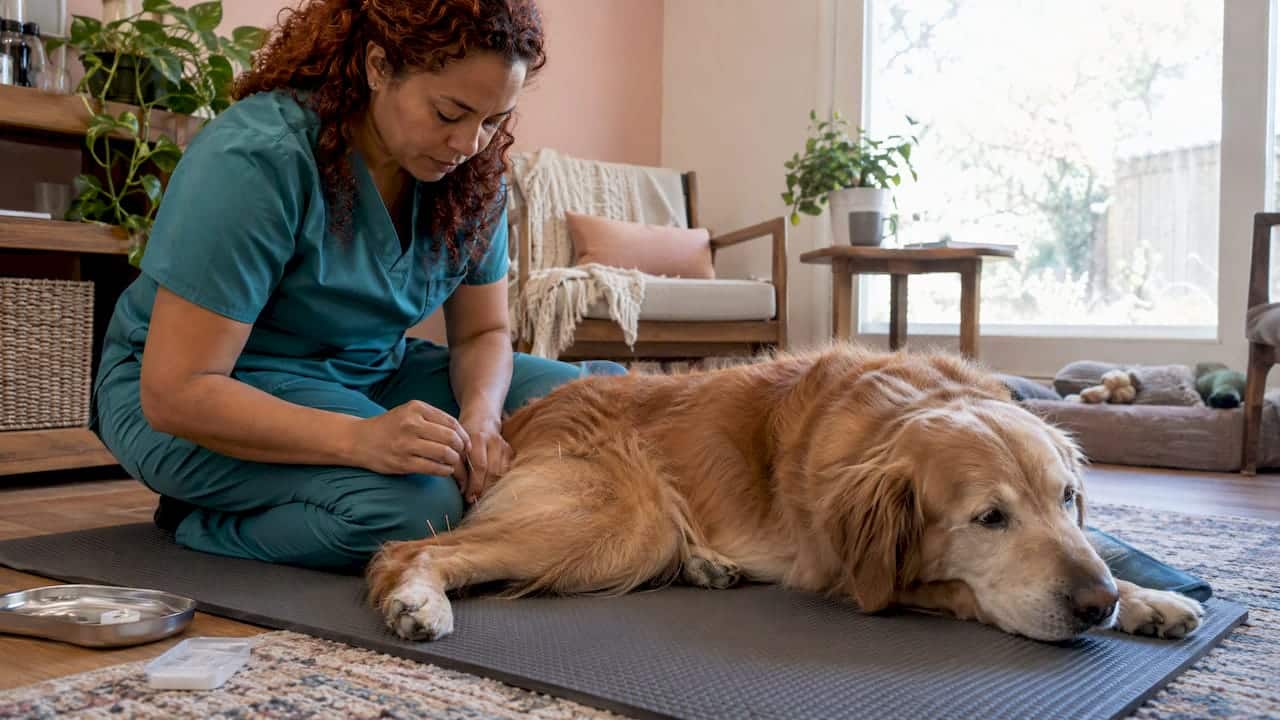
We see anxious cats in the place they feel safest: their own homes. A cat who would spend a clinic visit pressed flat against the back of the carrier will often sniff our bag, wander over, and let us work from a favorite chair. Much of the anxiety people try to treat with supplements is, we find, anxiety about the trip itself.
We use herbs, but carefully. Within Traditional Chinese Veterinary Medicine, we think of anxiety as a pattern of imbalance, a bit like sunlight and shade falling unevenly across a room, and we look at the whole animal: appetite, sleep, joints, temperature preference, and home life. Herbal formulas are chosen for that individual cat, not for a symptom on a label, and they complement your regular veterinarian’s care and never replace it. Acupuncture, acupressure, and food therapy may also be options for some cats, and we talk through what is realistic for each.
So when an owner asks us about valerian, we are glad they asked, and our answer is usually: please don’t start it on your own. Let’s look at why your cat is anxious first, and then choose something suited to your cat.
— Pet Acupuncture & Wellness
When an Anxious Cat Needs Professional Integrative Care
Consider calling a veterinarian, ideally one who can see your cat at home, if:
- Anxiety has lasted more than a couple of weeks or keeps getting worse.
- Your cat has stopped eating, drinking, grooming, or using the litter box normally.
- Your cat is a senior, has arthritis or other chronic pain, or has any condition that might be driving the behavior.
- Your cat is already on medication, so any herb needs checking for interactions.
- Getting your cat to a clinic is itself a source of dread for both of you.
Our herbal therapy service is where we build a plan like this, and we work with your cat’s regular veterinarian. If your older cat’s anxiety is tangled up with stiffness or discomfort, our piece on herbal support and diet for senior cats in pain explains how we approach it.
Care at Home in South Tampa
We bring integrative care to dogs and cats in South Tampa, including herbal therapy, acupuncture, acupressure, rehabilitation, laser therapy, food therapy, and telemedicine. For a cat whose stress starts with the carrier, a calm visit on the living room rug can be the first real relief.
Published prices, as of this writing: an initial assessment and acupuncture with a technician starts from $430, and a technician mobile fee of $60 applies. Electroacupuncture is $30, and laser treatments range from $45 to $120 per treatment. You can see the full list on our cost of services page. Herbal therapy has no published price, so reach out through our main site and we will talk through your cat’s situation.
FAQ
What does valerian do to cats?
For many cats, it acts as a stimulant, much like catnip. The compound actinidine can trigger rolling, rubbing, chasing, and playful hyperactivity. Some cats ignore it, and some become mellow after the excitement fades.
Is valerian root safe for cats?
Small scent exposures, such as a valerian-scented toy, are generally treated as low-risk for healthy cats. Feeding valerian is a different matter: it is not approved as a cat food, has no established dose, and may cause stomach upset or odd reactions. Ask your veterinarian before giving any herbal supplement, particularly to a senior cat or one on medication.
Can valerian help my cat in the car or at the vet?
It is a poor bet. Because many cats get excited by it, it may leave your cat more wound up, and there is no robust clinical evidence for it as a travel sedative. Carrier training, pheromone products, and, for severe cases, a veterinarian’s prescription plan are more dependable. Our guide on cats who hate car rides is a good place to begin.
What are better natural ways to calm an anxious cat?
Begin with the environment: climbing space, play that mimics hunting, puzzle feeders, steady routines, and safe hiding spots. Synthetic pheromone diffusers are a common next step. If you want to add herbs or other integrative therapies, a veterinarian should select the product and check it against your cat’s health history.
Are herbs safe for anxious dogs too?
Dogs are different from cats, and some herbs that are discussed for dogs are not suited to cats. We cover that in our guide to herbs for canine anxiety. Never assume that a dog product is safe for a cat.
Sources
- Responsiveness of cats to silver vine, Tatarian honeysuckle, valerian and catnip (PubMed)
- Behavioral differences among domestic cats in response to cat-attracting plants (PMC)
- Natural Calming Herbs and Supplements for Cats (PetMD)
- Can Cats Eat Valerian Root? Sedation and Dosing (Dr. Zubair Khalid)
- The ABCs of C-A-Ts (Cornellians, Cornell University)
- Is Valerian effective against stress in pets? (Vet Help Direct)
- Valerian Root: What Is It and How Can It Be Used for Cats? (CatHealth)
- Olfactory enrichment for shelter cats: valerian and catnip (Ghent University)
- The Effect of Pet Remedy on Feline Stress-Related Behaviours in a Rescue Centre