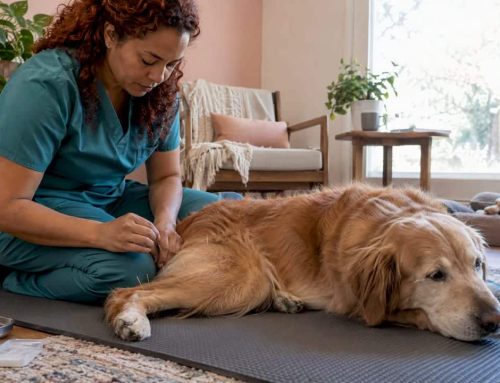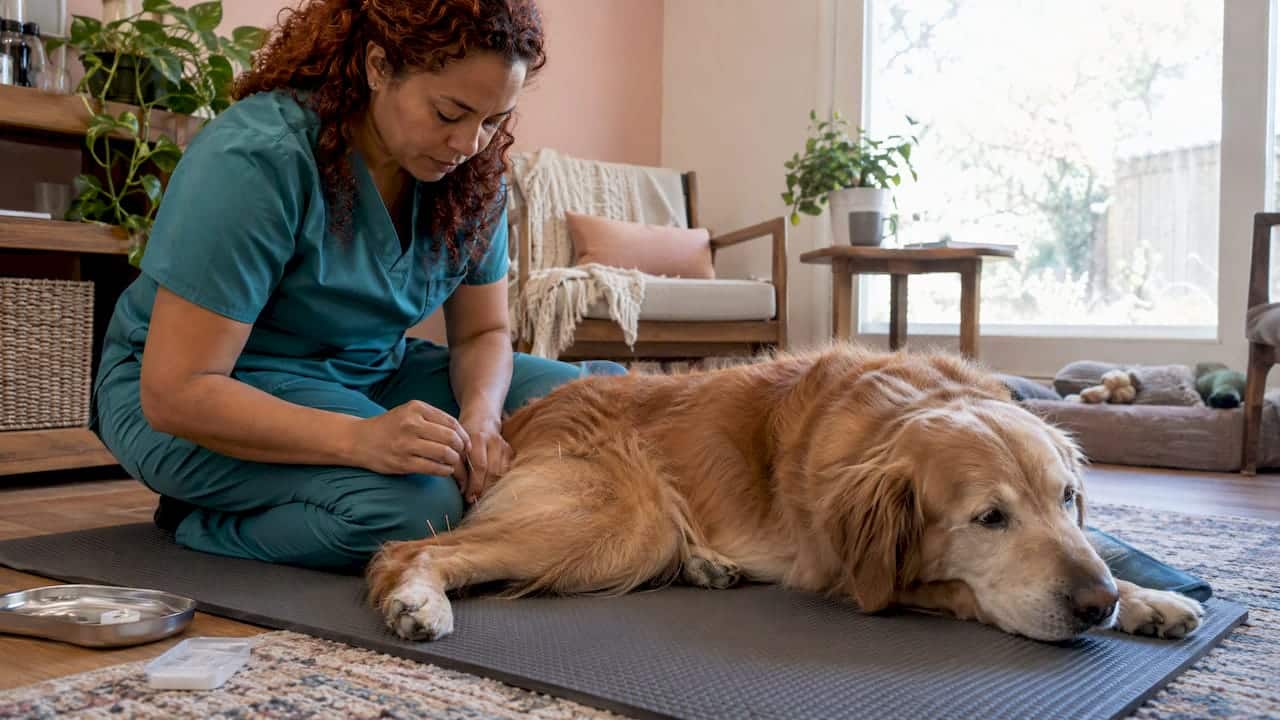
Tui Na is a form of Chinese medical massage. A trained practitioner uses set hand techniques on acupoints, muscles and joints to ease stiffness, calm the nervous system and support movement. For a senior dog who has slowed down on the stairs, it can be a gentle way to add comfort to a plan your veterinarian already knows about. It is not a cure, and it is never a replacement for a diagnosis. This guide explains what Tui Na is, what the research does and does not show, who tends to benefit, and how to try it safely at home in South Tampa.
TL;DR
- Tui Na is practitioner-directed Chinese medical massage, one of four branches of Traditional Chinese Veterinary Medicine (TCVM), alongside acupuncture, herbal medicine and food therapy.
- It is most often considered for chronic issues such as arthritis, back or neck stiffness, muscle spasm and trouble with stairs, after a veterinary exam.
- Research is encouraging but limited, so treat it as one part of a multimodal plan and never stop prescribed pain medication because your dog looks better.
- Skip it and call a vet right away for sudden inability to stand, severe pain, trauma, breathing trouble or collapse.
- For dogs who dread the car and the waiting room, an in-home visit lets the practitioner see how your dog really lives and moves.
Table of Contents
- What Tui Na actually is
- What the research says
- Which dogs may benefit
- When not to use Tui Na
- How Tui Na fits into a bigger plan
- Tui Na at home: what you can and cannot do yourself
- Why an in-home visit can make a difference
- Our perspective: comfort first, evidence honestly
- How to choose a provider
- What a visit with us looks like and what it costs
- FAQ
- Sources
What Tui Na actually is
The name comes from two Chinese words, roughly “push” and “grasp.” According to Chi University’s overview of TCVM, Tui Na uses different manipulations on acupoints and meridians to promote the circulation of Qi and correct imbalances. It sits beside acupuncture, herbal medicine and food therapy as one of the four TCVM branches.
If those terms are new, here is the simple picture. TCVM describes Qi as the energy that keeps a body moving and healthy. Meridians are like a highway system that carries it, with acupoints as the on-ramps and exits. When traffic backs up, you may see stiffness, pain or a dog who seems less like themselves. Tui Na uses the hands to clear the road. Yin and Yang, the shade and sunlight of the same hillside, describe the balance the whole approach tries to restore.
The practical difference matters more than the vocabulary. Tui Na is not a generic deep-tissue rub, and it is not the same as petting your dog for ten minutes. The practitioner chooses techniques and points based on an examination, adjusts pressure to the dog in front of them, and stays within what that dog can comfortably tolerate.
Common techniques you may see
Different practitioners use different combinations, but sessions usually draw from a few families of movement:
- Gliding and stroking: slow, light passes along the back and limbs that settle the nervous system and warm the tissue.
- Kneading and rolling: gentle compression of tight muscle, usually around the shoulders, hips and along the spine.
- Point pressure: steady, light pressure on acupoints, similar in intent to acupuncture without needles.
- Shaking and vibrating motions: soft movements of a limb or the muscle belly that encourage relaxation.
- Passive range of motion: slowly flexing and extending joints within a comfortable arc.
For a frail dog, all of these are done lightly. Firm pressure is not the goal.
What the research says
Here is where we want to be honest with you, because it affects what you should expect.
A 2021 cross-sectional study reviewed 527 dogs treated by 65 canine massage practitioners. Pain scores reported by owners and practitioners fell across successive treatments, and quality of life improved afterward. That is a hopeful result. But the study had no control group and was not double-blinded, so it cannot prove the massage itself caused the change.
A wider 2022 systematic review of soft tissue mobilization in dogs, cats and horses screened 1,189 publications and included only 11 studies. Eight had a high risk of bias and three a moderate risk, and the authors concluded the evidence was not strong enough to draw clear conclusions. The Merck Veterinary Manual likewise describes manual therapy as potentially useful for stiffness, spasm and mobility problems, while noting that evidence for animal massage remains limited.

What does that mean for you? Tui Na is a low-risk, comfort-focused therapy when done gently and after an exam, and many owners see their dogs relax and move more freely. It is not a proven treatment for any specific disease. That is why the best practitioners set measurable goals, such as easier rising, a longer comfortable walk or better sleep, and adjust or stop if your dog gets worse.
Which dogs may benefit
Veterinary sources point to the same group of dogs again and again: those with chronic musculoskeletal discomfort. The Merck Veterinary Manual lists neck or back pain or stiffness, reduced flexibility, muscle spasm and difficulty going up or down stairs among the signs where manual therapy may be considered after examination.
Osteoarthritis is the big one. A JAVMA review estimates it affects about 20% of dogs at least 1 year old and 90% of dogs older than 5 years. Those are population estimates, not a diagnosis for your dog, but they explain why so many seniors benefit from added comfort care. Warning signs the review lists include:
- Stiffness or reduced range of motion
- Muscle loss
- Limping
- Difficulty rising or using stairs
- Avoiding slippery floors
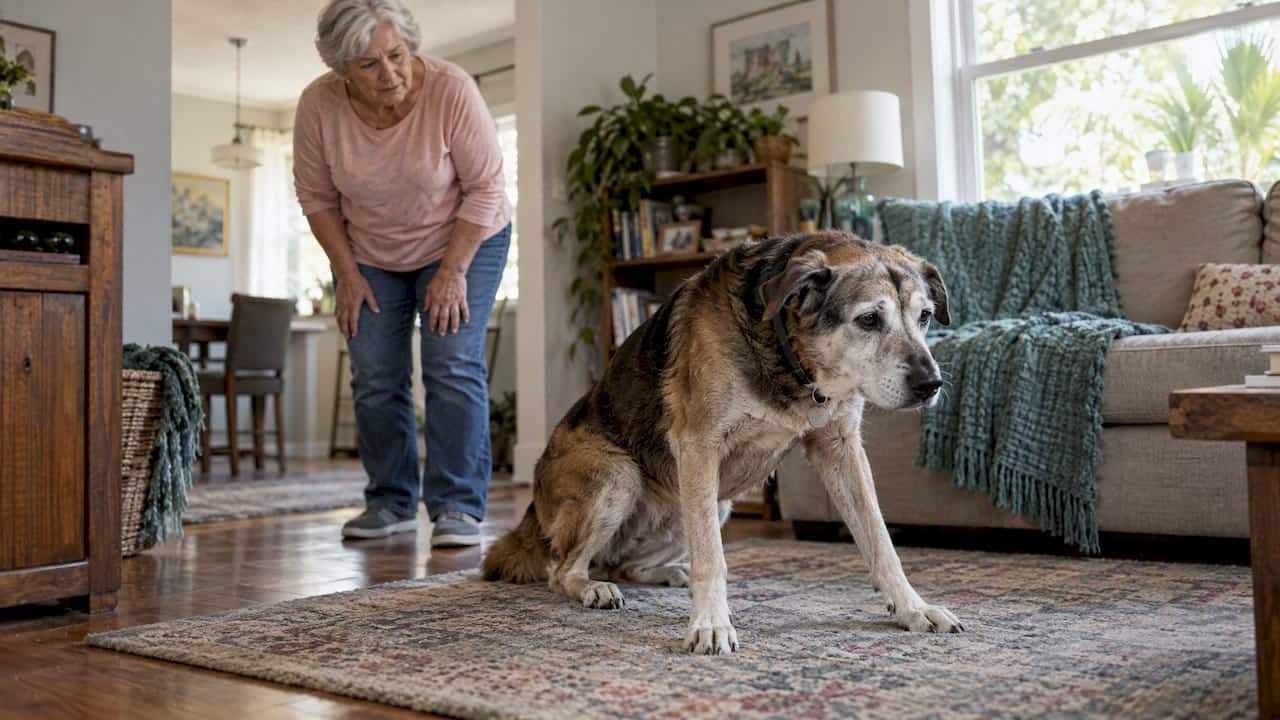
Subtle changes count too. Less play, a shift in mood, restless sleep or a new reluctance to jump on the couch can all signal pain, as AVMA News reporting on pain behavior explains. A change in mobility or temperament deserves a veterinary evaluation, not a shrug and the assumption that this is just old age.
Dogs who need extra care
Gentle touch can still be right for fragile dogs, but the practitioner needs to know the full picture. Dogs who are medically compromised, very thin, recovering from surgery or on multiple medications should be treated lightly and only with your regular veterinarian’s input. If your dog is paralyzed or has severe spinal disease, our guide to at-home rehab for paralyzed dogs covers what a structured plan looks like.
When not to use Tui Na
Tui Na is not an emergency treatment. Call your veterinarian or an emergency hospital immediately for any of these, as the AVMA’s first aid guidance stresses that first aid is no substitute for veterinary care:
- Sudden inability to stand or walk
- Severe or rapidly worsening pain
- Major trauma, such as a fall or car strike
- Trouble breathing or collapse
- Suspected poisoning
- Repeated vomiting or a swollen, tight belly
Even with a mild limp, do not press on an open wound, infection, area of acute inflammation, tumor, recent incision, fracture, burn or suspected clot, per the Merck manual. Pain and fear can make even the sweetest dog unpredictable, so never force massage on a dog who pulls away, and never restrain a painful body part. Forceful pressure can injure organs, vessels, nerves or bones.
One more rule that matters: do not stop prescribed pain medication because your dog seems better after a session. Merck’s pain guidance supports multimodal care, where medication, rehabilitation, home changes and complementary therapies work together.
How Tui Na fits into a bigger plan
Chi University describes TCVM and Western veterinary medicine as complementary. Conventional medicine is essential for precise diagnosis and fast treatment of acute illness, while TCVM offers a whole-patient framework that tends to suit chronic conditions. The safest message for a painful senior dog is to add Tui Na to an established plan, not to swap it for one.
A strong plan for an arthritic dog often layers several things:
- A veterinary diagnosis that rules out infection, trauma and other urgent causes.
- Pain control prescribed by your vet, adjusted over time.
- Weight and exercise management, including low-impact activity. The Merck manual notes that excessive exercise can worsen joint pain.
- Home changes such as rugs on slick floors, supportive bedding and warmth.
- Rehabilitation and manual therapy, including Tui Na, acupressure, acupuncture or laser.
If you want to see how that rehab layer works, a university rehabilitation service like the one at the University of Florida describes a visit that begins with a thorough exam, then moves to a personalized plan and home exercises. Complementary options can include manual therapy, acupuncture, laser therapy, hydrotherapy, electrical stimulation and therapeutic exercise. The same page notes that some rehab therapies may require sedation or anesthesia, so ask in advance what will be used and how your dog’s comfort will be monitored. A dog rescue rehabilitation guide shows the same principle from another angle: recovery goes best when the pace is set by the dog.
Nutrition counts as well. Fatty acids are a common conversation for arthritic dogs, and this overview of omega-3 benefits for dogs with arthritis is a starting point for the questions to bring to your vet before changing a diet or adding supplements.
Tui Na at home: what you can and cannot do yourself
Many owners ask whether they can simply learn Tui Na from a video. The honest answer is to learn from someone who has examined your dog first. A guide written for the general public cannot know that your dog has a sore left hip, a heart murmur or a tumor you have not found yet.
Once your vet has cleared your dog, calm, simple touch at home is usually reasonable. A few principles keep it safe:
- Choose a quiet time, such as after a walk or in the evening, with your dog on a non-slip surface or a bed they love.
- Begin with long, light strokes along the shoulders and back. Watch the face, ears and tail for tension.
- Stop if your dog stiffens, licks their lips repeatedly, turns away, or tries to move off.
- Keep sessions short, five to ten minutes, and end while your dog is still relaxed.
- Avoid the spine itself, joints that look swollen or warm, and anywhere that draws a flinch.
Gentle stroking may help reduce stress responses in some dogs, according to a 2021 study reported in the research we reviewed, but it is not a treatment for separation anxiety or disease. For a step-by-step approach built around arthritis, see our home massage guide for dogs with arthritis, and for deeper soft tissue work, our piece on myofascial release for dogs explains why rehab comes first and home care follows vet clearance.
Keep a simple mobility journal
One habit makes every session more useful. Take a 15-second video of your dog rising, walking and climbing a step once or twice a week, and jot down notes on sleep, appetite and mood. Pain experts note that this kind of record often beats trying to remember how your dog moved weeks ago. It also gives your practitioner real data to judge whether the plan is working.
Why an in-home visit can make a difference
Some dogs will not tolerate a car ride. Others can ride, but the slippery clinic floor, the barking in the lobby and the smell of other animals leave them tense, which is the opposite of what Tui Na is for. Owner stress counts too. 2024 AVMA research on dog owners found that stress around veterinary visits is a meaningful reason people delay care.
A house call changes the picture. The practitioner can see the flooring your dog slips on, the stairs they avoid, the bed they sleep in and the harness and route you use for walks. Washington State University’s integrative medicine service describes integrative care as combining complementary therapies with conventional care and working with other veterinary services, and that coordination is the part we care most about.
Home care also helps with follow-through. AVMA-published rehabilitation research points out that owners often struggle to carry out complex home programs. So we keep plans simple, show you every technique in your own living room, and give you a clear point at which to call us or your regular vet.
Our perspective: comfort first, evidence honestly
We see many senior and disabled dogs in South Tampa whose owners have quietly stopped taking them places because every outing is hard. What we hear most is not a demand for a miracle. It is a wish for the dog to get up from the bed without that long, painful pause, and for the owner to stop dreading the drive.
So here is how we think about Tui Na. It is one tool in a multimodal approach, not a standalone answer. We examine first, work alongside your pet’s regular veterinarian, and choose therapies that fit your dog’s condition and your home. Acupressure and gentle manual techniques can sit comfortably next to rehabilitation, laser, acupuncture, herbal and food therapy, depending on what your dog needs. We tell you what we are trying, what we are watching for, and when we would change course.
We also say plainly that the research on massage is still limited. That is why we agree on goals up front, such as easier stairs or a more comfortable walk, and review them together as your dog changes. If a therapy is not helping, you deserve to hear that.
— Pet Acupuncture & Wellness
How to choose a provider
Tui Na is a formal TCVM discipline, and Chi University reports that its founder, Huisheng Xie, has trained more than 12,000 veterinarians worldwide. Training matters, but credentials alone do not promise results for every dog. When you talk to any provider, ask:
- Are you a licensed veterinarian, and what formal training do you have in acupuncture, rehabilitation and Tui Na?
- Will you perform a conventional medical assessment first?
- How will you coordinate with my dog’s regular veterinarian?
- What are the realistic goals, the risks and the alternatives?
- How will we measure progress, and when will we reassess?
- Will any therapy involve sedation, and how will my dog’s comfort be monitored?
- What is the full cost, including any mobile or travel fee?
Be wary of anyone who promises to cure arthritis, discourages you from seeing your vet or suggests dropping medication.
What a visit with us looks like and what it costs
We provide mobile integrative care for dogs and cats across South Tampa. A typical first visit starts with a conversation about your dog’s history and daily routine, a hands-on assessment, and a plan built around what we find in your home. From there we may recommend acupressure, acupuncture, rehabilitation, laser therapy, herbal or food therapy, or a combination.
Here are the prices we publish, as listed on our cost of services page:
| Service | Published price |
|---|---|
| Initial assessment and acupuncture with a technician | From $430 |
| Technician mobile fee | $60 |
| Electroacupuncture | $30 |
| Laser treatments | $45 to $120 per treatment |
| At-home rehabilitation packages | $85 to $918 |
| Vitamin B12 injections | $31.50 |
We do not publish a price for Tui Na or acupressure, so please contact us for current pricing and to confirm whether it suits your dog. You can read more about acupressure and acupuncture in Tampa, our rehabilitation therapy or, if you are ready to book an in-home visit, start at pawvetpractice.com. For a broader picture of home-based movement care, our guide to dog physical therapy at home and our page on arthritis relief for dogs are good next reads.
FAQ
Is Tui Na safe for senior dogs?
It can be, when it is gentle and follows a veterinary exam. Frail or medically compromised dogs need lighter pressure and your regular vet’s input. Avoid any area with a wound, infection, tumor, recent incision, fracture or suspected clot.
How is Tui Na different from a regular dog massage?
Tui Na follows TCVM principles, with techniques and acupoints chosen from an examination to restore the flow of Qi. A general massage may relax muscles without that framework. In both cases, the evidence for animal massage is still limited, so expect comfort-focused support rather than a cure.
How soon will I notice a change?
That varies with the dog and the condition. In the 2021 study of 527 dogs, reported pain scores fell across successive treatments rather than after a single session. Look for small, measurable changes, such as easier rising or a more comfortable walk, and track them in a journal or short videos.
Can Tui Na replace my dog’s arthritis medication?
No. Veterinary pain guidance favors combining drug and nondrug approaches, and chronic pain needs reassessment over time. Never stop or lower a prescribed medication without talking to your veterinarian.
Do you offer Tui Na at home in South Tampa?
We provide in-home integrative care, including acupressure-style support and rehabilitation, coordinated with your dog’s regular veterinarian. Please contact us for current Tui Na pricing and to confirm that it is a good fit for your dog.
Sources
- Chi University: What is TCVM
- Chi University: Meet Dr. Xie
- Effect of massage therapy on pain and quality of life in dogs (PubMed)
- Systematic review: soft tissue mobilization (PMC)
- Merck Veterinary Manual: Manual Therapy in Veterinary Patients
- Merck Veterinary Manual: Pain Alleviation in Animals
- JAVMA review on canine osteoarthritis
- AVMA News: pain behavior in dogs
- AVMA: first aid tips for pet owners
- University of Florida: Sports Medicine and Rehabilitation
- Washington State University: Integrative Medicine
- JAVMA 2024: dog owners and pain-related behavior changes
- AJVR 2024: Animal rehabilitation