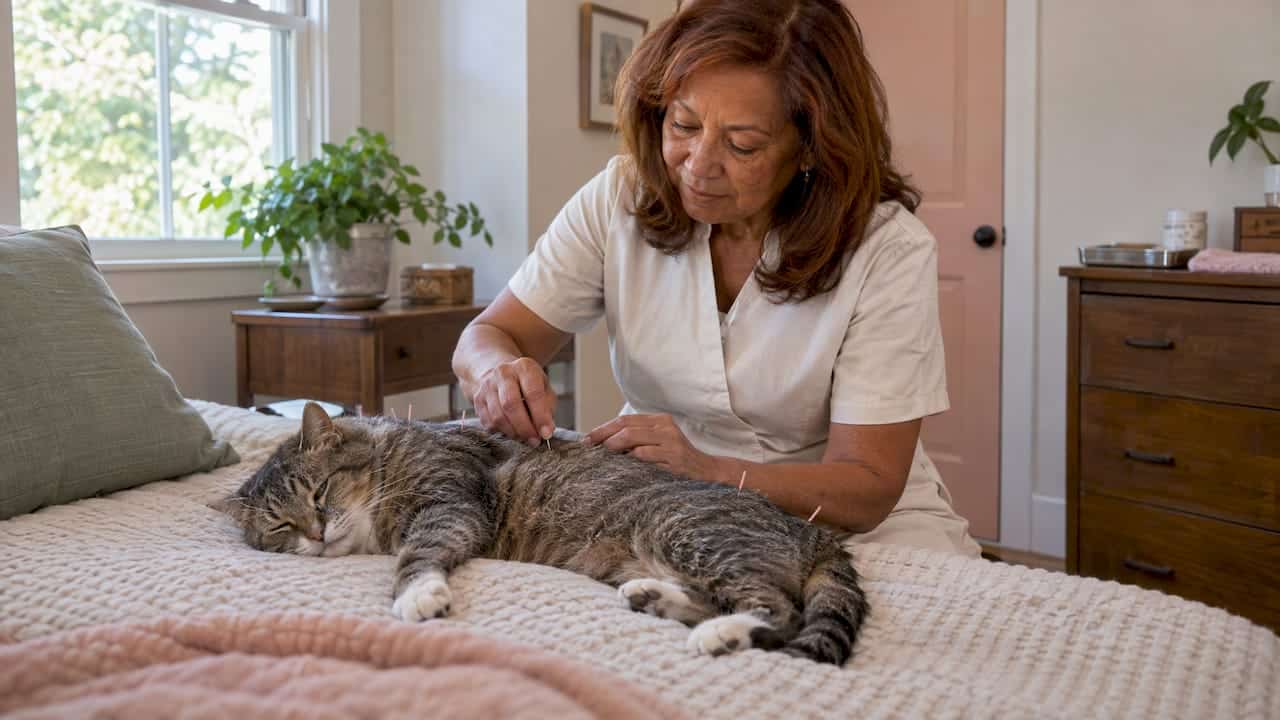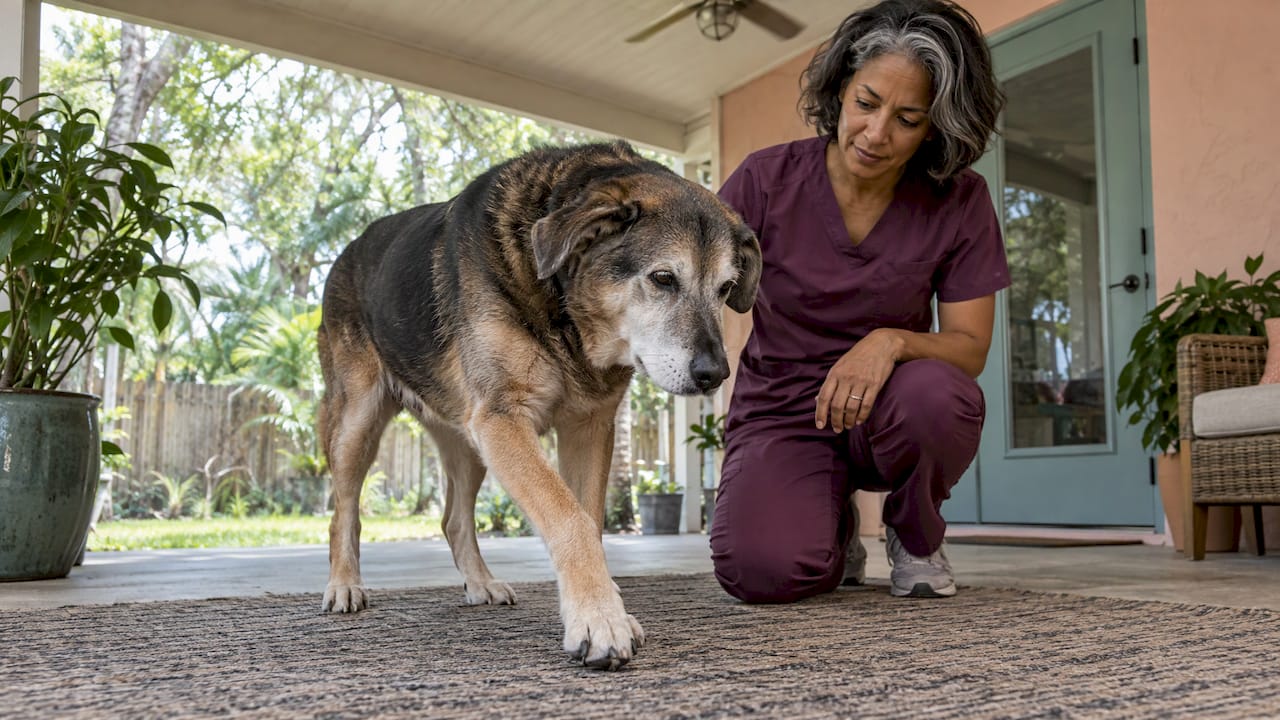
Your dog does not experience a 50°F morning or a muggy 90°F afternoon the way you do, and a senior dog with stiff joints experiences both differently again. Heat is the faster danger, because dogs cool themselves mostly by panting. Cold is the quieter one, because it settles into aging joints and makes every step harder. The good news is that you can read your dog’s signals, adjust the day around them, and know exactly when to act. And for dogs who struggle with car rides and waiting rooms, we bring integrative care to the living room, so comfort does not depend on a stressful trip.
TL;DR
- Tolerance is personal: size, coat, age, weight, and health conditions all change how your dog handles heat and cold.
- Heat is the bigger emergency. Heatstroke generally begins when body temperature reaches 105°F, and it needs a veterinary hospital right away.
- Cold hits seniors and arthritic dogs hardest, through slipping, stiffness, and trouble holding body heat.
- Warm, dry bedding and short, well-timed outings do more for a senior dog than any gadget.
- If your dog finds travel stressful, in-home acupuncture, laser, and rehabilitation can ease the stiffness that weather makes worse.
Table of Contents
- Why dogs handle heat and cold differently than you do
- How to tell if your dog is too hot
- How to tell if your dog is too cold
- Numbers worth knowing
- When heat or cold is an emergency
- What to do in the first minutes
- Heat and cold for aching joints
- Comfort routines for senior and disabled dogs
- Why weather matters more when your dog hurts
- Care that comes to your dog
- What a visit looks like and costs
- Our perspective
- FAQ
- Sources
Why dogs handle heat and cold differently than you do
There is no single temperature that is safe for every dog. According to the American Veterinary Medical Association, short-nosed and overweight dogs struggle more in heat, while small, thin-coated, very young, and very old dogs struggle more in cold and can get frostbite.
Heat is hard on dogs because of how they cool down. Cornell’s veterinary college explains that dogs have sweat glands only on their paws, so they rely mainly on panting. Short-muzzle dogs pant less efficiently. Cornell also lists elderly, overweight, thick-coated, and dark-coated dogs, and dogs with heart or breathing conditions, as higher-risk for heatstroke.
Cold works the other way. The AVMA’s cold weather guidance notes that diabetes, heart disease, kidney disease, hormonal imbalance, old age, and very young age can all make it harder for a dog to regulate body temperature.
So the same afternoon can be pleasant for a young Labrador and risky for your fourteen-year-old terrier with a heart murmur. A few things shift the line for your own dog:
- Age. Puppies and seniors both regulate temperature less well.
- Coat and color. Thick or dark coats hold heat; thin or short coats lose it.
- Weight and body condition. Extra weight hurts in heat, and being too thin hurts in cold.
- Health. Heart, kidney, breathing, and hormonal conditions narrow the comfortable range.
- Humidity and acclimation. The USDA’s temperature technical note lists humidity above 70% and lack of acclimation among temperature-stress risk factors.
That last point matters in a humid place like Tampa, where a dog who is perfectly fit on a dry day can struggle when the air is thick.
How to tell if your dog is too hot
You know your dog’s normal better than anyone. Watch for changes from it.
Cornell lists heavy panting, seeking shade, whining, reluctance to play, and drooling as early signs of overheating. The AVMA adds anxiety or weakness, reduced responsiveness, and discolored, dry, or sticky gums to the heat warnings.
Senior dogs often show these signs more subtly. A dog who simply lies down on the walk and will not budge, or who pants hard after a short stroll, is telling you something. Do not push through it.
How to tell if your dog is too cold
Cornell’s winter safety guidance lists these cold-weather behaviors: shivering, whining or barking, a tucked tail or hunched posture, lifting paws, and reluctance to walk. Prolonged exposure can cause frostbite or life-threatening hypothermia.
For a dog with arthritis, reluctance to walk on a cool morning may not be about the temperature at all. It may be stiffness. That overlap is why it helps to watch the whole pattern: does your dog hunch, shiver, and seek a warm spot, or does he loosen up after a few minutes of moving? Stiffness that eases with movement points to joints. Shivering and a hunched posture point to cold.
Numbers worth knowing
Symptoms are the first clue, and a measured temperature is the clearest. These figures come from veterinary and first-aid sources:
| Reading or condition | What it means | Source |
|---|---|---|
| 100.5–102.5°F | Normal body temperature range for a dog | Cornell |
| 105°F or higher | Heatstroke generally occurs; a medical emergency | Cornell |
| Below 98.5°F | One of the signs of hypothermia, along with a slow heart rate and pale or blue gums | American Red Cross |
For housing, the USDA’s technical note for regulated dog facilities says indoor or sheltered temperatures must not stay below 45°F for more than four consecutive hours, with a 50°F minimum for vulnerable or unacclimated dogs, and must not exceed 85°F for more than four consecutive hours. It is written for kennels and breeders, not family homes, but it shows how seriously temperature duration is taken. The same note says elderly, sick, very young, and cold-sensitive dogs need at least 50°F indoors.
So is 60 degrees in the house too cold? For most healthy dogs, no. For a thin, short-coated, or arthritic senior, a bed in a draft-free spot with a blanket is the kind of change that helps, and your dog’s behavior is the best guide.
When heat or cold is an emergency
Heatstroke is not a problem to watch at home. Cornell calls it a medical emergency because it can damage organs and be fatal. Go to a veterinary hospital right away if you see vomiting, bloody diarrhea, weakness, confusion, seizures, collapse, or continuing heavy panting and drooling.
For cold, the AVMA says muscle stiffness, shallow slow breathing, or collapse are signs of severe hypothermia that need immediate veterinary care. The Red Cross lists a body temperature below 98.5°F, a slow heart rate, pale or blue gums, dilated pupils, wobbliness, a weak pulse, or unconsciousness, and says to get the dog to a veterinary hospital immediately.
Frostbite is easy to miss. Cornell notes that it may be hard to assess at first and that damage can take days to become clear, so a dog who has been out in severe cold deserves a veterinary check even if he looks fine.
What to do in the first minutes
If your dog is too hot
- Move him indoors to air conditioning or into shade and offer water.
- Wet him with cool water and put him in front of a fan. Cornell says double-coated dogs should be wet down to the skin.
- If you suspect heatstroke, start cooling right away and keep going on the way to the veterinary hospital, with the car’s air conditioning on. Cornell’s heatstroke page describes this approach.
One caution from a veterinary hot-weather guide: do not use ice packs or cold water in a way that restricts blood flow. Cool, not icy, is the aim.
If your dog is too cold
- Bring him to a warm, dry area.
- Dry him off if he is wet and wrap him in blankets or towels.
- If you suspect hypothermia or frostbite, call a veterinary hospital right away.
Skip heating pads and hot-water bottles on a chilled dog, since direct heat can burn skin that is cold and less sensitive.
Heat and cold for aching joints
Many owners searching this topic are really asking a second question: should I use heat or cold on my dog’s sore joints? The answer depends on what is going on in the joint, so it is worth a quick conversation with your veterinarian first.
PetMD explains that a warm compress dilates blood vessels and improves circulation, and that it is commonly used for dogs with arthritis or recovering from injury or surgery. Cold is generally used for fresh swelling or heat in a joint. In both cases, use a thin cloth between the pack and the skin, keep sessions short, and never leave your dog unattended with it.

Gentle warmth and gentle movement work together. Our guide to senior dog mobility exercises shows how to build a routine, and joint range exercises explains how to stop at the first sign of pain. If you want to understand what is causing the stiffness in the first place, start with arthritis relief for dogs.
Comfort routines for senior and disabled dogs
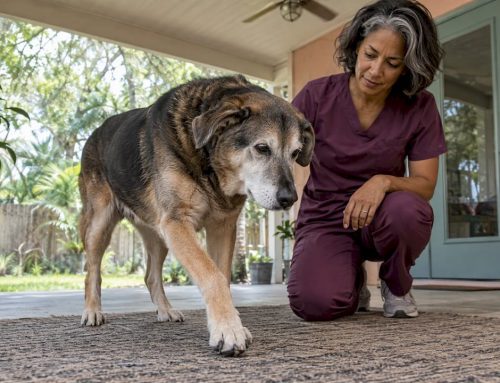
The AVMA points out that older or arthritic pets may struggle on snow and ice and slip or fall more easily, and that short-legged dogs can cool faster because their bodies are close to the ground. Florida rarely has ice, but cool tile floors and wet grass on a winter morning can have the same effect on a dog with weak hind legs.
In hot, humid weather
- Walk at the coolest part of the day, and skip the hottest hours, as Cornell advises.
- Keep shade and fresh water available, and never leave a dog in a parked car.
- Shorten walks and add rest stops for short-nosed and overweight dogs, as the AVMA suggests.
- Stay indoors in extreme heat or humidity.
In cool weather
- Shorten walks in very cold weather and check paws for cracked or bleeding pads, as the AVMA recommends.
- Give a thin-coated or older dog a thick, dry bed away from drafts.
- Add rugs or runners over slick floors so stiff legs have traction. Our home safety guide for senior dogs has more ideas.
If pain makes your dog hesitant in any weather, it helps to look at the bigger picture. Our pain relief guide for senior dogs walks through the options.
Why weather matters more when your dog hurts
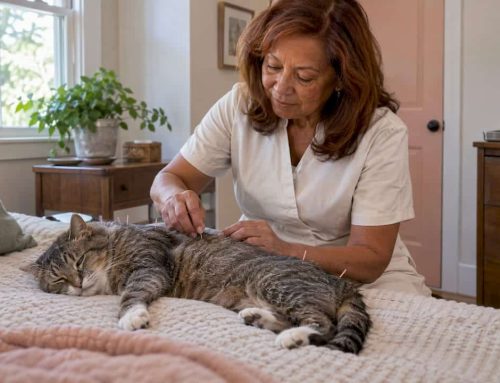
In Traditional Chinese Veterinary Medicine, we think of the body’s energy, or Qi, as flowing along pathways called meridians, a bit like a highway system. When an older dog is stiff, that traffic can slow down, and cold and damp conditions can make that feel worse. That is the lens we use for chronic pain: we want the traffic to move more freely so your dog can move, rest, and enjoy the day in comfort.
That is why a dog who seems fine in July can dread a cool, damp morning, and why helping the joints often helps the whole routine of a day.
Care that comes to your dog
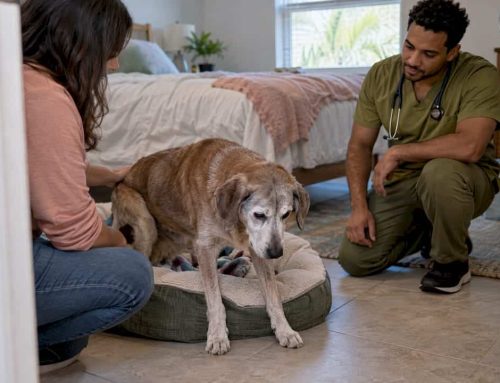
A car ride in summer heat, a cold waiting room, or a slippery clinic floor can be hard on a senior or disabled dog, and just as hard on you. We are a mobile practice in South Tampa, and our care happens in the place your dog already knows. We offer acupuncture and acupressure, rehabilitation therapy, laser treatments, herbal therapy, and food therapy, all designed to complement the care from your regular veterinarian.
Not sure whether your dog needs a visit? A short telemedicine consultation can help you decide between home care and an in-person visit.
What a visit looks like and costs
Our published prices are on our cost of services page. The initial assessment and acupuncture with a technician starts at $430, and the technician mobile fee is $60. Laser treatments run $45 to $120 per treatment, electroacupuncture is $30, and at-home rehabilitation packages range from $85 to $918.
If your dog is stiff, anxious about the car, or struggling in the weather, we would be glad to bring care to your door. You can see everything we offer on our home page.

Our perspective
When we sit on the floor beside an older dog, the weather is rarely the only issue. It is the weather plus a body that has less reserve than it used to. Heat asks more of a heart and lungs that are tired. Cold asks more of joints that are already sore.
That is why we do not treat temperature as a separate problem from comfort. We look at how your dog moves, rests, eats, and copes in the house you share, and we build a plan around it. Acupuncture, laser, rehabilitation, herbal therapy, and food therapy are tools we use to help a dog feel more like himself, and we work alongside your regular veterinarian so nothing is done in isolation.
Doing this at home matters. A calm dog on his own bed tells us far more than a nervous one on a clinic table, and you are spared the car ride. We believe good care for an aging pet should feel gentle for both of you.
Pet Acupuncture & Wellness
FAQ
Is 60 degrees in the house too cold for dogs?
For most healthy dogs, 60°F indoors is comfortable. Very young, very old, thin, short-coated, or sick dogs are more sensitive, and the USDA’s technical note for regulated facilities sets a 50°F minimum for such dogs. Give a senior dog a dry, draft-free bed and watch for shivering or a hunched posture.
How do I know if my dog is too hot or too cold?
Too hot looks like heavy panting, drooling, seeking shade, whining, or reluctance to play. Too cold looks like shivering, a tucked tail, lifting paws, and reluctance to walk. A measured temperature is the clearest check: normal is 100.5–102.5°F, and 105°F or higher is heatstroke territory that needs a veterinary hospital immediately.
Should I use heat or cold on my arthritic dog?
Warmth is commonly used for stiff, chronic arthritis, while cold is generally used for fresh swelling or a joint that feels hot. Always use a cloth barrier, keep sessions short, and stay with your dog. Check with your veterinarian before starting, especially after surgery or injury.
Can a mobile vet help if my dog hates car rides?
Yes. We bring acupuncture, laser, rehabilitation, and other integrative therapies to your home in South Tampa, so your dog is spared travel and waiting rooms. Our care is designed to complement your regular veterinarian’s.
Sources
- American Veterinary Medical Association: Walking or running with your dog
- American Veterinary Medical Association: Cold weather animal safety
- USDA APHIS: Temperature requirements for dogs
- Cornell University: Summer heat safety tips for dogs
- Cornell University: Winter safety tips
- Cornell University: Heatstroke, a medical emergency
- American Red Cross: Hypothermia in dogs
- PetMD: Can I use a warm compress on my dog?
- Chewy: How hot is too hot for dogs?