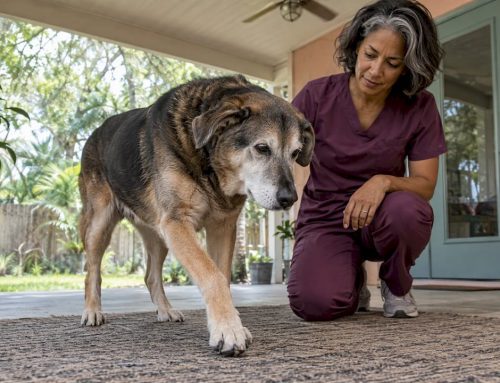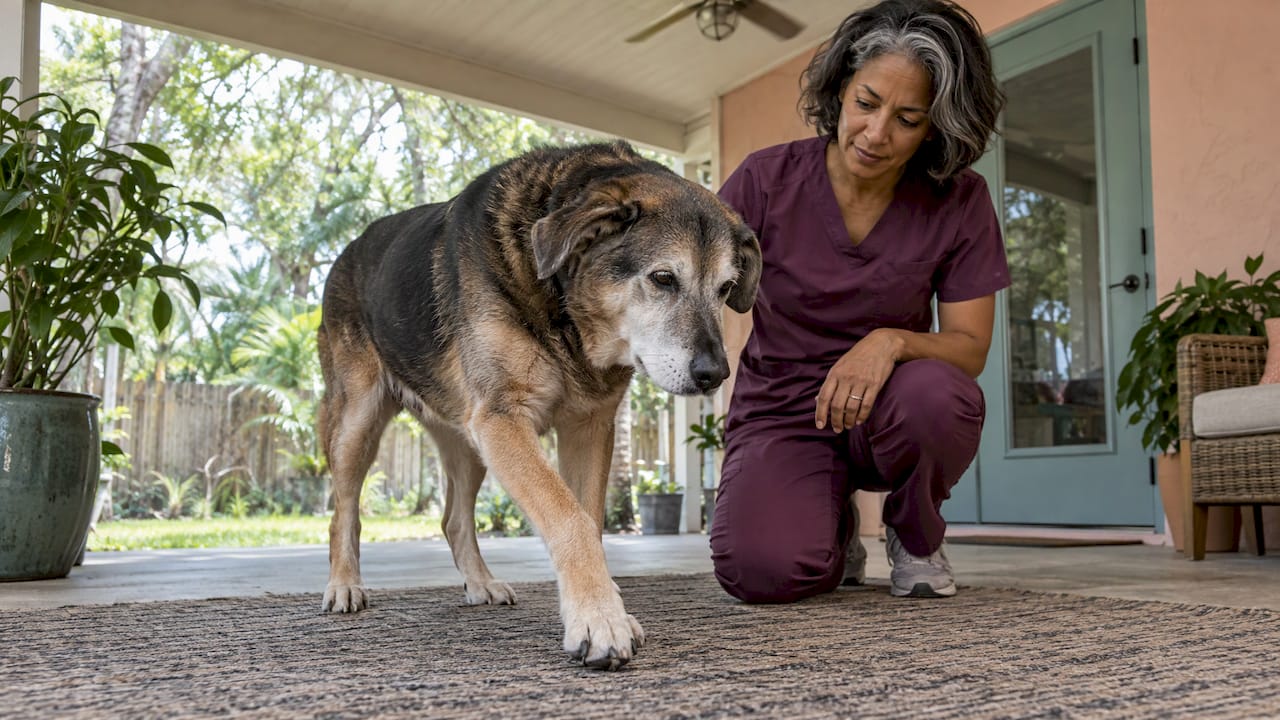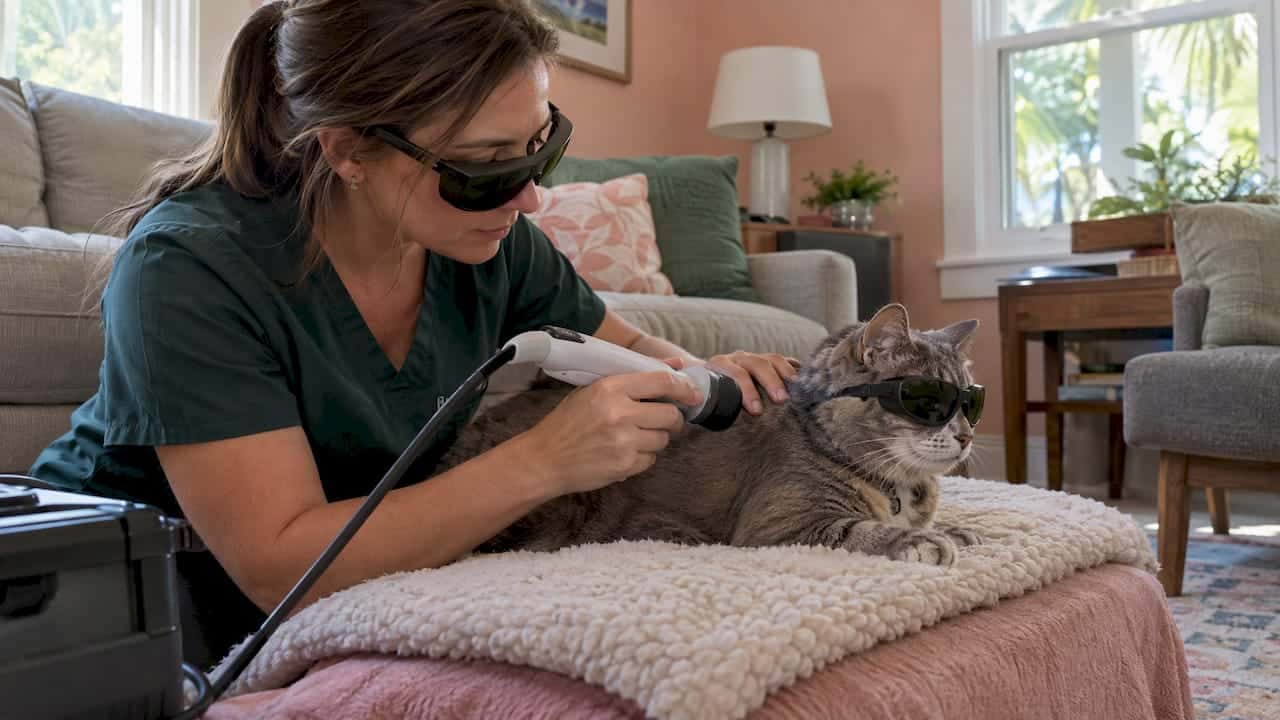
Integrative care for a disabled dog means combining conventional veterinary medicine with therapies such as acupuncture, rehabilitation, laser therapy, herbal medicine and food therapy, and building one plan around your dog’s body, your home and your family’s routine. For a dog who struggles with the car, the waiting room or slick clinic floors, the kindest version of that plan happens at home. That is how we work in South Tampa: we come to you, we plan alongside your regular veterinarian, and your dog stays on the couch, the dog bed or the rug they trust.
This guide explains what integrative care is, which therapies belong in a plan for a dog with limited mobility, how to set up your home, what a visit looks like and what it costs.
TL;DR
- Integrative care pairs conventional treatment with acupuncture, rehabilitation, laser, herbs and nutrition, and it is designed to work alongside your regular vet, not replace them.
- Veterinary guidance for senior dogs calls for pain and mobility care that is integrative and multimodal, meaning several tools working together.
- Home visits remove the car ride, the slick floors and the waiting room, which are the hardest parts of care for many disabled dogs and their owners.
- Our published prices start at $430 for the initial assessment and acupuncture with a technician, plus a $60 technician mobile fee.
- Small home changes, such as better footing and a fitted lifting harness, make every treatment work harder for your dog.
Table of Contents
- What Integrative Care Means for a Disabled Dog
- The Therapies in a Home-Based Plan
- Why the Home Setting Matters So Much
- Setting Up Your Home for a Dog With Limited Mobility
- How Integrative Care Works With Your Regular Veterinarian
- What a Home Visit Looks Like
- Published Prices for Integrative Care in South Tampa
- Our Perspective: Comfort Is Part of the Treatment
- Book Care for Your Dog at Home
- FAQ
- Sources
What Integrative Care Means for a Disabled Dog
The MSD Veterinary Manual describes integrative veterinary medicine as the use of complementary therapies together with conventional care. It notes that combining it with rehabilitation can offer nonsurgical options for neurologic and orthopedic problems. In plain terms, nothing is either/or. Your dog’s regular veterinarian keeps managing diagnoses, bloodwork and prescriptions. Integrative care adds more ways to ease pain, rebuild strength and keep your dog moving.
“Disabled” covers a lot of ground. You might be caring for a dog with:
- Hip or elbow arthritis that makes stairs and slippery floors frightening
- A spinal condition, such as a disc problem, that affects the hind legs
- Weakness or wobbliness after a neurologic event
- An amputated limb, so the other three legs carry extra load
- Age-related stiffness, with or without vision or hearing loss
- Anxiety that makes any trip to a clinic an ordeal
Each of these dogs needs a different plan. What they share is that the plan has to be gentle, repeatable and realistic for the person caring for them.
The Therapies in a Home-Based Plan
We treat dogs and cats in their homes, and the services below are the ones we offer for dogs with mobility and comfort needs. Which ones make up your dog’s plan depends on a full assessment.
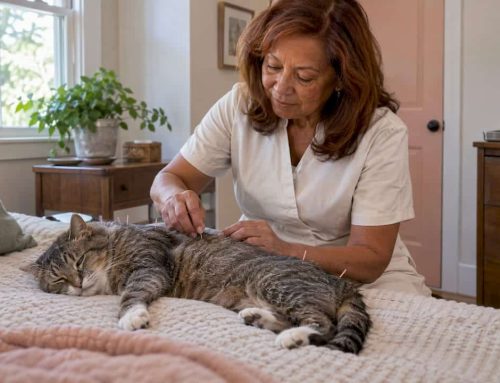
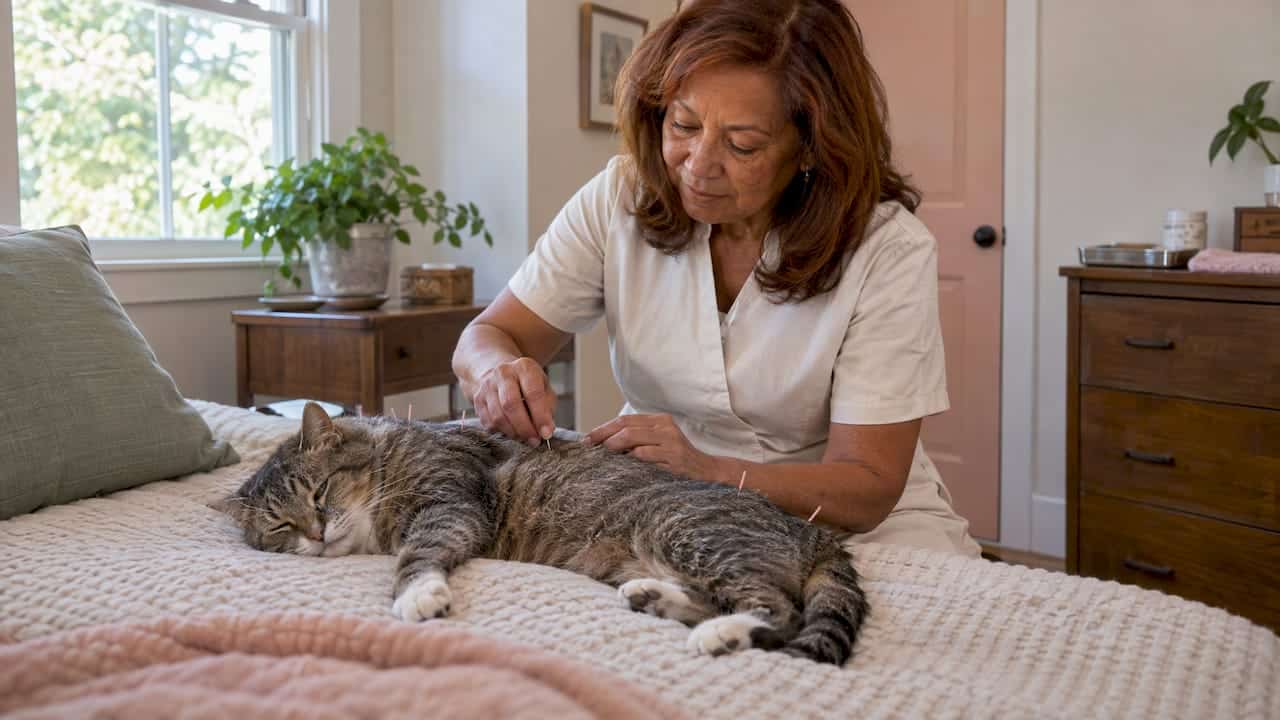
Acupuncture, Electroacupuncture and Acupressure
In Traditional Chinese Veterinary Medicine (TCVM), the body’s energy, called Qi, travels along pathways called meridians. Think of meridians as a highway system: when traffic flows, the body is comfortable and moving freely, and when there is a blockage, you see stiffness, pain or reluctance to move. Yin and Yang describe balance, like shade and sunlight on the same hillside. Acupuncture places very fine needles at specific points to restore that flow.
Most dogs are surprisingly relaxed about it, especially when they are lying on their own bed. Electroacupuncture adds a mild electrical stimulation to selected needles, which can be a useful option for muscles that have gone weak or sore. Acupressure uses finger pressure on the same points. It suits dogs who are sensitive to needles, and it gives families something gentle to understand and appreciate during recovery.
A dog with chronic stiffness often needs a short series of sessions before you can judge how well the approach suits them, and we adjust the schedule as your dog responds.

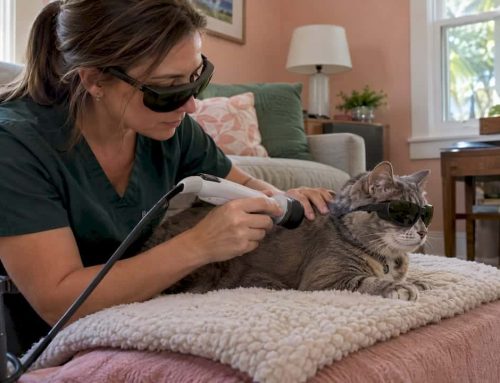
Laser Therapy
Laser therapy, also called photobiomodulation, uses light applied over the skin to support tissue comfort and recovery. A session is quiet, painless and quick, which makes it a good match for dogs who dislike being handled for long. AAHA’s senior-care guidance lists photobiomodulation among the rehabilitation options for senior dogs with chronic musculoskeletal disease.
Rehabilitation at Home
Rehabilitation is the part of care that helps your dog use their body better: controlled exercises, gentle strengthening, balance work and guidance on safe movement. The same AAHA guidance names exercise therapy, hydrotherapy and manual therapy alongside acupuncture in its list. Doing this at home has a real advantage, because we can build the exercises around your actual floors, your actual stairs and the spots where your dog really struggles. For a deeper look, see our guide to dog physical therapy at home and our overview of rehabilitation equipment.
Herbal Therapy and Food Therapy
In TCVM, herbs and food are treated as medicine. Herbal formulas are chosen to match the pattern we see in your dog, and food therapy looks at what your dog eats in terms of the body’s warmth, moisture and energy. If your dog needs help with weight or appetite, food therapy fits naturally into the same plan. You can read more on our pages for herbal therapy and food therapy, or browse our dog herbal remedies guide.
Safety comes first with anything your dog swallows. Tell us and your regular veterinarian about every medication, supplement and treat your dog receives, so that nothing is combined without a veterinarian looking at the whole list.
Telemedicine for Between-Visit Questions
Some weeks your dog does not need a visit, only an answer: is this new limp worth worrying about, should you adjust the routine, how do you handle a flare-up? Our telemedicine service gives you a way to ask. Our guide on using telemedicine to decide between home care and a clinic explains how it works.
Why the Home Setting Matters So Much
For a disabled dog, the trip is often harder than the treatment. Getting into a car, walking across a slick lobby and waiting beside unfamiliar animals can raise a dog’s stress and strain painful joints. It strains you too, especially if you are lifting a heavy dog.
AAHA’s guidance on humane handling advocates least-stressful handling and calm environments and notes that forceful restraint can work against good medical and emotional outcomes. Behavior specialists make the same point from the owner’s side: AVSAB’s guidance says that setting up a good visit starts at home, with comfort, favorite treats and advance information about your dog’s sensitive spots. A home visit starts from that ideal. The calm environment is already there.
There is also a practical benefit. A review of canine physiotherapy research highlighted that owner adherence is of utter importance and that minimizing the time that treatments and visits take may help owners stick with long-term care. When treatment arrives at your door, the plan is easier to keep.

Setting Up Your Home for a Dog With Limited Mobility
Treatment works best when your dog’s daily life supports it. AAHA’s senior-care guidance lists home modifications that make mobility and comfort easier, and they are a good checklist to start with:
- Ramps for the car, couch or steps
- Rugs or yoga mats on slick floors for better footing
- A fitted, padded harness for lifting and supporting your dog
- Toe grips, boots or socks for foot stability
- An appropriate bed that is easy to get into and out of
- Hazard checks for stairs or pools, especially if your dog has limited vision or hearing
South Tampa homes often have tile or hardwood throughout, which is exactly where dogs slip. Covering the main routes between the bed, the water bowl and the back door is one of the quickest changes you can make. We cover more ideas in five home changes that protect your senior dog and in our guide to mobility aids for dogs.
Routines matter as much as equipment. Dogs with disabilities lean on predictability, so keep feeding times, rest spots and walking routes steady. If a move is on the horizon, a plan for moving with pets helps you keep your dog’s routine and resting places familiar through the change.
How Integrative Care Works With Your Regular Veterinarian
We work collaboratively with your dog’s regular veterinarian to complement existing care. In practice, that means you keep your primary vet for vaccines, diagnostics and prescriptions, and we add the integrative pieces. Veterinary guidance supports the layered approach: the MSD Veterinary Manual states that chronic pain treatment is rarely monomodal and requires frequent reassessment. That is the logic of integrative care. A dog with arthritis might use a veterinarian-prescribed medication, a weight plan, home ramps, laser sessions and acupuncture, each doing a different job.
For questions on pain medication choices at home, you may find our guides to integrative pain management for dogs, non-opioid pain relief and pain relief for senior dogs helpful.
If your dog has a sudden change, such as loss of the use of the back legs, collapse, severe pain, trouble breathing or a refusal to eat or drink, contact your regular veterinarian or an emergency hospital right away. Integrative care is for ongoing comfort and function, not emergencies.
What a Home Visit Looks Like
Every plan starts with an assessment: your dog’s history, what your regular vet has found, how your dog moves across your floors, where they hesitate, and what a good day looks like for your family. From there we build a plan and a schedule. A typical visit might include a gentle exam, acupuncture or laser, a few guided exercises, and practical advice on the footing, bedding and routines in the room where your dog spends the most time.
Your dog sets the pace. Dogs can rest between steps, stay on their own bed, and have you beside them throughout. For a nervous dog, that makes the difference between a treatment that is tolerated and one that is actually calming. Our preparation guide for low-stress mobile vet visits walks through the 24 to 48 hours beforehand.
Published Prices for Integrative Care in South Tampa
These are the prices we publish on our cost of services page. Check the page for the current list.
| Service | Published price |
|---|---|
| Initial assessment and acupuncture with a technician | from $430 |
| Technician mobile fee | $60 |
| Electroacupuncture | $30 |
| Laser treatment | $45 to $120 per treatment |
| Vitamin B12 injection | $31.50 |
| At-home rehabilitation packages | $85 to $918 |
Acupressure, aquapuncture, herbal therapy, food therapy, telemedicine, injectable and traditional medications do not have a published price here. Ask us about them when you book, and we will go over what fits your dog’s plan.
Our Perspective: Comfort Is Part of the Treatment
We started this practice because we kept meeting families whose dogs needed care but could not easily get to it. A big dog with weak hind legs does not want to be lifted into a car. An anxious dog does not heal well in a waiting room. A tired owner should not have to choose between their dog’s comfort and their own back.
Our view is that for a disabled dog, where care happens is part of the care. At home, your dog is relaxed, we can see how they actually move on your floors, and the recommendations we give fit your real life, not a generic handout.
Integrative medicine gives us more ways to help. Acupuncture and electroacupuncture support comfort and movement. Laser therapy fits dogs who do not tolerate long handling. Rehabilitation rebuilds strength in the places where your dog needs it. Herbs and food therapy support the whole body. All of it is designed to sit beside your regular veterinarian’s care.
The goal is simple: more good days, more movement, and less worry for everyone who loves your dog.
Pet Acupuncture & Wellness
Book Care for Your Dog at Home
If your dog has mobility problems, chronic pain or a hard time with clinic visits, we bring acupuncture, laser therapy, rehabilitation, herbal therapy, food therapy and telemedicine to your door in South Tampa. Your first visit is the initial assessment and acupuncture with a technician, from $430, plus the $60 technician mobile fee.
See the full list of services and published prices on our cost of services page, read about our rehabilitation therapy, or start from our home page to book.
FAQ
What is integrative care for a disabled dog?
It is a plan that combines conventional veterinary medicine with therapies such as acupuncture, laser, rehabilitation, herbs and nutrition. The MSD Veterinary Manual describes it as the use of complementary therapies together with conventional care. Your regular veterinarian stays involved, and we work with them.
Do I need to stop my dog’s current medications?
No. Integrative care is designed to complement what your veterinarian has prescribed. Never stop or change a prescribed medication on your own. Give us the full list of medications, supplements and treats, and we will plan around it together with your regular vet.
How many visits will my dog need?
It depends on your dog’s condition, how long the problem has been present and how your dog responds. Many plans start with a short series of sessions and then move to a maintenance schedule. We adjust as we reassess, and telemedicine can cover questions between visits.
Can a dog with severe anxiety still be treated?
Yes, and that is a big reason families choose home visits. Your dog stays in familiar surroundings with you nearby, and treatments like laser and acupressure are quiet and gentle. Our low-stress visit preparation guide explains how to get ready.
Sources
- Overview of Integrative Veterinary Medicine, MSD Veterinary Manual
- Pain Management, 2023 AAHA Senior Care Guidelines for Dogs and Cats
- Chronic Pain in Animals, MSD Veterinary Manual
- Humane Restraint of Animals, AAHA
- Starting Off on the Right Paw, AVSAB
- Physiotherapeutic Strategies and Their Current Evidence for Canine Osteoarthritis, PMC
- Moving With Pets: A Plan for Cats, Dogs and Small Animals