If your older cat hesitates before a jump she used to take without thinking, or skips the bed she has slept on for years, she is telling you something. Mobility support for a senior cat comes down to three things: a home set up so she never has to leap or climb, a veterinary exam to find out what is behind the slowing down, and a gentle, vet-guided plan (movement, pain relief and, for many cats, acupuncture or rehabilitation) that keeps her comfortable. This guide walks through each one, including how to choose between ramps and stairs, in plain steps you can start this week.
TL;DR
- Reduced jumping, trouble with stairs, and litter box accidents are common signs of pain or stiffness in older cats, not just “getting old.”
- Sudden dragging of the back legs, collapse, or inability to stand is an emergency: go to an emergency veterinarian right away.
- Low-sided litter boxes, supplies on every floor, and carpeted ramps or steps are the simplest changes with the biggest payoff.
- A vet should guide any exercise or rehabilitation plan, and pain care often combines medication, weight management, acupuncture and rehab.
- If car rides and clinic waiting rooms stress your cat, we bring acupuncture and rehabilitation to your living room in South Tampa.
Table of Contents
- Signs your older cat is struggling to move
- When it is an emergency and when it can wait for an appointment
- Why older cats slow down
- Set up your home so she never has to leap
- Ramps or stairs? Choosing for your cat and your furniture
- Gentle movement and play
- Rehabilitation for senior cats
- Our perspective: comfort first, and the whole cat
- What a multimodal plan can include
- Ready for care at home?
- FAQ
- Sources
Signs your older cat is struggling to move
Cats are experts at hiding discomfort. Veterinary pain guidance points out that cats cannot tell us where it hurts and instinctively mask it, so vets rely on the behavior changes owners notice at home. That makes you the most important diagnostic tool your cat has.
The AAFP senior care guidelines list changes such as reduced jumping, difficulty with stairs, house-soiling, and changes in how a cat likes to be petted. In everyday terms, watch for:
- Pausing, crouching, or wiggling before a jump, or choosing a lower perch than before
- Taking stairs one at a time, or no longer coming to find you on another floor
- Missing the litter box, or perching on the edge instead of stepping in
- Less grooming, especially along the back and hips, which can leave a matted or greasy coat
- Flinching, swishing the tail, or walking away when you touch her back or hips
- Sleeping more, hiding more, or sleeping in a new spot closer to her food and box
None of these are just age. The American Veterinary Medical Association stresses that age is not a disease, and that exams can catch problems such as arthritis, kidney disease, or cognitive dysfunction before they become serious. Write down what you see and take short phone videos of her walking and jumping. Footage of a stiff gait at home is often more useful to your vet than anything seen in an anxious exam room.
If you want a deeper look at the subtle cues, our guide on how not to miss the signs of pain in a senior dog or cat is a good companion read.
When it is an emergency and when it can wait for an appointment
Slow, gradual stiffness deserves a prompt appointment. Sudden changes do not wait.
Veterinary guidance says that dragging the hind legs, collapse, or being unable to stand needs immediate emergency assessment, because conditions such as blood clots can cause abrupt hind-limb paralysis. If your cat cries out, is cold in the back legs, or suddenly cannot use them, do not wait to see if she improves overnight. Head to the nearest emergency veterinary hospital.
For a cat who is walking but struggling, the same source advises you to monitor for changes, avoid poking or testing painful limbs yourself, and contact your veterinarian promptly. Handling a sore joint to “see if it hurts” can hurt her, and it can make her wary of being touched.
A few practical notes while you wait for the visit:
- Keep her to one floor with food, water, a litter box and a warm bed all within a few steps.
- Do not give human pain relievers. Many are dangerous to cats, and only your vet should choose and dose pain medication.
- Keep notes: when she eats, how often she uses the box, and which movements look hardest.
Why older cats slow down
The most common culprit is degenerative joint disease, or arthritis. The AAFP and FelineVMA senior care guidance notes that studies have found as many as 92% of cats show signs of DJD, which is why so many “lazy” senior cats are actually sore ones.
Muscle loss plays a part too. Researchers writing about feline musculoskeletal ageing note that aging brings loss of lean muscle (sarcopenia), but that it is often complicated by joint disease, which makes diagnosis tricky and calls for careful professional assessment. A cat who looks thin and wobbly may have both problems at once, and each needs a different response.
When does “senior” begin? The FelineVMA guidelines describe cats as senior at 11 years old, and note that because cats age faster than people, a single checkup a year stops being enough at that stage. Many cats begin showing joint changes before that age, so do not wait for a birthday to take stiffness seriously.
Why regular checkups matter more with age
A hands-on exam, weight check and bloodwork give your vet the baseline needed to tell arthritis from kidney disease, thyroid trouble or muscle loss. A general practice that offers regular wellness exams and preventive care is the foundation, and integrative care such as ours is meant to sit alongside it, not replace it.
Set up your home so she never has to leap
Before buying anything, walk through your house at cat level. Where does she need to go for food, water, the box, a warm nap and your company? Every spot that requires a jump or a flight of stairs is a spot to fix.
The Cornell Feline Health Center recommends litter boxes with lower sides, resources on every floor, carpeted steps or ramps, and warm, soft resting places for older cats. Here is how that looks in a typical Tampa home with a mix of tile, wood and carpet:
- Litter boxes: Put one on every floor so she does not have to climb stairs to reach it. Choose a low-sided or low-entry box. PetMD notes that senior cats do better with lower sides or entryways. A plain storage tub with one side cut down works well.
- Food and water: Offer them in more than one place, as Cornell suggests, so she does not have to travel far. Some cats prefer slightly raised bowls, according to PetMD, so try one and watch her posture.
- Traction: Slick tile and hardwood are hard on weak hind legs. Runners, yoga mats or low-pile rugs along her usual routes give her paws something to grip.
- Warm resting spots: Soft, supportive beds placed where she already likes to be. Florida homes can run cool in air conditioning, and stiff joints often feel better in a warm, draft-free spot. Choose a bed with a low entry, not a tall bolster she must climb over.
- Nails and coat: Overgrown nails can make traction worse, and a cat who cannot groom her back may need gentle brushing from you.
For cats who are also losing weight or muscle, nutrition is part of mobility. Our guides on the best diet for senior cats and what to feed an older cat that is losing weight cover what to ask your vet.
Ramps or stairs? Choosing for your cat and your furniture
These are the questions we hear most: whether to buy a ramp, what kind of cat stairs work beside a bed, and which one is better. Veterinary guidance agrees that ramps and steps help cats reach favorite spots, as long as they are covered with carpet for firm footing so she does not slip. The goal is to reach a high resting place without a risky jump.
Beyond that, the choice depends on how your cat moves. Our practical rules of thumb:
| Situation | Usually a better fit | Why |
|---|---|---|
| Weak or wobbly hind legs, or a cat who stumbles | Ramp with a gentle slope | No lifting of the back end, one smooth surface |
| Stiff but still steady cat, short rise (a couch) | Wide, shallow steps | Compact, easier to fit beside furniture |
| Tall bed or window perch | Longer ramp or a staged set of two low steps | A steep short ramp feels like a slide |
| Cat who is unsure of new objects | Whichever one she will actually walk on | Comfort and familiarity beat design |
What to look for
- Surface: Carpeted or rubberized, never glossy plastic or bare wood.
- Width: Wide enough that her hips do not hang over the edge.
- Stability: It must not wobble or slide when she steps on. Place it against the bed frame or a non-slip mat.
- Height of each step: Low enough that she is not making a mini-jump on each one. Measure the height of your bed first, then divide it.
- Landing at the top: A flat spot where she can step off without hopping.
Teaching her to use it
- Put the ramp or stairs in place for a few days without expecting anything.
- Place a treat or her favorite blanket on the first step, then the second, and so on.
- Let her go at her own pace. Never push or lift her onto it.
- Once she trusts it, move it next to the bed or sofa for real use.
If she refuses it completely, the issue may be pain or fear, not stubbornness. Mention it to your vet.
Gentle movement and play
Rest is not the answer to arthritis. Cats do better when they keep moving within their comfort. The AAFP chronic pain guidance for owners suggests that, if your cat wants to, you offer play at least twice daily, noting that she may only play for a few minutes.
Keep it low-key:
- Drag a wand toy along the floor instead of dangling it high.
- Hide treats or kibble at ground level around the room for a slow “hunt.”
- Stop the moment she looks tired or loses interest. Short and happy wins.
- Skip anything that involves leaping, sharp turns or racing across slick floors.
If she shows no interest in play at all, that is information. Pain suppresses play, and a cat who starts engaging again after treatment is one of the clearest signs the plan is working.
Rehabilitation for senior cats
Feline rehab is real and practical. According to a veterinary nursing overview, rehabilitation for cats can include manual range-of-motion exercises, hydrotherapy and play, and the plan should be formulated by a veterinarian to avoid worsening clinical signs. Land-based work often involves controlled movements such as gentle “bicycling” of the limbs, or guided activities like walking under low poles.

A 2025 review adds an important rule: any rehabilitation program must be guided by a veterinarian so the cat feels better and moves better, and the plan must change if lameness increases or she regresses. That is why we do not recommend copying exercises from a video. A cat with a sore hip and a cat with a spinal problem need very different movements.
Cats are also often better rehab patients at home. There is no carrier, no car, and no strange smells. Our rehabilitation therapy is done on your own floors, with your own stairs and your cat’s actual routes, so we can work on the exact movements she struggles with.
Our perspective: comfort first, and the whole cat
At Pet Acupuncture & Wellness, we see the same story often. A senior cat slows down, her family takes it as age, and months later the litter box habits change. By then, getting her into a carrier and across town is the hardest part of her care. Many of the cats we visit are the ones who would otherwise go without.

We believe mobility support works best when it is layered. Conventional medicine finds the cause and manages pain. Integrative care, including acupuncture, laser therapy, herbs and food therapy, adds comfort and function on top. In Traditional Chinese Veterinary Medicine, we think of the body’s energy, or Qi, traveling along meridians like a highway system. When traffic gets blocked, stiffness and pain appear. Acupuncture aims to get it moving again. You do not need to adopt that view to see the point: a calm cat in her own home is easier to treat, and easier to love through the process.
We work alongside your regular veterinarian, never in place of them. Our plans are shaped around your cat’s health needs and your home, because a cat who lives in a two-story house needs different support than one in a ground-floor condo.
— Pet Acupuncture & Wellness
What a multimodal plan can include
The AAHA senior care guidelines describe pain management as multimodal: pharmaceuticals, nutraceuticals, weight management, acupuncture, physical rehabilitation and environmental modifications can all be part of one plan. No single item does it all, and your cat’s vet decides the mix.
Here is how our services fit into that picture for cats:
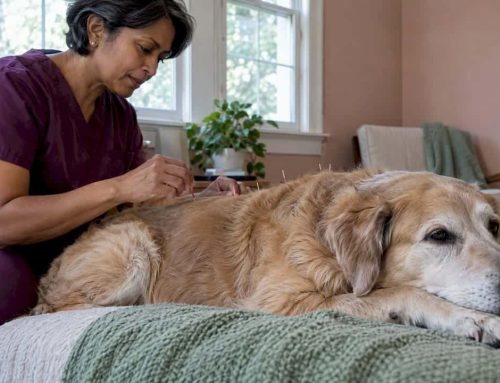
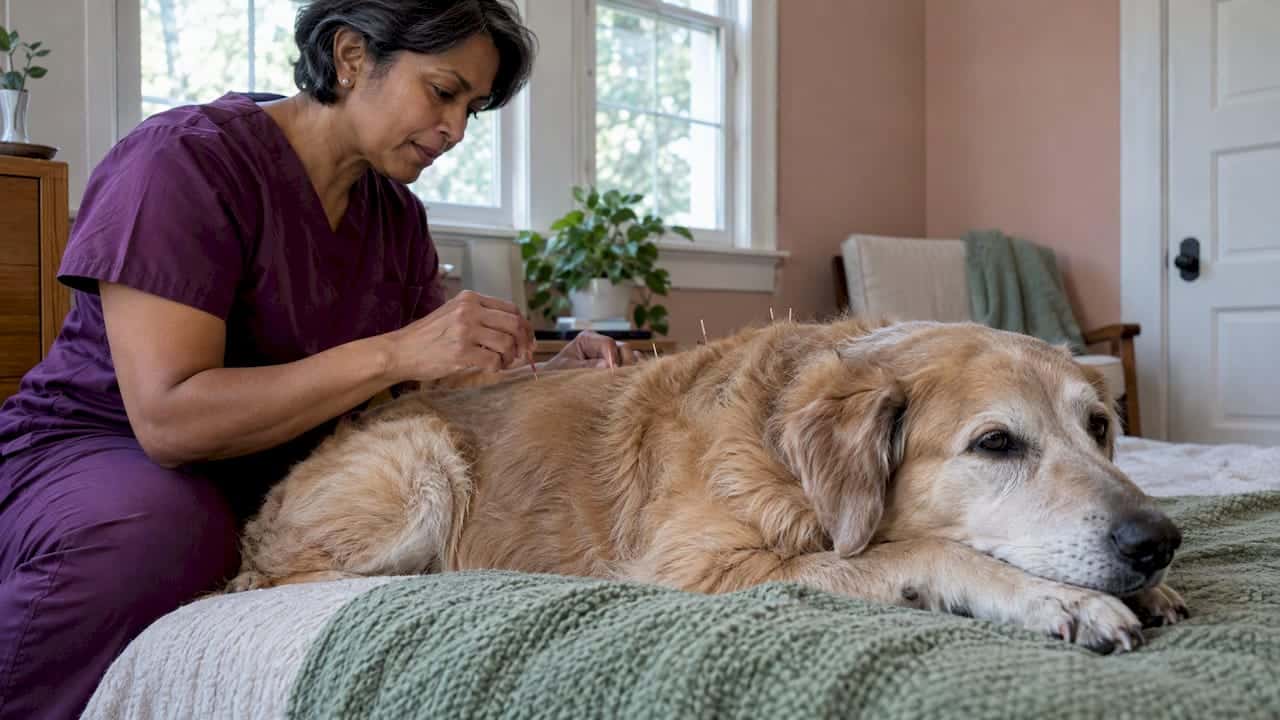
- Acupuncture and electroacupuncture: Fine needles at points chosen for your cat’s pattern. Many cats tolerate it surprisingly well at home. Read more in our guide to at-home acupuncture for senior cats and what to expect in arthritis cases.
- Laser therapy: A painless, short treatment. See laser therapy for cats.
- Herbal and food therapy: Support from the inside, always fitted to the individual cat. Start with our piece on herbal pain relief for senior cats.
- Rehabilitation: Home-based movement plans, as described above.
- Telemedicine: A video visit can help you decide whether home care or a clinic visit makes more sense. See telemedicine for senior pets.
What it costs in South Tampa
Our published prices, listed on our cost of services page, are:
| Service | Price |
|---|---|
| Initial assessment and acupuncture with a technician | from $430 |
| Technician mobile fee | $60 |
| Laser treatment | $45-$120 per treatment |
| Electroacupuncture | $30 |
| At-home rehabilitation packages | $85-$918 |
Packages vary because cats vary. A simple plan for one stiff hip looks very different from a program for a cat with multiple conditions.
Ready for care at home?
If your senior cat is stiff, anxious about travel, or both, we would love to help. We come to your South Tampa home, examine how she moves in her own space, and build a plan that complements your regular vet’s care. You can learn more about our in-home services or read how in-home acupuncture for senior cats skips the clinic stress entirely.
FAQ
What should I do if my elderly cat is struggling to walk?
Call your veterinarian promptly, watch for changes, and avoid testing sore limbs yourself. If she suddenly drags her back legs, collapses or cannot stand, treat it as an emergency and go to an emergency veterinary hospital immediately.
Is a ramp or stairs better for an older cat?
It depends on how she moves. A gently sloped, carpeted ramp suits cats with weak hind legs, while wide, shallow, carpeted steps work for stiff but steady cats and short rises. Whichever you choose, it must be stable and non-slip, and she should learn it gradually with treats.
At what age is a cat considered elderly?
The FelineVMA senior care guidelines place the senior stage at 11 years old, and recommend more frequent veterinary visits from then on. Some cats show joint stiffness earlier, so any change in jumping or litter box habits deserves a check at any age.
Can acupuncture help a senior cat with arthritis?
Acupuncture is listed by AAHA as one option within a multimodal pain plan, alongside medication, weight management and rehabilitation. Whether it suits your cat is a decision for you and your veterinarian after an exam, and we work with your regular vet to make that plan fit.
How can I tell if my cat is in pain?
Look for behavior changes: less jumping, trouble on stairs, missed litter box, changes in grooming and in how she likes to be touched. Report them to your vet, because they can signal pain or another health problem that needs a diagnosis.
Sources
- Loving Care for Older Cats, Cornell Feline Health Center
- How To Create an Accessible, Safe Home for Senior Cats, PetMD
- 2021 AAFP Feline Senior Care Guidelines
- FelineVMA Senior Care Guideline
- How Do I Know if my Cat is in Pain?, AAFP
- Feline musculoskeletal ageing, PMC
- Caring for senior cats and dogs, AVMA
- Senior Cat Mobility: What’s Normal and What Needs a Vet, Webvet
- Treating Chronic Pain with NSAIDs, AAFP
- Feline Physical Rehabilitation, Today’s Veterinary Nurse
- Physical rehabilitation of cats: Common conditions, PMC
- Pain Management, AAHA Senior Care Guidelines