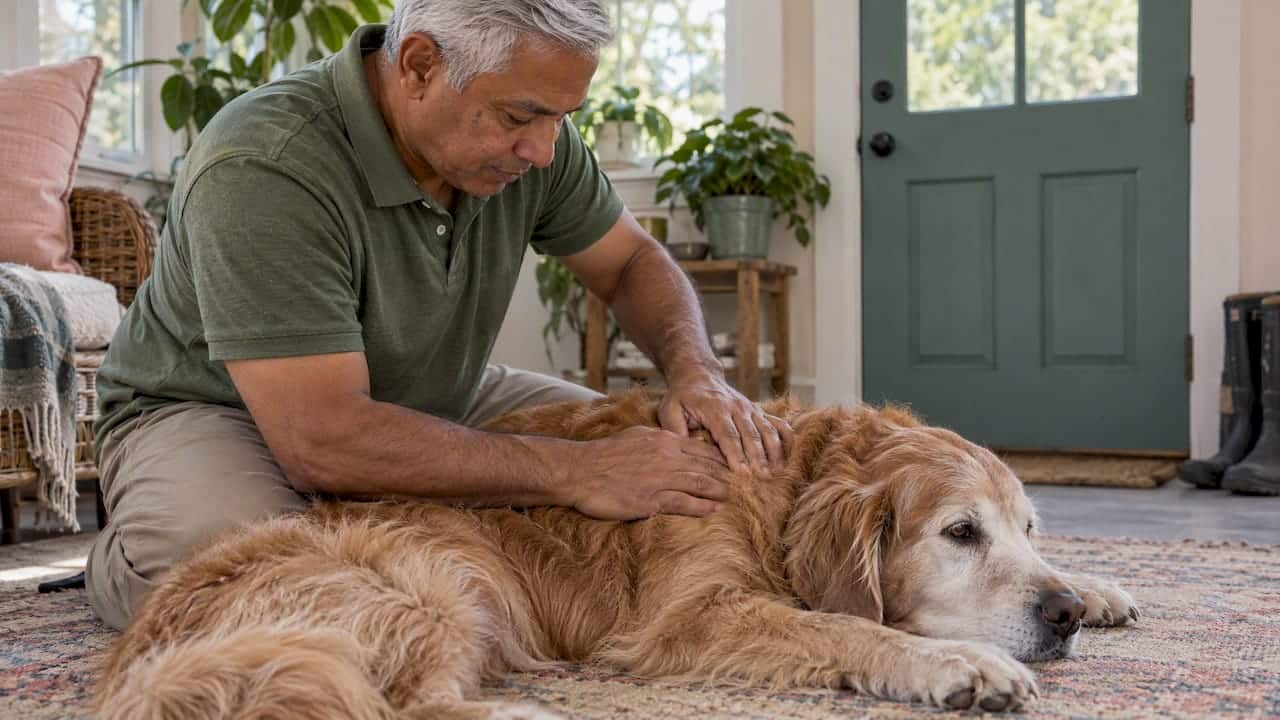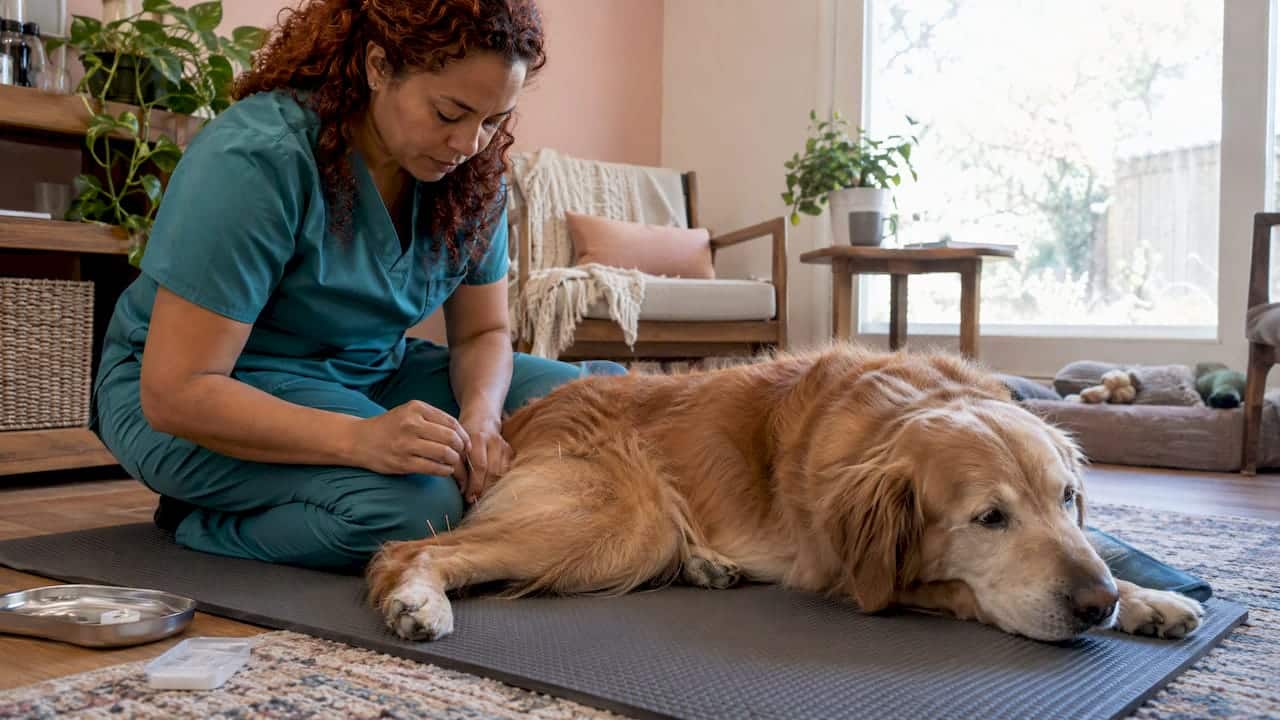
Acupuncture does not cure or shrink cancer in dogs. What it can do is act as supportive care, easing pain, nausea and low appetite, and helping a worn-out dog feel calmer and more comfortable, while the primary veterinarian and oncology team keep guiding the actual cancer treatment. If your dog has just been diagnosed, or you are weighing comfort-focused care for a senior dog, this guide explains what the research supports, what a session looks like, what to ask first, and where in-home care fits.
We know this is a tender subject. You are probably trying to do right by a dog you love, with limited time and a lot of conflicting information. We will keep it honest and practical.
TL;DR
- Acupuncture is a supportive therapy for dogs with cancer, used alongside conventional care and never as a replacement for it.
- The best-supported uses are pain relief and nausea control. Direct anticancer effects have not been demonstrated.
- Tell your oncologist and primary veterinarian before starting, and disclose every supplement and complementary treatment your dog receives.
- A typical session lasts 20 to 30 minutes with roughly 10 to 20 needles, and many dogs settle best at home.
- Look for a certified veterinary acupuncturist who will coordinate with your dog’s cancer team.
Table of Contents
- What acupuncture can and cannot do for a dog with cancer
- What the research actually shows
- How acupuncture is used for cancer comfort
- What happens during a session
- Safety: what to settle before the first session
- Working alongside conventional cancer care
- Why home visits can suit a dog with cancer
- Our perspective
- What in-home care costs in South Tampa
- FAQ
- Sources
What acupuncture can and cannot do for a dog with cancer
It helps to separate two goals: treating the cancer and caring for the dog who has it.
Treating the cancer means surgery, chemotherapy, radiation, or other therapies chosen by your veterinarian or a veterinary oncologist. Acupuncture is not in that category. A veterinary oncology risk review notes that few complementary therapies have demonstrated clinical anticancer effects and advises using them alongside established treatment, not instead of it.
Caring for the dog is where acupuncture earns its place. The Veterinary Cancer Society says acupuncture may be used as adjunctive therapy for pain management, appetite stimulation, nausea control and other cancer-related symptoms.
So a fair way to think about it:
- Realistic goals: less pain, fewer rough days, better appetite, steadier mood, more willingness to move and eat.
- Unrealistic goals: shrinking a tumor, slowing the disease, replacing chemotherapy or pain medication.
If anyone promises the second list, be cautious. The same oncology review advises counseling owners against unrealistic anticancer expectations, and warns that complementary treatments can cause toxicity, injury or interactions with other treatment.
What the research actually shows
The honest summary is that the evidence is encouraging for comfort and incomplete for cancer specifically.
Companion-animal acupuncture in general. A 2017 scoping review found 843 relevant citations, including 179 experimental studies and 175 case reports or case series, with dogs the most common experimental subjects. Musculoskeletal disease was the most common indication, and pain was among the most commonly measured outcomes. The authors also concluded that limited controlled trials and varied methods prevented firm conclusions about efficacy. That is a useful caution: lots of activity, not yet lots of certainty.
Cancer pain. A 2020 systematic review and meta-analysis looked at 24 animal trials of acupuncture for cancer-induced bone pain, 12 of which supplied data for meta-analysis. Electroacupuncture generally improved pain thresholds compared with sham or untreated model groups, but it was less effective than medicine on one measure, and the quality of evidence was limited. These were laboratory animals, not pet dogs, so treat it as a signal and not a promise.
A real dog. A 2023 peer-reviewed case report described electroacupuncture as an added pain-relief technique in a dog with oral fibrosarcoma whose facial pain was poorly controlled. Needles were placed away from the affected area, and it was used with other pain medication, not as a standalone treatment. One dog is not a trial, but it shows how a careful clinician uses the tool: as one layer of a multimodal plan.
Nausea and appetite. A veterinary cancer review reports some evidence that acupuncture reduces chemotherapy-associated nausea and helps pain, while stressing that the pain studies it cites were not done specifically in pets with cancer pain. That caveat matters, and we would rather you hear it from us.
Human data. The Veterinary Cancer Society points out that most studies of integrative cancer therapies come from human medicine, so human results should not be assumed to carry over to dogs.
Put together: acupuncture has a reasonable case as a low-risk, comfort-oriented add-on when delivered by a trained professional, and no case as a cancer treatment.

How acupuncture is used for cancer comfort
In Western terms, needling stimulates nerves, changes blood flow in tissue and influences how pain signals are processed. In Traditional Chinese Veterinary Medicine (TCVM), we picture Qi, the body’s vital energy, traveling along meridians, a bit like a highway system. When traffic stalls, pain and weakness can follow. Acupuncture aims to clear the jam and restore flow. Either way of describing it points to the same practical goal: a dog who hurts less and rests more easily.
For a dog with cancer, that usually means working on:
- Pain from the tumor itself, from arthritis in an older body, or from surgery.
- Nausea and poor appetite, especially around chemotherapy.
- Fatigue and low mood, when a dog stops wanting to greet you at the door.
- Stiffness and weakness, which are common in senior dogs and can be made worse by illness.
If your dog’s stomach is a main concern, our guide to acupuncture evidence for dog GI problems goes deeper, and our overview of natural pain relief for dogs with cancer covers the wider set of comfort measures at home.
What happens during a session
A veterinary oncology review describes the options as dry needles, aquapuncture (injecting a small amount of fluid at an acupuncture point) or electroacupuncture, with about 10 to 20 needles and sessions lasting 20 to 30 minutes. Treatments are typically repeated every one to three weeks and adjusted to the dog’s tolerance, pain severity and how long relief lasts.
In practice, a visit tends to go like this:
- A history and exam. We review your dog’s diagnosis, medications, recent bloodwork and what a good day looks like for them.
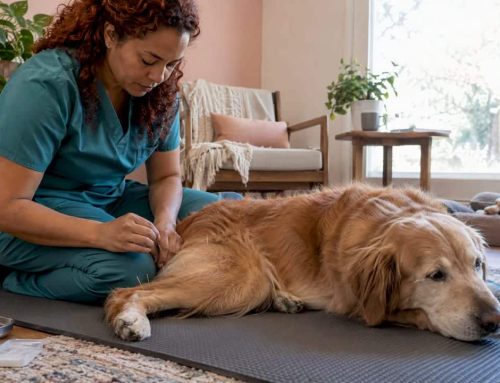
- A comfortable spot. Your dog stays on their own bed or favorite rug, and you sit close by.
- Needle placement. Fine needles go in at selected points. Many dogs relax noticeably, some doze.
- Optional electrical stimulation. In the case report above, current rose gradually from 0.2 mA to 1 mA over 30 minutes. A good clinician increases slowly and watches your dog’s face and body.
- A plan. You leave with a schedule, signs to watch for and a note for your regular veterinary team.
To learn more about the options, see our comparison of electroacupuncture versus acupuncture and our page on how often a dog should get acupuncture.
Signs your dog is comfortable
You are your dog’s best interpreter. Good signs include:
- Soft eyes, loose shoulders and a relaxed jaw
- Settling, lying down or yawning
- Normal breathing and a calm tail
- A bit of sleepiness afterward, or a little extra interest in food later that day
Signs to tell the clinician right away: pulling away, trembling, panting that does not settle, growling, or new soreness after a visit. A session can be paused or stopped at any point, and you should expect that.
Safety: what to settle before the first session
Acupuncture is generally considered low risk in trained hands, but cancer changes the rules. Four things matter most.

Tell the whole team. The Veterinary Cancer Society advises disclosing every supplement and complementary treatment because interactions with prescribed cancer drugs may cause serious reactions. This applies to herbs and food-therapy products too. Share your list with your oncologist or primary veterinarian, and with whoever treats your dog with acupuncture.
Keep needles away from tumors. According to a review by Elizabeth Hershey, DVM, DACVIM (Oncology), clinicians avoid needling directly in or around malignant tissue and avoid running electroacupuncture wires across a tumor. If a practitioner does not mention this, ask about it.
Do not skip diagnostics. Pain, nausea and weakness can come from things other than the cancer, such as kidney, liver or gut problems. Regular veterinary blood tests help your team understand what is going on and track how your dog responds to treatment, which also informs what is safe to add.
Choose a trained practitioner. The Veterinary Cancer Society recommends a certified veterinary acupuncturist who works closely with the primary veterinarian and medical oncologist. Our guides to what a certified veterinary acupuncturist is and veterinary acupuncture certification explain what to look for and the questions to ask.
If your dog is bleeding easily, has very low blood counts, or is acutely unwell, call your oncology team before booking anything. That is a conversation for a veterinarian, not for us to settle from a web page.
Working alongside conventional cancer care
The most useful framing is “and,” not “or.” The Veterinary Cancer Society recommends coordinating certified integrative care with the medical oncologist and primary veterinarian, and it encourages owners to define what good quality of life means for their own pet. Integrative care can support quality of life when coordinated this way, but diagnosis, prognosis, conventional treatment decisions and interaction review remain essential.
Here is how that looks in real life:
- During chemotherapy: sessions may be timed to support appetite and nausea control, as your oncologist agrees.
- With pain medication: acupuncture is added to the plan, and any change in medication is made by the prescribing veterinarian.
- In palliative or comfort care: the focus shifts fully to ease, appetite, movement and calm.
- For senior dogs with other conditions: arthritis, weakness and anxiety are often treated in the same visit.
Try defining “a good day” before you start. Maybe it is eating breakfast without coaxing, walking to the mailbox, or sleeping through the night. Write three or four of those down. They give you and the clinician a way to judge honestly whether acupuncture is helping, and they make it easier to stop if it is not.
Why home visits can suit a dog with cancer
A car ride, a waiting room, slippery floors and unfamiliar smells are a lot for a dog who is hurting. Tired, nauseated or arthritic dogs may struggle to get in a vehicle at all. Stress itself can make pain and appetite worse, and it can wear on you too.
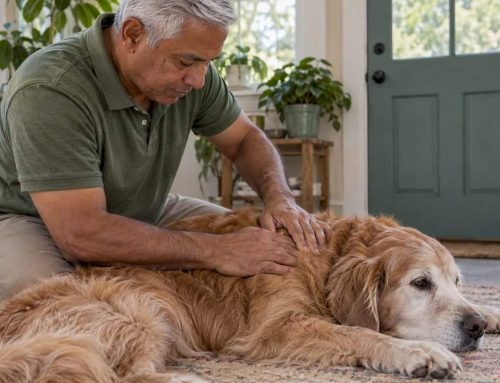
That is why we treat dogs exclusively at home. In your living room, your dog stays on familiar ground, you stay beside them, and we can see how they move through the space they live in. That helps us shape the plan around stairs, flooring and the corner where they like to rest.
For dogs who are also dealing with fear or restlessness, our article on acupuncture for dogs with anxiety may be helpful.
Our perspective
We see many senior dogs whose families are facing cancer, and we try to keep the message simple. Acupuncture is not a cure and we will never present it as one. We are there to make your dog’s days more comfortable, and to make the work of caring for them lighter for you.
We design treatment plans around each dog’s health needs and home environment, and we work with your dog’s regular veterinarian to complement existing care, never to compete with it. That can include acupuncture, laser therapy, rehabilitation, herbal therapy, food therapy and telemedicine, chosen one step at a time with your dog’s tolerance leading the way. If something is not helping, we say so and change course. If your dog’s oncologist has concerns, we listen.
The measure we care about is not a lab value. It is whether your dog is eating, resting and moving with more ease, and whether you feel more supported.
— Pet Acupuncture & Wellness
What in-home care costs in South Tampa
Prices below are as published on our cost of services page:
| Service | Published price |
|---|---|
| Initial assessment and acupuncture with a technician | From $430 |
| Technician mobile fee | $60 |
| Electroacupuncture | $30 |
| Laser treatments | $45 to $120 per treatment |
| Vitamin B12 injection | $31.50 |
Acupressure, herbal therapy, food therapy, aquapuncture, telemedicine and rehabilitation therapy are also available, and rehabilitation packages are published at $85 to $918. Which of these makes sense for your dog depends on their diagnosis, current medications and how they are coping, so the first step is a conversation.
Booking a first visit
If you live in South Tampa and want to explore comfort-focused care for your dog, see our services and get in touch. Have your dog’s diagnosis, medication list and your oncologist’s contact details ready. If you would like to start with a remote conversation about whether home care is right, our telemedicine consultations are another way in.
FAQ
Can acupuncture shrink a tumor in my dog?
There is no good evidence that it does. Veterinary oncology reviews state that few complementary therapies have shown clinical anticancer effects, and they advise using them alongside established treatment. Think of acupuncture as comfort care.
Is acupuncture safe during chemotherapy?
It is often used as an adjunct, and some evidence suggests it may reduce chemotherapy-related nausea. Because needling and any added herbs or supplements can interact with treatment or be unsuitable for some dogs, check with your oncologist first and make sure the acupuncturist knows the full treatment plan.
How many sessions will my dog need?
It varies. A veterinary oncology review describes repeat treatments commonly every one to three weeks, adjusted to your dog’s tolerance, pain level and how long relief lasts. Your practitioner should reassess after the first few visits and tell you honestly whether it is helping.
Will acupuncture hurt my dog?
The needles are very fine, and many dogs relax or doze during a session. Some dogs are more sensitive than others, and a good practitioner watches body language and adjusts or stops. Tell us about any past reactions so we can plan accordingly.
What if I cannot afford full cancer treatment?
Speak with your primary veterinarian or an oncologist about options at different levels of intensity, including palliative care focused on comfort. Supportive therapies like acupuncture can be part of a comfort plan, but they do not replace a diagnosis and your veterinarian’s guidance.
Sources
- A scoping review of the evidence for efficacy of acupuncture in companion animals
- Pet Owner Resources, Veterinary Cancer Society
- Acupuncture for Cancer-Induced Bone Pain in Animal Models
- Multimodal pain management in a dog with oral fibrosarcoma
- Alternative therapies in veterinary cancer: What are the risks?
- Acupuncture can manage pain in cancer patients, IVC Journal