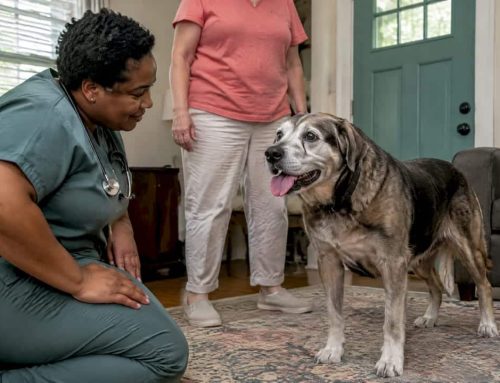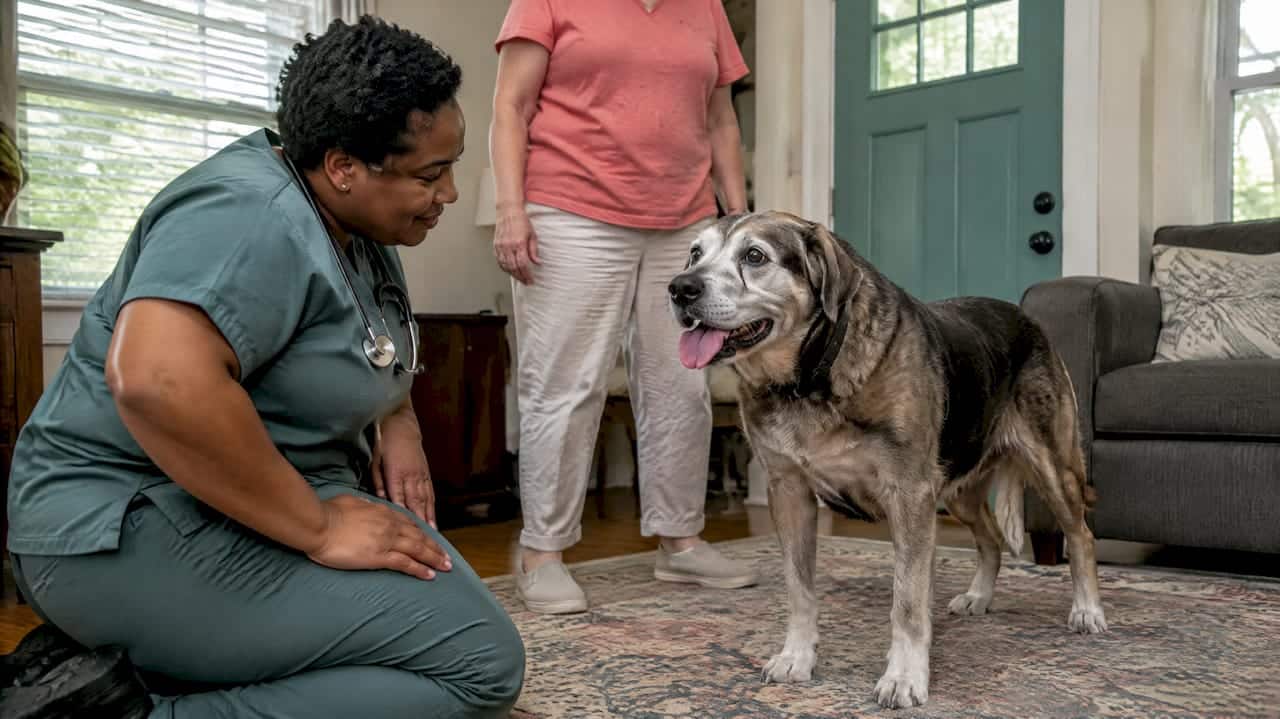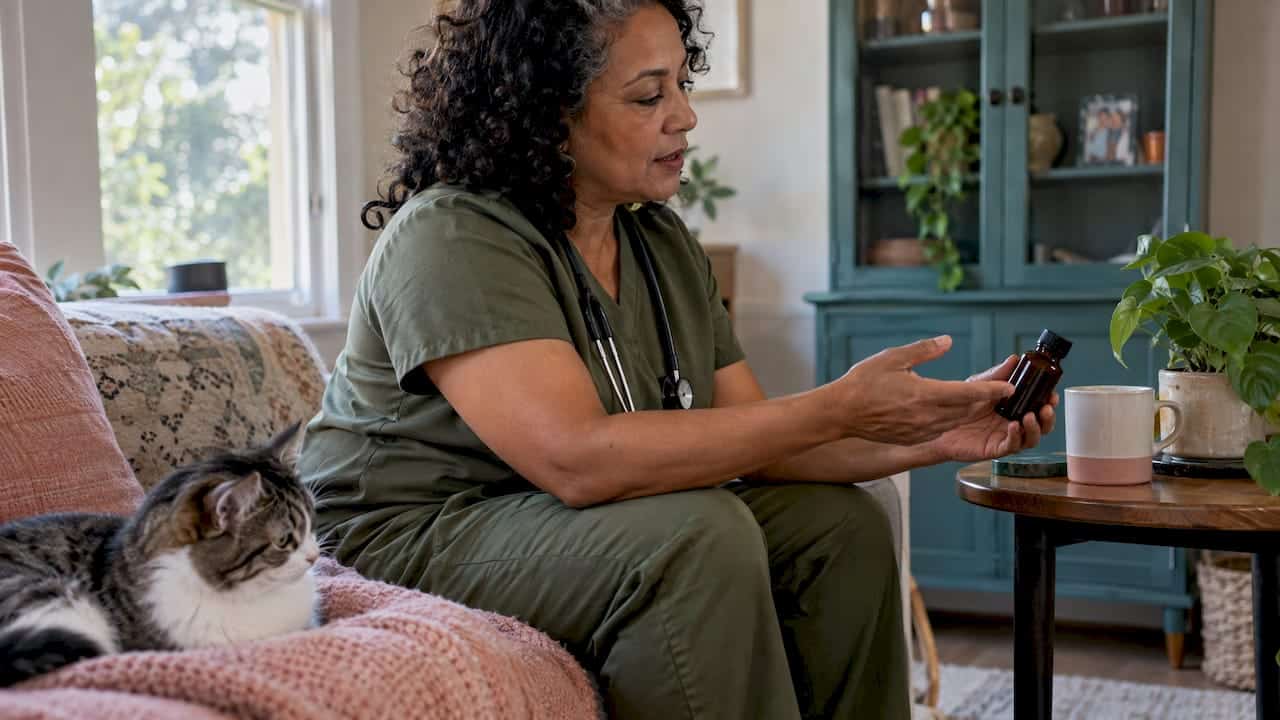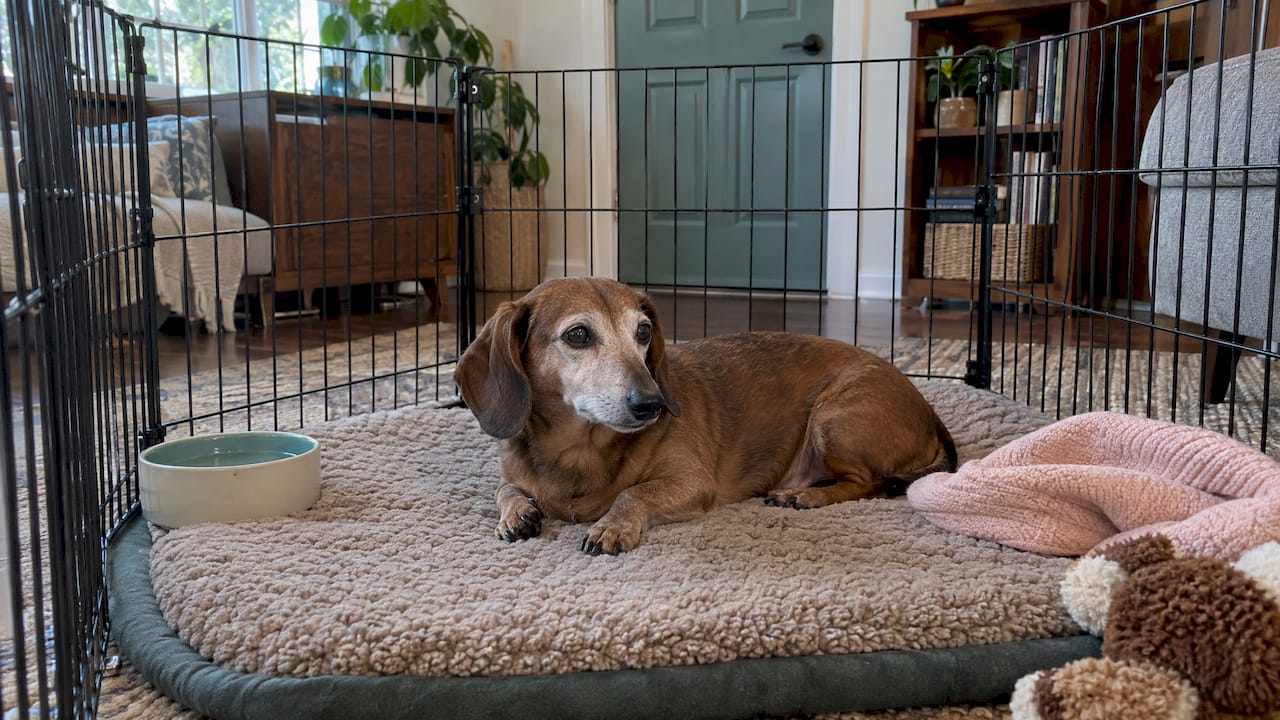
If your dog hesitates at the stairs, sits down mid-walk, or no longer jumps into the car, you may be looking at lumbosacral stenosis, a narrowing at the base of the spine that pinches the nerves heading to the back legs and tail. The good news is that most dogs with it live with back pain rather than paralysis, and a steady plan of home changes, veterinary guidance and gentle therapy can bring real comfort. For dogs who struggle with car rides and clinic visits, we bring integrative care to your living room in South Tampa, working alongside your regular veterinarian.
TL;DR
- Lumbosacral stenosis is a narrowing where the lower spine meets the pelvis. Pain is usually the main sign, and the first clues are often reluctance to jump, climb stairs or rise.
- A veterinarian confirms it with an orthopedic and neurologic exam, often followed by imaging. Do not test your dog’s back at home.
- Non-slip footing, ramps, a lean weight and short, controlled leash walks are the foundation of home care.
- Medication, laser, acupuncture and rehabilitation can be combined, and surgery is reserved for severe or worsening cases.
- Sudden loss of hind-leg use or bladder and bowel control is a same-day emergency.
Table of Contents
- What lumbosacral stenosis is, and what it looks like
- How veterinarians diagnose it
- Setting up your home for a dog with a sore back
- Treatment options your veterinarian may discuss
- What to expect over time
- When to call the vet right away
- Why home care suits dogs with spinal pain
- Care at your door in South Tampa
- FAQ
- Sources
What lumbosacral stenosis is, and what it looks like
The lumbosacral junction is the joint where the last lumbar vertebra meets the sacrum. A bundle of nerves called the cauda equina passes through it. In degenerative lumbosacral stenosis, discs bulge, ligaments thicken and the bony canal narrows, so those nerves get squeezed. The Merck Veterinary Manual notes it is most common in large-breed dogs, especially German Shepherds, with signs usually starting between 3 and 7 years of age. Pain when the joint is pressed or extended is the most consistent finding.
What owners notice first is subtle. In a 2019 review of the condition, about 90% of owners reported reluctance to jump or pain when jumping, rising or climbing stairs, and about 90% reported stiffness or pain during activity. Most suspected dogs came in for low back pain alone, and obvious neurologic deficits were extremely rare.
Watch for:
- Hesitating before the car, couch or stairs
- Rising slowly or sitting down during walks
- A low-carried tail or tail that seems weak
- Licking or chewing at the base of the tail or hind legs
- Scuffing the back toes or a stiff, short stride
- Flinching when you touch the lower back
Many of these get written off as “just getting older.” If you see them, the kindest step is a veterinary exam, not waiting.
How veterinarians diagnose it
The same review points out that this condition has no single telltale feature, so diagnosis is often presumptive: clinical signs, imaging and ruling out other causes of nerve compression. Dogs with wobbliness or poor limb placement need a thorough work-up to exclude other spinal problems such as degenerative myelopathy, a disc herniation higher in the back, infection of the discs or a tumor.
A typical path looks like this:
- History and observation. AAHA’s Trends Magazine stresses that a good history matters, including a recent move to a home with stairs or wood floors, a new roughhousing pet or a change in caregivers. It also suggests watching the dog from the moment it exits the car, because dogs hide pain less well then.
- Orthopedic and neurologic exam. This is where the vet checks the hips, spine, reflexes and nerve function.
- Imaging. Radiographs can show spondylosis (bony spurs), a narrowed disc space and arthritis. MRI is the most sensitive way to see the nerve roots and disc, according to the 2019 review, though WSAVA congress material notes that how bad the scan looks does not reliably match how bad the signs are.
AAHA also observes that advanced imaging can be cost-prohibitive, and that an integrative therapy sequence can be started first, with further testing typically needed for dogs that do not improve. Talk through that sequence with your own veterinarian. If you are not sure what is causing your dog’s slowing down, our related guide on natural treatment for spondylosis in dogs covers a neighboring spinal condition.
Please skip the home pain tests
It is tempting to lift the tail, stretch the hips back or press on the lower spine to see if your dog yelps. A home-care guide from a mobility-aid company warns that these provocative moves can worsen pain or cause a fall. Your dog’s trust is worth protecting. Describe what you see and let the veterinarian do the handling.
Setting up your home for a dog with a sore back
Home care is where you make the biggest daily difference. The goal is controlled, predictable movement: not a crate for months, but no slipping, leaping or twisting either. One veterinary supplement company’s guide points out that long inactivity costs the gluteal and core muscle that stabilizes this very joint.
Build a one-level route
The mobility guide suggests turning restrictions into a physical route linking bed, water, food and the door to the yard:
- Gate off both ends of the stairs.
- Join non-slip runners into a continuous path across tile and wood.
- Block furniture-jumping access with a ramp or step.
- Widen tight doorway turns.
- Place bowls at a height your vet approves, on a stable non-slip spot.
Florida homes are often full of tile and hard floors, so runners and yoga-style mats go a long way.
Weight, walks and support
The AKC’s back-pain guidance calls weight monitoring the most important home step, because extra pounds strain the spine. Work with your vet on safe weight loss. It also recommends shorter leash walks with less running and leaping, a support harness with hindquarter handles, ramps instead of jumping onto beds or furniture, and limited stair access.
A practical daily rhythm:
- Three or four short, level leash walks rather than one long outing
- No fetch, wrestling or sharp turns
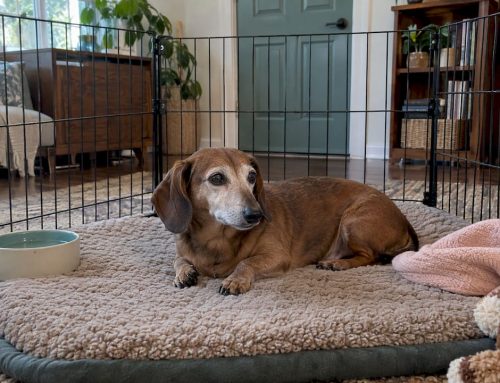
- A supportive orthopedic bed away from drafts
- A lift under the hindquarters for car and doorway thresholds
If your dog’s hips and joints are also aging, a joint-support chew such as these hip and joint chews can be added to the routine. Ask your veterinarian first about what fits your dog’s medications and diet.
Treatment options your veterinarian may discuss
The 2019 review states that there is no consensus on a single best treatment. For dogs with pain alone, it recommends starting with conservative care: analgesic or anti-inflammatory medication plus lifestyle change. Merck adds that dogs with mild pain as the only sign may improve with 4 to 6 weeks of rest.
Multimodal care
Today’s Veterinary Practice describes a layered approach: oral pain medicines such as NSAIDs, gabapentin or pregabalin and amantadine, therapeutic modalities such as laser and shockwave, and exercises such as nerve gliding and core strengthening, including underwater-treadmill work. Layering matters because each tool eases pain a different way, so doses of any one medicine can often stay modest. Our guide to multimodal pain plans for dogs walks through how these pieces fit together at home.

Acupuncture, laser and rehabilitation
AAHA reports that with medical acupuncture and physical rehabilitation in capable hands, outcomes for cauda equina syndrome or disc disease can be similar to surgery, without the cost, pain and intrusion of spinal surgery, and that surgery should be a last resort rather than a first step. In practice, that means a plan like:
- Acupuncture or electroacupuncture to ease muscle guarding and pain along the back and hind legs
- Laser therapy to calm sore tissue around the lumbosacral joint
- Rehabilitation with targeted core, hip-extensor and hind-limb strengthening, taught to you so you can repeat it between visits
- Herbal and food therapy from a Traditional Chinese Veterinary Medicine view, supporting energy (Qi) and circulation
The rehab piece deserves emphasis. Structured, professionally prescribed exercise is the part owners most often skip, and loading has to be specific to a spine that is sensitive to extension, so a generic online routine is not a substitute. Our pages on dog physical therapy at home and alternative pain relief for dogs explain what a plan looks like.
Epidural injections and surgery
Some dogs need more. Merck reports that epidural methylprednisolone injections on days 1, 14 and 42 help about 80% of dogs with pain and minimal neurologic signs. A 2020 trial found that a single injection helped 27 of 32 dogs, with relapse common within months, which is why vets often plan follow-up care alongside it. When pain does not respond or nerve deficits appear, surgical decompression may be recommended, and Merck cites improvement in roughly 70 to 95% of dogs with surgery. Incontinence or severe, progressing stenosis are the usual reasons to raise it. These decisions belong to your veterinarian or a veterinary surgeon, and we coordinate with them.
What to expect over time
Outcomes vary. In the 2019 review, one report found 55% of dogs managed medically, while 32% went on to surgery. Another found only half of owners reporting a good result from rest and NSAIDs alone. That is why a consistent plan with regular rechecks matters: pain, strength and mobility change slowly, and adjustments keep pace.
A simple weekly notebook helps. Note how your dog manages the stairs, how many minutes of walking feel comfortable, and whether they are rising easily. Those notes make every appointment more useful.
When to call the vet right away
Some changes cannot wait. Contact an emergency or treating veterinarian the same day if you see:
- Sudden inability to stand or use the hind legs
- Loss of bladder or bowel control, a dribbling bladder or new trouble passing urine
- Rapidly worsening weakness, collapse or severe, unrelenting pain
- Marked distress or reduced awareness
The mobility guide advises keeping movement to a minimum while you arrange care, preventing falls, using as few transfers as possible and asking the clinic how to transport your dog. A veterinary care guide adds that nerve function that is being lost is time-sensitive.
Why home care suits dogs with spinal pain

For a dog with a sore back, the trip itself is a problem: the jump into the car, the slick clinic floor, the barking waiting room. Seniors and anxious dogs tire and tense up, which can make exams harder and hide how they truly move. At home, your dog walks across the floors they actually live on, and we can see the stairs, rugs and furniture that shape their day.
Our practice provides mobile veterinary care in South Tampa, with acupuncture, laser therapy, rehabilitation, herbal and food therapy and telemedicine, tailored to each pet’s needs and home environment. Our care complements, and works with, your pet’s regular veterinarian.
We see lumbosacral pain as a whole-dog problem, not just a spot on an X-ray. A dog who hurts guards the back, shortens the stride and slowly loses the muscle that holds the spine steady. Our approach is to ease the pain first, then rebuild strength gently, in the rooms where your dog actually lives.
In Traditional Chinese Veterinary Medicine terms, pain often signals stuck Qi along the meridians, the body’s highway system. Acupuncture, electroacupuncture, laser and herbal therapy are designed to help restore that flow, while rehabilitation and food therapy support the body day to day. We design each plan around your dog’s home, your routine and what your regular veterinarian is already doing.
Most of all, we want the visit to be calm. When a senior or anxious dog can stay on their own bed, treatment becomes something they tolerate and, often, relax into.
Pet Acupuncture & Wellness
Care at your door in South Tampa
If your dog finds travel hard, we can bring the exam and treatment to you. The initial assessment and acupuncture with a technician starts from $430, with a $60 technician mobile fee. Laser treatments range from $45 to $120 per treatment, electroacupuncture is $30, and at-home rehabilitation packages range from $85 to $918. You can see everything on our cost of services page, and learn about our at-home rehabilitation therapy or acupressure and acupuncture.
Not sure whether your dog needs a visit? Our telemedicine consultations are a gentle first step from your couch.
FAQ
Can lumbosacral stenosis heal on its own?
The narrowing itself is degenerative and does not reverse, but pain can improve. Merck notes that dogs with mild pain as the only sign may improve with 4 to 6 weeks of rest. Because signs can return, a plan with rehabilitation and follow-up is wiser than rest alone.
Can a dog with lumbosacral stenosis still go for walks?
Yes, usually short, level, controlled leash walks. Avoid running, jumping, sharp turns and slippery surfaces. Your veterinarian or rehabilitation practitioner can set the right length for your dog.
Does acupuncture help dogs with lumbosacral stenosis?
AAHA reports that medical acupuncture combined with physical rehabilitation can produce outcomes similar to surgery for cauda equina syndrome or disc disease in the right hands. We use acupuncture, electroacupuncture and laser as part of a broader at-home plan that complements your regular veterinarian’s care.
Does my dog need surgery?
Not always. Conservative care is usually the first step for dogs with pain alone, and surgery is considered for severe or progressive stenosis, incontinence or pain that does not respond. Your veterinarian or a veterinary surgeon makes that call after an exam and imaging.
Sources
- Canine Degenerative Lumbosacral Stenosis: Prevalence, Impact and Management (PMC)
- Canine Degenerative Lumbosacral Stenosis (Veterinary Medicine: Research and Reports)
- Merck Veterinary Manual: Degenerative Diseases of the Spinal Column and Cord
- AAHA Trends Magazine: Lumbosacral Conditions in Dogs
- WSAVA 2017: Lumbosacral Disease, Diagnosis and Treatment
- Today’s Veterinary Practice: Pain Management in Dogs With Low Back Pain and Sciatica
- Single dose epidural methylprednisolone trial (PubMed)
- AKC: Is Your Dog Experiencing Back Pain?
- Lumbosacral Stenosis in Dogs: Signs & Home Care
- What to Give a Dog With Lumbosacral Stenosis
- What Helps a Dog With Cauda Equina Syndrome?