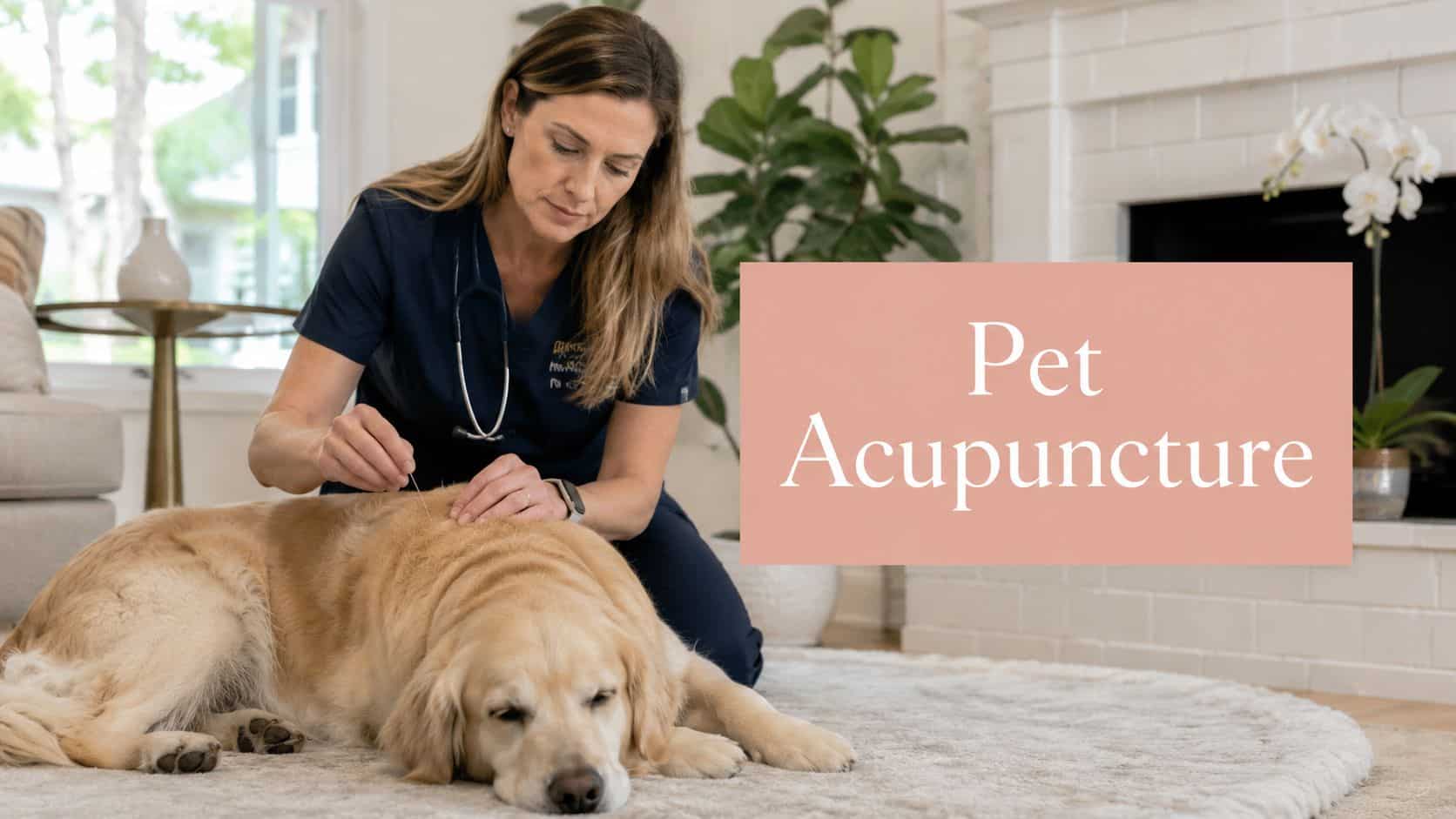
Your cat disappears the moment the carrier comes out. Your older dog stands at the door, willing to go, but getting into the car looks painful. You're trying to do the right thing, and somehow the whole process still feels hard on everyone.
That's where a virtual vet visit can help.
For many pet owners in South Tampa, the hardest part of veterinary care isn't caring. It's the logistics, the stress, and the worry that the trip itself may make things worse. Senior pets can stiffen up after travel. Anxious pets may pant, shake, hide, or stop acting like themselves the moment they leave home. Sometimes you don't even know whether the problem needs a full exam or just good veterinary guidance right away.
A virtual visit doesn't replace all in-person care. It gives you a calmer first step. In the right situation, it lets a veterinarian watch your pet in their own environment, hear the full story from you, and help you decide what should happen next.
Is a Traditional Vet Visit Stressing Out Your Pet
You know your pet's normal face, normal walk, normal appetite, normal attitude. So when something changes, you notice it quickly. The trouble starts when getting help means turning your home upside down.
A common example is the cat who senses the carrier from across the room. She vanishes under the bed, and what should have been a simple visit turns into a sweaty, emotional negotiation. By the time you arrive at the clinic, she's frightened, silent, and nothing like the cat you wanted the veterinarian to see.

Older dogs often struggle in a different way. They may be willing, but sore hips, weak back legs, or poor balance can turn a short outing into a big event. Even a well-meaning trip can leave them tired for the rest of the day.
Why Home Matters So Much
Pets don't separate “the appointment” from the whole experience around it. They feel the carrier, the car ride, the lobby sounds, the smells, and the unfamiliar handling. For some pets, that stress changes what the veterinarian can observe.
At home, many pets show more of their true day-to-day behavior. A dog may walk more naturally across their own floor than they do on a slick clinic surface. A cat may settle on a windowsill, jump to a favorite spot, or interact with family in a way that tells a richer story than a brief exam-room snapshot.
Practical rule: If travel is making it harder to observe your pet's real symptoms, a virtual visit may be a better starting point than forcing a stressful car ride.
For pet owners looking for calmer options in South Tampa, it also helps to know that home-based care isn't limited to video calls. Some families combine telemedicine with in-home veterinary support for pets in South Tampa when a hands-on visit is the better next step.
A Gentler First Step
A virtual vet visit can be especially helpful when you're asking questions like these:
- Is this urgent or can it wait until tomorrow? You want guidance without guessing.
- Does my pet need a hands-on exam? Not every issue can be sorted out on camera.
- Can a veterinarian see what I'm seeing at home? Sometimes the answer is yes, especially with good video and a calm setting.
That mix of reassurance and triage is why virtual care has become much more normal in veterinary medicine. It isn't a shortcut. Used well, it's a thoughtful way to reduce stress while keeping your pet's safety at the center.
Understanding the Virtual Vet Visit
A virtual vet visit is a veterinary consultation done remotely, usually by live video, sometimes supported by photos, short video clips, or phone discussion. The simplest comparison is a telehealth appointment with your own doctor. You're still speaking with a licensed professional. The difference is that the veterinarian is assessing your pet through what they can see and what you can report.

This isn't a fringe service anymore. One industry report says the global veterinary telehealth market was valued at $306.7 million in 2024 and is projected to reach $921.4 million by 2030, with a projected 20.3% CAGR. The same report says teleconsulting was the largest segment in 2024 at $132.8 million and 36.36% market share, which shows that live video and phone advice have become the main use case for virtual care, not a side feature (veterinary telehealth market reporting).
What Actually Happens During The Visit
Most virtual appointments follow a simple flow.
- You explain the concern. When did it start, what changed, and what worries you most?
- The veterinarian watches your pet. That might include breathing, posture, movement, interaction, skin changes, incision healing, or behavior in familiar surroundings.
- You answer follow-up questions. Appetite, thirst, bathroom habits, medications, environment, and past medical issues often matter as much as the visible symptom.
- You get a plan. That may be home care guidance, monitoring instructions, a follow-up recommendation, or advice to schedule hands-on care promptly.
Some concerns work especially well in this format. Others don't. That's not a flaw in telemedicine. It's the boundary between observation and physical examination.
What Makes Virtual Care Useful
Virtual visits are often valuable because they let the veterinarian see the context around the pet, not just the pet. A dog's gait across a hallway. A cat scratching at one ear after waking up. A senior pet's ability to rise from their bed. Those details can be hard to recreate in a clinic.
A virtual consult may involve:
- Live video interaction so the veterinarian can ask for different camera angles or observe movement in real time
- Photo review for skin changes, wounds, swelling, stool, vomit, or healing progress
- Short clips sent ahead of time when the symptom comes and goes, such as limping or unusual behavior
- Phone support when visual review is limited but a detailed history still helps with next-step decisions
The best virtual visits don't try to imitate every part of an exam. They use the strengths of home observation and owner history to answer the questions that can safely be answered remotely.
For worried owners, that distinction matters. A virtual visit is still real veterinary care. It's just designed for situations where remote guidance is appropriate and useful.
Choosing the Right Care In-Person or Online
The most important question isn't whether virtual care is “good” or “bad.” The key question is which type of care fits this problem today.
That's where pet owners often get stuck. A rash on the belly, a dog who seems stiffer than usual, a cat who isn't acting right but isn't obviously in crisis. You don't want to underreact. You also don't want to drag a fragile or fearful pet somewhere if a calmer first step would be enough.
When Virtual Care Fits Best
Evidence supports telemedicine most strongly for follow-ups, surgical site inspections, and mobility monitoring. It can be helpful for behavior concerns, medication check-ins, and deciding whether a new issue likely needs hands-on diagnostics. At the same time, telemedicine should not be treated as a broad substitute for in-person care, because many urgent but not dramatic problems still require a physical exam, especially concerns like new lameness or abdominal issues (review of veterinary telemedicine limits and strengths).
Here's a simple decision guide.
| Situation | Virtual Visit | In-Home Visit | In-Clinic / ER Visit |
|---|---|---|---|
| Post-surgical incision check | Often a good fit if the pet seems comfortable and the concern is how healing looks | Helpful if the pet also needs a hands-on recovery exam | Needed if the incision is opening, bleeding, or the pet seems systemically unwell |
| Mild behavior change or anxiety concern | Good starting point for history and home observation | Very helpful when environment and routine are part of the issue | Usually not first choice unless severe symptoms suggest illness |
| Senior pet mobility decline | Useful for watching gait at home and discussing patterns | Often ideal when the pet needs physical assessment in a familiar setting | Needed if diagnostics such as imaging are likely required |
| Vomiting, diarrhea, or not eating | Sometimes useful for early triage if symptoms are mild and the pet is bright | May help if the pet is stable but travel is difficult | Best if symptoms are persistent, worsening, or paired with weakness, pain, or dehydration concerns |
| New lump, swelling, or skin issue | Good for deciding urgency and reviewing photos | Helpful when the pet needs direct palpation without clinic stress | Needed if sampling, imaging, or procedural care is required |
| Trouble breathing, collapse, seizure, major trauma, toxin exposure | Not appropriate as the main plan | Not appropriate if emergency stabilization is needed | Immediate ER care |
The Middle Option Many Owners Forget
People often think there are only two choices. Clinic or video. In reality, an in-home visit can be the bridge between them.
That middle option can be especially valuable for senior pets, cats who hate travel, and dogs whose pain or mobility changes are hard to judge from one brief camera angle. Families thinking through comfort, function, and day-to-day well-being may also find it helpful to review how pet quality of life is evaluated at home.
A Safe Way To Decide
If you're unsure, ask yourself three practical questions:
- Does my pet need hands-on testing? Bloodwork, X-rays, ultrasound, sampling, and many pain evaluations can't happen virtually.
- Is my pet stable right now? If breathing, alertness, balance, or comfort are clearly off, don't wait on a remote option.
- Would home observation add value? For gait, behavior, recovery, and stress-sensitive symptoms, often yes.
The right choice is the one that gets your pet the right level of care without delay. Sometimes that's a screen. Sometimes that's your living room with a veterinarian present. Sometimes it's the emergency hospital.
What Vets Can and Cannot Do Remotely
The most honest way to understand a virtual vet visit is this. A veterinarian can gather history and perform a visual assessment, but can't do the hands-on parts of medicine through a screen.
That boundary matters because pet owners often assume a clear video should be enough. Sometimes it is. Often it isn't. A camera can show a limp, a swollen eyelid, or an incision that looks redder than yesterday. It can't let the veterinarian feel abdominal tension, listen to a heart murmur, check a painful joint through range of motion, or draw blood.

The AVMA notes that virtual care depends heavily on what can be seen and transmitted well. Its telehealth guidance recommends at least 10 Mbps upload and download speed for real-time video transfer of clinical information, and notes that photos and videos are especially useful for monitoring incision healing, gait, and mobility (AVMA veterinary telehealth guidelines).
What Remote Care Usually Handles Well
A virtual visit can be very useful when the goal is observation, guidance, or follow-up.
- Recovery checks after a procedure, especially when the main question is how a site looks or how the pet is moving
- Behavior discussions about pacing, vocalizing, house-soiling, sleep disruption, or anxiety triggers
- Mobility review when the veterinarian needs to watch how your pet rises, turns, uses stairs, or bears weight at home
- Chronic care conversations about comfort, appetite trends, medication tolerance, and next-step planning
- Triage when you need help deciding whether an issue can wait, needs a home visit, or should go straight to a clinic
A good virtual appointment often answers one of two questions very well. “Can we monitor this?” or “Does this pet need hands-on care now?”
For dogs who seem sore or stiff, that triage role can be especially helpful before you try home comfort strategies. Some owners also look for guidance on at-home dog pain relief alongside veterinary advice, since pain can be subtle and easy to underestimate.
What Remote Care Cannot Replace
Some parts of medicine require touch, tools, or immediate intervention.
- Physical examination such as palpation, auscultation, temperature taking, or detailed oral and orthopedic assessment
- Diagnostics including bloodwork, urinalysis, imaging, cytology, and biopsy
- Procedures like surgery, wound repair, fluid therapy, or vaccinations
- Emergency treatment for severe breathing problems, collapse, active seizures, major bleeding, or trauma
- Certain prescriptions when regulations or medical judgment require an in-person exam first
That's why responsible telemedicine is never about stretching remote care too far. It's about using it well, then moving to hands-on care at the right time.
How to Prepare for a Successful Virtual Appointment
A virtual visit goes best when you don't rely on memory alone. The more objective information you bring, the easier it is for the veterinarian to spot patterns, judge urgency, and recommend the right next step.
A useful appointment often starts before the call. Choose a quiet room, charge your device, and think like your pet's observer. What changed, when did it change, and can you show it clearly?

A practical walkthrough can help if you'd like to see the process in action:
Before The Call
A virtual visit is most effective when the owner provides structured objective data. Preparing a 48-hour log of water intake and energy levels, a list of recent medications, and high-resolution videos of abnormal behaviors can help the veterinarian infer urgency and likely causes more accurately (virtual appointment preparation checklist for pet owners).
Use this short checklist:
- Write a timeline: Note when the issue started and whether it's improving, worsening, or coming and going.
- Gather medications and supplements: Include flea, tick, heartworm, pain medications, herbs, and anything over the counter.
- Record normal changes: Appetite, thirst, urination, stool, sleep, and energy tell an important story.
- Take short videos: Walking, scratching, coughing, breathing, getting up, jumping, or unusual episodes are often more useful than still photos alone.
- Set up the room: Good light matters. Natural light or a bright lamp helps more than people expect.
During The Call
Your job isn't to “perform well.” It's to help the veterinarian see your pet as clearly as possible.
Try to keep the camera steady and move slowly. If your veterinarian asks to see your dog walk away and back, make one smooth pass. If they want to see a skin lesion, pause and let the camera focus instead of moving closer too fast.
A few simple habits help:
- Answer exactly what's asked first, then add detail
- Say what you've observed, not what you fear it “must be”
- Keep treats nearby for positioning, especially with cats and senior dogs
- Have another adult help if your pet is wiggly or if you need one person to handle and one to film
Good preparation doesn't make a virtual exam perfect. It makes it clear enough for the veterinarian to make safer decisions.
After The Call
Write down the plan before you hang up if possible. That includes what to monitor, what should improve, what would count as worsening, and when to switch to in-person care.
If your pet does best at home, many families also explore the benefits of at-home vet care as part of a broader long-term plan, especially for seniors, mobility patients, and anxious pets.
Virtual Care with PAW Vet Practice in South Tampa
In South Tampa, virtual care makes the most sense when it's part of a larger care plan, not treated like a stand-alone shortcut.
That's especially true for older pets, pets with arthritis or neurologic changes, and pets who become distressed by clinic travel. These patients often need continuity. Someone who understands how they move at home, how they respond after treatment, and how their comfort changes day to day. A virtual check-in can support that kind of care when used thoughtfully alongside hands-on visits.
Why This Hybrid Model Matters
Access has become a real issue for many families. A 2025 industry tracker reported that veterinary visits fell 2.3% in 2024 versus 2023, active patients declined 1.9%, and the average time between visits rose to 85.8 days, which was a 48% increase compared with the same period three years earlier. In a separate consumer survey, about 40% of pet owners said they'd be interested in telemedicine, community clinics, or in-home veterinary visits if available (veterinary access and client demand data).
For South Tampa pet owners, those pressures often show up in very personal ways. A dog with chronic stiffness may need regular reassessment, but the car ride makes him sore. A senior cat may need close monitoring, but every clinic trip leads to hiding and appetite disruption afterward. In those situations, virtual care can help maintain contact between hands-on visits.
How Integrative Care Uses Virtual Follow-Up
In an integrative setting, telemedicine can fit naturally into the rhythm of care.
A veterinarian may use a virtual appointment to review how a pet responded after acupuncture, laser therapy, rehabilitation exercises, or a change in supplements or food therapy. The owner can show gait, rising from bed, stair use, sleeping posture, or whether the pet seems brighter and more comfortable in the home environment.
This also helps with decision-making. Sometimes the next best step is another in-home treatment visit. Sometimes the pet needs diagnostic testing elsewhere. Sometimes a plan just needs a small adjustment and careful monitoring.
For local families who want to learn more about this option, telemedicine and tele-advice for pets in Tampa can be one part of a calmer, more flexible care approach.
Best Fit For South Tampa Pets
This model tends to be especially helpful for:
- Senior dogs and cats who need low-stress monitoring
- Anxious pets who don't show their normal behavior in a clinic
- Mobility patients whose walking, stairs, and bedding setup matter clinically
- Pets receiving integrative support where response over time is as important as one single exam moment
For the right patient, virtual care doesn't replace compassionate medicine. It helps deliver it more gently.
Frequently Asked Questions About Virtual Vet Care
How Much Does A Virtual Visit Cost And Is It Covered By Insurance
Fees vary by practice, location, visit type, and whether the appointment is advice, follow-up, or part of ongoing care. Because pricing and reimbursement policies differ, it's best to ask the practice directly and check with your pet insurance company if you carry coverage.
Some insurance plans may reimburse certain telemedicine services, while others may not. Ask for the exact documentation they require before the visit if reimbursement matters to you.
What Is A VCPR And Do I Need One For A Virtual Visit In Florida
A Veterinarian-Client-Patient Relationship, often shortened to VCPR, is the legal and medical relationship that allows a veterinarian to diagnose, treat, and in some cases prescribe based on sufficient knowledge of the patient.
Whether a virtual visit can establish or support a VCPR depends on current state rules and the specifics of the situation. Because regulations can change and individual cases differ, ask the veterinarian or practice what is allowed for your appointment type in Florida.
Can A Veterinarian Prescribe Medication Through A Virtual Visit
Sometimes yes, sometimes no.
It depends on the type of medication, the veterinarian's medical judgment, whether there is an appropriate existing relationship with the patient, and current legal requirements. If a medication can't be prescribed remotely, a virtual visit can still be very useful because it helps determine whether your pet needs an in-home exam, an in-clinic exam, or emergency care.
What Happens If My Pet Needs An In-Person Exam After The Virtual Consultation
That's a normal outcome for some cases. A virtual visit often answers the question, “What should I do next?” If the veterinarian identifies signs that can't be safely assessed remotely, they'll recommend hands-on care.
That next step may be:
- A scheduled in-home visit if the pet is stable and home care is appropriate
- A clinic appointment if diagnostics or procedures are likely needed
- An emergency hospital visit if the concern sounds time-sensitive or severe
Is A Virtual Vet Visit A Good Choice For Senior Pets
Often, yes. Senior pets can benefit when travel is tiring, painful, or upsetting. Video can be especially useful for observing how an older pet moves in their own space, where they sleep, how they rise, and how they get around floors or stairs.
Still, senior pets also commonly need physical exams, pain assessments, and diagnostics. The safest approach is to treat virtual care as one tool within a broader care plan.
What If My Pet Won't Sit Still On Camera
That's common, and veterinarians expect it.
You usually don't need a perfectly cooperative pet. Short clips recorded before the call are often more useful than trying to get everything live. Good lighting, a helper, favorite treats, and filming your pet doing normal activities can go a long way.
Can A Virtual Visit Help With End-Of-Life Or Quality-Of-Life Questions
Yes, these conversations can work very well virtually. Many families find it easier to talk openly at home, where the pet is relaxed and daily struggles are easier to show. A veterinarian can help you think through comfort, appetite, mobility, interaction, and whether hands-on support is needed soon.
When Should I Skip Virtual Care Entirely
Skip the virtual route and seek urgent in-person help if your pet has trouble breathing, collapses, has ongoing seizures, experiences major trauma, shows severe weakness, or may have ingested a toxin. In those moments, speed matters more than convenience.
If your dog or cat would benefit from calm, at-home support, Pet Acupuncture & Wellness (PAW Vet Practice) offers compassionate mobile and telemedicine care in South Tampa. Dr. Monica focuses on senior pets, anxious pets, mobility concerns, pain relief, and integrative wellness, with care designed around your pet's comfort and safety at home.