
Pet caregiver burnout is the physical and emotional exhaustion that builds up when you’re managing the ongoing medical, physical, and emotional needs of a sick, senior, or disabled dog or cat. It’s real, it’s common, and it doesn’t mean you love your pet any less.
If you’re reading this at 2 a.m. after another sleepless night with a dog who needs repositioning every few hours, here’s what to do right now: take sixty seconds for a self-check (do you feel emotionally numb, physically depleted, or unable to keep up with basic care tasks?). If you’re having thoughts of harming yourself or feel unable to keep your pet safe, contact the 988 Suicide & Crisis Lifeline immediately. If the crisis is about care logistics rather than your own safety, call your veterinary team today and ask them to help you simplify the treatment plan.
- Self-check: Rate your exhaustion, guilt, and physical fatigue from 1 to 10. A consistent 7 or higher for more than two weeks is worth addressing now.
- Crisis support: The 988 Lifeline is free, confidential, and available around the clock.
- Veterinary contact: Ask specifically for a simplified plan, not just reassurance.
Owners of chronically or terminally ill pets report significantly higher caregiver burden, stress, anxiety, and depressive symptoms than owners of healthy pets, with results holding up across multiple peer-reviewed studies. You are not imagining the weight of this. It’s measurable, and it’s common enough that veterinary medicine now studies it as its own clinical concern.
Key Takeaways
Pet caregiver burnout is a measurable, common response to intensive caregiving that improves with simplified care plans, delegated support, and early professional help.
| Point | Details |
|---|---|
| Recognize the signs early | Watch for emotional numbness, decision fatigue, sleep disruption, and social withdrawal before they compound. |
| Use a validated self-check | The abbreviated 7-item burden scale gives a concrete score to guide when to seek more support. |
| Delegate specific tasks | Assign named people to named tasks rather than asking for vague help. |
| Ask your vet to simplify | Longer-acting medications, easier administration, and nurse demos reduce daily workload. |
| Consider in-home integrative care | Pet Acupuncture & Wellness offers mobile acupuncture, rehab, and herbal therapy in South Tampa to reduce transport stress and support realistic, at-home care plans. |
Table of Contents
- Recognizing the Signs of Pet Caregiver Burnout
- Why Pet Caregiver Burnout Happens
- How Serious Is Your Caregiver Burden? A Quick Self-Assessment
- Practical Strategies to Reduce Pet Caregiver Fatigue
- How Veterinary Teams and In-Home Care Ease the Burden
- When to Seek Professional Mental Health Support
- Resources: Assessments, Equipment, and Peer Support
- The Long-Term Toll of Unmanaged Pet Caregiver Burnout
- Building a Support Network as a Pet Caregiver
- Preventing Burnout Before It Starts
- Chronic Illness, Aging, and Sudden Injury: Different Burdens
- A Note From Pet Acupuncture & Wellness
- A Simpler Way to Manage Care at Home
- Sources
- FAQ
Recognizing the Signs of Pet Caregiver Burnout
Burnout rarely announces itself. It creeps in through small, cumulative changes that are easy to write off as “just being tired.” Knowing the specific signs helps you catch it before it becomes a crisis.
- Emotional signs: Persistent guilt over not doing enough, emotional numbness where you used to feel connected to caregiving tasks, and anticipatory grief that shows up as sadness or dread even during calm moments.
- Cognitive signs: Mental fog, trouble making even small decisions (which medication first, which vet question to ask), and a nagging sense that you’re forgetting things.
- Physical signs: Disrupted sleep, appetite changes, frequent headaches, or getting sick more often than usual because your body’s stress response stays switched on.
- Behavioral and social signs: Withdrawing from friends, skipping your own medical appointments, missing work, or letting household tasks pile up because there’s no bandwidth left.
Compassion fatigue and pet caregiver burnout overlap but aren’t identical. Compassion fatigue tends to center on the emotional cost of witnessing suffering, common among veterinary staff and hospice volunteers. Caregiver burnout for pet owners layers that emotional toll on top of hands-on physical labor, financial pressure, and a role you never applied for and can’t clock out of. Workplace burnout has an end of shift. Caring for a senior or disabled pet often doesn’t, which is exactly why the fatigue compounds differently.
Why Pet Caregiver Burnout Happens
Burnout isn’t a character flaw. It’s a predictable response to a specific set of pressures, and most caregivers face the same core drivers in different combinations.
- Treatment complexity and time demand. Multiple daily medications, injections, wound care, or mobility assistance can turn a normal day into a rotating schedule with no downtime.
- Household disruption. Ramps, baby gates, incontinence pads, and rearranged furniture change how your whole home functions, and the physical tasks (lifting, cleaning, transporting) add up fast.
- Social isolation. Friends stop asking how you’re doing because they don’t know what to say, and pet-related caregiving rarely gets the same social recognition as caring for a human family member.
- Financial strain. Ongoing vet visits, medications, and specialized equipment create a slow financial drain that adds worry on top of physical exhaustion.
These drivers feed each other in a loop that’s worth naming out loud: treatment complexity increases burden, burden reduces your ability to follow the plan consistently, inconsistent follow-through leads to more health setbacks, and those setbacks increase burden again. Higher caregiver burden is directly linked to more nonbillable contact with veterinary staff and more difficulty following complex treatment plans, which is the clinical fingerprint of that loop in action.
Pro Tip: If you notice you’ve skipped a medication dose or a rehab exercise more than once this week, that’s not a discipline problem. It’s a signal the plan is too heavy for your current bandwidth, and it’s worth calling your vet before the pattern repeats.
How Serious Is Your Caregiver Burden? A Quick Self-Assessment
Researchers have adapted the Zarit Burden Interview, a tool originally built for human caregivers, into a version specific to pet owners. An abbreviated 7-item version of this scale correlates strongly with the full measure (strong correlation), making it a reliable quick check you can do in under five minutes.
The seven items ask you to rate, on a simple frequency scale, how often you feel things like insufficient time for yourself, strain between caregiving and other responsibilities, uncertainty about what to do, and a sense that your life has been taken over by your pet’s care needs.
- 0 to 8: Typical of healthy-pet-owner samples. Your burden is within a manageable range, though it’s still worth checking in periodically.
- 9 to 15 (moderate): Worth active attention. This range often correlates with rising stress and early depressive symptoms, and it’s a good time to bring in delegation and vet-side simplification.
- 16 and above (high): Elevated scores in this range are associated with greater psychological distress and more frequent veterinary contact outside scheduled visits. This is the point to talk to both your vet and, potentially, a therapist.
Higher scores on burden measures consistently track with worse psychosocial outcomes and more contact with clinic staff outside routine visits, which is exactly why veterinary teams increasingly use these tools to flag caregivers who need extra support before a crisis hits.
Practical Strategies to Reduce Pet Caregiver Fatigue
Managing pet caregiver burnout starts with the assumption that your current system is unsustainable by design, not because you’re failing at it. Here’s where to focus first.
- Schedule rest like a care task. Block off “off-duty” windows on your calendar the same way you’d schedule a medication dose. Ask a family member, friend, or pet sitter to cover a two-hour window twice a week so your nervous system actually gets to downshift.
- Build a shared-care rotation. Make a specific list of delegable tasks (grocery runs, overnight monitoring, one medication dose, transport to appointments) and ask specific people to own specific tasks. “Can you help sometimes?” gets vague answers. “Can you handle the Tuesday evening pill?” gets a yes or no you can plan around.
- Ask your vet to simplify the regimen. Many treatment plans can flex more than owners realize. Ask about swapping pills for pill pockets or compounded flavored liquids, switching from twice-daily to longer-acting formulations, or requesting a nurse demonstration for injections or wound care so you feel less alone in the technical parts.
- Use adaptive equipment and delivery services. Ramps, slings, and orthopedic bedding cut down on the physical strain of lifting and repositioning. Home-delivery pharmacy services remove one more errand from an already full week, and rehabilitation equipment guides can help you choose gear suited to your pet’s specific mobility issue.
- Name compassion fatigue and set real boundaries. Give the exhaustion a name instead of pushing through it silently. Setting a boundary, like “I will not do overnight checks past midnight more than three nights a week,” is not neglect. It’s what keeps you capable of caregiving at all.
- Join peer support and take brief emotional breaks. Even a 10 minute walk without your phone, or fifteen minutes in an online caregiver forum where people understand the specific grief of watching a pet decline, measurably lowers baseline stress.
Social support isn’t a soft add-on here. Research on caregivers of dogs with chronic paresis or paralysis found that social support is significantly linked to lower caregiver burden (p = 0.005), which means the friend who takes one overnight shift a week is doing measurable clinical good, not just being kind.
Pro Tip: Write down your pet’s care routine in full detail, every medication, every task, every timing window, and hand it to one other person. The act of externalizing the plan often reveals how much you’ve been holding in your head alone, and it makes delegation actually possible.
How Veterinary Teams and In-Home Care Ease the Burden
Veterinary teams are in a unique position to interrupt the burnout cycle before it deepens, and the best ones do it deliberately rather than by accident.
- Simplified written plans. A one-page summary with realistic goals, rather than a dense multi-page protocol, reduces cognitive load and gives you something to reference at 6 a.m. without having to remember every detail.
- Scheduled brief check-ins. A short call or telemedicine touchpoint between full visits catches small problems before they become emergencies, and it gives you a place to voice frustration before it turns into avoidance.
- At-home visits. Removing the transport step, the waiting room stress, and the unfamiliar environment lowers anxiety for both you and your pet, and it lets a clinician coach you directly on handling techniques in the space where you’ll actually use them.
- Care changes that cut daily workload. Longer-acting medications, easier administration routes, and rehabilitation equipment demonstrated in your own home all shrink the number of decisions and physical tasks you face each day.
Recognizing caregiver burden gives clinical teams the chance to respond with empathy and adjust care before adherence breaks down, rather than after a crisis visit forces the conversation.
The payoff runs both directions. Better adherence means fewer emergency visits, and fewer emergency visits mean less burden on you, which is the feedback loop working in your favor instead of against you.
When to Seek Professional Mental Health Support
Some warning signs require immediate action, not a wait-and-see approach.
- Emergency red flags: Thoughts of self-harm, or intrusive thoughts of harming your pet out of exhaustion or hopelessness, need immediate attention. Call the 988 Suicide & Crisis Lifeline or go to an emergency room right away.
- When to seek a clinician: If you’ve had two or more weeks of disrupted sleep, loss of interest in things you used to enjoy, or an inability to complete basic daily tasks, that’s the threshold for reaching out to a therapist rather than trying to push through alone.
- Finding affordable help: Look for sliding-scale therapy practices, teletherapy platforms, and community mental health centers, many of which now specifically list caregiver stress among their intake concerns.
- Talking to your vet about burden: Say it plainly. “I’m struggling to keep up with this plan, and I need help” is a normal, expected sentence in a veterinary exam room, not an admission of failure.
Caregiver burden has been shown to predict earlier consideration of euthanasia independent of the pet’s actual quality-of-life score, which is exactly why addressing your own exhaustion is not a side issue. It directly shapes the medical decisions you’re capable of making clearly.
Resources: Assessments, Equipment, and Peer Support
You don’t have to build a support system from scratch. Start with categories that map directly onto your biggest pain points.
- Self-assessment: The abbreviated 7-item caregiver burden scale takes about five minutes and gives you a concrete number to bring to your vet or therapist.
- Adaptive equipment: Search specifically for slings, ramps, orthopedic bedding, and incontinence supplies suited to your pet’s size and condition; a guide to rehabilitation equipment can narrow the options.
- Peer support: Online caregiver forums, pet-loss counselors, and veterinary social workers (a growing specialty in many clinics) all offer a place to process what you’re carrying.
- At-home guidance: Step-by-step resources on at-home physical therapy can reduce how much you’re improvising day to day.
The Long-Term Toll of Unmanaged Pet Caregiver Burnout
Left unaddressed, pet caregiver burnout doesn’t plateau. It tends to compound. Chronic stress hormones stay elevated for months at a time in caregivers managing long-term illness, and that has consequences well beyond feeling tired.
Physically, prolonged burnout is linked to a weaker immune response, more frequent minor illness, and disrupted sleep architecture that doesn’t fully resolve even after a pet’s condition stabilizes. Emotionally, unresolved caregiver burden often carries forward into what some clinicians call “post-caregiver syndrome,” a period after a pet’s death or recovery marked by lingering exhaustion, identity disruption, and difficulty re-engaging with normal routines. The mind and body spent months organized entirely around a caregiving role, and unwinding that takes real time.
There’s also a decision-making cost that’s easy to miss in the moment. Burden that goes unaddressed predicts earlier consideration of euthanasia even when the pet’s measurable quality of life hasn’t changed, meaning your exhaustion can quietly steer a decision that should be based on your pet’s condition, not yours. That’s not a criticism. It’s a reason to treat your own well-being as a clinical variable in your pet’s care, not an afterthought to manage once everything else is handled.
Addressing burnout early, through delegation, simplified care plans, and emotional support, protects both your long-term health and the quality of decisions you’re able to make for your pet.
Building a Support Network as a Pet Caregiver
Isolation is one of the biggest multipliers of caregiver burden, and it’s also one of the most fixable. Most caregivers underestimate how much a small, specific network can absorb.

Start close to home. Family and friends often want to help but don’t know how, so give them a concrete task instead of a general appeal. Online communities built specifically for caregivers of chronically ill or aging pets offer something friends and family often can’t: people who understand the particular grief of managing a slow decline, without needing it explained.
Veterinary social workers, a role that’s expanding across clinics, specialize in connecting caregivers to counseling, financial assistance programs, and hospice resources. Many local and national pet-loss organizations also run support groups specifically for caregivers still in the active caregiving phase, not just after a pet’s death, which fills a gap that general grief resources often miss.
A rotating shared-care arrangement with even one or two trusted people, where someone else covers a defined block of time each week, turns an isolating role into something distributed. The goal isn’t to eliminate your responsibility. It’s to make sure you’re never the only person who knows how to do it.
Preventing Burnout Before It Starts
The strongest position is catching the pattern before it fully forms, and prevention is largely about building structure while you still have the bandwidth to build it.
Set up your delegation system at diagnosis, not at the breaking point. The first weeks after a diagnosis of chronic illness are the easiest time to recruit help, because urgency is high and people are motivated to offer support. Waiting until you’re depleted to ask makes the ask feel heavier for everyone involved.
Build rest into the schedule from day one rather than treating it as a reward for good behavior. A caregiver who takes a scheduled break every week starts from a stronger baseline than one who waits for exhaustion to force a pause. Run the 7-item self-check monthly, not just when things feel bad, so you can catch a rising trend early. Ask your vet at the outset which parts of the treatment plan have flexibility, so you know your options before you’re too tired to ask.
Chronic Illness, Aging, and Sudden Injury: Different Burdens
Not all caregiving situations create burnout the same way, and recognizing which pattern you’re in helps you respond appropriately.
Chronic illness (diabetes, kidney disease, cancer) tends to produce burnout through sustained treatment complexity, the daily grind of medications and monitoring stretched over months or years with no clear endpoint.
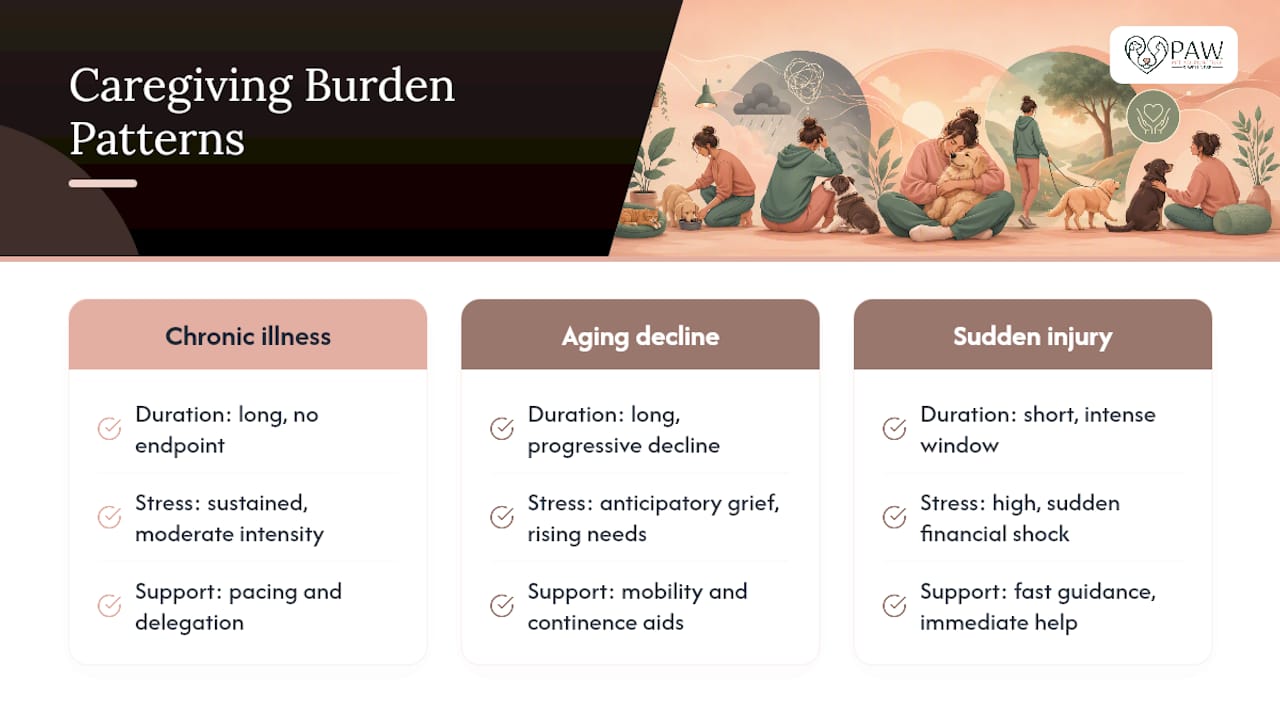
Aging and progressive decline create a different kind of weight: anticipatory grief layered onto slowly increasing physical care needs, where you’re often mourning a pet who’s still alive while managing mobility aids, incontinence, and cognitive changes at the same time.
Sudden injury or acute illness compresses the same stress into a shorter, more intense window, with financial shock, emergency decision-making, and a steep and rapid learning curve replacing the slow accumulation seen in chronic cases. There’s often less time to build support systems, which is part of why acute cases can feel disproportionately overwhelming even when the caregiving period itself is shorter.
Knowing which pattern fits your situation helps you choose the right intervention. Chronic and aging cases benefit most from pacing and delegation built for the long haul, while acute cases need fast access to simplified guidance and immediate practical help.
A Note From Pet Acupuncture & Wellness
We see this exhaustion every week in South Tampa living rooms, and we want you to hear this clearly: struggling with the weight of caring for a sick or aging pet doesn’t mean you’re doing it wrong. If you’re not sure whether your current care plan is realistic for your life right now, we’re glad to talk through simpler, in-home options that might fit better.
A Simpler Way to Manage Care at Home
Pet Acupuncture & Wellness is the alternative to repeated clinic trips for South Tampa pet owners managing chronic illness, mobility loss, or age-related decline. Instead of loading a stressed, painful pet into a car for another waiting-room visit, our team comes to you.

Mobile acupuncture treats pain and mobility issues in the environment your pet already finds calming, cutting out transport stress for both of you. In-home rehabilitation therapy includes direct, hands-on coaching so you learn safe handling and exercise techniques instead of guessing from a printed handout. Herbal therapy can complement conventional treatment for pets who don’t tolerate standard medications well. Each visit also gives us a chance to look at your day-to-day routine and suggest realistic adjustments, not a rigid protocol you’re expected to follow perfectly.
This approach fits caregivers of senior, disabled, or chronically ill dogs and cats who are already stretched thin by transport, waiting rooms, or a pet who dreads the car ride. Costs vary by treatment plan, and we’re happy to walk through what to expect before you book. If your current routine feels unsustainable, schedule a consult and let’s figure out what a lighter version of caregiving could look like for your household.
Sources
- Caregiver burden in owners of a sick companion animal: a cross‐sectional observational study
- Statistical reduction and validation of an adapted Zarit Burden measure for pet caregivers (abbreviated 7-item)
- Caregiver burden in owners of dogs with chronic paresis or paralysis
- Assessment of caregiver burden and associations with psychosocial function, veterinary service use, and factors related to treatment plan adherence among owners of dogs and cats
FAQ
How long does it take to recover from caregiver burnout?
Recovery varies widely, but many caregivers see meaningful improvement within a few weeks of reducing task load and adding social support, while deeper emotional recovery after a pet’s decline or death can take several months.
What are the symptoms of caretaker exhaustion?
Common symptoms include emotional numbness, guilt, decision fatigue, disrupted sleep and appetite, and withdrawing from friends or missing your own medical appointments.
What is post-caregiver syndrome and what are its symptoms?
Post-caregiver syndrome describes the lingering exhaustion, identity disruption, and difficulty resuming normal routines that some caregivers experience after intensive caregiving ends, whether through a pet’s recovery or death.
How can I avoid burnout as a caregiver?
Build delegation and rest into your routine early, ask your veterinary team to simplify the treatment plan, and use a validated tool like the 7-item burden scale to track your stress level over time. In-home integrative options, such as those offered by Pet Acupuncture & Wellness, can also reduce the transport and logistics burden that drives much of the daily fatigue.