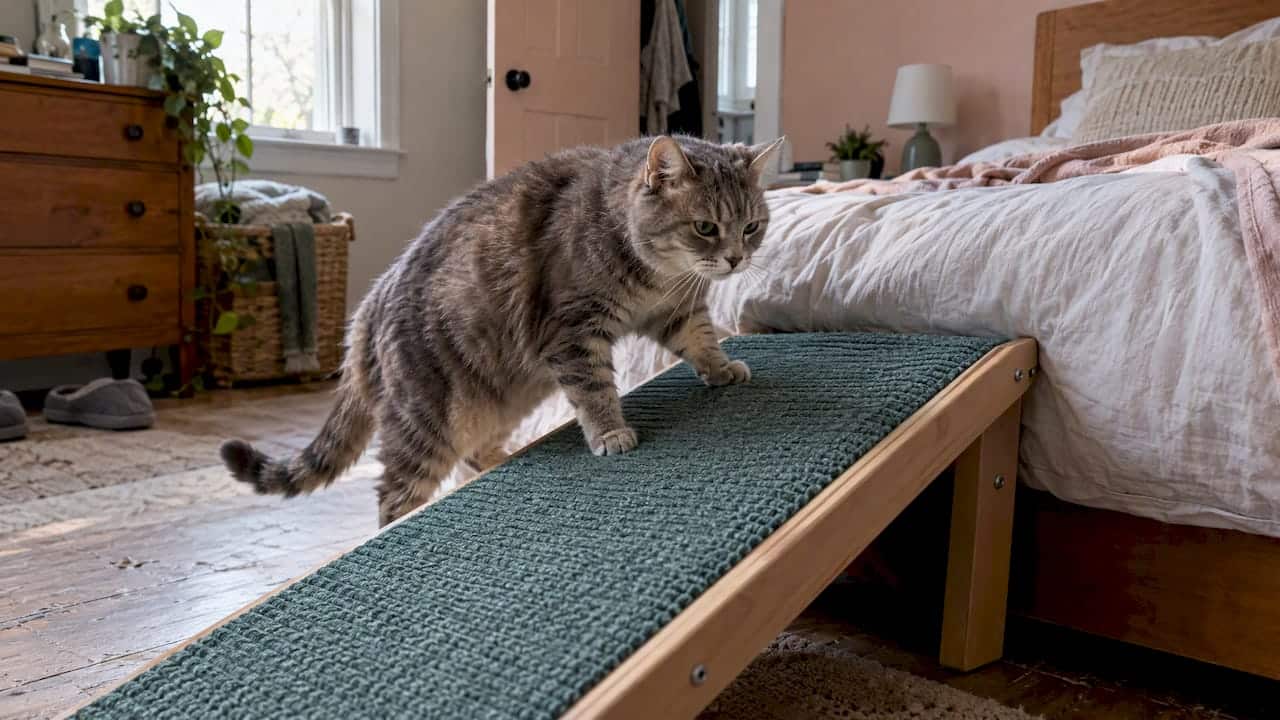
If your older cat has started perching on the edge of the box, skipping it, or leaving puddles beside it, the box itself is often the first thing to fix. For an arthritic cat, the best litter box is a large, uncovered one with a low front entry (3 inches or less), placed on the same floor where your cat spends the day, kept spotless and left in the same spot. Below, we walk through each of those choices, explain why they matter to stiff joints, and tell you when an accident is a medical signal rather than a box problem.
TL;DR
- Choose a box with a front entry low enough to step into without jumping, 3 inches or less, and roomy enough to turn around in.
- Put a box on every level your cat uses, close to where she rests, and avoid making her climb stairs to reach one.
- Scoop often, keep the box in the same place, and clean accidents with an enzymatic cleanser. Never scold.
- A cat who suddenly stops using the box may have more going on than arthritis, so call your veterinarian about any change.
- Weight, traction and a calm home all help joints, and the box is only one piece.
Table of Contents
- Why the litter box becomes hard with arthritis
- Choosing the right box
- Where to put it
- Litter and cleaning
- Helping a disabled cat use the box safely
- Weight and mobility
- When it might not be arthritis
- Our perspective: the box is a clue, not the cure
- Treating the pain behind the problem
- FAQ
- Sources
Why the litter box becomes hard with arthritis
Feline arthritis, also called degenerative joint disease, is far more common than most owners realize. Veterinary guidelines report that as many as 92% of cats have it. Cats are also masters at hiding pain, so the litter box is often where you first notice something is wrong.
Think about what a litter visit asks of a cat. She has to step over a lip, bend her hips and knees to squat, hold that posture, turn, scratch, and step out again. Each of those moves loads a joint that may already ache. Cornell’s feline health center notes that arthritis can make litter box access difficult, especially when a cat has to jump or climb stairs to get there, and suggests a box with low sides or a cut-out entry.
Cats are clean animals. If the box hurts, she will do the sensible thing in her own mind and choose a spot that doesn’t. That is not defiance, and it is not something she can be trained out of.
Signs the box is the problem
You might see:
- Standing on the rim, or hesitating at the entrance before going in
- Urine or stool just outside the box, often right at the doorway
- Peeing in a spot with a soft, easy surface, such as a bath mat or a rug
- Using a box on the ground floor and avoiding one upstairs
- Short, stiff scratching, or leaving the box without covering anything
If you want to look at the bigger picture, our guide to the early signs of arthritis covers the changes in jumping, grooming and temperament that tend to appear alongside box trouble.
Choosing the right box
Entry height
This is the single most important feature. Look for a side low enough to step into without jumping, 3 inches or less. Many cats with mild stiffness do fine with a low-entry model. A cat with significant hip or back pain, or one who is weak in the rear legs, may need an even lower or nearly flat entrance.
You don’t need to buy anything special to start. A shallow under-bed storage tub or a large plastic tray can work, and you can cut a U-shaped opening in the front of a standard storage bin. Sand the cut edge smooth, so it can’t scratch her belly or paws.
Size
Senior cats need space to adjust their posture without bumping a wall. The AAHA and AAFP feline life stage guidelines say a box should be 1.5 times your cat’s length, nose to base of tail, and that larger containers can be a suitable alternative to commercial boxes. Measure your cat, multiply, and compare that number with the interior floor of the box, not the outside dimensions.
Covered or uncovered
Hoods and flaps add a step and cut down on room to maneuver. They also trap odor, which a cat with a sensitive nose may dislike. For an arthritic cat, we generally suggest an open box, and pairing it with a spot where she can see the room and feel safe.

Automatic boxes
Self-cleaning boxes are convenient, but many have a tall entry sill and a noisy motor. If you like the convenience, check the entry height before you buy, and consider a ramp or step only if your cat can use it confidently. Some cats with balance problems are less steady on a ramp than on a low flat entry.
Surface stability
A box that slides or flexes when your cat steps in can frighten her. Place it on a non-slip mat, or on a rug. The AAHA pain management owner handout recommends rugs, carpet or yoga mats in the areas your pet travels most to prevent slipping, and the same logic applies on the path to the box.

Where to put it
Placement matters as much as the box. The AAHA guidelines advise an easily accessible, lower-height box close to the cat’s core areas so that she doesn’t need to climb stairs. Consider these rules:
- One box per level. Feline behavior guidelines recommend at least one litter box on each level of a multilevel home, with boxes in several accessible locations around the house. A cat with sore hips may not make it down a flight of stairs in time.
- Near where she rests. Put one close to her favorite bed or window perch, so the trip is short.
- Keep it where it is. Moving boxes can confuse a cat, so keep them in the same place. Older cats are also more sensitive to household changes, because their ability to adapt to unfamiliar situations declines with age. If you must add a box, add it rather than relocating the existing one.
- Quiet, not cornered. Avoid spots next to a noisy washing machine or a dead-end corner where another pet can block her.
- Clear path. Remove any hurdle on the way: a baby gate, a step stool, a slippery hardwood hallway without a runner.
Making the change gradually
Put the new low box next to the old one for a week or two. Once you see her using the new one, remove the old one. If she is nervous, leave both and watch which she prefers. Offering choices is exactly how you learn her preferences.
Litter and cleaning
A stiff cat is also more likely to refuse a dirty box, because standing in a soiled one is uncomfortable and each extra step hurts. Scoop at least once daily, and more often if you can. Wash the box regularly with mild unscented soap.
Litter type. Stay with what she already likes unless there’s a reason to change. If your cat has a history of urinary problems, AAHA suggests unscented clumping litter may be preferred, and recommends testing preferences by offering different litters in separate boxes. Soft, fine-grained litter is usually kinder on sore paws than coarse pellets. A shallow layer also means less to dig through.
Accidents. Clean them with an enzymatic cleanser made to neutralize pet odors, since lingering scent invites a repeat. And please never scold. Veterinary behavior guidance warns that punishment is associated with fear and can damage the bond between you and your cat. She is not misbehaving; she is telling you something hurts.
Helping a disabled cat use the box safely
Some cats go beyond stiffness. They may have weak hind legs, balance problems, or a limb that no longer bears weight. For them:
- Use a very shallow tray or a box with a fully open front, lined with a non-slip mat underneath.
- Keep food, water, bed and box within a few steps of each other. Low, wide bowls that don’t press on her whiskers are recommended for senior cats.
- Add traction on any floor she crosses. Runners, carpet squares or yoga mats make a real difference.
- Check her fur and skin around the hind end. A cat who can’t posture well may get urine on her legs, and she may need gentle wiping or a trim to avoid irritation.
- Add extra boxes rather than depending on one. If she needs a few tries to get there, shorter distances help.
If your cat can’t reach the box even with these changes, call your veterinarian. Pain control, not only furniture, may be the missing piece.
Weight and mobility
Extra pounds put extra load on every joint. Veterinary guidelines state that keeping a senior cat at a healthy weight is crucial because overweight cats are more likely to develop diabetes and arthritis. On the flip side, weight loss in an older cat should always be reported to your vet.
Two cautions apply:
- Don’t crash-diet a senior. For cats over 10, the AAHA nutrition guidelines say the resting energy requirement should be multiplied by 10 to 20%, and in some cases up to 25%. Older cats often need more calories than you would expect, so any weight plan should come from your vet.
- Look at muscle, not just fat. Research on body composition supports assessing muscle condition alongside body condition, because an older cat can look round while losing lean muscle.
The principle of balancing calories with joint health is the same across species, and this explanation of calorie control for arthritic pets shows how weight and muscle connect to mobility. For cats specifically, see our guides to the best diet for senior cats, what to feed an older cat that is losing weight, and the benefits of a healthy weight.
When it might not be arthritis
A better box fixes a mobility problem. It doesn’t fix every problem. AAHA says senior cats with elimination issues deserve a thorough diagnostic evaluation, because diabetes, chronic kidney disease, hyperthyroidism and degenerative joint disease can all contribute. Cornell likewise links litter box problems in older cats with kidney failure, diabetes and hyperthyroidism, and advises contacting a veterinarian about any change in behavior or physical condition.
Call your veterinarian promptly if you notice:
- Straining, crying, or frequent trips with little or no urine produced
- Blood in the urine
- Much larger urine clumps than usual, or increased thirst
- Weight loss, vomiting, or a change in appetite
- Constipation or very hard stools, especially if she is straining
A cat who is straining to urinate and producing nothing needs to be seen the same day. Senior pets should see a vet at least twice a year according to the AVMA, which is how age-related conditions get caught early. If a clinic trip stresses your cat, a video check-in can help you decide what to do next. Our telemedicine for senior pets page explains how that works.
Our perspective: the box is a clue, not the cure
When families call us about a cat who is missing the box, the story is usually the same. The cat is 11 or 12, has slowed down, and has quietly stopped jumping onto the bed. Nobody noticed, because she never complained. Then the accidents start.
In Traditional Chinese Veterinary Medicine, we think of movement as energy flowing through pathways, a bit like a highway system. When Qi gets stuck, like a traffic jam, joints get stiff and sore. A low box helps the cat get around the jam, but it doesn’t clear it. That is why we pair environmental changes with treatment for the pain itself.
We treat senior and disabled cats in their own homes, which means we can see the actual litter box, the actual stairs and the actual flooring your cat deals with every day. We can often suggest a change in five minutes that you would never think of from a clinic exam room. Treatment plans are tailored to the cat and the home, and we work alongside your regular veterinarian, not instead of them, so that diagnostics and conventional care stay in place.
If you see the signs, don’t wait for the accidents to pile up. A cat who can use her box comfortably is a cat who is comfortable.
— Pet Acupuncture & Wellness
Treating the pain behind the problem
If your cat’s stiffness is the cause, comfort at the box usually improves when the pain does. For South Tampa cats, we bring care to your living room: acupuncture, electroacupuncture, laser therapy, rehabilitation and herbal or food therapy, with no carrier, car ride or waiting room. Published prices on our cost of services page include an initial assessment and acupuncture with a technician from $430, a $60 technician mobile fee, electroacupuncture at $30, and laser treatments at $45 to $120 per treatment.

To learn what a visit looks like, read about at-home acupuncture for senior cats, our overview of cat arthritis treatment, or pain management for senior cats. You can start from our home page to book.
FAQ
What is the best litter box height for an arthritic cat?
Aim for a side of 3 inches or less, so your cat can step in rather than jump. Cats with advanced arthritis or weak hind legs may need an even lower or nearly flat entrance. A cut-out in a large storage tub is a budget option.
Should an elderly cat use a covered litter box?
An open box is usually easier. Covers add a barrier, limit turning space and hold odor. Some cats like the privacy, so watch your cat’s behavior, and if she is comfortable, there is no need to change what works.
Why is my elderly cat missing the litter box?
Pain on entering the box is a common reason, but it isn’t the only one. Kidney disease, diabetes, hyperthyroidism and urinary problems can also cause accidents. Because any change in elimination can signal illness, have your veterinarian examine her before assuming it is behavioral.
What is the best litter for senior cats?
Usually the one your cat already prefers. If she has a history of urinary problems, an unscented clumping litter is often a good choice. Offer two litters in separate boxes to see which she picks.
Can acupuncture help a cat who struggles to get into the litter box?
Acupuncture is used to ease the pain and stiffness of arthritis, which can make movement more comfortable. Results vary from cat to cat, and it works best alongside the home changes above and your regular veterinarian’s care. We can talk through whether it suits your cat at an in-home assessment.
Sources
- The Special Needs of the Senior Cat, Cornell Feline Health Center
- Senior Care Guideline, Feline Veterinary Medical Association
- Elimination in Senior Cats, AAHA
- General Litter Box Considerations, AAHA
- Nutrition and Weight: Mature Adult and Senior Cats, AAHA
- How to Make Your Arthritic Cat More Comfortable, Zoetis Petcare
- AAFP and ISFM Guidelines for Diagnosing and Solving House-Soiling
- Litter Box Problems, ASPCA
- Feline House Soiling, Clinician’s Brief
- AAHA Pain Management Pet Owner Handout
- Senior Pets, AVMA brochure
- Assessing body composition of dogs and cats, JAVMA