For most arthritic, large, or back-injured dogs, a gentle ramp is the safer, more comfortable choice. Small, agile dogs without joint pain often do just as well, or better, with steps. The right answer depends less on personal preference and more on three quick checks: the slope angle, how much traction the surface offers, and how confident your dog feels stepping onto something new.
Before you buy anything, run through this short checklist:
- Measure the rise from the floor to the bed, couch, or car trunk your dog needs to reach.
- Check the weight capacity against your dog’s actual weight, not just their breed’s average.
- Confirm the surface is non-slip on every step or panel, wet or dry.
Key Takeaways
The right mobility device depends on your dog’s condition and size, but a ramp with a gentle slope and reliable traction outperforms stairs for arthritic and large dogs.
| Point | Details |
|---|---|
| Match device to condition | Ramps suit arthritic, large, or back-injured dogs; stairs suit small, agile dogs with healthy joints. |
| Prioritize slope over compactness | A longer, gentler ramp angle is safer than a short, steep one placed over existing stairs. |
| Traction is non-negotiable | Rubberized, ridged, or high-friction carpet surfaces prevent slipping on any device. |
| Train gradually | Short, reward-based sessions over several days build confidence better than forcing use. |
| Devices support, not replace, treatment | Combine ramps or stairs with weight management, exercise, and rehab, and consult a vet for red flags. |
This article is general information, not a substitute for advice from a qualified doctor. Consult a qualified healthcare professional about your own circumstances before acting on anything here.
Table of Contents
- Dog Ramp vs. Stairs: When Each One Wins
- What to Check Before You Buy a Ramp or Stairs
- How to Set Up a Ramp or Stairs Safely
- Training Your Dog to Use a Ramp or Stairs
- Where Ramps and Stairs Fit Into a Bigger Mobility Plan
- Why We Push Owners Past the “Just Buy a Ramp” Advice
- Ready to Build a Real Mobility Plan for Your Dog?
- Sources
- FAQ
Dog Ramp vs. Stairs: When Each One Wins
A ramp earns its keep with dogs who have arthritis, hip dysplasia, or any back condition where jumping or flexing joints on a step causes pain. The gradual incline spreads weight-bearing across the whole limb instead of asking a sore joint to bend sharply. Ramps also shine for car and trunk access, since most SUV tailgates sit too high and too abrupt for a set of stairs to bridge safely. Large and giant breeds, whose weight puts more strain on a joint mid-step, tend to move more comfortably up a slope than a staircase.
Stairs make more sense for small breeds like Dachshunds, Shih Tzus, or Chihuahuas who don’t have the leg length to comfortably walk a long ramp incline. They also solve a real household problem: floor space. A four-step staircase tucked against a bed frame takes up a fraction of the footprint a ramp needs to achieve the same gentle slope. Some dogs, especially those who grew up on stairs, simply feel steadier with defined foot placement rather than an open surface.
A few practical middle-ground options exist:
- Convertible ramp-stair hybrids that fold from an incline into stepped mode.
- Single wide steps for dogs who only need to clear a low bed height, not a full staircase.
- Portable ramps that pack into a car for dogs who need both home and travel solutions.
According to PetMD, dogs without significant orthopedic limitations often do fine either way, and the deciding factor becomes dog size and available space rather than medical necessity.
What to Check Before You Buy a Ramp or Stairs
Getting the measurements right matters more than the brand name on the box. Here’s how to evaluate any product before it comes home:
- Measure the rise, then calculate a gentle slope. A rough rule many rehab professionals use: aim for roughly one foot of ramp length for every four to six inches of rise for arthritic or weak dogs, and go longer for larger or less confident dogs.
- Match width to your dog’s size. Small dogs typically need at least 12 inches of usable width; medium to large dogs do better with 16 inches or more, especially if they walk with a wider gait.
- Confirm weight capacity with margin. Don’t buy a ramp rated exactly to your dog’s weight. Build in buffer for a wiggling, hesitant dog shifting their center of gravity mid-crossing.
- Prioritize the surface texture. Rubberized ridges, outdoor-grade carpet with a high-friction backing, or textured non-slip coating all outperform smooth wood or bare plastic.
- Weigh portability against stability. Folding ramps travel well but can flex or wobble under a large dog’s weight; solid, non-folding designs are heavier but steadier.
According to the AKC, ramps are generally lighter and more portable, while stairs use less floor space; the right pick still comes down to matching the device to your dog’s size, condition, and your own household layout.
Pro Tip: If you have limited upper-body strength or a bad back yourself, test-lift any folding ramp in the store before buying. A ramp rated for a 150-pound dog can weigh 25 pounds or more, and you’ll be moving it daily.
How to Set Up a Ramp or Stairs Safely
A wobbly ramp or an unanchored staircase creates more risk than the mobility problem you’re trying to solve. Start with the base: place a rubber-backed mat under any ramp or staircase resting on hardwood, tile, or laminate, since these surfaces let feet and legs slide out from under even a healthy dog.
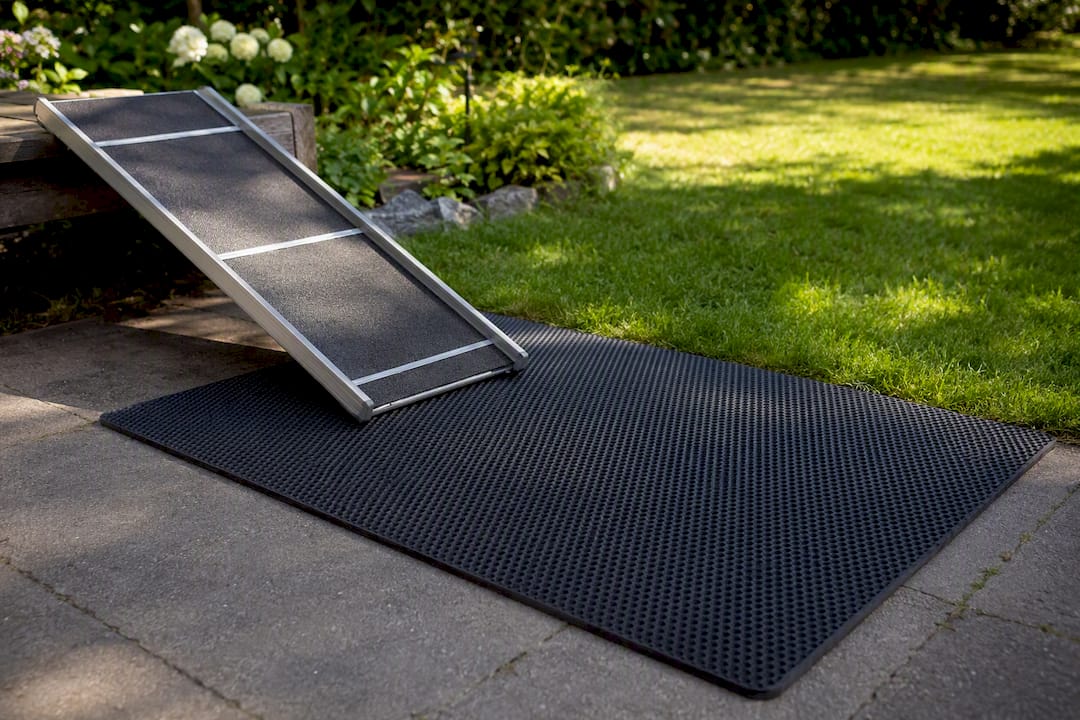
Add side guides or bump stops at the top of a ramp so your dog gets a clear tactile cue before stepping onto solid ground, reducing the chance of overshooting the landing. A low barrier, like a rug anchored at the top edge, gives dogs a visual reference point that meaningfully cuts down on lateral slipping.
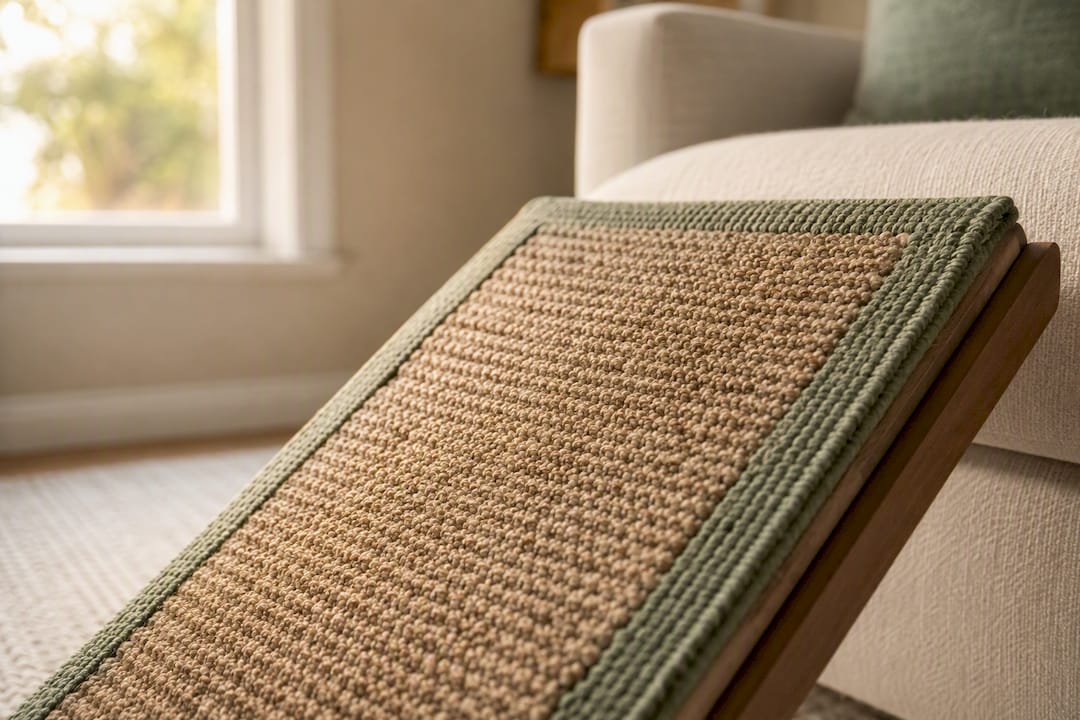
Slope matters more than most owners realize. Canine Arthritis Resources warns that placing a ramp directly over an existing staircase often creates a short, steep incline that’s more dangerous than having no ramp at all. A too-steep angle causes dogs to rush, slip, or refuse the ramp entirely, so a longer, gentler slope beats a compact one every time.
Before each use, run a quick inspection:
- Check for wobble in the legs or frame.
- Look for worn or peeling traction surfaces.
- Confirm hinges are locked if the device folds.
- Verify the bottom won’t shift when weight is applied.
Training Your Dog to Use a Ramp or Stairs
Rushing the introduction is the single biggest reason dogs refuse a ramp or staircase after the first try. Let your dog sniff and explore the device on their own terms first, rewarding any calm investigation with a treat or praise, even if they never step on it that session.
- Start at the lowest, shallowest setting you can manage, whether that means a low step height or a short, gentle ramp angle.
- Run short sessions of two to three minutes, using treats to lure your dog partway up, then gradually further as confidence builds.
- Increase length or angle slowly across several days rather than jumping straight to full height.
- Watch for hesitation versus pain. A dog who freezes, yelps, or refuses repeatedly may be signaling discomfort rather than simple unfamiliarity.
Vetstreet notes that gradual, reward-based introduction matters as much as which device you choose. If resistance continues past a week of patient practice, or your dog shows any sign of pain, loop in a trainer or your veterinarian rather than pushing through it.
Where Ramps and Stairs Fit Into a Bigger Mobility Plan
A ramp or staircase is a tool, not a treatment. The AAHA’s senior care guidelines frame mobility aids as one piece of a multimodal pain-management plan that also includes weight management, appropriate exercise, medication, and rehabilitation. Leaning on a ramp alone while ignoring an underlying arthritis diagnosis just delays the conversation your dog’s joints are already having with you.
A peer-reviewed kinematics study found that ramp ascent increased forelimb joint range of motion more than stair ascent in healthy dogs, suggesting ramps can serve a real rehabilitative purpose when used in controlled, supervised sessions rather than as an all-day, unstructured tool.
Watch for red flags that call for a vet visit rather than a new ramp: sudden reluctance to move, a gait that’s worsening week over week, or any sign of neurologic trouble like knuckling or dragging a paw. In-home rehabilitation therapy can help you integrate a ramp or staircase correctly into your dog’s specific recovery plan instead of guessing at angles and reps on your own.
Pro Tip: Introduce a rehab-grade ramp exercise only under professional guidance if your dog is recovering from surgery. What builds range of motion in a healthy joint can overload a healing one.
Why We Push Owners Past the “Just Buy a Ramp” Advice
In our home visits across South Tampa, we’ve watched dogs thrive once a ramp or staircase gets paired with an actual mobility plan rather than treated as a standalone fix. One senior dog with hip dysplasia went from refusing the car entirely to confidently loading up once we adjusted the ramp angle and added rehab exercises alongside it. If you’re unsure which device fits your dog’s condition, talk to a clinician before guessing.
— Pet Acupuncture & Wellness
Ready to Build a Real Mobility Plan for Your Dog?
Choosing between a ramp and stairs solves the access problem. It doesn’t solve the arthritis, the healing incision, or the stiff hips causing the access problem in the first place. Pet Acupuncture & Wellness brings in-home acupuncture and integrative rehabilitation directly to your South Tampa living room, so your dog gets a mobility plan built around their actual diagnosis, not a one-size-fits-all product recommendation. If your dog is struggling on stairs, hesitant around ramps, or simply slowing down with age, book an in-home evaluation and let’s figure out what’s really going on.
Sources
- Does My Dog Need Dog Stairs or a Ramp? | PetMD
- Does Your Dog Need Dog Stairs or a Ramp? | AKC
- 2023 AAHA senior care guidelines for dogs and cats — pain management
- Kinematics of stair ascent in healthy dogs | Journal of Small Animal Practice
- Assistive devices | Canine Arthritis Resources
FAQ
Do Dogs Prefer Steps or Ramps?
It varies by dog. Some prefer the predictable foot placement of steps, while others feel steadier on a gentle, continuous ramp incline, so patient introduction matters more than assuming a universal preference.
Can You Put a Ramp Over Stairs for a Dog?
Generally, no. Doing so often creates a short, steep slope that increases the risk of slipping, so it’s safer to use a ramp designed for a proper, gradual incline rather than covering an existing staircase.
Is a Ramp or Stairs Better for a Dog With Arthritis?
A ramp is typically better for arthritic dogs, since the gradual incline distributes weight more evenly and avoids the joint-bending motion that steps require.
Do Vets Recommend Dog Steps?
Vets recommend both, depending on the dog. Steps can work well for small, agile dogs without joint pain, while larger or arthritic dogs are usually steered toward ramps as part of a broader mobility plan.