TL;DR:
- Laser therapy for dogs is accessible in South Tampa through local clinics and mobile services, offering a drug-free treatment for pain and healing. It works by using focused light energy to stimulate cellular repair, reduce inflammation, and improve mobility, especially in conditions like arthritis and post-surgical recovery. In-home laser therapy from Pet Acupuncture & Wellness provides personalized, low-stress treatment options tailored to each dog’s needs.
Laser therapy for dogs is available right now in South Tampa, both at local veterinary clinics and through in-home mobile services. If your dog is dealing with arthritis, a recent surgery, or a soft-tissue injury, you can book a session today without ever loading them into the car. Pet Acupuncture & Wellness brings canine laser treatment directly to your home, making it one of the most accessible options for senior, anxious, or mobility-limited dogs in the South Tampa area.
Quick action steps:
- Call or book online to schedule an initial consultation with a local provider or mobile service
- Ask specifically whether they offer Class 4 laser equipment and a written treatment plan
- Confirm whether in-home visits are available for your zip code
Pro Tip: Ask up front about loading-phase package pricing. Clinics and mobile providers often offer bundled rates for the first 3–4 weeks of treatment, which can meaningfully reduce your per-session cost compared to booking one appointment at a time.
Table of Contents
- How does veterinary laser therapy actually work in dogs?
- What conditions in your dog respond well to laser therapy?
- Cold laser vs. Class 4: what should you ask about the equipment?
- What does a laser therapy appointment actually look like?
- How often does your dog need treatment, and when will you see results?
- What does laser therapy for dogs typically cost?
- How do you choose the right local laser therapy provider?
- What does the research actually say about laser therapy for dogs?
- Is laser therapy right for your dog, and when should you combine it with other care?
- How Pet Acupuncture & Wellness delivers in-home laser therapy in South Tampa
- Key Takeaways
- What we’ve seen with in-home laser therapy
- Ready to book in-home laser therapy for your dog in South Tampa?
- Useful sources
- FAQ
How does veterinary laser therapy actually work in dogs?
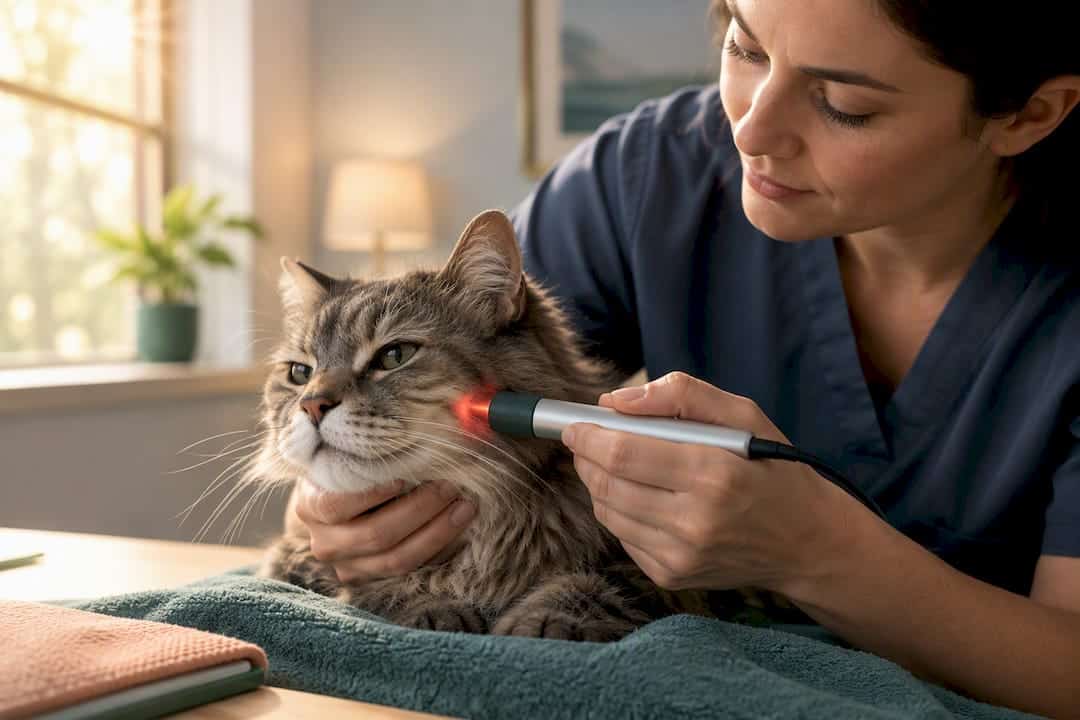
Veterinary laser therapy, more precisely called photobiomodulation (PBM), uses focused light energy at specific therapeutic wavelengths to trigger healing at the cellular level. The light penetrates tissue and is absorbed by mitochondria, which then produce more ATP, the energy currency cells use to repair themselves. The result is a cascade of effects that reduce pain and speed recovery without drugs or incisions.
AAHA describes photobiomodulation as a noninvasive adjunct therapy that decreases inflammation, reduces pain, and supports wound healing, particularly valuable for pets that cannot tolerate systemic medications. For senior dogs already managing kidney disease or GI sensitivities alongside joint pain, that drug-free quality is not a minor detail.
Key physiological effects:
- Increased ATP production, giving damaged cells the energy to repair
- Modulation of inflammatory mediators, reducing swelling and localized heat
- Stimulation of endorphin release, providing natural pain relief
- Improved local circulation, which accelerates tissue clearance and healing
Clinical note: A randomized controlled trial published in the American Journal of Veterinary Research found that dogs with hip osteoarthritis showed measurable improvements in joint range of motion and pain scores within 8–15 days of starting photobiomodulation therapy.
What conditions in your dog respond well to laser therapy?
Most dogs that benefit from laser pain relief fall into a few clear categories. If your dog is slowing down on walks, reluctant to climb stairs, or recovering from a procedure, there is a good chance photobiomodulation is worth discussing with your vet.
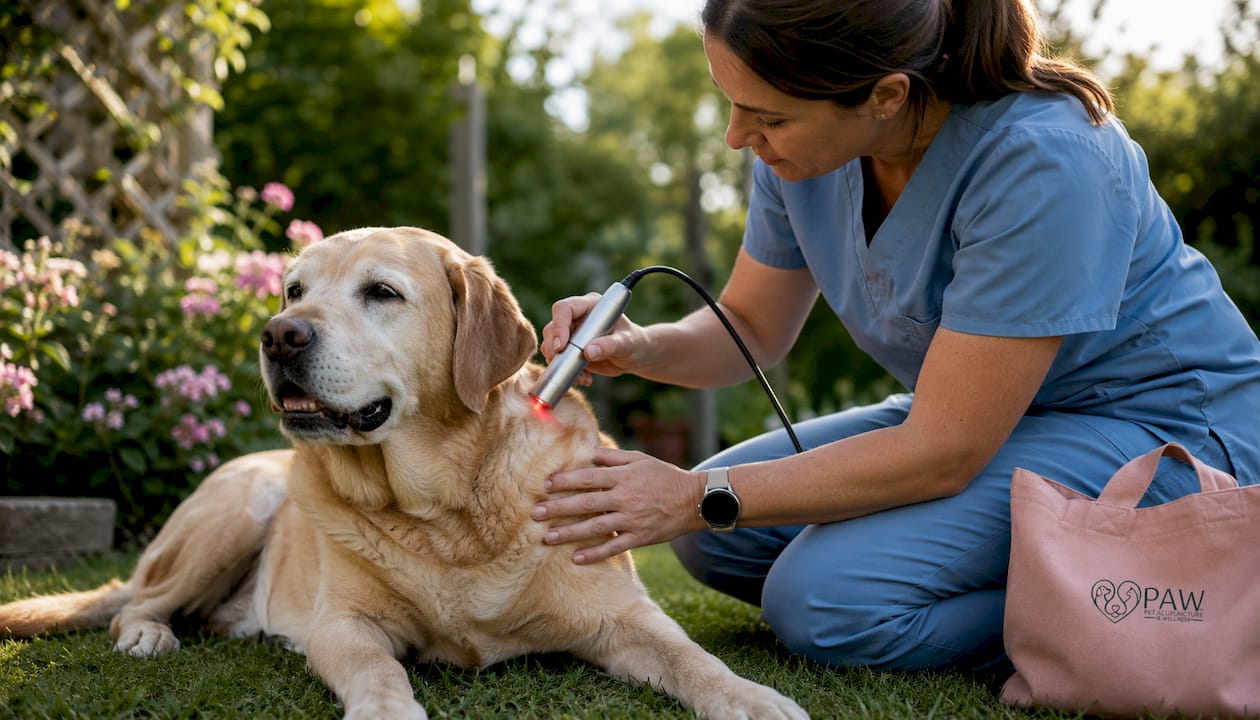
Chewy’s pet health overview notes that cold laser therapy reduces swelling, eases inflammation, and improves mobility, with arthritis and post-surgical wounds among the most common applications.
Conditions that commonly respond well:
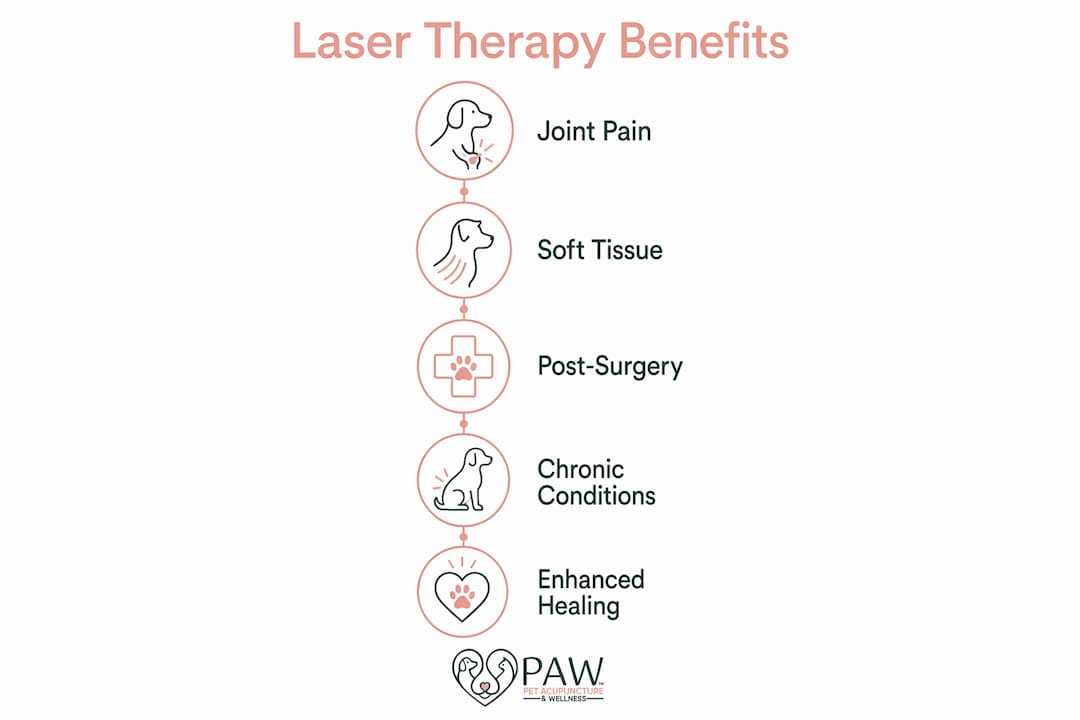
- Osteoarthritis and hip dysplasia: Reduces joint inflammation and pain, often improving willingness to move and overall comfort
- Post-surgical incisions: Accelerates tissue repair and reduces swelling after orthopedic or soft-tissue procedures
- Tendon and ligament strains: Speeds healing of soft-tissue injuries and reduces scar tissue formation
- Intervertebral disc disease (IVDD): Supports nerve healing and reduces inflammation around the spinal cord
- Wound healing: Promotes faster closure and reduces infection risk for chronic or slow-healing wounds
- Periodontal and oral tissue healing: Used after dental procedures to reduce inflammation and support gum recovery
Pro Tip: Deep joint conditions like hip dysplasia and IVDD typically need the higher power output of a Class 4 clinic laser. Superficial wounds and post-surgical skin incisions often respond well to lower-power cold laser devices, which some vets recommend for at-home maintenance between clinic visits.
Cold laser vs. Class 4: what should you ask about the equipment?
Both types of veterinary lasers work through photobiomodulation, but they are not interchangeable. The Merck Veterinary Manual draws a clear clinical distinction: Class 4 lasers deliver deeper tissue penetration and faster analgesia, while lower-power cold lasers are preferred for delicate wound healing and superficial tissue work.
At a glance:
- Class 4 lasers: Higher power output, reach deep joints and muscle tissue, shorter sessions (often 5–15 minutes), used for arthritis, IVDD, and post-op recovery
- Cold/LLLT lasers: Lower power, gentler on delicate tissue, better suited for wounds and surface-level healing, longer session times
- Home devices: Lower power than clinic units, more accessible for daily maintenance, cost-effective for long-term use but generally lack the power density needed for deep joint problems
A best-practice approach pairs clinic Class 4 sessions during the acute phase with a lower-power home device for daily maintenance between visits. This balances clinical power with long-term accessibility and cost.
Pro Tip: When you call a provider, ask two specific questions: “Do you use Class 4 equipment?” and “Can you share the wavelength and power settings you use for my dog’s condition?” A provider who answers both clearly is one who tracks outcomes.
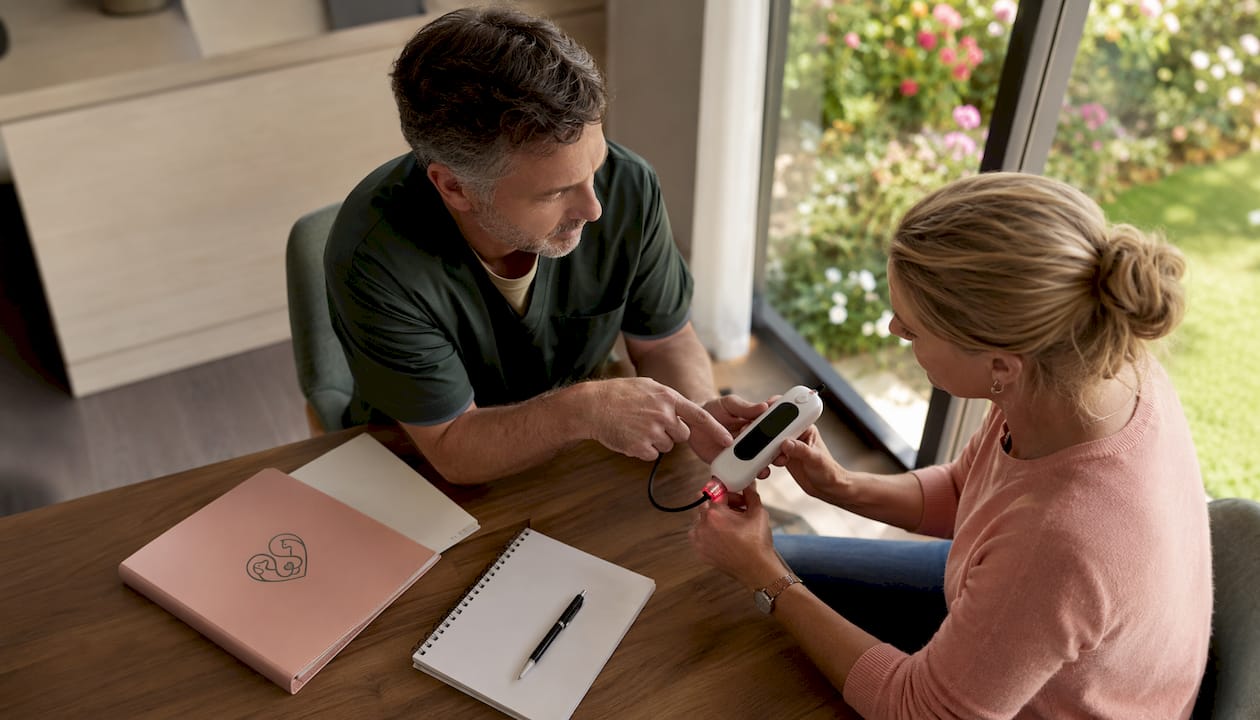
For a deeper look at device differences and what parameters matter, the dog laser therapy machine guide from Pet Acupuncture & Wellness walks through the technical side in plain language.
What does a laser therapy appointment actually look like?
Sessions are calm, painless, and typically last 10–30 minutes depending on the area being treated and the device being used. Most dogs relax or even fall asleep during treatment. There is no sedation, no shaving, and no recovery time afterward.
A typical session, step by step:
- Intake and assessment: The provider reviews your dog’s condition, recent history, and any medications
- Positioning: Your dog is settled comfortably, usually lying down or sitting
- Protective eyewear: Both the provider and your dog wear laser-safe goggles throughout the session
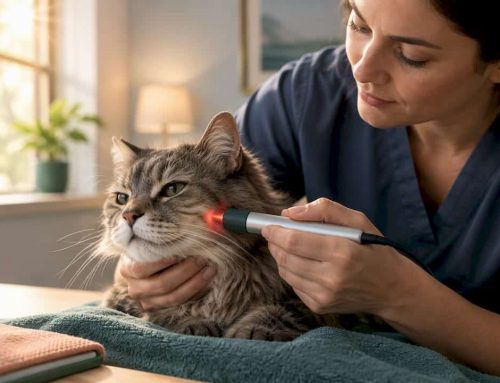
- Probe movement: The laser handpiece is moved slowly over the treatment area in a consistent pattern
- Post-session notes: The provider records the dose delivered and notes any immediate response
Safety matters here. A randomized trial reported no side effects in trial subjects, but real-world practice cautions include the risk of burns if the probe is held stationary too long and retinal injury if proper eyewear is skipped. A qualified provider keeps the handpiece moving and never directs the beam toward the eyes.
Session length note: Most appointments run between several minutes to about half an hour. Class 4 systems finish faster because of higher power output; cold laser sessions on larger dogs may run toward the longer end of that range.
How often does your dog need treatment, and when will you see results?
Most protocols follow a loading phase followed by a taper. AAHA guidance and practitioner experience both point to roughly 3 sessions per week for the first 3–4 weeks as the standard starting point for acute or chronic conditions. After that, frequency typically drops to weekly, then monthly maintenance based on how your dog responds.
A general timeline:
- Weeks 1–4 (loading phase): Three sessions per week; this is when the cumulative effect builds and most owners notice the first signs of improvement
- Months 2–3 (transition phase): Frequency tapers to once weekly; the goal is to sustain gains and assess long-term response
- Ongoing (maintenance phase): Monthly or as-needed sessions to maintain comfort and mobility
Photobiomodulation is cumulative by nature. Stopping after two or three sessions because improvement seems modest is one of the most common reasons owners don’t see the full benefit. The loading phase is the most important predictor of medium-term results.
Pro Tip: Ask your provider about bundle pricing specifically for the loading phase. Paying for 9–12 sessions upfront is almost always cheaper per session than booking individually, and it removes the temptation to stop early when results are still building.
For dogs managing chronic pain at home between clinic visits, the at-home dog pain relief guide covers complementary strategies that pair well with a laser protocol.
What does laser therapy for dogs typically cost?
Per-session pricing at veterinary clinics typically ranges from $25 to $150, with most standard sessions falling in this price bracket. A full loading-phase plan of 9–12 sessions commonly totals $100–$500 or more depending on condition, session count, and clinic type.
What drives the cost:
- Laser class: Class 4 equipment costs more to operate than cold laser units
- Number of sessions: A full loading phase (9–12 sessions) costs more upfront but less per session with bundle pricing
- Dog size: Larger dogs require more energy delivered per session, which some clinics factor into pricing
- Clinic vs. mobile: In-home visits often carry a travel surcharge on top of the session fee
- Region and clinic type: Specialty rehabilitation centers tend to charge more than general practice clinics
Practical steps to manage cost:
- Ask every provider whether they offer package pricing for the loading phase
- Confirm whether the quoted price includes the initial assessment or charges it separately
- Ask about maintenance plan pricing once the loading phase is complete
- For in-home services, clarify the travel fee and whether it applies per visit or per trip
Pairing clinic sessions with a lower-power home device for daily maintenance can reduce long-term costs significantly, since home devices eliminate per-session fees after the initial purchase.
How do you choose the right local laser therapy provider?
The quality of photobiomodulation treatment depends heavily on the provider’s training, equipment, and protocol discipline. A clinic that cannot tell you the wavelength and power settings they use is one that likely isn’t tracking outcomes either.
Positive signals to look for:
- AAHA endorsement or a veterinarian with formal rehabilitation certification (CCRP, CCRT, or equivalent)
- Class 4 laser equipment available for deep-tissue conditions
- A written treatment plan with measurable goals and a defined session count
- Transparent pricing, including package options and travel fees for mobile services
- DVM oversight of all therapy sessions
Red flags:
- Vague answers about equipment class or dose parameters
- No written treatment plan or outcome tracking
- Pressure to commit to long-term packages before an initial assessment
Questions to ask when you call:
- What class of laser do you use, and what wavelengths?
- Do you provide a written treatment plan with a defined number of sessions?
- Is a DVM involved in every session, or do technicians administer therapy independently?
- Do you offer bundle pricing for the loading phase?
- For mobile services: what is the travel fee, and which zip codes do you serve?
Pro Tip: Rehabilitation certifications (CCRP or CCRT) are a meaningful credential signal. They indicate the provider has completed structured post-graduate training in physical rehabilitation, which includes photobiomodulation protocols.
What does the research actually say about laser therapy for dogs?
The clinical evidence supports photobiomodulation for osteoarthritis and soft-tissue healing, but the literature has real limitations worth understanding. A 2023 systematic review found mixed results across studies, largely because of wide variability in treatment protocols: different wavelengths, power levels, session durations, and dosing intervals make direct comparisons difficult.
“The literature review showed conflicting study results and unclear application for clinical use. This can be explained by the wide variety of treatment parameters used in the searched studies, such as wavelength, laser class, dose, and effect, as well as the frequency and duration of treatment.”
— PubMed systematic review, photobiomodulation in veterinary patients
That variability is not a reason to dismiss the therapy. It is a reason to choose providers who document their protocols and track individual outcomes. The randomized controlled trial published in the American Journal of Veterinary Research showed measurable improvements in pain and joint range of motion within 8–15 days, with benefits lasting up to 30 days after treatment ended in many measures.
What the evidence supports:
- Meaningful pain reduction and improved mobility in dogs with osteoarthritis
- Faster soft-tissue and wound healing compared to untreated controls
- A favorable safety profile when protocols are followed correctly
Where the evidence is weaker:
- Long-term outcomes beyond 30 days post-treatment are less well-documented
- Optimal dose parameters (wavelength, power, duration) are not yet standardized across the field
- Fewer high-quality trials exist for conditions like IVDD compared to osteoarthritis
Pro Tip: Ask your provider which specific protocol they follow and whether they track outcomes over time. Providers who reference published dose guidelines and document your dog’s progress are operating at a higher standard than those who apply a generic “laser treatment” without parameters.
Is laser therapy right for your dog, and when should you combine it with other care?
Laser therapy suits most dogs dealing with pain, inflammation, or healing needs, but it is not appropriate in every situation. Always consult your primary vet before starting any new therapy, particularly if your dog has an active diagnosis that may affect treatment safety.
Contraindications and cautions:
- Known or suspected cancer: Never apply laser therapy directly over a tumor or suspected malignancy; photobiomodulation can stimulate cellular activity, which is counterproductive in cancerous tissue
- Pregnancy: Avoid laser therapy over the abdomen in pregnant animals
- Direct eye exposure: The laser beam must never be directed at the eyes; protective goggles are non-negotiable for both the dog and the handler
- Open fontanelles or growth plates in young animals: Use with caution in puppies whose skeletal development is incomplete
- Photosensitizing medications: Some drugs increase light sensitivity; confirm with your vet before starting
Combining laser therapy with other care:
Photobiomodulation works well alongside NSAIDs, physical rehabilitation, acupuncture, and post-surgical recovery protocols. It does not replace your vet’s primary treatment plan; it complements it. For dogs managing degenerative joint disease, pairing laser therapy with joint supplements and an orthopedic sleeping surface can meaningfully improve day-to-day comfort.
Owners looking at alternative pain relief options for dogs who cannot tolerate long-term NSAID use will find photobiomodulation consistently recommended as a first-line adjunct. Supporting joint health with dog joint supplements alongside laser sessions is another layer many integrative vets suggest for chronic conditions.
How Pet Acupuncture & Wellness delivers in-home laser therapy in South Tampa
Pet Acupuncture & Wellness offers mobile, in-home laser therapy throughout South Tampa and nearby Florida communities, bringing the full session directly to your dog’s most comfortable environment. There is no loading into the car, no waiting room, and no unfamiliar smells triggering anxiety before treatment even begins. For senior dogs, dogs with mobility limitations, or pets who find clinic visits stressful, that difference in setting can genuinely affect how well they tolerate and respond to treatment.
What the service includes:
- An initial in-home consultation to assess your dog’s condition and design a personalized treatment plan
- Class-level laser therapy integrated with other available modalities (acupuncture, rehabilitation, herbal support) as appropriate
- Written treatment plans with defined session counts and measurable goals
- Flexible scheduling for loading-phase sessions and ongoing maintenance visits
- Coordination with your primary vet to complement existing care
How booking works:
- Contact Pet Acupuncture & Wellness by phone or through the online booking form to schedule an initial consultation
- The provider reviews your dog’s history, current medications, and primary vet notes before the first visit
- A treatment plan is discussed and agreed upon at the consultation, including session frequency and package pricing
- Sessions are scheduled at your home during available visit windows for your area
- After the loading phase, follow-up appointments are scheduled based on your dog’s response and maintenance needs
What to have ready at home:
- A quiet, comfortable space where your dog can lie down without distraction
- Your dog’s current medication list and any recent vet records
- Protective eyewear if you have it (the provider brings their own as well)
Pro Tip: Let your dog explore the space and settle before the provider begins. A relaxed dog at the start of a session tends to tolerate the handpiece movement better and may show faster improvement across the loading phase.
Pet Acupuncture & Wellness prioritizes low-stress visits for anxious and senior pets, and the in-home setting is a deliberate clinical choice, not just a convenience. Reduced stress lowers cortisol, which can improve inflammatory responses and overall treatment tolerance.
Key Takeaways
Laser therapy for dogs is a well-supported, drug-free option for pain and healing, and in South Tampa, you can access it without leaving your home through Pet Acupuncture & Wellness.
| Point | Details |
|---|---|
| Who benefits most | Senior dogs, post-surgical patients, and dogs with arthritis or soft-tissue injuries are the strongest candidates. |
| Typical cost range | Per-session pricing typically runs $25–$150; full loading-phase plans commonly total $100–$500 or more. |
| Treatment commitment | Plan for roughly 3 sessions per week for the first 3–4 weeks; stopping early reduces effectiveness. |
| Results timeline | Most dogs show measurable improvement within 8–15 days of starting a consistent loading phase. |
| Pet Acupuncture & Wellness | Offers mobile in-home laser therapy in South Tampa, with personalized protocols and low-stress house calls for anxious or senior dogs. |
What we’ve seen with in-home laser therapy
The conversation around photobiomodulation in veterinary medicine has shifted noticeably in recent years. What was once treated as a fringe adjunct is now backed by randomized controlled trials and endorsed by AAHA as a legitimate complement to conventional care. That matters. But what the published literature does not fully capture is how much the setting of treatment affects outcomes for certain patients.
Senior dogs and anxious pets are not just inconvenienced by clinic visits. The stress response is physiological. Elevated cortisol suppresses the very inflammatory pathways that laser therapy is trying to modulate. Treating a dog in their own home, on their own bed, with familiar smells around them, is not a luxury feature. It is a clinical variable.
The other thing worth saying plainly: photobiomodulation is not magic, and it is not a replacement for a thorough diagnosis. Owners who see the most benefit are the ones who commit to the loading phase, ask their provider for protocol specifics, and coordinate with their primary vet. The therapy works best as part of a plan, not as a standalone last resort tried after everything else.
For dogs with arthritis or degenerative joint disease, combining laser therapy with acupuncture, appropriate joint support, and an orthopedic sleeping surface tends to produce better sustained results than any single modality alone. That integrative approach is exactly what Pet Acupuncture & Wellness is built around.
Ready to book in-home laser therapy for your dog in South Tampa?
Your dog does not have to endure a stressful clinic trip to get effective, evidence-based pain relief. Pet Acupuncture & Wellness brings professional laser therapy directly to your home in South Tampa, designed specifically for dogs that need calm, personalized care.
Sessions are tailored to your dog’s condition, with Class-level equipment, written treatment plans, and the option to integrate laser therapy with acupuncture or rehabilitation for a complete care approach. Per-session pricing typically runs $25–$150, with loading-phase packages (covering the first 3–4 weeks at 9–12 sessions) usually totaling $100–$500 or more. In-home visits include a travel component, so ask about the fee for your specific area when you call.
To get started, visit the South Tampa integrative care page or call to schedule your dog’s initial in-home consultation. Come ready with your dog’s medication list and any recent vet records, and the provider will handle the rest.
Useful sources
The following sources informed the clinical claims and cost figures in this article:
- A randomized double-blinded controlled trial on photobiomodulation in dogs with osteoarthritis — American Journal of Veterinary Research; clinical improvements in pain and range of motion observed within 8–15 days
- What Is Veterinary Laser Therapy? — AAHA — authoritative guidance on photobiomodulation as a noninvasive adjunct, loading-phase protocols, and use in medication-sensitive patients
- Photomedicine in veterinary patients — Merck Veterinary Manual — clinical comparison of cold/LLLT and Class 4 laser equipment
- Systematic review on photobiomodulation therapy in veterinary patients — MDPI Animals — 2023 review noting protocol variability and mixed study results
- A Systematic Literature Review of Complementary and Alternative Veterinary Medicine: Laser Therapy — PubMed — broader systematic review covering 45 studies across dogs, cats, and horses
- How Much Does Laser Therapy for Dogs Cost? — Vety — per-session and package cost ranges ($25–$150 per session; $100–$500 for initial plans)
- Cold laser therapy for dogs — Chewy — consumer-facing overview of conditions treated and typical session pricing ($40–$100)
- At-Home Red Light Therapy vs. Vet Clinic Laser Sessions — Lumera Pet — comparison of home device vs. clinic laser trade-offs and combination protocols
Cost reference: Per-session pricing typically ranges from $25–$150 at veterinary clinics, with full loading-phase plans commonly totaling $100–$500 or more depending on condition, session count, and additional fees.
FAQ
How much does laser therapy cost for a dog?
Per-session pricing at veterinary clinics typically runs $25–$150, and a full loading-phase plan covering the first few weeks (9–12 sessions) commonly totals $100–$500 or more, with bundle pricing usually reducing the per-session cost.
Does laser therapy really work on dogs?
Clinical evidence supports it, particularly for osteoarthritis and soft-tissue healing. A randomized controlled trial published in the American Journal of Veterinary Research found measurable improvements in pain scores and joint range of motion within 8–15 days of starting photobiomodulation therapy.
What are two drawbacks of laser therapy for dogs?
The two most practical drawbacks are the cumulative commitment required (stopping the loading phase early significantly reduces benefit) and the protocol variability across providers, which means results depend heavily on the equipment class and dose parameters used.
What is the best laser therapy for dogs near me in South Tampa?
Pet Acupuncture & Wellness offers mobile, in-home photobiomodulation in South Tampa with personalized protocols, DVM oversight, and integration with acupuncture and rehabilitation, making it a strong option for senior, anxious, or mobility-limited dogs who need low-stress care at home.