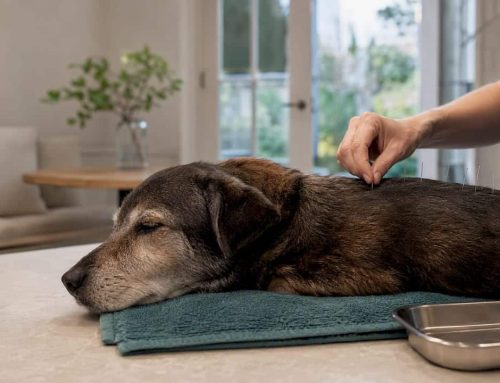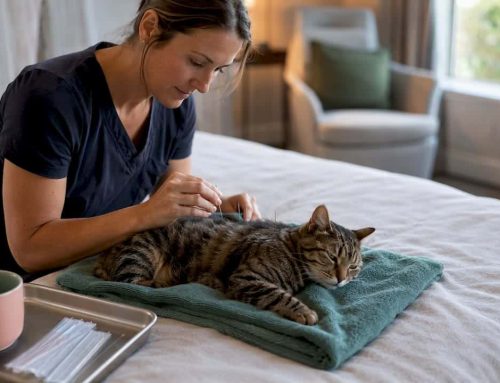
Dog laser therapy side effects are usually mild and short-lived, things like brief soreness or a warm sensation at the treatment site that fades within a day or two. Serious complications like burns or retinal damage are rare and almost always tied to operator error, not the therapy itself. The real contraindications to watch for are treatment over active cancer sites, direct eye exposure, active bleeding, pregnancy, and growth plates in puppies. Safety comes down almost entirely to the skill of the person holding the probe.
TL;DR:
- Serious risks like retinal damage are extremely rare and mostly preventable through proper protective eyewear and correct operator technique.
- Operator error, such as a stationary probe or excessive power settings, significantly increases the chance of superficial burns or tissue irritation.
- Dogs with active cancer, uncontrolled bleeding, or eye exposure should never undergo laser therapy, and pregnant or young animals require customized protocols.
- Most side effects are minor, like warmth or mild redness, and typically resolve within a few days without intervention.
- Consistent documentation of laser settings and careful session management are essential to minimize risks and ensure safety during treatment.
Table of Contents
- What Is Dog Laser Therapy and Why Do Vets Use It?
- What Happens During a Laser Therapy Session?
- Common vs. Serious Side Effects: What to Actually Watch For
- Contraindications and Special Precautions Owners Should Know
- How to Reduce Risk: Questions to Ask Before You Book
- What Does the Research Actually Say About Safety?
- Monitoring After Treatment: When to Call Your Vet
- Our Approach to Safe In-Home Laser Therapy
- Booking In-Home Laser Therapy With Pet Acupuncture & Wellness
- Sources
- FAQ
What Is Dog Laser Therapy and Why Do Vets Use It?
Laser therapy, formally called photobiomodulation or low-level laser therapy (LLLT), uses specific wavelengths of light to trigger changes at the cellular level. The goal is to calm inflammation and speed up tissue repair, not to cut or burn anything, despite the word “laser” sounding intense.
Think of it less like a surgical tool and more like a targeted dose of sunlight aimed at reducing swelling and encouraging cells to heal faster. Devices generally fall into two categories: class 3b lasers, which are lower power and gentler, and class 4 lasers, which deliver more energy and treat larger areas faster but demand tighter operator control because they generate more heat, according to the American Animal Hospital Association.
Veterinarians reach for laser therapy most often for osteoarthritis pain, post-surgical wound healing, and general recovery support after orthopedic procedures. It’s a common companion to acupuncture and rehabilitation work, especially in senior dogs whose joints have simply worn down over time.
One thing owners often get wrong: expecting results after a single session. Benefits build cumulatively, and most treatment plans run multiple sessions before you see the full picture of improvement.
What Happens During a Laser Therapy Session?
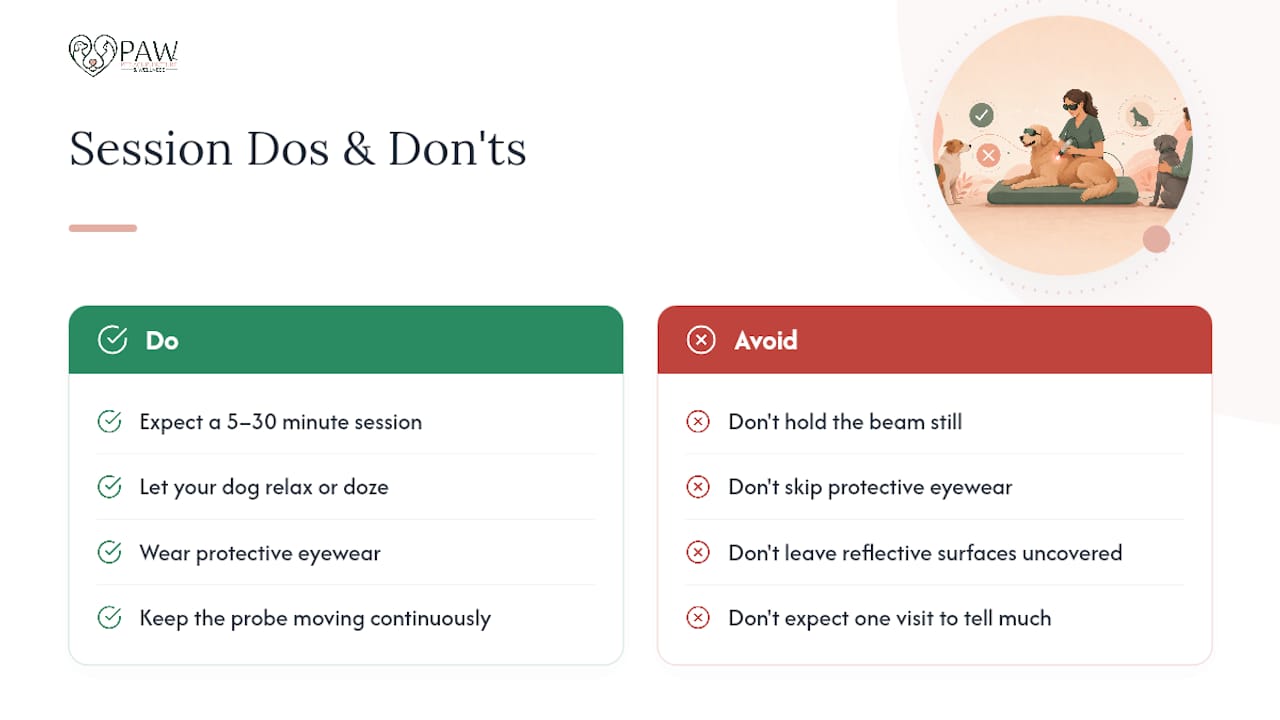
A typical session runs somewhere between 5 and 30 minutes, depending on the size of the treatment area and the condition being addressed. A single sore hip takes less time than a full-body treatment for a dog recovering from surgery.
Most dogs find the sensation genuinely pleasant. The handheld probe delivers a gentle, spreading warmth, and many dogs relax or even doze off partway through. If your dog seems mildly wiggly or unsure at first, that’s normal. Dogs who are anxious about clinical settings in general tend to settle once they realize nothing is poking or pinching.
The clinician’s job during that window is where the real safety work happens. Protective eyewear is non-negotiable, both for the person operating the laser and, when the beam is close to the face, for the dog. The operator should keep the probe moving continuously rather than holding it still in one spot, since a stationary beam is the single biggest driver of thermal injury. Reflective surfaces, like a stainless exam table or a metal tag on a collar, get covered or removed because they can bounce the beam somewhere unintended.
Most conditions call for weekly sessions initially, tapering as the dog improves. That cumulative pattern is why one visit rarely tells you much either way.
Common vs. Serious Side Effects: What to Actually Watch For
Most reactions to laser therapy for dogs are minor and predictable. The uncommon and rare categories are where real vigilance matters.
Common, expected reactions usually resolve on their own within 24 to 72 hours:
- Mild warmth or a slightly flushed appearance at the treatment site
- Transient soreness, similar to how a deep tissue message can leave you a little tender the next day
- Occasional mild redness that fades without intervention
Uncommon, operator-related harms happen when technique slips:
- Superficial burns, almost always from a stationary probe or power settings that run too high for the tissue and coat thickness involved
- Localized tissue irritation from repeated passes over the same small area
Rare but serious risks are the ones that justify real caution:
- Retinal damage from direct or reflected beam exposure, which is why eye protection protocols exist in the first place
- Deeper burns in cases of significant operator error or equipment malfunction
A retrospective study of 17 dogs treated weekly for osteoarthritis pain over six weeks reported meaningful pain score improvements and no laser-related side effects among the dogs studied. Other trials examining photobiomodulation for canine mobility have occasionally noted minor, localized reactions like itching, redness, swelling, or pigment changes, but nothing that pointed to a systemic pattern across dogs or studies.
Pro Tip: Ask whether your dog’s provider tracks laser settings session to session. A clinic that documents wattage and treatment time isn’t being bureaucratic. It’s the same habit that keeps burn risk low.
The throughline across nearly every documented complication is the same: operator technique, not the underlying therapy, is the variable that determines whether a session goes smoothly.
Contraindications and Special Precautions Owners Should Know
Certain conditions rule laser therapy out entirely, and others simply call for a modified approach. The Merck Veterinary Manual lists the clearest boundaries in veterinary photomedicine.
Absolute contraindications, meaning laser therapy should not be used at all in these circumstances:
- Direct or indirect exposure to the eyes
- Active hemorrhage or uncontrolled bleeding at the treatment site
- Known malignancy located in or near the treatment area, since stimulating blood flow to a tumor site is not a risk worth taking
Situations requiring caution or a modified protocol:
- Pregnancy, where data on fetal safety is limited enough that most practitioners avoid treatment altogether
- Young animals with open growth plates in long bones, where energy delivery near active growth zones needs a conservative approach
- Patients on photosensitizing medications, which can change how tissue responds to light exposure
- Dogs receiving liposomal bupivacaine or similar drug-delivery systems, since one proof-of-concept study testing photobiomodulation near liposomal bupivacaine found no premature drug release at the settings tested, but the cadaver-based design and single device tested mean the researchers themselves urged caution before assuming that holds across every device and setting
Any dog with a cancer history or a complex medication list deserves a conversation with the treating veterinarian before laser therapy gets added to the plan. A responsible provider documents that discussion, notes the settings used, and adjusts the protocol rather than running a standard session on a nonstandard patient.
How to Reduce Risk: Questions to Ask Before You Book
Vetting a laser therapy provider takes about five minutes of conversation, and it’s worth every second of it.
- What class of laser do you use, and why? A class 4 device moves faster but runs hotter, so ask how they manage that extra heat.
- Are goggles worn by everyone in the room, including the dog when appropriate? This should be an automatic yes, not a hesitant one.
- How do you decide power and time settings for my dog specifically? Coat thickness, skin pigment, and body condition all change the math.
- What does follow-up look like? A provider who tracks progress across sessions is treating this as medicine, not a one-off spa service.
Red flags to walk away from: a provider who holds the probe still instead of moving it continuously, skips eyewear “because it’s quick,” or can’t explain their settings in plain language.
At home after a session, keep an eye on the treatment site for the first day, skip anything that increases sun sensitivity if your dog is on a photosensitizing medication, and let your dog rest rather than jumping straight into a hard hike. Related reading on safe at-home laser sessions covers eyewear and positioning in more depth if your dog is receiving mobile treatment.
What Does the Research Actually Say About Safety?
The evidence base for canine laser therapy is smaller than owners might assume, and that’s worth being honest about rather than glossing over.
The strongest available data comes from a handful of trials. The retrospective osteoarthritis study of 17 dogs found significant pain improvement and no laser-related side effects, but a sample that size can’t rule out rare complications. A randomized controlled trial on photobiomodulation for canine osteoarthritis found mobility improvements in some dogs, with adverse events reported as uncommon, though the study notes that trials vary widely in device type and settings, which limits how confidently results generalize across every laser on the market.
A single study reporting zero side effects in its sample doesn’t mean every device or protocol carries zero risk. Wavelength, power, pulse frequency, and total energy delivered vary enough between machines that a clean safety record on one device says little about another.
That variability is exactly why the Merck Veterinary Manual and AAHA both put so much weight on operator technique and protective eyewear rather than on any single device spec. What remains genuinely unsettled: whether any device class carries a long-term risk near tumor sites hasn’t been proven either way, and most trials are still too small or too short to answer that with confidence.
- Small sample sizes limit how far any single study’s safety findings can be generalized
- Device and protocol variation across studies makes cross-comparison difficult
- Conservative dosing and documented settings are what separate a well-run session from a risky one
Monitoring After Treatment: When to Call Your Vet
Most reactions resolve within 24 to 72 hours. Warmth or mild soreness right after a session is expected and should fade on its own, with real functional gains showing up gradually across multiple sessions rather than overnight.
Contact your veterinarian promptly if you notice:
- Redness or discomfort that worsens instead of improving
- Any blistering or skin breakdown at the treatment site
- Sudden vision changes or unusual eye behavior
- Significant swelling or any signs of a systemic reaction, like lethargy or fever
If something looks off, snap a photo, note the time it appeared, and have your session details on hand (settings, duration, treatment area). A good provider will use that information to adjust power settings, pause treatment, or refer you for further evaluation.
Our Approach to Safe In-Home Laser Therapy
Treating a nervous senior dog on their own living room floor changes the calculus for safety. A responsible provider trains for that setting specifically: trained staff, documented laser settings for every dog, protective eyewear as standard, and conservative dosing rather than pushing power to shorten session time. Laser therapy is recommended when a dog’s condition and temperament fit it well, with acupuncture, rehabilitation, or referral considered when appropriate.
— Pet Acupuncture & Wellness
Booking In-Home Laser Therapy With Pet Acupuncture & Wellness
Pet Acupuncture & Wellness is the alternative to a clinic waiting room for South Tampa dogs who find travel and exam tables genuinely stressful. Bringing laser therapy into your own home means your dog stays on familiar ground, and treatment sessions run at their pace instead of a packed clinic schedule.

Booking starts with an in-home assessment where we walk through your dog’s history, explain the settings we plan to use, and build a safety plan specific to their age, coat, and condition, whether that’s osteoarthritis, post-surgical healing, or general mobility support. Follow-up is built in from the start, so you’re never guessing whether the plan needs adjusting. If your dog’s case calls for a complementary approach, we can pair laser sessions with in-home acupuncture or rehabilitation therapy as part of one coordinated plan. Reach out to schedule an assessment and find out whether in-home laser therapy fits your dog’s needs.
This article is general information, not a substitute for advice from a qualified doctor. Consult a qualified healthcare professional about your own circumstances before acting on anything here.
Sources
- Photomedicine in Veterinary Patients – Merck Veterinary Manual
- What is veterinary laser therapy? – AAHA
- Preliminary clinical experience of low-level laser therapy for the treatment of canine osteoarthritis-associated pain
- Proof-of-concept study on photobiomodulation and liposomal bupivacaine – AJVR
FAQ
Is Laser Therapy Worth It for Dogs?
For dogs with osteoarthritis or slow-healing wounds, most owners see it as worthwhile. Studies have reported real pain score improvements with few or no observed side effects, though results depend heavily on operator skill and consistent follow-through across sessions.
How Long Do the Effects of Laser Therapy Last on a Dog?
A single session’s warmth and soreness resolve within 24 to 72 hours. The therapeutic benefit, like reduced joint pain or faster wound healing, tends to build across a series of four to eight sessions and can last weeks to months depending on the underlying condition.
What Is the Average Cost of Laser Therapy for Dogs?
Pricing varies by region, device class, and treatment area, and it’s worth getting a direct quote from your provider. Our laser therapy cost breakdown walks through the main factors that affect pricing.
Who Should Not Get Laser Therapy?
Dogs with active malignancy at the treatment site, active bleeding, or pregnancy generally should not receive laser therapy. Extra caution applies to puppies with open growth plates and dogs on photosensitizing medications, and any eye exposure is off the table entirely.