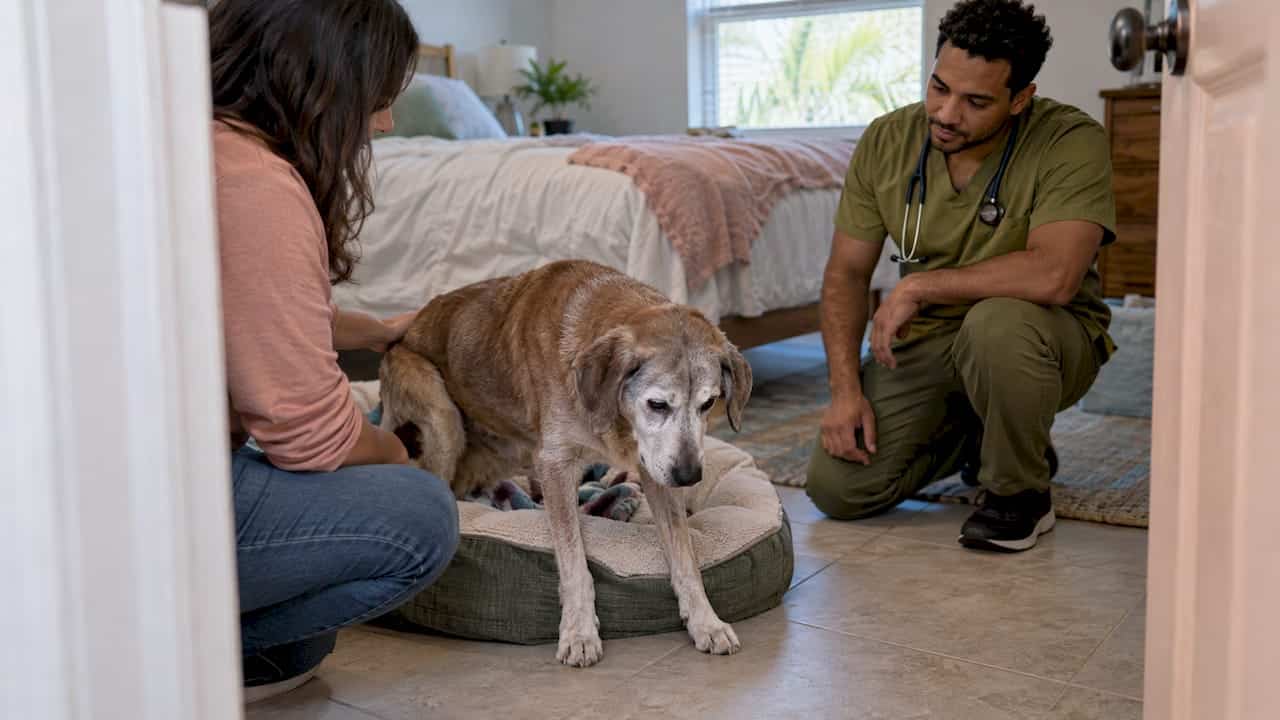
If your dog has been diagnosed with intervertebral disc disease (IVDD), home is where most of the recovery happens. Your veterinarian decides whether the case is medical or surgical. You and your dog then spend weeks together on rest, medication, safe movement and, when cleared, rehabilitation. This guide covers what that looks like and when home care is not enough. It also covers how in-home integrative care can take the strain off both of you. In South Tampa, we bring that care to your living room, so a dog who hurts never has to ride to a clinic.
TL;DR
- Home care suits dogs who are still walking, with pain or mild weakness, and a veterinarian has examined them. A dog who cannot stand, or who is losing movement, needs urgent care.
- Strict rest, prescribed medication and short, supported bathroom breaks are the core of conservative care. Never give human pain relievers.
- Once your veterinarian clears it, rehabilitation helps rebuild strength and comfort. It can be done at home.
- We work alongside your regular veterinarian with acupuncture, laser, rehab and herbal support in your home in South Tampa.
Table of Contents
- What IVDD is, in plain words
- When home care is not enough
- The shape of conservative care at home
- Comfort without risk
- What the recovery numbers say
- Rehabilitation: where home care becomes active
- What a mobile visit looks like and what it costs
- Promo: IVDD support at your door in South Tampa
- Our perspective
- FAQ
- Sources
What IVDD is, in plain words
Between each pair of spinal bones sits a disc that works like a cushion. In some dogs, especially short-legged breeds such as dachshunds, the disc hardens and degenerates early. Cornell’s Riney Canine Health Center explains that in the most common form the disc’s center can burst through its outer layer and press on the spinal cord. Signs include weakness in the back legs, knuckling (walking on the tops of the paws), wobbliness, neck or back pain, and in severe cases paralysis.
You may notice it first as small changes: your dog hesitates at the couch, yelps when picked up, or hunches and trembles. Those quiet signs matter. Early veterinary attention gives your dog the most options.
When home care is not enough
Home care is a partnership with a veterinarian, never a substitute for a diagnosis. Please go to an emergency hospital or a veterinary neurologist right away if you see any of these:
- Your dog cannot stand or walk, even a step.
- Pain is moderate to severe despite medication.
- Your dog has not urinated in more than 24 hours. Remedy Vets lists these as emergency signs.
- Weakness is getting worse from hour to hour.
Timing can change the outcome. A neurology specialist writing in Veterinary Practice News notes that early surgery within 24 to 48 hours of losing the ability to walk can mean the difference between full recovery and permanent paralysis. If you see symptoms start, note the time and tell the veterinarian.
How vets decide between surgery and rest
The 2022 ACVIM consensus statement says dogs who can still walk can be managed medically. Surgery should be considered when signs progress, fail to improve, or pain persists despite medication. For dogs who cannot walk but still feel their toes, surgery is recommended, and it is recommended for paralyzed dogs with no deep pain sensation. For that last group, medical management rarely succeeds.
The same panel says a medical attempt is reasonable at every grade when surgery is not possible, for example because of cost or health. You are not alone in that decision. As one DVM360 report puts it, the choice comes down to your dog’s neurologic status and also the family’s finances. Many families land on conservative care, and it deserves to be done well.

The shape of conservative care at home
A typical plan for a dog with pain only, or mild weakness, has a few parts. Your veterinarian sets the details for your dog.
- Strict rest. Veterinary Practice News describes strict cage rest for at least four weeks, along with anti-inflammatories, pain management and muscle relaxants. Rest gives the injured disc time to settle.
- Medication exactly as prescribed. Your veterinarian chooses what fits your dog.
- Careful toileting. Short, supported trips outside, never free roaming.
- A gradual return to activity. Slow, on flat ground, and only when your veterinarian says so.
- Rehabilitation once cleared, to rebuild strength and confidence.
Setting up the resting space
Choose a crate or exercise pen where your dog can stand, turn around and lie down, but cannot run or jump. Add a thick, non-slip mat or foam bed. Put water within easy reach. Place the crate where the family spends time, because a dog who can see you stays calmer. For a dog who is resting alone all day, calm company matters as much as the crate.
Traction is the quiet danger at home. Put runners or yoga mats over slick floors, block stairs, and keep couches and beds off limits, or add ramps. Prevention advice from veterinary hospitals consistently pairs recovery with weight control and fewer jumps.
Lifting and carrying
Support the whole body. Slide one hand under the chest and the other under the hindquarters, and keep the spine straight and level, never sagging or twisting. Lift close to your body, and don’t let your dog scramble out of your arms. For larger dogs, ask a second person to help, or use a towel or sling under the belly. Avoid massaging the back on your own while the disc is injured.
Bathroom breaks and bladder care
Bladder care is one of the most important parts of aftercare. The authors in Today’s Veterinary Practice point to bladder management, including keeping the bladder empty, as the most important component. If your dog is not urinating, dribbles, or seems unaware of leaking, call your veterinarian that day. A full bladder that can’t empty is not something to wait on.
For dogs who can walk, keep trips short and on a leash, with a harness rather than a collar if the neck hurts. Come straight back inside to the crate.
Comfort without risk
Watching a dog hurt is hard, and the urge to do something is strong. These choices protect your dog:
- Never give human pain relievers. Ibuprofen, naproxen and acetaminophen can be toxic to dogs. Only give what your veterinarian prescribed, at the dose and schedule written on the label.
- Don’t combine medications on your own. Anti-inflammatory drugs and steroids in particular are not meant to be given together, so ask before adding anything.
- Keep the environment calm. Soft light, quiet, a familiar blanket and gentle talking help a dog settle.
- Skip back braces unless your veterinarian recommends one. There’s no good evidence they help.
- Write down changes. Appetite, toileting, how your dog moves from the crate, and any yelping help your veterinarian adjust the plan.
Once the acute phase passes, integrative therapies can sit alongside the medications. Our guide to at-home dog pain relief explains the options we use in the home.
What the recovery numbers say
Outcomes depend heavily on how much function your dog has at the start. In a 2022 study of 40 dachshunds treated with nonsurgical rehabilitation, 85% regained functional pet status by 12 weeks. All 27 dogs who could still move their legs at the start recovered. Seven of nine paralyzed dogs with deep pain sensation recovered. Recurrence was 5% at one year and 11.3% at two years. The authors note that this path still takes real time and money from the owner.

DVM360’s review reports around 90% recovery for grades 1 and 2 with either medical or surgical care. For paralyzed dogs, surgery generally does better, which is why those dogs need a specialist quickly. Numbers describe groups, not your dog, so use them to frame a conversation with your veterinarian, not as a promise.
Rehabilitation: where home care becomes active
Resting protects the spine, but muscles weaken quickly while a dog is crated. Texas A&M’s veterinary hospital says physical rehabilitation, including active weight-bearing exercises, passive range of motion and electrical muscle stimulation, can dramatically shorten recovery time and prevent muscle loss. Today’s Veterinary Practice notes that rehab is recommended case by case, and even when walking does not improve, quality of life may.
That is the place home care shines. Your dog practices on the floors and in the hallways where life actually happens. A rehabilitation plan can be shaped around your home, your stairs and your dog’s own confidence. Our pages on paralyzed dog home rehab, home exercises after surgery and balance exercises show what early, safe movement looks like. If you are weighing gear such as slings and carts, see our guide to rehabilitation equipment.
Acupuncture and laser for disc pain
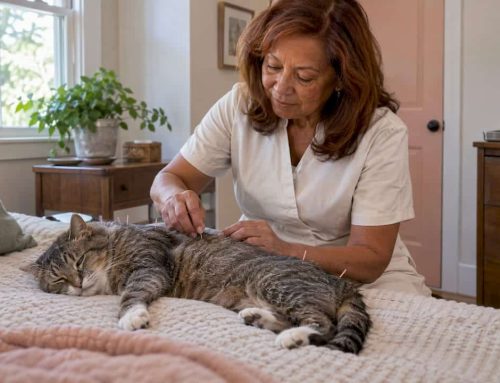
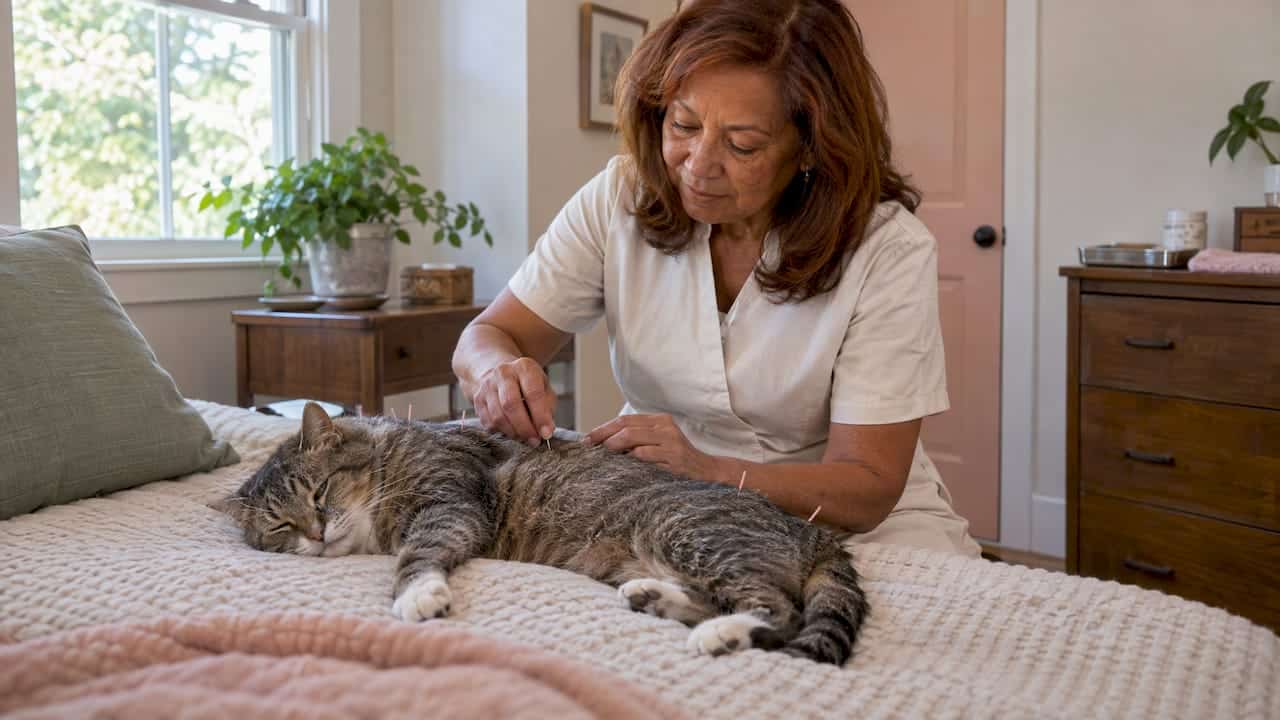
In Traditional Chinese Veterinary Medicine, we think of Qi, the body’s energy, traveling along meridians like a highway system. When a pathway is blocked by pain and tension, acupuncture aims to restore its flow. Many owners of senior dogs choose it to ease chronic back discomfort alongside conventional care. Read more in our guide to acupuncture for degenerative disc disease. We also offer laser therapy, a gentle, quiet treatment most dogs tolerate while lying on their own bed. Herbal and food therapy can round out a plan, and you can explore them in our dog herbal remedies guide.
What a mobile visit looks like and what it costs
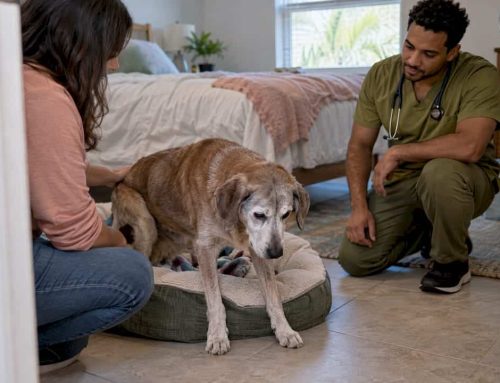
Many IVDD dogs hurt when they are moved. A car ride, a waiting room and a slick exam table can undo a week of rest and frighten a dog who is already anxious. A house call removes all of that. Your dog stays on a familiar bed, you stay calm, and your regular veterinarian stays in the loop.
These are our published prices as of September 2026:
| Service | Published price |
|---|---|
| Initial assessment and acupuncture with a technician | from $430 |
| Technician mobile fee | $60 |
| Laser treatment | $45 to $120 per treatment |
| Electroacupuncture | $30 |
| At-home rehabilitation packages | $85 to $918 |
| Vitamin B12 injection | $31.50 |
See the full list on our cost of services page. Telemedicine, herbal therapy, food therapy and acupressure are also available, and you can reach them through the pages linked below.
Promo: IVDD support at your door in South Tampa
If your dog has an IVDD diagnosis and your veterinarian has cleared complementary care, we can come to you. Pet Acupuncture & Wellness offers in-home acupuncture, laser, rehabilitation, herbal therapy and food therapy for senior, disabled and anxious dogs in South Tampa, with plans tailored to your pet and your home and coordinated with your regular veterinarian.
Start with rehabilitation therapy, or visit our main page to book. If you are unsure whether a house call fits, our telemedicine consultations are a gentle first step.
Our perspective
We meet many families at the hardest moment: a dog who was leaping onto the couch last month now needs to be carried. The most common thing we hear is fear, of the diagnosis, of the crate, of the car ride.
Our view is that IVDD care works best when it is calm, consistent and close to home. A dog who is not frightened rests better. A family who feels supported follows the plan more faithfully. That is why every plan we make is built around the pet’s own home and health needs, and why we work alongside the regular veterinarian who made the diagnosis, never in place of them.
We believe integrative care belongs next to conventional care. Acupuncture, laser, rehabilitation and herbal support are designed to help your dog stay comfortable and keep moving as safely as possible, while medication and rest do their work.
Above all, we want you to feel less alone in this. Your dog does not need heroics. Your dog needs you nearby, a soft bed and a steady plan.
Pet Acupuncture & Wellness
FAQ
Can IVDD in dogs be managed without surgery?
Often, yes, especially when a dog can still walk and has pain or mild weakness. The ACVIM consensus says ambulatory dogs can be managed medically. It recommends surgery when signs worsen, or for dogs who cannot walk. Your veterinarian will help you choose.
How long does a dog with IVDD need strict rest?
A board-certified neurologist in Veterinary Practice News describes at least four weeks of strict rest for medically managed dogs. Your veterinarian may extend that depending on how your dog responds. Activity returns gradually and only with their approval.
What should I never give my dog for IVDD pain?
Never give human pain relievers such as ibuprofen, naproxen or acetaminophen, because they are toxic to dogs. Give only the medicines your veterinarian prescribed, exactly as directed, and don’t combine them without asking. Call your veterinarian if pain seems to break through.
Can rehabilitation really be done at home?
Yes, once your veterinarian has cleared it. Texas A&M notes rehab can shorten recovery and help prevent muscle loss. We bring a plan to your home in South Tampa and shape it around your floors, stairs and routines.
Sources
- Chondrodystrophy and intervertebral disc disease, Cornell Riney Canine Health Center
- ACVIM consensus statement on diagnosis and management of acute canine thoracolumbar IVDD
- Nonsurgical Rehabilitation in Dachshunds With T3-L3 Myelopathy
- Managing IVDD: When to medicate, when to refer, Veterinary Practice News
- Making the cut: Surgical versus medical management of canine disk disease, DVM360
- Intervertebral Disk Disease in Dogs, Today’s Veterinary Practice
- Intervertebral Disk Herniation, Texas A&M Veterinary Medical Teaching Hospital
- Conservative IVDD Treatment for Dogs, emergency signs