Food therapy is a veterinary-guided way to use specific foods and herbs as a complementary treatment tailored to your dog’s constitution and medical needs. It draws on Traditional Chinese Veterinary Medicine (TCVM), which is taught in credentialed veterinary courses like Chi University’s Certified Veterinary Food Therapist program, so it isn’t a home remedy fad. Owners typically turn to it for:
- Chronic skin and allergy flare-ups
- Digestive upset and picky appetite
- Kidney support in aging dogs
- Arthritis and stiffness in senior pets
Some dietary adjuncts show real, measured results. A randomized controlled trial on Fortetropin found statistically significant mobility improvements in senior dogs by week six. Food therapy works alongside your vet’s diagnosis and treatment plan at Pet Acupuncture & Wellness, not instead of it. If your dog shows sudden vomiting, lethargy, or refuses food for more than a day, that calls for urgent veterinary evaluation first.
Key Takeaways
Food therapy works best as a slow, personalized adjunct to conventional veterinary care, not a standalone fix for acute illness.
| Point | Details |
|---|---|
| Match food to constitution | Warming foods suit cold, sluggish dogs; cooling foods suit hot, inflamed ones. |
| Expect gradual results | Dietary adjuncts like Fortetropin showed measurable gains only after six weeks. |
| Never DIY a chronic diagnosis | Kidney, liver, and metabolic disease need a vet-formulated plan, not home experiments. |
| Trial one change at a time | Document baseline, change one ingredient, monitor a week, then recheck with your vet. |
| Book an in-home evaluation | Pet Acupuncture & Wellness builds personalized food therapy plans during mobile visits in South Tampa. |
Table of Contents
- What Is Food Therapy for Dogs, Really?
- Which Health Conditions Respond to Food Therapy?
- What Happens During a Food Therapy Consultation?
- How Can You Safely Try Food Therapy at Home?
- What Are the Risks and Limits of Food Therapy?
- How Pet Acupuncture & Wellness Brings Food Therapy Home
- Editorial Perspective: Where Food Therapy Delivers and Where It Overpromises
- Ready to Try Food Therapy the Right Way?
- Sources
- FAQ
What Is Food Therapy for Dogs, Really?
Nutrient counting asks “does this meet AAFCO minimums?” Food therapy asks a different question: “does this food’s nature match what my dog’s body needs right now?” It’s a formal branch of TCVM that classifies every ingredient by its energetic effect on the body, not just its calorie or protein content.
The core tool is thermal classification. Foods are sorted as hot, warm, neutral, cool, or cold based on how they tend to affect the body:
- Warming foods (lamb, chicken, ginger) suit dogs who run cold, tire easily, or seem sluggish
- Cooling foods (rabbit, duck, watermelon) suit dogs prone to inflammation, itching, or restlessness
- Neutral foods (most fish, pork, sweet potato) form a safe base for almost any constitution
Personalization matters as much as the classification itself. A veterinarian trained in food therapy weighs your dog’s constitution, age, the season, and the specific disease pattern before recommending anything. A hot, itchy Labrador in July gets a very different plan than a frail, cold-natured senior Chihuahua in January. This isn’t new age guesswork. Practitioners have refined these classifications over centuries, and Chi University now teaches them through hands-on clinical labs to working veterinarians.
Which Health Conditions Respond to Food Therapy?
Food therapy earns its keep in a handful of specific clinical situations, and knowing which ones sets realistic expectations before you start.
- Skin and allergy support. Cooling proteins like duck or white fish often get paired with anti-inflammatory omega-3s to calm chronic itching, working alongside topical or medical treatment rather than replacing it.
- Gastrointestinal issues and appetite loss. Novel, easily digestible proteins can settle a sensitive gut and tempt a dog who’s gone off its food, especially useful during recovery from illness.
- Kidney and liver disease. Diet becomes a primary management tool here, with careful protein and phosphorus adjustments. Read our nutrition guidance for dogs with kidney disease before making changes at home.
- Arthritis and mobility decline. Warming proteins combine with joint-support nutrients, and adjuncts like Fortetropin have shown mild but statistically significant LOAD score improvements at six and twelve weeks in senior dogs. A systematic review of aging-dog diets also links omega-3s and MCTs to better cognitive and mobility outcomes.
- Anxiety and behavioral support, usually as one piece of a larger multimodal plan alongside acupuncture or rehab.
What Happens During a Food Therapy Consultation?
A real consultation looks nothing like a quick diet swap suggested online. It’s a structured process built around your dog’s actual medical history.
Before the appointment, gather recent bloodwork, a detailed diet history (brands, treats, table scraps included), and photos showing your dog’s body condition and coat. Bring notes on stool quality and energy levels over the past few weeks.
During the visit, the veterinarian reviews conventional findings like weight trends and lab values alongside TCVM assessment elements, including tongue color and pulse quality, which offer clues about internal heat, cold, or deficiency patterns. You’ll leave with a written diet plan, not a verbal suggestion.
Most plans include a trial phase of several weeks, followed by a recheck to confirm the dog is responding well and staying nutritionally balanced. University-based nutrition services often bill the initial consult and the written diet plan as separate line items, a structure worth expecting rather than assuming is bundled.
How Can You Safely Try Food Therapy at Home?
Small, documented changes beat wholesale diet overhauls. Here’s how the warming and cooling categories break down for common proteins:
| Category | Examples | Best suited for |
|---|---|---|
| Warming | Lamb, chicken, ginger, oats | Cold-natured, sluggish, or arthritic dogs |
| Neutral | Pork, most fish, sweet potato, carrots | Safe base for most dogs, any season |
| Cooling | Rabbit, duck, watermelon, egg whites | Itchy, inflamed, or restless dogs |
Toppers should stay simple and measured. A spoonful of plain pumpkin or a small portion of cooked rabbit is very different from unmeasured MCT oil poured over kibble, which can trigger loose stool or, in dogs prone to pancreatitis, a genuine emergency.
A safe trial follows four steps: document your dog’s current stool quality, appetite, and energy for a week. Introduce one single change. Watch closely for a week. Then recheck with your vet before adding anything else.
Pro Tip: If your dog has a diagnosed chronic illness like kidney disease, don’t experiment with home-cooked swaps alone. Ask your vet about converting to a veterinary-formulated therapeutic diet that already balances the energetics with the exact nutrient profile your dog needs.
What Are the Risks and Limits of Food Therapy?
Home cooking without guidance carries real risk. Veterinary reviews of internet dog-diet recipes have found that most fail to meet complete nutritional standards, often falling short on calcium, zinc, or specific amino acids over time.
Food therapy is not the right tool for acute emergencies, unstable metabolic disease, or a dog in active crisis. It’s an adjunct, valuable for long-term management, not a substitute for diagnosis and immediate treatment when your dog is seriously ill. High-fat homemade toppers also raise pancreatitis risk in predisposed breeds, and some herbal additions can interact with prescription medications.
Call your veterinarian immediately if your dog shows any of these signs:
- Repeated vomiting or diarrhea lasting more than a day
- Refusal to eat for over 24 hours
- Sudden lethargy, collapse, or pale gums
- Abdominal pain or a hunched posture
How Pet Acupuncture & Wellness Brings Food Therapy Home
Pet Acupuncture & Wellness builds food therapy into the same integrative toolkit we use for acupuncture, rehabilitation, and herbal treatments, all delivered as mobile veterinary care in South Tampa. For a senior dog with arthritis or a cat too anxious to travel, that combination matters.
A typical in-home visit includes a full history review and TCVM assessment in your own living room, a personalized food therapy plan matched to your pet’s constitution and current diagnosis, and follow-up support to adjust the plan as your pet responds. Food therapy often pairs with acupuncture or rehab for compounding benefit, and in-home follow-up may help improve compliance and consistency of the therapeutic plan.
Editorial Perspective: Where Food Therapy Delivers and Where It Overpromises
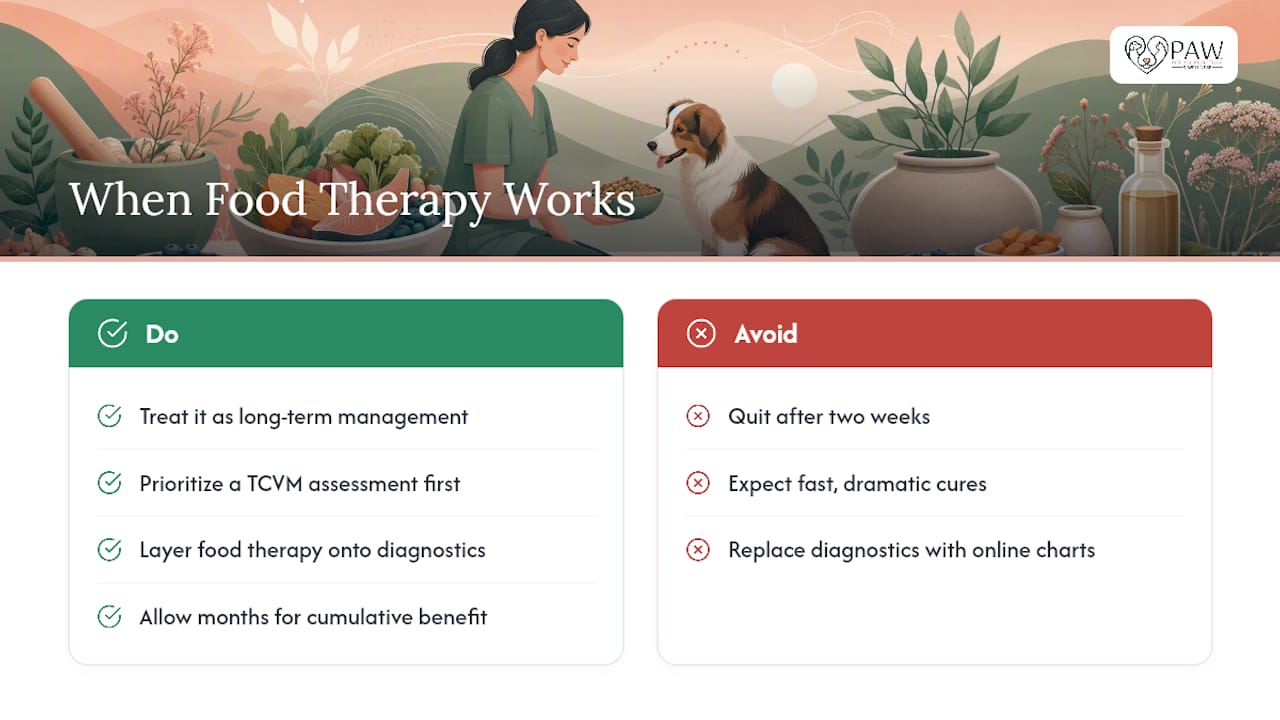
The biggest misconception about food therapy isn’t that it’s fake. It’s that people expect it to work like medicine, fast and dramatic. It doesn’t. The evidence, including the Fortetropin trial’s mild but statistically significant results, points to slow, cumulative benefit rather than overnight transformation. Owners who quit after two weeks because “nothing changed” are judging a marathon by a sprint’s timeline.
Conventional advice often treats food therapy as either miracle or nonsense, with little room in between. Both extremes miss what the research actually supports: a low-risk, evidence-informed adjunct that works best layered onto proper diagnostics, not as a replacement for them. The dogs who benefit most are the ones whose owners treat this as a long-term management strategy, not a crisis fix.
If you take one thing from this, prioritize getting a proper TCVM assessment, tongue, pulse, constitution, and disease pattern, before you start swapping proteins based on a chart you found online. The chart is a starting point. The clinician’s read on your specific dog is what actually makes the plan work.
Ready to Try Food Therapy the Right Way?
Skip the guesswork of piecing together warming and cooling ingredients from articles alone. Pet Acupuncture & Wellness brings TCVM food therapy consultations directly to your South Tampa home, so your senior or anxious dog gets a personalized diet plan without the stress of a clinic visit. This fits especially well for pets already managing arthritis, kidney issues, or chronic skin conditions who could benefit from pairing food therapy with acupuncture or herbal therapy in the same visit.
Our integrative veterinary care approach means one veterinarian coordinates your dog’s food therapy plan alongside any other treatments already underway, rather than juggling separate providers who never talk to each other. If your dog struggles with car rides or waiting rooms, that coordination alone can be the difference between a plan you actually stick with and one that stalls after week two. Book a South Tampa food therapy consultation and get a written, personalized plan built around your dog’s specific constitution and diagnosis.
Sources
- Chi University — Food Therapy course overview
- UTCVM — What to expect for nutrition consults (example workflow and fees)
- Fortetropin study — randomized controlled trial on mobility in senior dogs
FAQ
What is the one meat to never feed your dog?
There’s no single meat that’s universally unsafe, but raw or undercooked pork and any processed deli meat carry real risk from parasites, bacteria, and excess sodium, and food therapy protocols always call for cooked, food-safe proteins.
What is the healthiest dog food overall?
There’s no single “best” food for every dog. Food therapy treats the healthiest choice as whatever diet matches your individual dog’s constitution, life stage, and medical condition, which is why a personalized consultation beats a generic recommendation.
What is the 90/10 rule for dogs?
This matters for food therapy too, since unmeasured toppers can throw off an otherwise balanced therapeutic plan.
What should I do if my dog won’t eat?
Refusal to eat for more than 24 hours warrants a veterinary call, since it can signal anything from nausea to a serious underlying illness. In food therapy, appetite loss is often addressed with novel, highly digestible proteins chosen for the dog’s specific pattern, but that decision should follow a veterinary assessment, not replace it.