TL;DR:
- High-dilution homeopathy has no reliable evidence of pain relief in dogs and should not replace proven treatments. Veterinary-approved natural supplements and physical therapies, such as acupuncture and PEMF, can provide modest benefits when used responsibly under veterinary guidance. Delaying effective diagnosis and analgesia poses the greatest risk to canine welfare.
High-dilution classical homeopathy has no reliable evidence of pain relief in dogs. That’s the honest starting point. The AVMA’s official position is clear: homeopathy is not endorsed as an effective veterinary modality, and every therapy your dog receives should meet the same evidence standards as conventional medicine. That said, some herbal supplements and integrative modalities, such as acupuncture and PEMF, do show measurable benefit for canine pain when used under veterinary supervision. The critical distinction is between high-dilution homeopathic remedies (where no molecules of the original substance likely remain) and evidence-supported natural supplements or physical therapies.
Here’s what you need to know before trying anything:
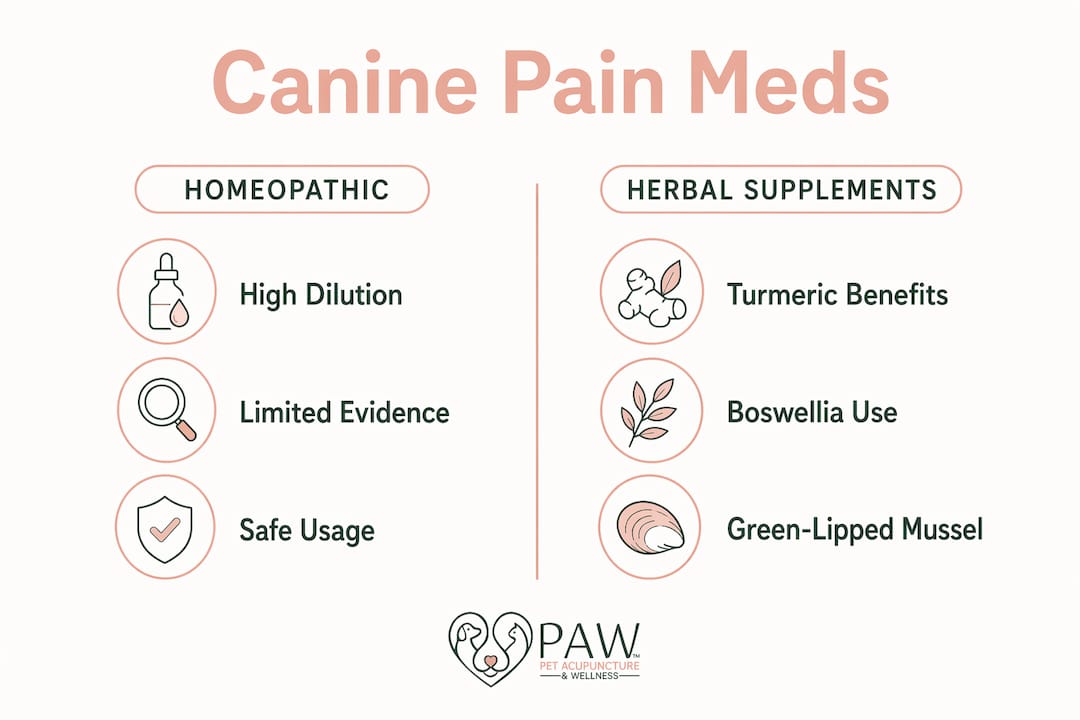
- High-dilution homeopathy (e.g., Arnica montana 30C pellets): no reliable clinical evidence of pain relief beyond placebo in dogs.
- Herbal supplements (turmeric/curcumin, boswellia, green-lipped mussel): modest evidence for chronic osteoarthritis, with real caveats about product quality and dosing.
- Integrative modalities (acupuncture, PEMF, laser therapy, rehabilitation): accepted adjuncts in veterinary integrative medicine with growing clinical support.
- The biggest risk is not a side effect from a homeopathic pellet. It’s delaying a proper diagnosis and proven pain management while a progressive condition like osteoarthritis quietly worsens.
Pro Tip: Before you try any natural or homeopathic remedy, get a veterinary diagnosis first. Knowing exactly what’s causing your dog’s pain is the only way to choose a safe, appropriate adjunct and avoid masking a condition that needs real treatment.
Table of Contents
- What homeopathic and natural pain options do people try for dogs?
- What does the science actually say about these options?
- Are there safety risks with homeopathic and natural remedies for dogs?
- How do you try a natural option safely and responsibly?
- How does natural pain relief fit into a full integrative care plan?
- When is a home remedy not enough?
- How do you choose safe products and qualified integrative vets?
- Key Takeaways
- A clinician’s honest perspective on integrative care
- Pet Acupuncture & Wellness brings integrative care to your home
- Useful sources and further reading
- FAQ
What homeopathic and natural pain options do people try for dogs?
Pet owners searching for safe pain meds for dogs encounter a wide range of products and therapies online and in clinics. Here’s a practical at-a-glance catalog of the most common ones.
Homeopathic remedies and herbal supplements
- Arnica montana (30C pellets): Oral homeopathic; most often used for acute bruising, post-surgical soreness, or muscle strain. Onset claimed within hours, but evidence is limited to one small exploratory study. No measurable active ingredient at this dilution.
- Turmeric/curcumin: Oral supplement (powder, capsule, or chew); used for chronic joint inflammation and osteoarthritis. Onset typically 2–6 weeks of consistent use. Modest evidence; quality varies widely by product.
- Boswellia serrata: Oral extract or capsule; used for chronic osteoarthritis and inflammatory joint disease. Onset 2–4 weeks. Some positive small trials in dogs; needs veterinary-grade sourcing.
- Green-lipped mussel (GLM): Oral powder or soft chew; used for chronic osteoarthritis, especially hip and elbow. Onset 4–6 weeks. One of the better-studied natural supplements for canine joint pain.
- Devil’s Claw (Harpagophytum procumbens): Oral extract; used for chronic musculoskeletal pain. Onset 2–4 weeks. Known interactions with NSAIDs and anticoagulants — never combine without veterinary guidance.
- Topical arnica formulations and herbal liniments: Applied to skin over sore joints or muscles; used for localized acute soreness. Onset hours. Low-dilution topicals may contain measurable actives; keep away from mucous membranes and wounds.
Non-pharmaceutical modalities
- Acupuncture: Needle stimulation of specific points along meridians (the body’s Qi pathways); used for chronic pain, nerve pain, and post-surgical recovery. Onset often 1–3 sessions. Widely accepted in integrative veterinary medicine.
- PEMF (pulsed electromagnetic field therapy): Device-based therapy; used for chronic osteoarthritis and post-surgical healing. Onset 2–4 weeks of regular sessions. Growing evidence base.
- Laser therapy (photobiomodulation): Used for soft tissue pain, wound healing, and joint inflammation. Onset 1–3 sessions for acute conditions; weeks for chronic.
- Targeted rehabilitation: Exercises, underwater treadmill, balance work; used for chronic pain, post-surgical recovery, and weight-related joint stress. Onset weeks; long-term benefit well-supported.
- Massage: Manual soft tissue work; used for muscle tension and mild soreness. Onset immediate comfort; no lasting structural change.
- Weight management: Reducing excess body weight relieves mechanical load on joints. Onset weeks to months; one of the highest-impact interventions for hip osteoarthritis in dogs.
What does the science actually say about these options?
The evidence picture here is not uniform, and that matters for your dog’s welfare.
The AVMA’s position and the homeopathy evidence gap
The AVMA does not endorse homeopathy as an effective veterinary treatment. Systematic reviews and meta-analyses consistently find that high-dilution homeopathy produces no effects distinguishable from placebo across a wide range of conditions in animals and humans. The theoretical mechanism, that water retains a “memory” of a substance diluted beyond any molecular presence, has no accepted basis in chemistry or physics.
Professional consensus: Major reviews, including analyses applying AMSTAR quality criteria to veterinary homeopathy trials, conclude there is no reliable evidence that high-dilution homeopathic remedies outperform placebo for pain or any other condition in dogs and cats.
One small exploratory study did report a statistically significant analgesic effect for Arnica montana 30cH in 30 female dogs after surgery. That’s worth knowing. But a single small trial with no independent replication does not change the overall evidence grade, especially when the broader body of systematic reviews points the other way.
Low-dilution complexes: a different story
Not all products labeled “homeopathic” are the same. A pharmacological review explains that low-dilution complex formulations can contain measurable concentrations of active ingredients, unlike classical high-dilution preparations. One randomized, double-blinded controlled trial of a low-dilution homeopathic combination product (Zeel®) in 44 dogs with osteoarthritis found significantly better outcomes than placebo on several mobility and pain measures, though carprofen (an NSAID) still outperformed it. This is a meaningful distinction: the benefit seen in that trial likely reflects pharmacological activity from measurable ingredients, not a homeopathic mechanism.

Where herbal supplements show modest promise
Turmeric/curcumin, boswellia serrata, and green-lipped mussel have small but real bodies of clinical evidence for chronic osteoarthritis in dogs. Herbal blends are also being studied in pilot trials, though sample sizes remain limited and replication is needed before strong recommendations are possible. The consistent caveats across all supplement research are product quality variation, inconsistent dosing between brands, and the absence of large, well-controlled trials. Veterinary oversight matters here because the supplement market is largely unregulated, and what’s on the label may not match what’s in the bottle.
Apparent improvements after any of these therapies can also reflect natural waxing and waning of chronic conditions, increased owner attention, or placebo-like effects rather than a specific treatment response. Objective monitoring, not just owner impression, is the only reliable way to judge whether something is working.
Are there safety risks with homeopathic and natural remedies for dogs?
The short answer is yes, though the risks vary significantly by product type.
What you need to check before giving anything
- Turmeric/curcumin can affect platelet function and may increase bleeding risk, particularly in dogs already on NSAIDs or before surgery. Discuss timing with your vet.
- Devil’s Claw has known interactions with NSAIDs and anticoagulants. Never combine it with carprofen, meloxicam, or similar drugs without veterinary clearance.
- Boswellia is generally well-tolerated but can cause mild gastrointestinal upset in some dogs at higher doses.
- High-dilution homeopathic products (30C and above) contain no measurable active ingredient, so direct pharmacological harm is unlikely. However, low-dilution complexes may contain actives and carry real interaction potential.
- Herbal liver metabolism: Many herbs are processed by the liver. Dogs with hepatic disease or on medications with hepatic metabolism need extra caution and veterinary review.
- Delay of effective care is the most serious risk of all. For progressive conditions like osteoarthritis, weeks spent on an ineffective remedy are weeks of unmanaged pain and joint deterioration.
Regulatory context: what FDA oversight means for you
The FDA regulates animal drugs under the Federal Food, Drug, and Cosmetic Act, and homeopathic products are not exempt from those requirements. The FDA’s guidance for homeopathic drug products uses a risk-based enforcement approach, meaning many homeopathic products reach the market without the pre-market safety and efficacy review that approved animal drugs undergo. The FDA’s animal drug regulation framework makes clear that unapproved new animal drugs have not been verified for safety, effectiveness, or manufacturing consistency. Veterinarians are licensed at the state level in Florida, and only a licensed veterinarian can legally prescribe prescription animal drugs.
Before giving your dog any supplement or homeopathic product, run through this checklist:
- [ ] Veterinary diagnosis confirmed (you know what’s causing the pain)
- [ ] Current medications reviewed for interactions
- [ ] Product has third-party quality testing or a veterinary formulation
- [ ] Label lists ingredients, dilution or concentration, and dosing clearly
- [ ] You have a plan to document and reassess the response
Pro Tip: Take a short video of your dog walking, climbing stairs, or rising from rest before starting any new remedy. Date it. Repeat every two weeks. Video is far more objective than memory, and it gives your veterinarian something concrete to evaluate at the follow-up.
How do you try a natural option safely and responsibly?
A structured trial protects your dog and gives you real information about whether something is working.
Step-by-step protocol
- Get a veterinary diagnosis and baseline pain assessment. Know the source and severity of pain before choosing any adjunct. A vet can score mobility, assess joint health, and establish a baseline you can measure against.
- Review current medications and contraindications. Share every supplement and medication your dog takes. Your vet can flag interactions before they become problems.
- Choose one narrowly scoped adjunct at a time. Adding multiple new products simultaneously makes it impossible to know what’s helping or causing a reaction. Start with a single supplement or modality.
- Set measurable goals and objective markers. Define what “better” looks like: a timed stair climb, a measured walk distance, a gait score. Vague impressions are unreliable.
- Define a trial length and stopping rules. Most supplements need 4–6 weeks to show effect. Decide in advance: if there’s no measurable improvement by week 6, stop and reassess. If pain worsens at any point, stop immediately.
- Document and reassess with your vet. Bring your videos, notes, and observations to the follow-up. Let the data guide the decision, not hope.
What to check when buying a product
- Clear ingredient list with concentrations or dilutions stated
- Third-party testing certificate (NSF, USP, or equivalent)
- Manufacturer contact information and transparent sourcing
- No unverified disease-cure claims on the label
- Veterinary formulation preferred over generic human supplements
You can also find at-home dog pain relief guidance that walks through safe monitoring steps between vet visits.
Pro Tip: Keep a simple calendar with a daily pain score (1–5 scale based on mobility and behavior) alongside your video record. Natural fluctuation in chronic conditions can easily be mistaken for a treatment effect. A calendar makes the pattern visible.
How does natural pain relief fit into a full integrative care plan?
Homeopathic remedies and supplements work best, when they work at all, as part of a broader plan rather than as standalone treatments. Here’s how that looks in practice.

Sample care plans by pain severity
Mild early arthritis (young to middle-aged dog, mild stiffness):
Weight management is the first intervention if the dog carries extra pounds. Add green-lipped mussel or fish oil as a joint-supportive supplement. Consider a course of acupuncture to support Qi flow and reduce local inflammation. Monitor with monthly mobility assessments. No prescription analgesia needed yet, but keep it on the table.
Moderate chronic osteoarthritis (dog on NSAID):
The NSAID stays. Acupuncture and PEMF are added as adjuncts to reduce the pain burden and potentially allow a lower effective NSAID dose over time. A certified canine rehabilitation practitioner designs a targeted exercise program. Green-lipped mussel or boswellia may be added after confirming no interactions with the NSAID. For senior dogs with multiple comorbidities, food therapy and Traditional Chinese Veterinary Medicine (TCVM) principles can guide dietary adjustments that support Yin balance and reduce systemic inflammation.
Geriatric dog with multimodal plan:
Prescription analgesia (NSAID plus gabapentin or another adjunct analgesic) forms the foundation. Acupuncture sessions every 2–4 weeks support nerve pain and mobility. PEMF at home between sessions. Gentle rehabilitation exercises adapted to the dog’s capacity. Herbal therapy selected by a veterinarian trained in TCVM. Owner-monitored daily mobility scores and monthly vet reassessments.
What each modality adds
- Acupuncture: Stimulates endorphin release, modulates pain signals along meridians, and reduces local muscle tension. Particularly effective for nerve pain and chronic musculoskeletal conditions.
- PEMF: Promotes cellular repair and reduces inflammatory mediators at the tissue level. Useful between clinic visits with a home device.
- Targeted rehabilitation: Builds muscle support around painful joints, improves proprioception, and maintains range of motion. No other modality replaces this for long-term function.
- Weight loss: Reduces mechanical load on every joint with every step. For a dog with hip dysplasia, even modest weight reduction can meaningfully reduce pain.
- Pharmaceutical analgesia: The foundation for moderate to severe pain. Integrative adjuncts complement it; they do not replace it.
An integrative veterinary care approach combines these layers based on the individual dog’s diagnosis, age, and overall health.
Integrative veterinary practitioners emphasize patient welfare above all: evidence-based conventional treatments and complementary therapies work together, with proven analgesics always taking priority when pain is moderate or severe. Complementary options add value within a monitored plan, not instead of one.
Red flags that mean adjuncts are not enough
- Pain is not controlled despite 2–4 weeks of supplements and modalities
- The dog is losing muscle mass or function
- Appetite is reduced or the dog is withdrawing from family interaction
- Mobility is declining week over week
- Any neurological sign appears (weakness, stumbling, loss of bladder control)
When is a home remedy not enough?
Some signs require a call to your veterinarian today, not after another week of supplements.
Seek veterinary care immediately if your dog shows:
- Non-weightbearing lameness on any limb
- Sudden collapse or inability to rise
- Vocalization when touched, moved, or at rest
- Severe appetite loss lasting more than 24 hours
- Fever (rectal temperature above 103°F)
- Neurological signs: stumbling, dragging a limb, loss of bladder or bowel control
- Rapid worsening of pain or mobility within a short trial period
Practical timelines to guide your decisions:
- Acupuncture: expect some response within 1–3 sessions (1–3 weeks); reassess after 4–6 sessions.
- Herbal supplements and green-lipped mussel: allow 4–6 weeks before judging effect.
- PEMF: 2–4 weeks of regular use for chronic conditions.
- High-dilution homeopathic remedies: if no change in 1–2 weeks for acute conditions, stop and consult your vet.
For dogs with back pain specifically, neurological signs like hind-limb weakness are an emergency, not a wait-and-see situation. Record your observations and share them with your veterinarian at every visit.
How do you choose safe products and qualified integrative vets?
The supplement and homeopathic product market is largely unregulated, and practitioner credentials vary widely. Here’s how to navigate both.
Checklist for product selection
- Third-party quality testing (NSF International, USP Verified, or NASC Quality Seal for pet supplements)
- Clear label: ingredient names, concentrations or dilution levels, species-specific dosing
- Manufacturer transparency: contact information, batch testing available on request
- No disease-cure claims (these are illegal on supplement labels under FDA rules)
- Veterinary formulation preferred; human supplements are not always safe or appropriately dosed for dogs
- Avoid products sold with testimonials as the primary evidence
You can browse quality-focused options at a reputable pet shop that carries vetted supplement lines, but always confirm choices with your veterinarian before starting.
Questions to ask a practitioner
- Are you a licensed veterinarian in Florida?
- Do you hold integrative credentials (DACVSMR, certified veterinary acupuncturist, certified canine rehabilitation practitioner)?
- How do you document treatment responses and adjust plans over time?
- How do you decide when a dog needs prescription analgesia rather than complementary therapy alone?
- What is your approach to combining supplements with conventional medications?
Red flags in practitioners and products
- Advising you to stop required vaccinations (rabies vaccination is legally required in Florida)
- Refusing to use proven analgesics when a dog is in moderate or severe pain
- Claiming homeopathy can cure or replace all conventional treatment
- No record-keeping or follow-up plan
- Products with no ingredient list or no dosing guidance
Key Takeaways
Natural and herbal supplements can play a real supporting role in canine pain management, but high-dilution homeopathy lacks reliable evidence and should never replace proven analgesia for moderate or severe pain.
| Point | Details |
|---|---|
| Homeopathy evidence gap | High-dilution homeopathic remedies show no reliable effect beyond placebo in dogs, per AVMA policy and systematic reviews. |
| Supplements with modest support | Turmeric/curcumin, boswellia, and green-lipped mussel have limited but real evidence for chronic osteoarthritis under veterinary guidance. |
| Integrative modalities work | Acupuncture, PEMF, and targeted rehabilitation are accepted adjuncts with growing clinical support for canine pain. |
| Safety first | Delay of effective treatment is the greatest risk; always get a veterinary diagnosis before trialing any natural remedy. |
| Pet Acupuncture & Wellness | Offers in-home acupuncture, herbal therapy, PEMF, and rehabilitation in South Tampa as part of a vet-led integrative pain plan. |
A clinician’s honest perspective on integrative care
The conversation around homeopathic pain meds for dogs tends to split into two camps: true believers who credit every improvement to the remedy, and strict skeptics who dismiss anything outside a prescription pad. Neither position serves your dog well.
What we see in practice at Pet Acupuncture & Wellness is more nuanced. Dogs with chronic osteoarthritis often respond beautifully to a multimodal plan, but the gains come from the acupuncture, the rehabilitation work, the weight management, and when needed, the pharmaceutical analgesia. The herbal components, chosen carefully and dosed correctly under TCVM principles, can add a meaningful layer to that plan. High-dilution homeopathy, though, is a different matter. The honest answer is that the evidence simply isn’t there, and recommending it as a primary pain treatment would be doing your dog a disservice.
What concerns us most is the owner who spends six weeks giving their arthritic dog arnica pellets, watching hopefully, and delaying the NSAID or the acupuncture course that would actually help. Osteoarthritis is progressive. Those weeks matter. The goal of integrative care is not to avoid conventional medicine; it’s to use every tool that genuinely helps, in the right combination, at the right time.
Owner values matter too. If you want to minimize pharmaceutical exposure, that’s a legitimate goal we can work toward together, with a plan built on evidence, monitoring, and honest reassessment. That’s what responsible integrative care looks like.
Pet Acupuncture & Wellness brings integrative care to your home
Your dog shouldn’t have to endure a stressful car ride to get expert pain management. Pet Acupuncture & Wellness provides mobile veterinary integrative care throughout South Tampa, bringing in-home acupuncture, herbal therapy, PEMF, and targeted rehabilitation directly to your dog’s most comfortable environment.
Every plan starts with a thorough assessment: a baseline mobility evaluation, a review of current medications, and an honest conversation about what the evidence supports for your dog’s specific condition. There are no one-size-fits-all protocols here. A geriatric dog with hip dysplasia gets a different plan than a middle-aged dog with early elbow arthritis, and both plans are built around what will genuinely help, not what sounds appealing on a supplement label.
If you’re ready to move beyond guessing and toward a vet-led plan that combines the best of conventional and integrative medicine, book a home consultation with Pet Acupuncture & Wellness. Your dog’s comfort is worth a real conversation.
Useful sources and further reading
- AVMA Policy on Complementary, Alternative, and Integrative Veterinary Medicine — Official AVMA position on homeopathy and evidence standards for all veterinary therapies.
- Comparison of Veterinary Drugs and Veterinary Homeopathy: Part 1 (PMC) — Detailed review of pharmacological vs. homeopathic mechanisms, placebo effects, and regression to the mean.
- Exploratory Study on Arnica montana 30cH in Dogs (Europe PMC) — Small post-surgical trial reporting a statistically significant analgesic effect; important context for interpreting limited positive evidence.
- Homeopathy for Dogs and Cats: What’s the Evidence? (Vet Help Direct) — Accessible summary of systematic reviews and the placebo/natural fluctuation explanation for apparent homeopathic effects.
- FDA Guidance for Homeopathic Drug Products — FDA’s risk-based enforcement framework for homeopathic products; essential for understanding labeling and sourcing risks.
- FDA Regulation of Animal Drugs — Explains the approval process for animal drugs and the legal status of unapproved products.
- FDA’s Role in Protecting Animal Health — Broader context on FDA oversight of animal health products.
Bring these sources to your veterinarian if you want to discuss integrative options for your dog’s pain. A good integrative vet will welcome the conversation.
FAQ
What is the best natural pain medication for dogs?
Green-lipped mussel, boswellia serrata, and turmeric/curcumin have the strongest evidence among natural supplements for chronic canine osteoarthritis, but none should replace a veterinary diagnosis or prescription analgesia when pain is moderate to severe. Acupuncture and targeted rehabilitation are the best-supported non-pharmaceutical modalities.
Can I give my dog homeopathic arnica for pain?
High-dilution arnica (30C) is unlikely to cause direct harm since no measurable active ingredient remains at that dilution, but there is no reliable evidence it relieves pain in dogs. One small exploratory study showed a post-surgical effect, but independent replication is lacking. Consult your vet before using it, and never rely on it as a primary pain treatment.
Can I give my dog anything for pain without seeing a vet?
Skipping a veterinary diagnosis before treating pain is risky because the underlying cause determines the right treatment. Some over-the-counter supplements like fish oil or green-lipped mussel are generally low-risk, but NSAIDs safe for humans (ibuprofen, acetaminophen) are toxic to dogs. A vet visit is the safest first step.
What is the strongest natural anti-inflammatory for dogs?
Boswellia serrata and green-lipped mussel are among the most studied natural anti-inflammatories for dogs with joint pain, with boswellia showing particular promise in small clinical trials. Neither matches the anti-inflammatory potency of veterinary NSAIDs, but both can serve as useful adjuncts within a supervised plan.