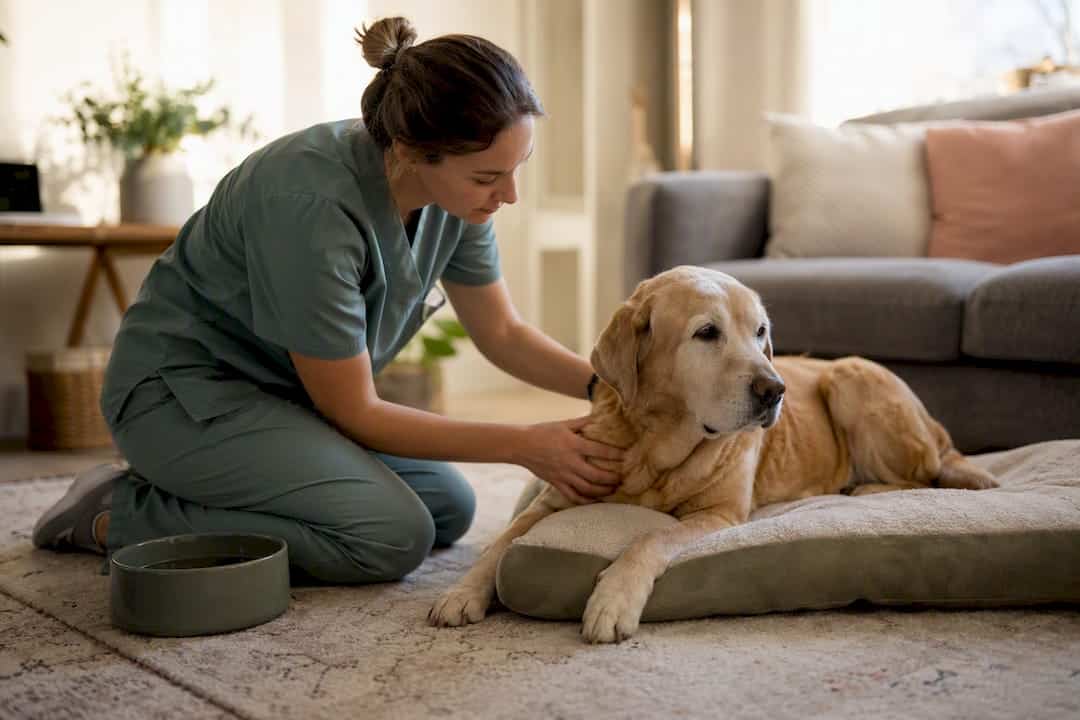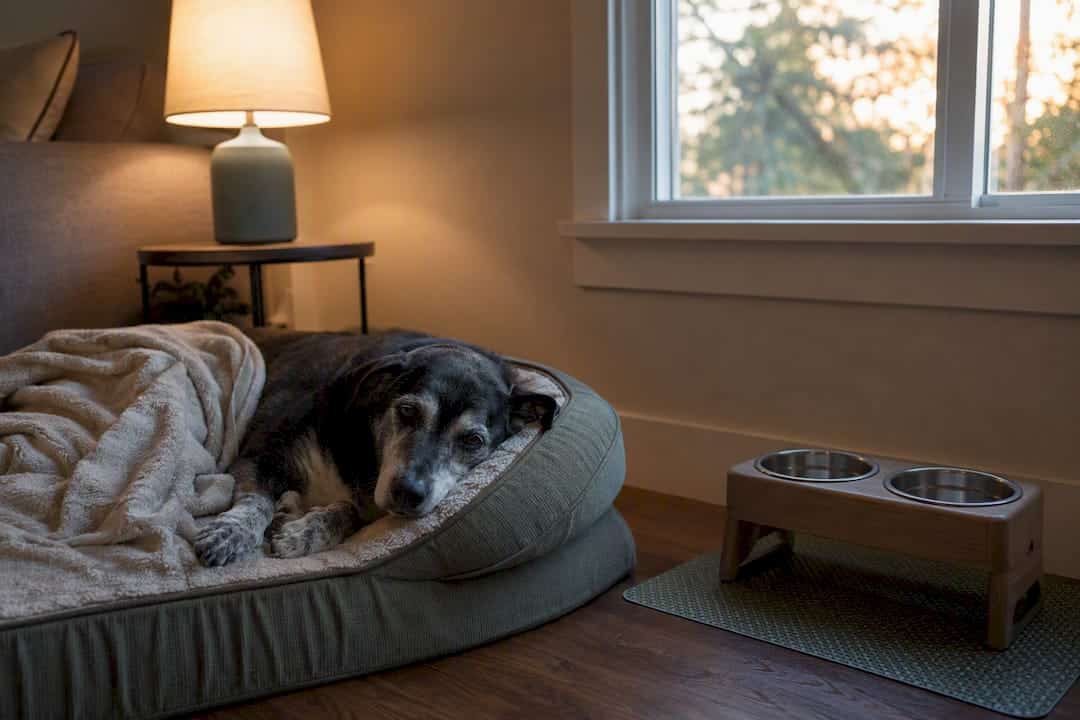
Home nursing for pets is professional, in-home clinical care, delivered by a veterinarian-led team and licensed veterinary technicians, to manage chronic illness, post-operative recovery, mobility-limited pets, and end-of-life comfort. Care follows the same standards a clinic would use for medication administration, wound care, and monitoring, just in the pet’s own space. Owners choose it for two reasons: it lowers the physical and emotional toll of transport, and it lets a clinician watch how a pet actually moves and rests on home turf.
TL;DR:
- Home nursing is ideal for pets with chronic illnesses, mobility issues, or end-of-life care, offering monitoring and treatments without stressful travel.
- In-home services include medication administration, wound care, fluid therapy, basic diagnostics, and rehab, but exclude advanced imaging and surgeries.
- Verify provider credentials, ensure supervision details are clear, and confirm liability insurance before booking in-home nursing.
- Cost ranges from $50 to $150 for a base visit, with full wellness exams between $100 and $250, plus travel fees of $40 to $75, depending on distance.
- Effective medication management requires a written schedule and daily monitoring logs, with clear communication between the nursing team and your primary veterinarian.
Table of Contents
- What Services Does Home Nursing for Pets Include?
- Who Provides In-Home Nursing Care for Pets?
- When Should You Choose In-Home Nursing Over a Clinic Visit?
- What to Expect During a Home Nursing Visit (And What It Costs)
- How to Prepare Your Home Before a Nursing Visit
- How Do You Know a Provider Is Safe and Qualified?
- How Does Home Nursing Support a Pet’s Emotional Well-Being?
- What Should You Do in a Pet Emergency at Home?
- How Do You Manage Medication and Monitoring Between Visits?
- How Do Home Nurses Coordinate With Your Primary Veterinarian?
- What Equipment Do Home Nursing Visits Typically Use?
- What Medical Procedures Happen During a Typical Nursing Visit?
- How Integrative Care Deepens What Home Nursing Can Offer
- Book In-Home Nursing and Integrative Care With Pet Acupuncture & Wellness
- Sources
- FAQ
What Services Does Home Nursing for Pets Include?
A home nursing visit covers most of what a clinic nursing appointment does, minus the fluorescent lights and car ride. The core work is clinical, not just companionship, and it typically includes:
- Medication administration, both oral and injectable
- Wound care and bandage changes
- Subcutaneous or IV fluid therapy when appropriate for the setting
- Basic diagnostics, such as point-of-care bloodwork
- Mobility support and guided rehab exercises
- Hospice and comfort-focused interventions for pets nearing the end of life
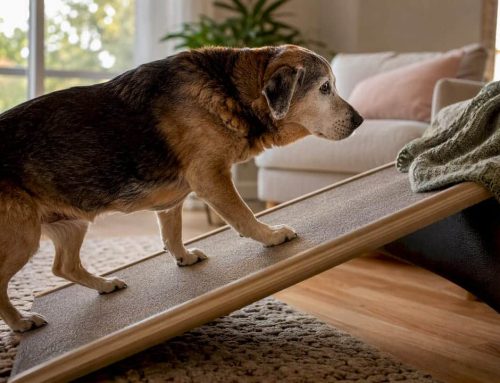
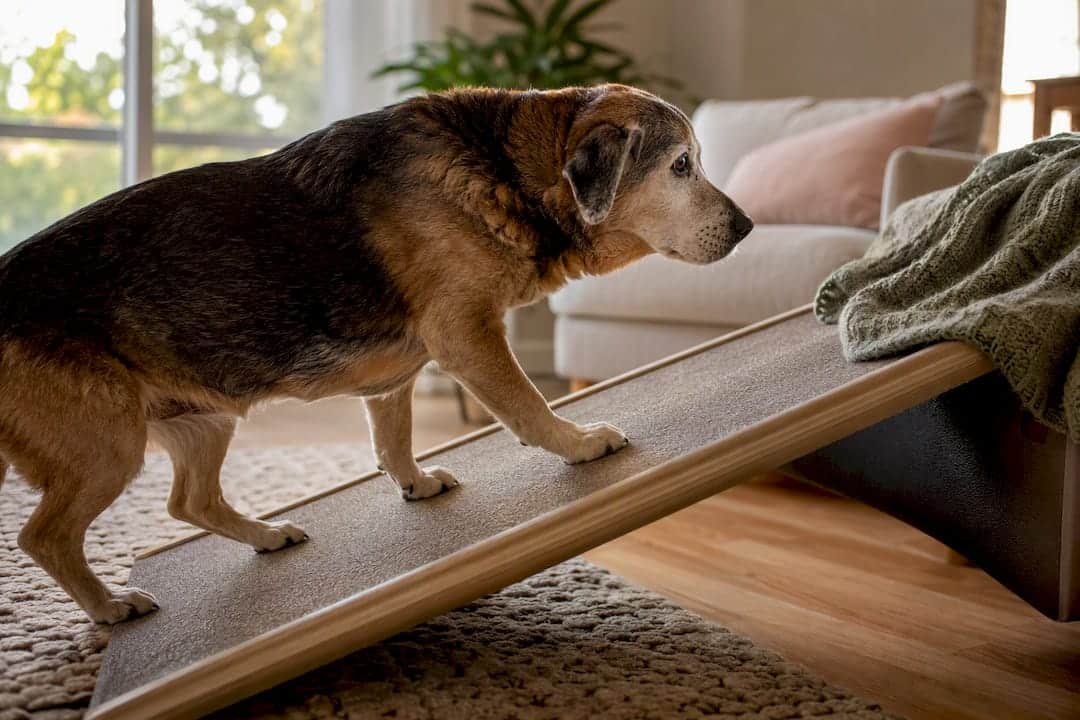
Some things still require a clinic. Advanced imaging like MRI or CT, surgical procedures, and certain emergency interventions (like managing severe trauma) are outside the scope of a house call. What home visits do especially well is observation. Watching a dog navigate its own stairs or a cat eat from its usual bowl tells a clinician things a fifteen-minute exam room visit often misses.
Who Provides In-Home Nursing Care for Pets?
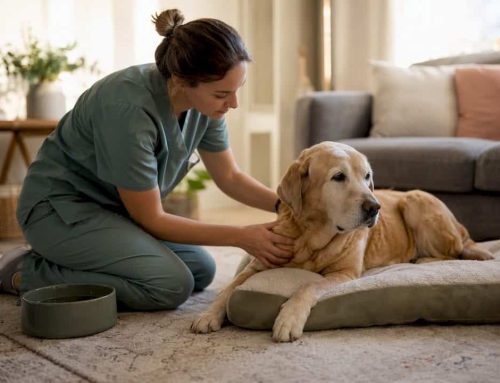
Three roles show up in home nursing, each with a distinct scope. A veterinarian diagnoses conditions, prescribes medication, and directs the overall treatment plan. A licensed veterinary technician performs the hands-on clinical nursing, things like placing catheters, monitoring vitals, and administering treatments under veterinary direction. An assistant works within a narrower, more supportive scope and does not perform independent clinical tasks.
Here’s something worth knowing: the word “nurse” isn’t a uniformly protected title in veterinary medicine the way it is in human healthcare. In the United States, 39 states restrict use of the human “nurse” title, but “veterinary technician” is the actual regulated paraveterinary role. Scopes also vary by state, since credentialing for paraveterinary workers isn’t identical everywhere.
Before booking, confirm:
- The veterinarian’s state license and the technician’s credential status
- Whether the technician has passed the Veterinary Technician National Exam (VTNE) where applicable
- Who supervises the visit and how that supervision actually works in practice
Pro Tip: Ask the provider directly, “Is my technician licensed or registered in this state, and can I see that credential?” A confident, specific answer is a good early signal of a professional operation.
When Should You Choose In-Home Nursing Over a Clinic Visit?
Home nursing fits certain situations far better than a waiting room ever could. Consider it when:
- Your pet has a chronic condition (kidney disease, diabetes, arthritis) that needs regular monitoring and adjustment.
- Mobility loss makes car rides or clinic stairs genuinely painful or risky.
- Your pet has severe anxiety or fear around veterinary visits, to the point where the stress itself becomes a health concern.
- Your pet is recovering from surgery and needs wound checks or rehab without the jostle of travel.
- You’re navigating palliative or end-of-life care and want your pet to stay in a familiar, calm environment.
Some situations still call for immediate clinic or emergency care, no exceptions: severe or uncontrolled bleeding, collapse, labored breathing that doesn’t resolve, seizures lasting more than a couple of minutes, or a pet who is unresponsive. If you’re unsure which category you’re in, run through this quick check: Is my pet stable right now? Can this wait a few hours for a scheduled visit? If either answer is no, head to an emergency clinic first and arrange nursing follow-up after.
What to Expect During a Home Nursing Visit (And What It Costs)
A typical visit follows a rhythm you’ll come to recognize after the first one. It opens with an intake conversation and history update, moves into a focused exam, then covers whatever intervention brought the clinician there, medication, wound care, fluids, followed by client education and a written care plan with next steps.
Clinicians usually bring a compact kit: a stethoscope, thermometer, basic bloodwork tools, bandaging supplies, and portable fluid equipment. Some procedures still belong in a clinic, and portable diagnostic units used in field care illustrate both what’s possible on the road and where the limits sit compared with hospital-grade imaging.
Sample cost ranges for planning purposes: base visit fees generally run $50 to $150, full wellness exams commonly fall between $100 and $250, and in-home end-of-life care often runs $150 to $400. Travel typically adds another $40 to $75 depending on distance.
A few ways to keep costs predictable:
- Ask for a written estimate before the visit, not after
- Bundle services (a wellness check plus a rehab session) into one visit when possible
- Check whether your pet insurance reimburses mobile or in-home visits, since policies vary widely
How to Prepare Your Home Before a Nursing Visit
A little prep work makes the actual visit shorter, calmer, and more useful.
- Clear a quiet, well-lit space, ideally away from other pets, where the exam can happen.
- Gather current medications, dosing schedules, and any recent clinic records.
- Take a short video of any concerning behavior (limping, coughing, disorientation) since these often disappear the moment a clinician walks in.
- Secure other pets and small children in a separate room for the first part of the visit.
- Set aside any special items requested in advance, oxygen supplies, a favorite blanket, mobility slings, or a fresh urine or stool sample.
If the practice offers telemedicine triage beforehand, use it. A short video call ahead of time often changes what the clinician packs and how much time they schedule.
Pro Tip: Write your top three questions on a sticky note before the visit starts. Nerves make people forget what they meant to ask, and a written list keeps the visit focused.
How Do You Know a Provider Is Safe and Qualified?
Before booking, a few direct questions separate a trustworthy provider from a risky one. Ask to see the veterinarian’s state license and the technician’s credential, including VTNE status where relevant. Ask how the provider handles an emergency: do they have a relationship with a nearby clinic or hospital, and what’s the actual escalation plan if your pet destabilizes mid-visit?
Beyond credentials, look for:
- Clear infection control practices (handwashing, clean equipment between patients)
- Proper sharps and biohazard waste disposal
- Documented liability insurance
- A written care plan after every visit, not just a verbal summary
A provider who answers these questions without hesitation, and who can point you to a referral pathway when a case needs more than a house call can offer, is one worth trusting.
How Does Home Nursing Support a Pet’s Emotional Well-Being?
Clinical care is only part of the picture. A pet recovering from surgery or managing a chronic illness is also navigating stress, confusion, and sometimes isolation, especially if mobility loss keeps them from their usual routines.
Staying home changes that experience. A cat can watch the same window, sleep in the same sunny spot, and hear the same household sounds during treatment instead of associating recovery with a stressful car ride and a strange-smelling waiting room. For anxious dogs, this alone often reduces the physiological stress response that can mask or worsen symptoms during a clinic exam.
Social interaction matters too, particularly for senior or terminally ill pets. Multi-pet households sometimes need brief separation during a procedure, but companionship afterward, a familiar pet nearby, a family member close by, tends to support faster, calmer recovery. Isolation, on the other hand, can slow healing and increase behavioral withdrawal, especially in dogs with strong pack instincts or cats sensitive to household disruption.
This is part of why hospice and palliative nursing increasingly builds in “quality time” as a formal goal, not an afterthought. A visit isn’t just injections and bandage checks; it’s also making sure a pet still gets gentle affection, familiar smells, and normal daily rhythms for as long as possible. Providers who ask about your pet’s favorite routines, not just their symptoms, are usually the ones thinking about this correctly.
What Should You Do in a Pet Emergency at Home?
Even with regular in-home nursing, emergencies happen between visits. Knowing the difference between “call the nurse” and “go to the ER now” can save your pet’s life.
Immediate emergency signs include: uncontrolled bleeding, collapse or inability to stand, gums that turn pale, blue, or white, breathing that’s labored or open-mouthed in a cat, seizures lasting more than two to three minutes, or a pet who won’t respond to their name or touch. None of these wait for a scheduled visit.
Owners managing chronic or palliative care at home benefit from basic training before a crisis hits, not during one. Ask your care team to walk you through:
- How to check gum color and capillary refill time
- How to take a resting respiratory rate (count breaths for 30 seconds, multiply by two)
- What your pet’s normal baseline looks like, so you can spot deviation quickly
- Exactly which symptoms mean “call now” versus “monitor and update the care team tomorrow”
Keep your emergency clinic’s number and address somewhere visible, not buried in your phone. A written care plan from your nursing provider should include this escalation information by default. If it doesn’t, ask for it before the next visit.
How Do You Manage Medication and Monitoring Between Visits?
Medication mistakes are one of the most common, and most preventable, problems in home pet care. Missed doses, doubled doses, and mixed-up timing happen easily when a household has multiple pets or multiple caregivers.
A simple written schedule, taped to the fridge or kept in a shared notes app, solves most of this. Note the drug name, dose, time, and whether it needs food. For pets on several medications, a labeled pill organizer (the kind made for humans works fine) prevents the “did I already give this?” panic that derails otherwise careful owners.
Monitoring matters as much as dosing. Track appetite, water intake, energy level, and bathroom habits daily, even briefly. A short daily log, just a line or two, gives your nursing team something concrete to review instead of a vague “she seems a little off” at the next visit. Weight checks matter too; a pet losing weight steadily despite eating normally is often an earlier warning sign than owners expect.
If your pet resists oral medication, ask about alternatives before giving up on compliance: compounded flavored formulations, transdermal gels, or timing doses around meals can all improve success. Never adjust a dose on your own, even when a pet seems better, since some medications (particularly for chronic pain or seizure control) cause serious problems if stopped abruptly.
How Do Home Nurses Coordinate With Your Primary Veterinarian?
In-home nursing works best as an extension of your primary veterinary relationship, not a replacement for it. The strongest setups involve regular, documented communication between the technician or nurse doing the visits and the veterinarian directing the overall plan.
After every visit, ask for a written summary: what was done, what was observed, and what changed since the last check-in. This record should travel back to your primary vet, either through shared software, a faxed or emailed report, or a direct phone call for anything urgent. If a home nursing provider operates independently of your regular vet, ask upfront how they’ll share notes and lab results, and how quickly.
Good coordination also means agreeing in advance on thresholds: at what point does the home nursing team call your vet directly rather than waiting for the next scheduled update? A well-run practice builds this into the care plan from day one, not after a scare.
What Equipment Do Home Nursing Visits Typically Use?
Home nursing kits are compact but genuinely clinical. Standard equipment includes a stethoscope, digital thermometer, otoscope for ear checks, and a portable scale for accurate weight tracking, since weight changes matter for dosing and disease monitoring alike.
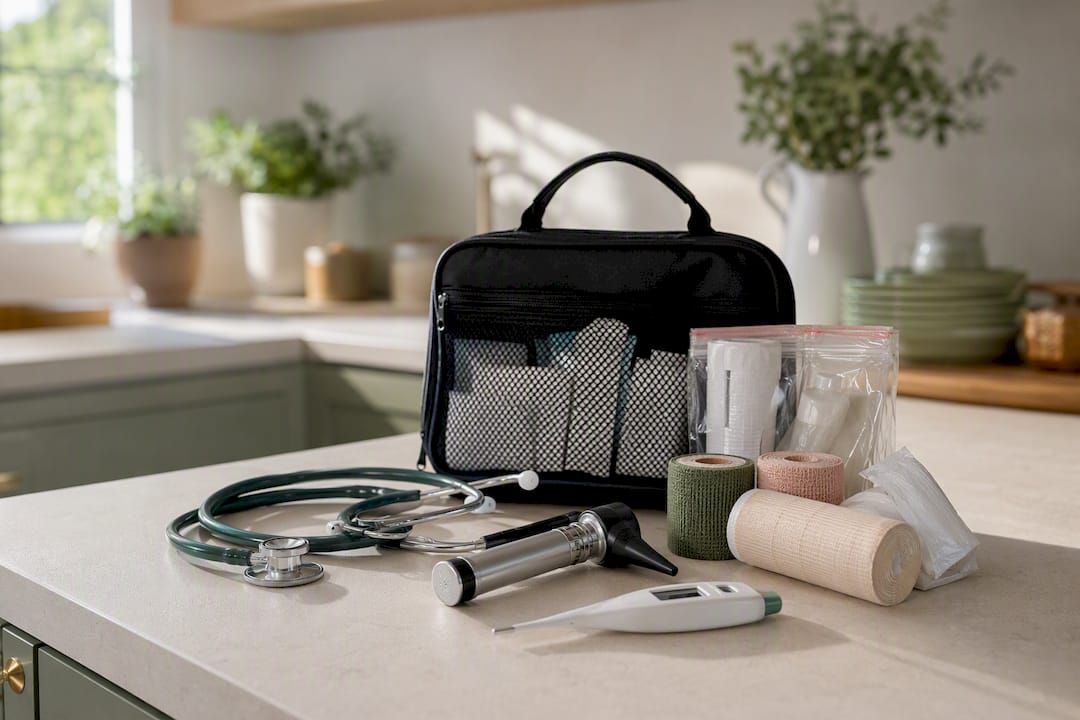
For hands-on treatment, expect bandaging and wound care supplies, IV and subcutaneous fluid setups, syringes and needles for injections, and point-of-care bloodwork tools that can run basic panels on the spot. Oxygen support, mobility slings, and orthopedic bedding sometimes travel along for specific cases, particularly hospice or post-surgical visits.
What doesn’t travel: MRI and CT machines, surgical suites, and most advanced imaging. Understanding what portable field units can and can’t do helps set realistic expectations about when a home visit is enough and when a clinic referral is the right call.
What Medical Procedures Happen During a Typical Nursing Visit?
The most common procedures fall into a predictable set of categories. Injection-based treatments, vaccines, pain medication, fluid therapy, make up a large share of visits. Wound care, including cleaning, redressing, and monitoring for infection, is another frequent task, especially post-surgery.
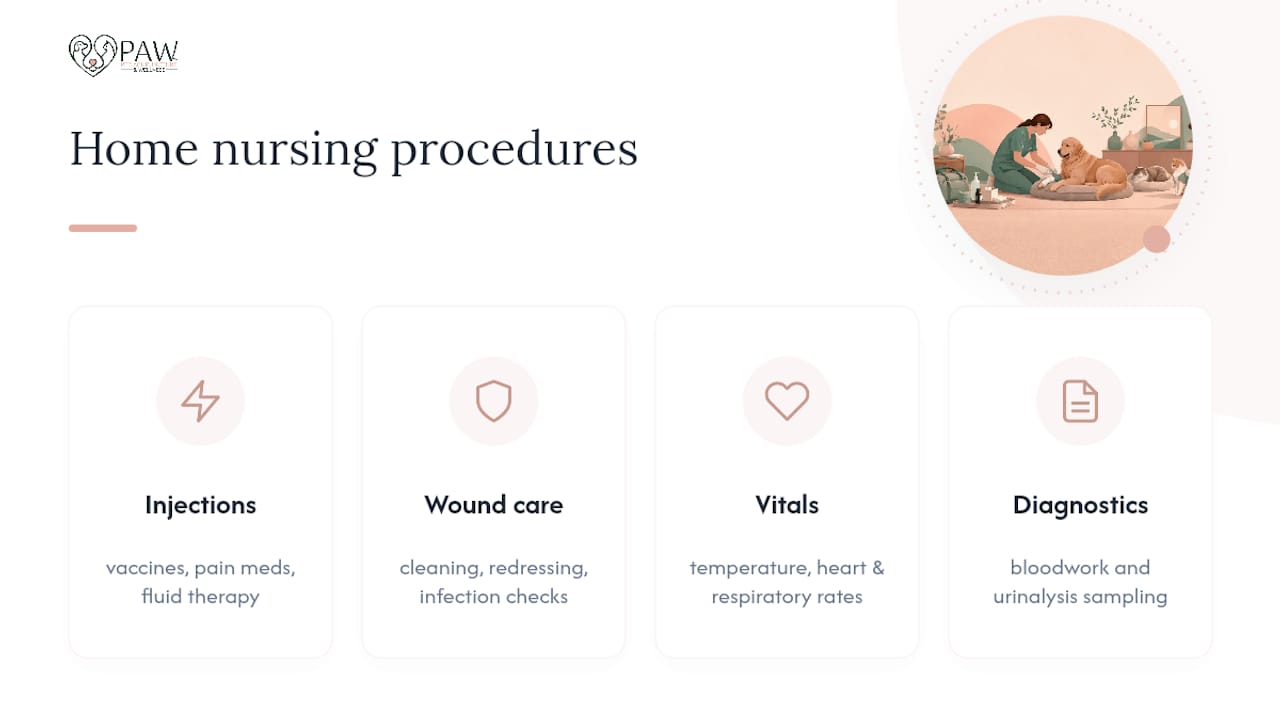
Beyond that, expect vital sign checks (temperature, heart rate, respiratory rate), basic diagnostic sampling like bloodwork or urinalysis, nail trims and hygiene care for pets who can’t easily get to a groomer, and rehabilitation exercises for pets recovering mobility after surgery or injury. Nutritional assessments and feeding plan adjustments show up often for chronic kidney or metabolic conditions.
Veterinary nursing standards describe this full scope, medication administration, pain assessment, nutritional management, post-surgical support, and chronic condition monitoring, as core clinical nursing work when a veterinarian directs the plan. In a home setting, technicians frequently catch subtle changes, an odd gait on familiar flooring, hesitation near stairs, that clinic visits sometimes miss simply because the environment itself is unfamiliar and stressful for the pet.
How Integrative Care Deepens What Home Nursing Can Offer
Clinical nursing handles the medical mechanics: medications given correctly, wounds monitored, vitals tracked. But comfort is its own discipline, and that’s where integrative therapies earn their place alongside conventional nursing.
Pet Acupuncture & Wellness works primarily with senior, disabled, and anxious pets, the patients who benefit most from staying home rather than enduring a stressful clinic transfer. Acupuncture, rehabilitation, and herbal support don’t replace nursing care; they extend it, often easing pain and anxiety in ways that let nursing interventions go more smoothly. A dog receiving acupuncture for arthritis pain, for instance, often tolerates handling and mobility exercises better than one managing pain with medication alone.
Treating pets at home carries a dual benefit that’s easy to underestimate: it’s clinically sound, since a relaxed patient yields more accurate exams, and it’s emotionally sound, since owners aren’t white-knuckling a car ride while managing their own anxiety about the appointment.
— Pet Acupuncture & Wellness
Book In-Home Nursing and Integrative Care With Pet Acupuncture & Wellness
Pet Acupuncture & Wellness is the direct option for South Tampa pet owners who want clinical nursing and integrative therapy handled by the same team, rather than juggling separate providers for medication management and pain relief. Mobile visits combine core nursing tasks, medication administration, wound checks, monitoring, comfort care, with acupuncture, rehabilitation, and herbal treatments tailored to senior, disabled, or anxious pets who struggle with clinic visits.

Every visit starts with a conversation about your pet’s specific needs, whether that’s ongoing arthritis management, post-surgical recovery, or end-of-life comfort care. Check service availability in the South Tampa area, request a visit estimate, and explore mobile acupuncture and pain relief options built around keeping your pet calm and comfortable at home. Scheduling a first visit is the fastest way to see whether an integrative, in-home approach fits your pet’s situation.
Sources
This article drew on veterinary nursing standards from the Royal Veterinary College, credentialing guidance from Penn Foster, paraveterinary role definitions via Wikipedia, and current mobile vet pricing data from Mountain Veterinary Service and Orlando Mobile Vet. Explore in-home vet services to learn more.
- Vet Tech vs Vet Nurse: What’s The Difference? | Penn Foster
- Veterinary nursing: What veterinary nurses do | Royal Veterinary College (RVC)
- Mobile Vet Cost in 2026: What You’ll Really Pay | Mountain Veterinary Service
- Mobile Vet Prices in Orlando | Full Service Pricing Guide | Orlando Mobile Vet
- Paraveterinary worker — Wikipedia
FAQ
What is a nurse for animals called?
The regulated professional title is “veterinary technician” or “licensed veterinary technician,” not “nurse.” The human nursing title is restricted in 39 states, so “vet tech” is the accurate credential to ask about.
How much does it cost for a vet to come to your house?
Base visit fees generally range from $50 to $150, with full wellness exams often between $100 and $250 and end-of-life visits commonly $150 to $400. Travel typically adds another $40 to $75 on top of the visit fee.
Where can I find in-home pet euthanasia and hospice support?
Many mobile veterinary practices, including practices like Pet Acupuncture & Wellness in South Tampa, offer in-home hospice and end-of-life care designed to keep pets comfortable in familiar surroundings. Ask directly about hospice protocols, pain management options, and what emotional support is available for the family during and after the visit.
What makes an illness hard to treat at home?
Conditions that require advanced imaging, surgery, or continuous hospitalization aren’t suited to home nursing, but many “hard to treat” cases are simply diagnosed late because early behavioral changes went unnoticed. Regular at-home monitoring and nursing follow-up catch these signs earlier, before a condition becomes harder to manage.
Can veterinary technicians prescribe medication during home visits?
No. Prescribing and diagnosing remain the veterinarian’s role; licensed veterinary technicians administer treatments and monitor patients under that veterinarian’s direction, following the same scope-of-practice standards used in clinical settings.