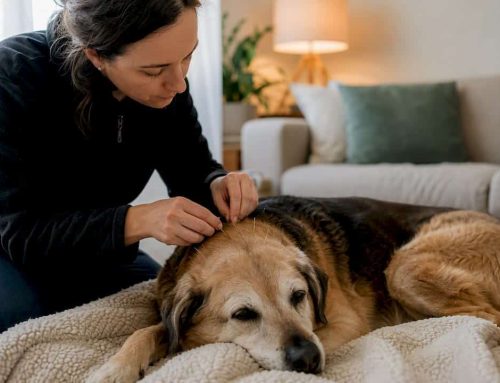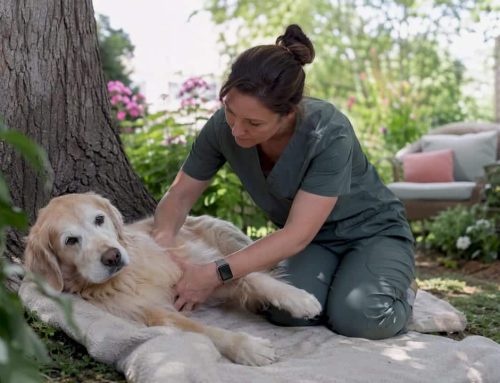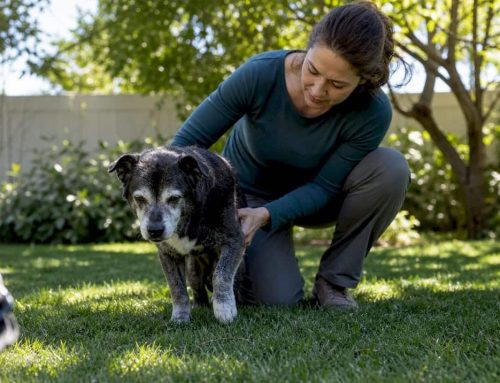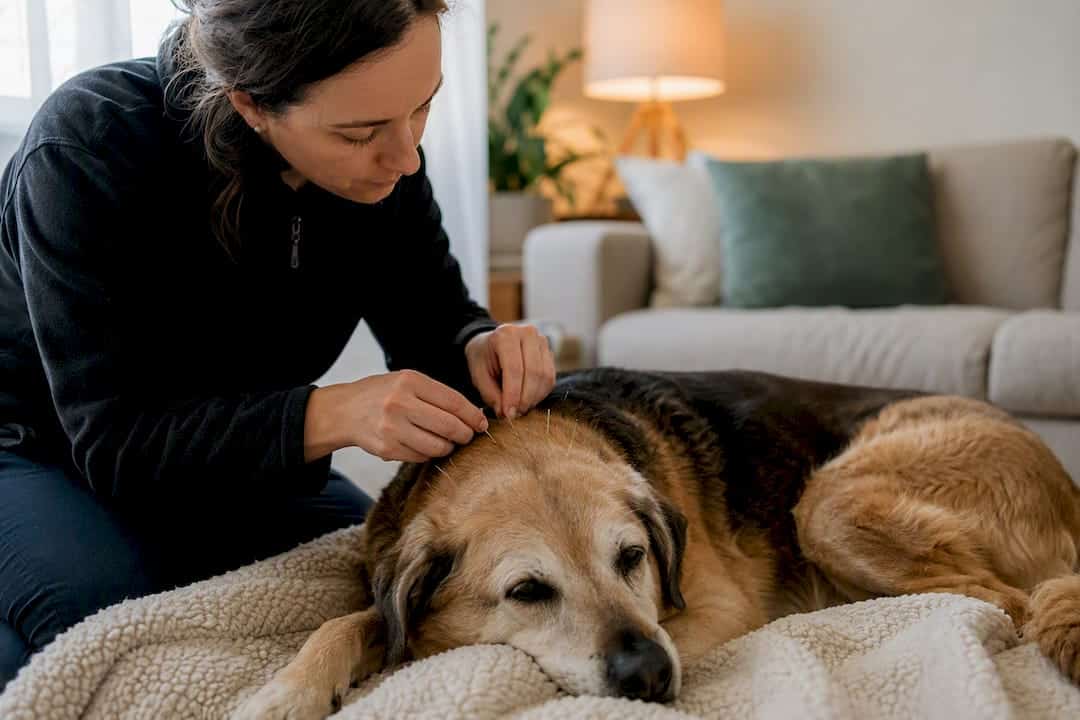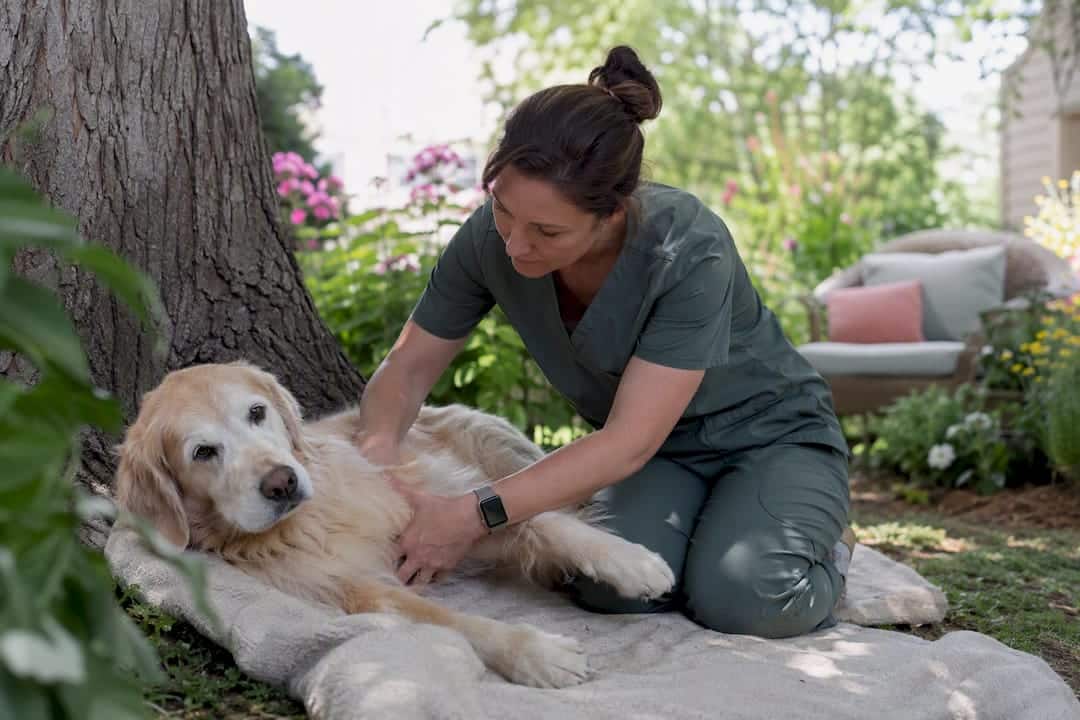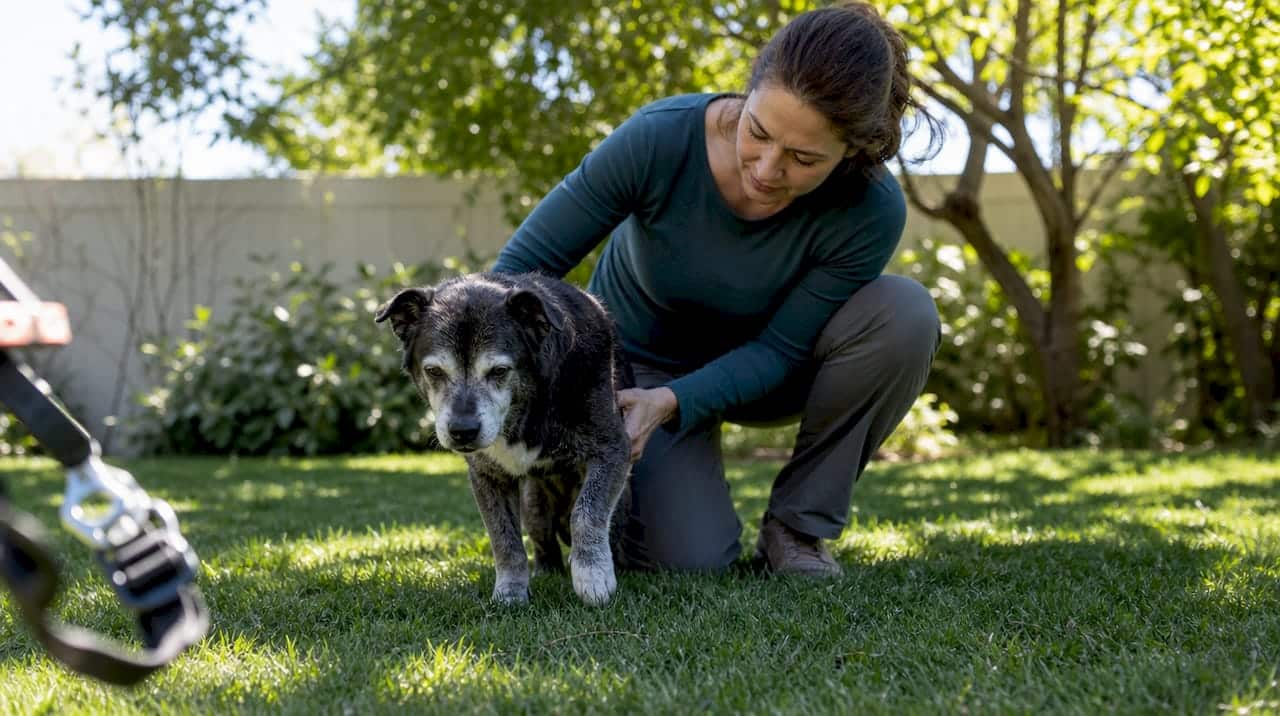
Start home exercises after your dog’s surgery only once your surgeon says it’s time, and begin gently: passive range-of-motion (PROM) work, light massage, cryotherapy, and short leash walks on a strict activity schedule. A retrospective cohort study of dogs recovering from TPLO found that dogs receiving guided rehabilitation were 1.9 times more likely to reach full function by eight weeks, with no added complication risk. That’s the whole premise of a good home exercise program: movement done right speeds healing, and Pet Acupuncture & Wellness sees this firsthand supporting South Tampa dogs through in-home rehab visits.
Here’s what the first 24 to 72 hours should look like:
- Give pain medication exactly as prescribed, on schedule, not just when your dog seems uncomfortable
- Check the incision twice daily for redness, swelling, discharge, or gaps
- Apply cold therapy for 10 to 15 minutes several times a day, as your vet directs
- Do gentle PROM only after a brief massage warms the tissue, and only if your surgeon has cleared it
- Keep your dog confined to a crate or small room between sessions, no jumping, no stairs, no other pets roughhousing
Call your vet immediately if you see: increasing swelling, discharge from the incision, worsening lameness, crying out when touched or moved, or any sudden weakness, wobbliness, or loss of coordination.
Key Takeaways
A phase-based home exercise program built on PROM, controlled leash walking, cryotherapy, and progressive strengthening, guided by objective function cues rather than the calendar, gives dogs the best shot at full recovery after surgery.
| Point | Details |
|---|---|
| Get written clearance first | Ask your surgeon for a specific home exercise program before leaving the clinic, not just discharge instructions. |
| Follow the three phases | Move from acute pain control (0–2 weeks) to early rehab (2–6 weeks) to strengthening (6–12+ weeks) based on healing, not dates. |
| Progress on function, not days | Advance reps or duration only when your dog completes current exercises without limping, hesitation, or fatigue. |
| Know the red flags | Increasing swelling, discharge, new lameness, or neurologic changes mean stop exercises and call the vet immediately. |
| Consider in-home support | Pet Acupuncture & Wellness offers house-call rehab assessments and integrative pain relief for owners who want hands-on guidance during recovery. |
Table of Contents
- When Can You Start Home Exercises After Surgery for Your Dog?
- Recovery Timeline: A Phase-by-Phase Home Exercise Plan
- Step-by-Step Exercises for Your Dog’s Home Recovery
- When to Stop: Pain Signs and Red Flags During Recovery
- How to Measure Progress and Know When to Advance
- Adjusting Home Exercises for Different Types of Surgery
- What the Research Says About Home Rehab for Dogs
- How Pet Acupuncture & Wellness Supports Your Dog’s Home Recovery
- Get In-Home Support for Your Dog’s Recovery Plan
- Sources
- FAQ
When Can You Start Home Exercises After Surgery for Your Dog?
The honest answer is: not until your surgeon says so, and not one day sooner. Every discharge packet should spell out a home exercise program, but the starting line moves depending on the procedure, and pushing ahead of it is one of the most common mistakes owners make. A Cornell Riney Small Animal Center resource points out that surgery repairs the structure, but rehabilitation restores the function, and pain relief can trick owners into thinking their dog is further along than the tissue actually is.
Typical clearance checkpoints look like this:
- Days 1 to 3: Gentle PROM and massage, often approved at discharge itself
- Days 7 to 14: Incision recheck; controlled leash walks usually begin here if healing looks clean
- Around week 8: Radiographic bone-healing check for many orthopedic procedures, often the gate for higher-intensity work like trotting or hills
Some procedures don’t follow this timeline at all. Spinal surgery, external fixators, and certain complex fracture repairs need individualized plans built by the surgeon, sometimes with movement restricted well past the two-week mark. Don’t assume your neighbor’s TPLO timeline applies to your dog’s FHO or disc surgery.
Pro Tip: Ask your surgeon for the home exercise program in writing before you leave the clinic, and confirm whether pain medications should continue during exercise sessions or be given beforehand to ease movement.
Recovery Timeline: A Phase-by-Phase Home Exercise Plan
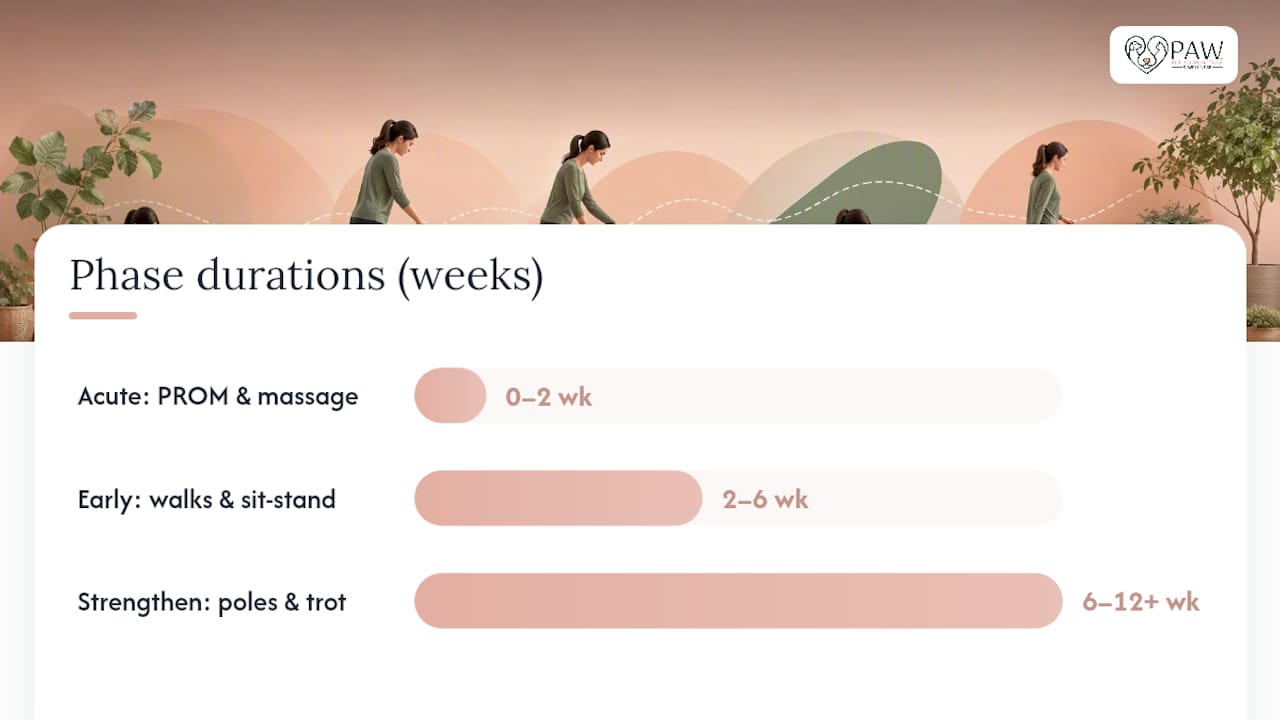
A good rehabilitation exercise plan for dogs moves through three phases, each with its own job. Trying to rush strengthening work before the acute phase has settled down is exactly how owners end up back in the surgeon’s office.
Phase 1: Acute (0 to 2 weeks). The goal is pain control and protecting range of motion, nothing more. This is PROM, massage, and cryotherapy, done in short, calm sessions.
Phase 2: Early rehabilitation (2 to 6 weeks). The goal shifts to re-establishing normal weight-bearing and neuromuscular control. Controlled leash walks lengthen, sit-to-stand exercises begin, and weight-shifting drills start teaching the limb to bear load again.
Phase 3: Strengthening and function (6 to 12+ weeks). Now you’re building real strength and coordination: cavaletti poles, gentle hill walking, and eventually controlled trotting, assuming your vet has cleared the dog based on healing milestones, not just the calendar.
| Phase | Typical activities | Frequency/duration |
|---|---|---|
| Acute (0–2 wks) | PROM, massage, cryotherapy, brief potty walks on leash | PROM 10 reps, 3–4x/day; walks 5 minutes, several times a day |
| Early rehab (2–6 wks) | Longer leash walks, sit-to-stand, weight shifts, figure-8 walking | Walks 10–15 min, 2–3x/day; sit-to-stand 5–10 reps, 1–2x/day |
| Strengthening (6–12+ wks) | Cavaletti/pole work, hill walking, controlled trotting, balance work | 10–20 min sessions, gradually increasing incline/speed |
A sample early-phase day might run like this: morning massage followed by PROM on the affected limb, a five-minute leash walk before breakfast, a midday ice pack session, another short walk in the afternoon, and a final PROM set before bed. By mid-phase, that same day adds a set of sit-to-stands after the morning walk and a weight-shift drill in the evening, with walk times stretched to 10 or 15 minutes.
Progress by cues, not just days on a calendar:
- Increase walk duration by no more than two to three minutes every few days if your dog shows no limping afterward
- Add reps to strengthening exercises only when the current set is completed without hesitation or favoring the leg
- Regress immediately, back to the prior week’s routine, if you notice increased stiffness, reluctance to move, or swelling the next morning
- Reassess with your vet or rehab practitioner before advancing to trotting, jumping, or off-leash activity of any kind
This staged approach lines up with what a detailed TPLO home care guideline recommends: short frequent walks and PROM in weeks one and two, figure-eights and sit-to-stand by weeks five and six, and controlled trotting only after a week seven or eight radiographic check confirms the bone has healed enough to handle it.
Step-by-Step Exercises for Your Dog’s Home Recovery
Each exercise below has a job to do, and doing it correctly matters more than doing it often.
Passive range of motion (PROM). Start in phase one, right after a brief massage warms the joint. Support the limb above and below the joint you’re moving, then slowly flex and extend to the point of mild resistance, never pain. A rehabilitation technique guide recommends 10 to 15 slow reps per joint, three to four times daily, working through the hock, knee, and hip in sequence for hind-limb surgeries. The most common mistake: forcing the joint past resistance because the dog didn’t flinch. Resistance is the stopping point, not pain.
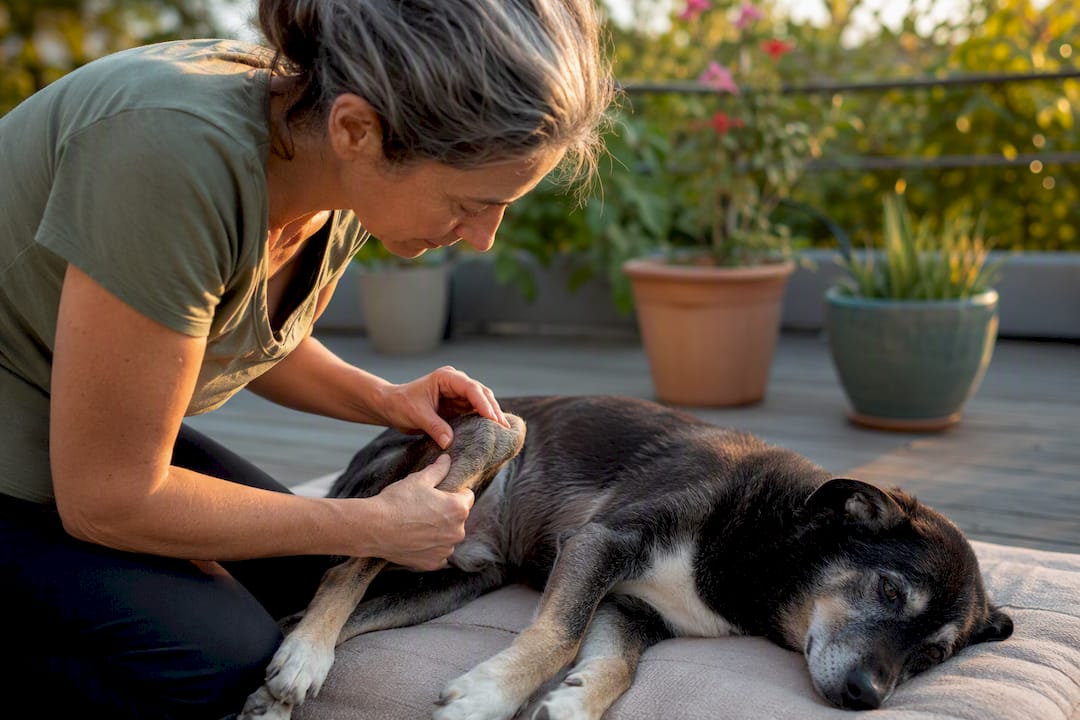
Gentle massage. Use flat, light circular strokes along the muscles surrounding, not directly on, the incision. Two to three minutes before PROM sessions loosens tissue and seems to make dogs more tolerant of the movement that follows.
Keep your dog on a short leash, slow pace, straight lines only at first, no sniffing detours that twist the body. Five-minute walks, several times a day, beat one long outing. Add figure-eight patterns once your vet clears turning motion, usually by weeks three to four; see our guide on best parks and home tips for safe local terrain options. Keep your dog on a short leash, slow pace, straight lines only at first, no sniffing detours that twist the body. Five-minute walks, several times a day, beat one long outing. Add figure-eight patterns once your vet clears turning motion, usually by weeks three to four.
Sit-to-stand. Starts in early rehab. Position your dog square, cue a sit, then a stand, using a treat to guide the head up and forward rather than pulling on a harness. Five to eight reps, once or twice daily. The common error is letting the dog sit crooked, which lets the good leg do all the work.
Weight shifts. Stand your dog square on all four feet and gently rock weight side to side, or press lightly on the shoulder or hip opposite the surgical leg to load it briefly. Ten reps, twice daily, starting mid-recovery.
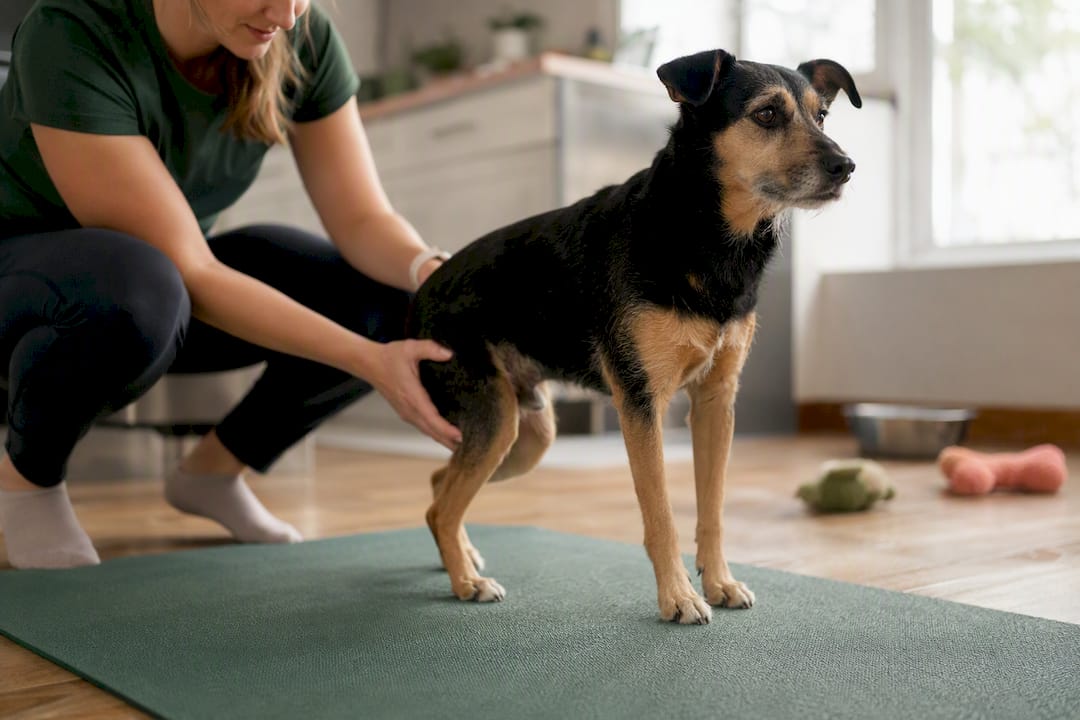
Balance work. A folded towel or thin cushion under the front or back feet challenges proprioception. Thirty seconds at a time, building to a minute, introduced once weight-bearing looks steady.
Cavaletti and step work. Broom handles laid flat, spaced a stride-length apart, force deliberate limb lift. Save this for the strengthening phase, four to six poles, two passes, twice a day.
| Exercise | Early phase | Mid phase | Late phase |
|---|---|---|---|
| PROM | 10–15 reps, 3–4x/day | 10 reps, 2–3x/day | Often discontinued if ROM is normal |
| Leash walks | 5 minutes, several times a day | 10–15 min, 2–3x/day | 20+ min, includes hills/uneven ground |
| Sit-to-stand | Not started | 5–8 reps, 1–2x/day | 10–15 reps, 2x/day |
| Cavaletti | Not started | Not started | 4–6 poles, 2 passes, 2x/day |
Small-breed dogs often tolerate PROM better lying on your lap; large breeds may need a helper to support their weight during sit-to-stand. Senior dogs benefit from shorter, more frequent sessions rather than fewer long ones. If your dog resists handling, stop, offer a treat, and try again in a calmer moment rather than pushing through.
Pro Tip: Support the limb close to the joint, not the paw, during PROM. Grabbing the foot gives you leverage but can twist the joint in ways you don’t intend.
Pro Tip: Pair every exercise session with a small treat or favorite toy afterward. Dogs learn fast that rehab time means good things follow, which makes the next session easier for both of you.
When to Stop: Pain Signs and Red Flags During Recovery
Some soreness after activity is normal. Persistent limping, swelling, or reluctance that doesn’t ease with rest is not, and a systematic review of post-cruciate-surgery rehabilitation notes that even well-supported interventions like cold compression need to be paired with close monitoring, since study quality on timing and dosage still varies.
Stop exercises and call your vet if you notice:
- Swelling that increases rather than gradually decreases
- Discharge, foul odor, or gaping at the incision site
- New or worsening lameness after several days of improvement
- Complete refusal to bear weight on the operated limb
- Wobbliness, dragging a paw, or other neurologic changes
- Crying out, snapping, or panting heavily just from being touched
For swelling, apply a cold pack wrapped in a thin towel for 10 to 15 minutes, several times a day, and keep the dog confined between sessions rather than free to move around. Continue prescribed pain medication on schedule. Never give human over-the-counter pain relievers; many are toxic to dogs even at doses that seem small. Document anything unusual with a quick note or photo so you can describe it accurately if you call the clinic.
How to Measure Progress and Know When to Advance
Track function, not the calendar. A dog who’s technically at week four but still favoring the leg isn’t ready for week-four exercises, regardless of what the schedule says.
Watch for these objective cues before progressing:
- Consistent weight-bearing on all four legs during walking, not intermittent hopping
- Decreased limping over a one to two week stretch, not just a good day here and there
- Ability to complete the current rep count without hesitation, stumbling, or fatigue
Run a few simple home checks two to three times a week: watch the quality of a sit-to-stand (even, no favoring one side), time a short walk and note limping, and see how confidently your dog handles a single low step. Keep a simple log, reps completed, walk duration, any pain behaviors, incision status, since this record makes video check-ins with your vet or rehab practitioner far more useful. Clinicians generally advance intensity only once a dog performs current exercises without compensation or fatigue, which matters more than hitting a specific week on paper. If you see pain, stumbling, or a new limp, pause and get a formal reassessment before pushing forward.
Adjusting Home Exercises for Different Types of Surgery
Not every recovery follows the same script, and adapting the plan to the actual procedure matters more than following a generic timeline.
CCL/TPLO repairs: Early PROM and short leash walks typically start within the first week, with walk time increasing gradually through weeks three and four. Higher-intensity work, trotting, hills, cavaletti, usually waits for a radiographic check around week eight confirming bone healing, as outlined in detailed TPLO recovery protocols.
FHO (femoral head ostectomy): Recovery leans harder on early weight-bearing encouragement since there’s no bone to heal, just soft tissue and muscle to rebuild. Range of motion and muscle-building exercises often start sooner than with TPLO, with hill and cavaletti work added once the dog bears weight confidently, often by weeks three to four.
Soft-tissue and spinal procedures: These need extra caution around rotation and lateral bending. Balance work and figure-eight walking are typically delayed until a specialist explicitly clears them, since twisting motions can undo delicate repairs.
Assistive devices matter across all three categories. A rear-support sling or harness helps large or weak dogs navigate stairs and slippery floors without you straining your back or risking a fall.
What the Research Says About Home Rehab for Dogs
That finding, from the TPLO rehabilitation cohort study, is one of the stronger pieces of evidence behind structured home rehab. A separate JAVMA study found that dogs combining underwater treadmill work with a nutrient-enriched diet showed increased light-to-moderate activity months after surgery, not just in the first few weeks.
A few practical takeaways follow from this body of research:
- Therapeutic exercise shows the most consistent positive signal across studies, even though individual study quality varies
- Progression should track healing and function, not a fixed number of days
- Cold compression has real supporting evidence, but timing and dosage still need clinical judgment
How Pet Acupuncture & Wellness Supports Your Dog’s Home Recovery
We’ve watched enough recoveries to know the plan on paper and the plan that actually happens in someone’s living room are two different things. Dogs get anxious during PROM. Owners second-guess whether a limp is normal soreness or a problem. That gap between the discharge instructions and the daily reality is where most home rehab programs quietly fall apart, not from a lack of good information, but from a lack of feedback in the moment.
Our approach leans on in-home assessments, an individualized home exercise plan, and periodic video check-ins so you’re never guessing alone. When progress stalls or red flags show up, we can add hydrotherapy referrals or laser therapy without uprooting your dog’s routine. Keep a simple log, set realistic weekly goals, and ask for a modification the moment something feels off rather than pushing through or stopping altogether.
Get In-Home Support for Your Dog’s Recovery Plan
Pet Acupuncture & Wellness brings the rehabilitation visit to your living room instead of asking a healing dog to tolerate a stressful car ride and waiting room. That matters most in the early weeks, when a car ride can undo careful pain management, and when watching PROM done correctly, in person, beats reading instructions off a discharge sheet.
If your dog is struggling with PROM, progress has stalled, or you’ve noticed any of the red flags covered above, it’s worth booking a house-call assessment rather than waiting for the next scheduled recheck. We also offer in-home acupuncture for pain relief as an integrative complement to exercise-based rehab, and can coordinate referrals for supervised hydrotherapy or laser therapy through our veterinary rehab services when a dog needs more support than a home program alone provides. Telemedicine video checks are available too, for owners who just need a second set of eyes between visits. Reach out to schedule an in-home evaluation and get a rehab plan built around your dog’s actual recovery, not a generic timeline.
Sources
- Safety and efficacy of postoperative rehabilitation in dogs undergoing TPLO (retrospective cohort study)
- Systematic review of postoperative rehabilitation interventions after cranial cruciate ligament surgery in dogs
Some of the underlying studies carry a real risk of bias due to small sample sizes or inconsistent protocols, so treat these as background guidance to discuss with your vet, not strict prescriptions.
This article is general information, not a substitute for advice from a qualified doctor. Consult a qualified healthcare professional about your own circumstances before acting on anything here.
FAQ
How can I help my dog heal faster after surgery?
Follow your vet’s phase-based home exercise program closely: consistent PROM, short controlled walks, cold therapy, and pain management on schedule. Rehabilitation-supported dogs were 1.9 times more likely to reach full function by eight weeks than those managed with rest alone.
How long does a dog need to rest after surgery?
Strict activity restriction typically lasts through the acute phase, roughly the first two weeks, with a gradual return to normal activity over 6 to 12 or more weeks depending on the procedure. Full clearance depends on your surgeon’s exam and, for many orthopedic surgeries, an 8-week radiographic check.
How do I cheer up my dog after surgery at home?
Keep sessions short and reward-based, pair exercises with treats and calm praise, and offer familiar bedding and low-key company rather than excitement or visitors. A predictable daily rhythm of rest, gentle handling, and short exercise sessions tends to settle anxious dogs faster than trying to entertain them.
Can I leave my dog alone three days after surgery?
Brief periods alone are usually fine if your dog is confined safely and can’t access stairs, jump on furniture, or reach the incision. Avoid leaving a freshly operated dog alone for extended stretches during the first week, since early complications like swelling or incision issues need prompt attention.
When should I bring in professional help instead of doing exercises alone?
Contact your vet or a certified canine rehabilitation practitioner if your dog resists handling, progress stalls for more than a week, or you’re unsure how to perform PROM correctly. Pet Acupuncture & Wellness offers in-home assessments for owners who want hands-on guidance without a stressful clinic visit.