When your older cat sniffs her bowl and walks away, a little warmth can change the meal. Gently warmed wet food smells stronger and more inviting, and veterinary nutrition guidance supports it as a simple way to encourage eating. “Warming foods” can also mean something else: the Traditional Chinese Veterinary Medicine (TCVM) idea that some foods are warming and others cooling for the body. This guide covers both, so you can warm a meal safely tonight and understand how food therapy fits into the care of a senior or achy cat. If your cat is not eating well, we can help you sort out why, in your own living room.
TL;DR
- Warm wet food only until it is lukewarm, roughly 70 to 100°F, and always test it on your wrist before serving.
- Many older cats prefer warmed food, but preferences vary from cat to cat, so offer a small portion and watch.
- A cat that is nauseated may refuse warm food because the stronger smell turns her off. Try it unheated.
- Food therapy supports appetite and comfort. It does not replace treating pain, dental disease or kidney disease.
- If your cat has eaten little or nothing for about three days, call your veterinarian rather than trying more recipes.
Table of Contents
- Two meanings of “warming foods”
- Do cats really prefer warm food?
- How to warm your cat’s food safely
- When warm food is the wrong move
- Feeding senior cats and cats in pain
- Warming foods in Traditional Chinese Veterinary Medicine
- When a poor appetite means a call to the vet
- Our perspective
- Food therapy for your cat, at home
- FAQ
- Sources
Two meanings of “warming foods”
Owners searching this phrase usually want one of two things.
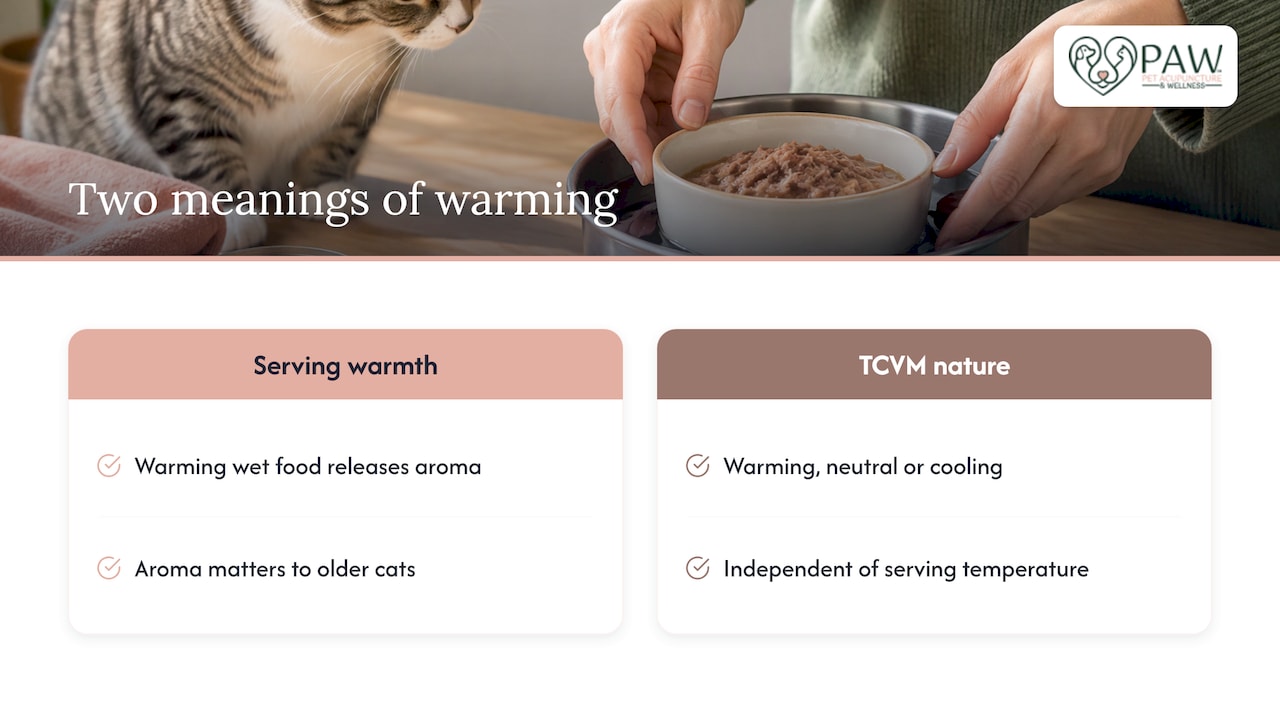
The first is practical: how do I make my cat’s food warm, and is it okay? That is about serving temperature. Warming wet food releases aroma, and aroma matters a great deal to cats, especially older ones whose appetite is fading.
The second comes from TCVM, the tradition behind acupuncture and herbal medicine. In it, foods carry an “energetic” nature, such as warming, neutral or cooling, regardless of how hot the dish is when served. A cat who always seeks sunny spots, curls up near the heater and moves stiffly in the cold may be described as running “cool,” and a practitioner might suggest foods considered warming for her. That is food therapy, which we offer as part of our in-home food therapy service.
Both ideas share a goal: getting the right nourishment into a cat who is comfortable enough to eat it. We take them in order.
Do cats really prefer warm food?
Often, yes, though not every cat. Lisa M. Freeman, DVM, PhD, a board-certified veterinary nutritionist at Tufts, reports on a controlled preference study in which older cats preferred warmed wet food overall, while individual cats differed. Her takeaway is a useful one: treat warming as an experiment worth trying, not a rule.
The reasoning is simple. Cats hunt by scent as much as by sight, and warmth lifts the aroma from the food. A report on the same research from WALTHAM suggests warming food only until it is warm to the touch, never hot, for fussy senior eaters.
A good way to find out about your own cat is to put two small saucers down, one at room temperature and one gently warmed, and see which one she visits first. Do this for a few meals. The answer is usually clear.
How to warm your cat’s food safely
The goal is lukewarm, never hot. The Purina Institute suggests warming wet food to 70 to 100°F (21 to 38°C), and the AAFP/ISFM nursing guidelines say canned food can be warmed to body temperature by microwave or by adding warm water.
- Start with a small portion. Spoon out only what she will eat in one sitting. The same guidelines recommend offering fresh food in small amounts rather than leaving a large bowl to sit.
- Warm gently. Use a microwave-safe dish for a few seconds, or set the dish in a bowl of warm water. Avoid cooking the food. Thiamine, a vitamin cats need, is sensitive to heat, so gentle warming is better than strong heating.
- Stir well. Microwaves leave hot pockets. Stir until the temperature is even, and let it rest a moment.
- Test on your wrist. Dr. Freeman recommends checking the food on your wrist before serving to avoid burning your cat’s mouth. It should feel barely warm, not hot.
- Serve and discard. Warm food spoils faster. Throw away what she leaves rather than reheating it again.
Cats with sore necks, painful teeth or stiff joints often do better with a shallow dish at a comfortable height. AAFP/ISFM senior-care guidance notes that elevated bowls may help cats with degenerative joint disease, which is a common cause of stiffness in older cats.
When warm food is the wrong move
Warming helps some cats and puts others off. FelineVMA nursing guidance explains that nauseated cats may prefer unheated food because the scent is less pronounced. If your cat sniffs warm food, backs away, licks her lips or drools, offer the same meal cool and tell your veterinarian about it. Nausea needs its own treatment.
The same guidance says not to push food on a reluctant cat. Syringe-feeding, force-feeding or wiping food on her nose can cause distress and food aversion. Forcing a disliked diet can also teach her to refuse it for good. A calm, quiet spot, small portions and patience work better.
Feeding senior cats and cats in pain
An older cat who eats less is rarely being stubborn. The AAFP senior-care guidelines explain that dental disease, cognitive changes and systemic illness can all reduce intake, and that cats over 10 may do better on calorie-dense, highly digestible protein in smaller, more frequent meals. They also note that cats 12 and older have increased daily energy needs, so what she actually eats matters. Keep a simple note of how much she finishes each day.
For cats living with chronic pain, the AAFP chronic-pain toolkit recommends small, frequent meals and considering food warming to enhance smell. It also says a cat’s food preferences may need to take precedence so that she eats enough. In other words, a food she accepts is worth more than a perfect food she ignores.
Canned food has another benefit: VCA notes that its high water content may help cats who need more water, such as those with urinary disease or chronic kidney disease, and that it can be gently warmed to increase aroma. Any change in diet for a cat with a medical condition should go through your veterinarian, and changes are best made slowly.
Some families also read about supplements such as functional mushrooms for pets while looking for ways to support a cat with a poor appetite. Before adding anything to her bowl, ask us or your regular veterinarian whether it suits her health and medications.
If you want the bigger picture on what an older cat should be eating, our guide to the best diet for senior cats goes through it.
Warming foods in Traditional Chinese Veterinary Medicine
In TCVM, health is about balance. Yin and Yang are like shade and sunlight, and Qi, the body’s energy, travels along meridians, which you can picture as a highway system. A cat with stiff joints who seeks warmth, sleeps curled tight and moves slowly in the cold may be seen as needing more warming support, while a cat who pants, seeks cool tile or has red, inflamed skin may be seen as running hot.
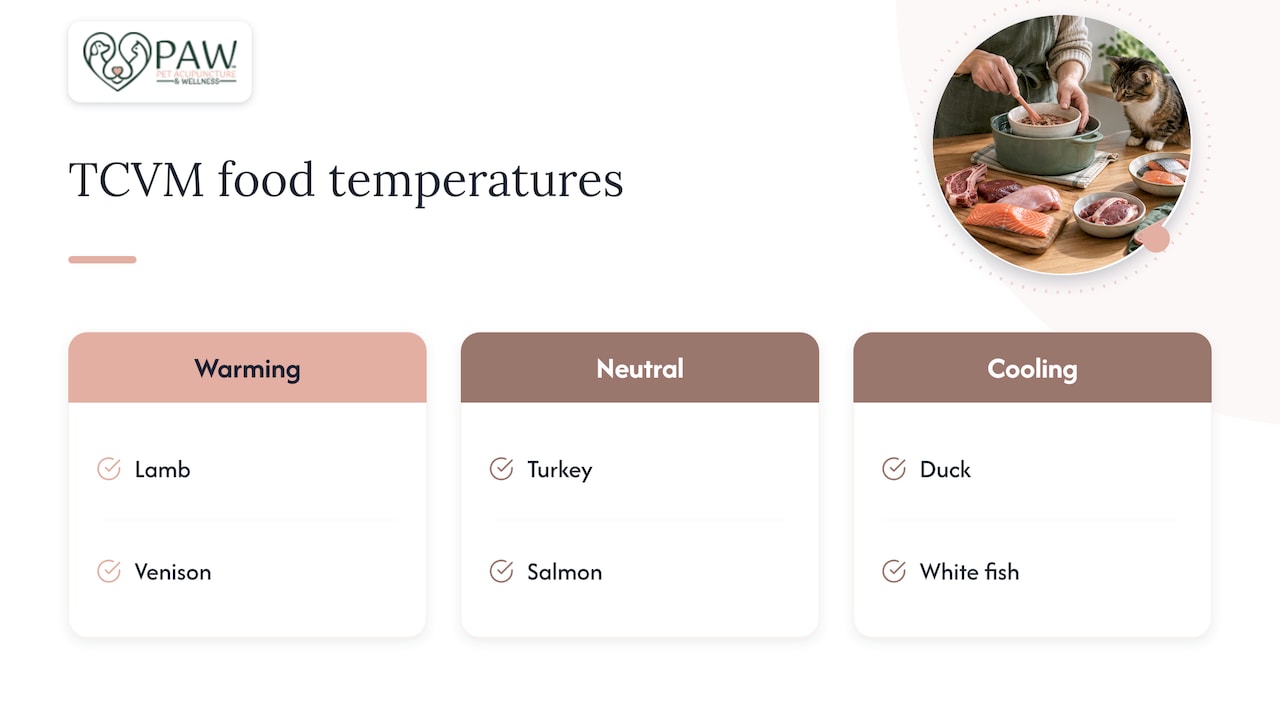
In food therapy, the choice of protein follows that picture. Lamb and venison are traditionally considered warming, turkey and salmon are generally neutral, and duck and white fish are considered cooling. Classifications vary between sources, which is exactly why an individual assessment matters more than a chart. This is also why we do not hand out a single list of “best” foods.
This is about a food’s inherent nature, not the serving temperature. A warmed bowl of duck is still considered a cooling food, and cooled lamb is still considered warming. The two ideas work together: the right food by TCVM thinking, served at a temperature that makes it smell good.
Food therapy is supportive care. It aims to improve intake, comfort and overall wellness, and it fits best alongside the rest of a plan: pain management, acupuncture, laser therapy and rehabilitation where your cat needs them. Our guide to how acupuncture, laser therapy, rehab and massage fit in shows how these pieces come together for senior cats.
When a poor appetite means a call to the vet
Warming food is a gentle tool, not a diagnosis. An appetite that has faded deserves a medical look. A 2020 review on feeding cats says reduced appetite should not be considered normal food-preference behavior until health problems have been addressed or ruled out.
The ISFM consensus guideline says nutritional intervention should begin no later than three days after a cat stops eating, counting days of poor intake at home. So if your cat has eaten little or nothing for about three days, vomits, loses weight, hides or seems to be in pain, call your veterinarian promptly. Do not keep trying new recipes. Our page on when to call your veterinarian right away lists the signs.
Our perspective
We meet many cats whose families say the same thing: she used to love her food, and now she picks at it. We start with the whole cat, her comfort, her mobility and the home she lives in, because a cat who hurts rarely eats well.
That is why we pair food therapy with the rest of integrative care. Warming a meal makes it smell better, and TCVM food therapy helps us tailor what goes in the bowl to your cat’s individual needs. Acupuncture, laser therapy and rehabilitation work on the comfort that lets her eat, move and settle again.
We do all of this at home, where your cat is relaxed and you do not have to wrestle a carrier into the car. We also work alongside your regular veterinarian, so our plan complements the care she already has.
Pet Acupuncture & Wellness
Food therapy for your cat, at home
We bring integrative care to senior, disabled and anxious cats in South Tampa, including food therapy, herbal therapy, acupuncture, laser therapy and rehabilitation. Treatment plans are tailored to each pet’s health needs and home environment.
Our initial assessment and acupuncture with a technician starts from $430, with a $60 technician mobile fee, and laser treatments run $45 to $120 per treatment. Our cost of services page lists the current fees. If you are not sure where to begin, a telemedicine conversation is one way to start, and you can read about it on our telemedicine page. To book, visit pawvetpractice.com.
FAQ
Is it okay to feed cats warm food?
Yes, when it is lukewarm and not hot. Aim for roughly 70 to 100°F, stir out any hot spots and test it on your wrist first. Many older cats prefer it, though individual cats differ.
Can I warm dry food?
Warming is meant for wet food, where heat lifts the aroma. For a cat who ignores dry kibble, a spoonful of warmed wet food or a little warm water added to it can make the bowl more inviting. Ask us or your veterinarian before changing her main diet, especially if she has kidney or urinary disease.
What does food therapy for cats mean?
It means choosing food, texture, temperature, freshness and meal routine to support your cat’s intake and overall wellness. In TCVM, it also means matching foods to your cat’s individual constitution. It supports the rest of her care and does not replace treatment for pain or illness.
Should I warm food if my cat seems nauseated?
Usually not. Nauseated cats can be put off by the stronger smell of warm food, so offer it at room temperature and call your veterinarian, since the nausea itself needs treatment.
How often should I feed an older cat?
Small, frequent meals often suit older cats, especially those in pain or with a weaker appetite. Record how much she really eats and share that with your veterinarian, who can tell you the right amount for her age and health.
Sources
- Too hot? Too cold? Keeping your pet’s food temperature just right (Tufts Petfoodology)
- Strategies to Improve Renal Diet Acceptance in Cats (Purina Institute)
- AAFP and ISFM Feline-Friendly Nursing Care Guidelines
- Could science hold the answer to senior cats’ picky palate? (WALTHAM)
- Analysis of thiamine concentrations in commercial canned cat foods (JAVMA)
- 2021 AAFP Feline Senior Care Guidelines
- FelineVMA Nursing Nutrition for the Hospitalized Inappetent Feline Patient
- AAFP Chronic Pain Toolkit
- Dry, Canned, or Semi-Moist: Food Choices for Cats (VCA)
- Feeding Cats for Optimal Mental and Behavioral Well-Being
- 2022 ISFM Consensus Guidelines on Management of the Inappetent Hospitalised Cat