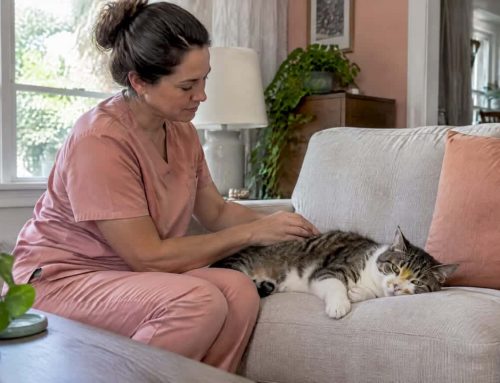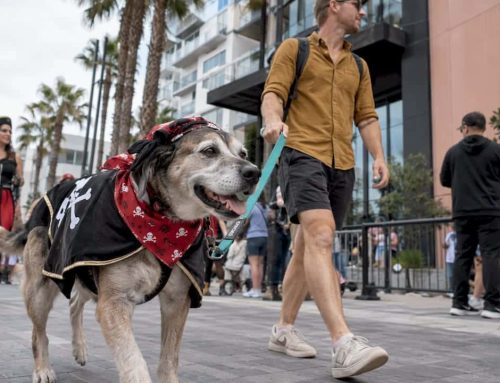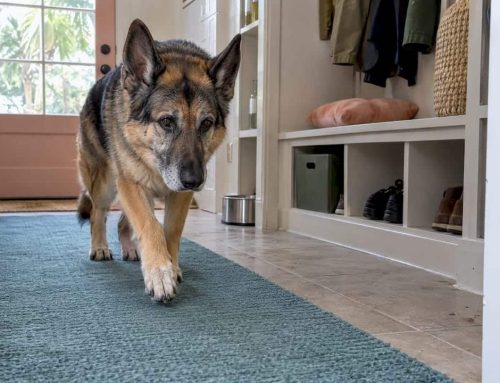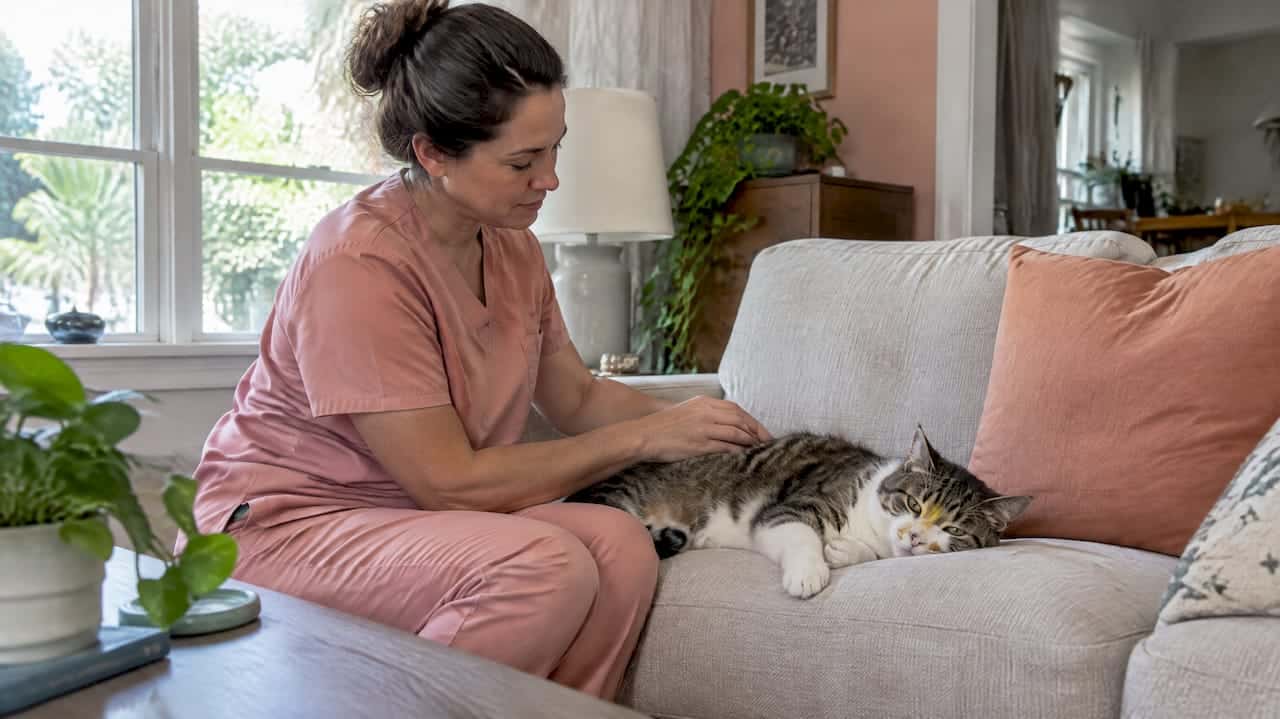
If your dog starts to tremble, drool or refuse to climb in the moment the car door opens, the problem is rarely just the drive. For many dogs the car has become the first step of a stressful vet visit, and that fear can build with every trip. You can ease it in two ways: teach your dog, slowly, that the car is safe, and take as many of the car trips out of their care as possible. For senior, disabled or anxious dogs in South Tampa, that second part is what we do. Our veterinary care happens on your living room floor, so your dog’s comfort does not depend on winning the car battle first.
TL;DR
- Salivation or vomiting while the car moves points toward motion sickness. A dog who is anxious as soon as they get in, even with the engine off, likely has car anxiety. Many dogs have both.
- Gradual desensitization (small steps, high-value treats, stopping when your dog shows stress) is the foundation. Expect days or weeks, not one afternoon.
- Your veterinarian can prescribe anti-nausea or anti-anxiety medication, but only they should choose the drug and the dose.
- Mix in car trips to places your dog loves, so the car does not predict only the vet.
- When travel is hard for a senior, arthritic or fearful dog, our mobile veterinary visits bring integrative care to your home in South Tampa.
Table of Contents
- Car anxiety or motion sickness: what is your dog telling you?
- Why the ride to the vet is often the worst part
- A gentle plan to rebuild your dog’s trust in the car
- Making the vet visit itself less frightening
- When to talk to your veterinarian about medication
- Supplements, CBD and herbs: ask before you give
- When the car is the obstacle to care itself
- Perspective
- What at-home care looks like and what it costs
- A realistic week for an anxious car rider
- FAQ
- Sources
Car anxiety or motion sickness: what is your dog telling you?
The two look alike from the driver’s seat, and a dog can have both. Telling them apart helps you and your vet pick the right help.
Motion sickness is physical. The Merck Veterinary Manual explains that it comes from a mismatch between what the inner ear senses and what the eyes see, which sets off nausea, vomiting, drooling and agitation. It is more common in puppies, whose balance systems are still maturing.
Car anxiety is emotional. The same Merck page notes that fear of the vehicle can become a conditioned response, so signs can show up even when the car is parked. Nausea and anticipation also feed each other: a dog who has felt sick in the car begins to dread it, and the dread can itself bring on nausea.
A quick way to sort out what you are seeing:
| What you notice | More likely |
|---|---|
| Drooling, lip smacking or vomiting only once the car is moving | Motion sickness |
| Pacing, whining, panting or trembling as soon as your dog sees or enters the car, engine off | Car anxiety |
| Both, or signs that worsen with each trip | A combination, where nausea has created fear |
Jot down what you see, when it starts and how long it lasts. A short behavior log is useful to bring to your veterinarian.
Why the ride to the vet is often the worst part
Many dogs ride in the car only for appointments. If the car predicts a slippery exam-room floor, strange smells and handling, your dog is not being dramatic. They are making a reasonable prediction. The American Kennel Club’s guidance on car anxiety makes this point: because vet and grooming visits are stressful, it helps to balance them with trips to places your dog loves, so the car does not mean only one thing.
For an older dog the picture is often layered. Stiff hips make jumping in painful. A slick back seat makes it hard to keep their footing. Every turn means bracing sore joints. Fear, nausea and pain stack on top of one another, and your dog learns to dread the whole sequence. If your senior dog suddenly resists the car after years of happy rides, mention it to your veterinarian. Pain and balance problems can look like fear.
A gentle plan to rebuild your dog’s trust in the car
The approach veterinary behavior experts recommend is called desensitization and counter-conditioning. In plain words: you expose your dog to the car in tiny steps they can handle, and you pair each step with something wonderful. The American Kennel Club’s guide to preventing car anxiety lays out the pattern, and it works like this.
- Start where your dog is relaxed. That may be several feet from the parked car. Give a high-value treat (something better than ordinary kibble) and stay there until your dog is loose and easy.
- Move closer, one small step at a time. Advance only when your dog is completely relaxed at the current distance.
- Add car sounds and routines one by one. Closing a door, the beep of the remote lock, then the engine on and off. Pair each with a treat.
- Bring in the seat gear. If your dog rides in a crate or a seat-belt harness, introduce it at home first, then in the parked car, so it feels familiar.
- Take very short drives to fun places. A nearby park or a quiet stretch of road works. Add a little time as your dog stays comfortable.
The most important rule is the stopping rule. If your dog starts to pant, drool or freeze, end the session, go back to an easier step and try again later or the next day. Pushing through teaches your dog that their warning signals do not work, and the fear deepens.
A few comfort measures help along the way:
- Keep the cabin cool and crack a window for fresh air.
- Offer a light meal a few hours before the trip rather than a full bowl right before it, and check with your vet if you want to hold back food.
- Exercise your dog for about 20 minutes beforehand, as the AKC suggests, so they are pleasantly tired.
- Seat your dog facing forward with secure footing, since pre-travel checklists from veterinarians recommend it.
- Bring a familiar blanket and a chew or a lick mat for your dog to settle with.
These steps take patience. That is normal. Plan on days or weeks of short, happy sessions, and keep every one of them low pressure.
Making the vet visit itself less frightening
Training the car helps. So does changing what happens when you arrive. Cornell University’s Riney Canine Health Center describes “happy visits”: trips to the clinic where nothing medical happens. You start with treats in the car or parking lot, ask staff to greet your dog outside, and then gradually move inside. Cornell also suggests:
- Calling ahead so you can wait in the car or outside if the waiting room is too much.
- Bringing small soft treats or a frozen stuffed toy.
- Practicing paw, ear and mouth handling at home, with treats, and never forcing touch.
- Speaking up for alternatives such as sedation if a needed procedure cannot be completed because your dog’s fear is escalating.
We also keep a close eye on how a visit goes, and we have a separate plan for this. Our four-week plan to reduce vet panic in dogs walks through the steps and the in-home options for dogs who struggle with clinic visits.
When to talk to your veterinarian about medication
Training works best when your dog is not overwhelmed. For some dogs, medication makes learning possible. Bring this up with your regular veterinarian if your dog drools or vomits while the car is moving, is anxious before the car even starts, or if fear makes a needed exam hard to complete. Cornell notes that anti-anxiety medication given at home a few hours before a visit can significantly improve a dog’s welfare and behavior, and that intense fear can get in the way of a proper exam.
What your vet may consider depends on what is going on:
- Motion sickness: The Merck Veterinary Manual says maropitant (Cerenia) is FDA-approved and the preferred drug for motion sickness in dogs, given once daily, for dogs at least 8 weeks old.
- Situational anxiety (car rides, vet visits): Veterinary Practice News reports that trazodone is the most commonly prescribed anxiolytic for short-term situations, given about 90 minutes before the stressor. The vet sets the dose for your dog’s weight and health.
- Chronic anxiety: The same article distinguishes this from situational anxiety and says it usually needs daily medication plus behavior work, with a timeline of several weeks to reach full effect.
Two safety points matter here. First, sedation and incoordination are possible side effects, and the Merck manual specifically flags older or medically compromised animals. If your dog is a senior, tell your vet about every condition and medication, including supplements. Second, a veterinary checklist advises doing a trial dose at home one to two weeks before travel, because a small percentage of dogs respond with more agitation rather than less. Never give a human medication or your own supply of a drug without your vet’s direction.
Supplements, CBD and herbs: ask before you give
Calming chews, pheromone sprays and herbal blends are easy to find, and owners naturally want something gentle. Pheromone sprays, collars and diffusers are among the comfort steps the AKC lists for car trips. For anything you swallow rather than spray, the safest path is to talk with a veterinarian first, because supplements are not regulated like medications and can interact with prescriptions.
CBD deserves a particular note. Veterinary Practice News summarizes a controlled trial using a noise-fear model in which the CBD dose tested did not produce a measurable calming effect in dogs. Cats absorb oral CBD differently, and one cat in a safety study developed persistent liver enzyme elevation. That is a good reason to involve your veterinarian before trying it with either species.
When a calming plan includes herbs, quality, dose and interactions matter more than the label. Our guide to herbs for canine anxiety covers the safety questions and red flags, and herbal therapy is one of the services we offer as part of an integrative plan alongside your dog’s regular veterinary care. You can read more about herbal therapy on our site.
When the car is the obstacle to care itself
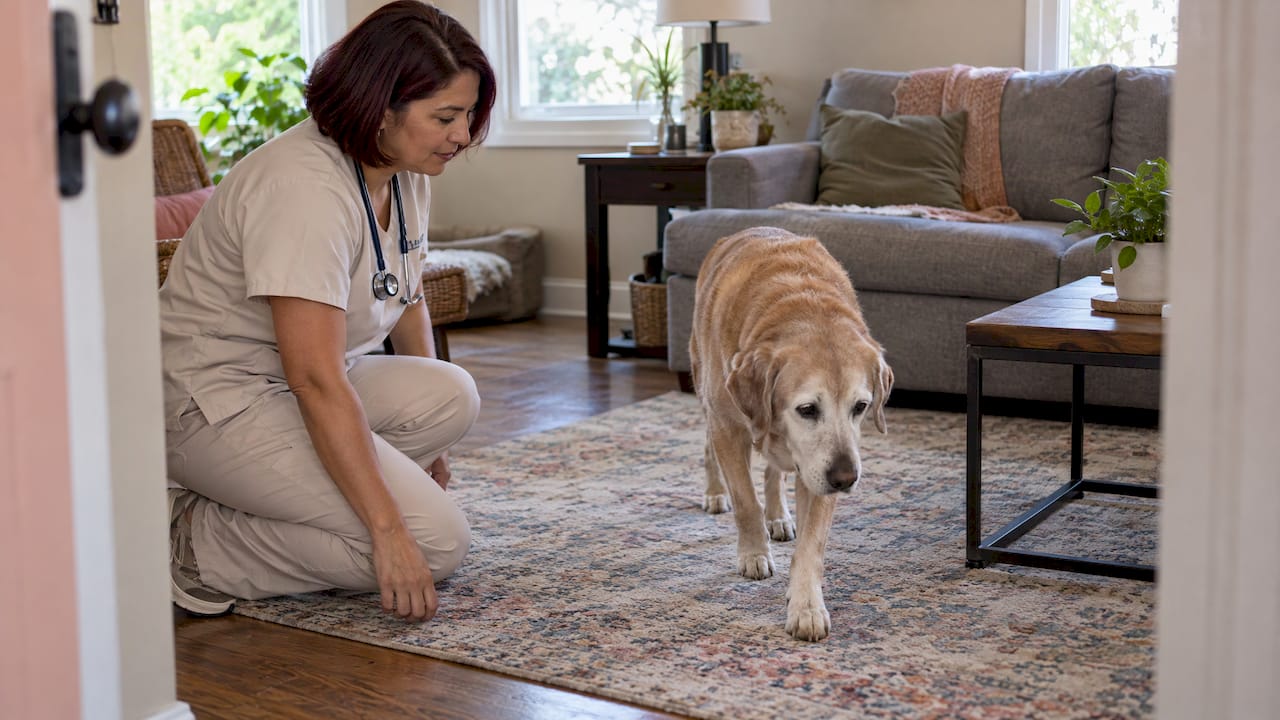
Here is the point many owners reach, and it is nothing to feel guilty about. Your dog is 13, their back legs slip on tile, and a 20-minute drive leaves both of you shaking. Or your dog is disabled and lifting them into the car is a struggle. Training the car is still worth doing if you want it. But your dog’s pain management, rehabilitation and wellness care should not wait for it.
There are two ways to take the car out of the equation for at least part of your dog’s care:
- Telehealth. Virtual appointments can mean less stress for a nervous pet and less travel for a pet or owner with mobility issues. Rules differ by state, though, and a veterinarian generally needs an established relationship with your dog, which usually includes an in-person exam, before diagnosing or prescribing.
- A veterinarian who comes to you. An exam, a treatment and a conversation all happen where your dog already feels safe, on their own bed, with their own smells around them.
Our practice was built for the second option. We provide mobile care in South Tampa, and we work with your pet’s regular veterinarian to complement existing care rather than replace it. Your dog’s regular vet remains the right contact for vaccines, diagnostics and anything that needs a clinic.
Perspective
When an owner tells us their dog shakes in the car, we hear two stories at once. One is about the dog’s fear. The other is about the owner, who dreads each trip as much as the dog does and who often puts off care because of it.
We believe the kindest approach starts by lowering the stakes. Our care happens in your home, in the place where your dog is calmest, which is why we focus on senior, disabled and anxious dogs and cats. Treatment plans are tailored to each pet’s health needs and home environment, and we work alongside your regular veterinarian.
Our integrative toolkit includes acupuncture, laser therapy, rehabilitation, herbal therapy, food therapy and Chinese veterinary medicine. Used thoughtfully, these support comfort and mobility so your dog can move more easily around the house, onto the couch, and even, when the time is right, into the car for a happy trip to the park.
Fear is learned, and it can be softened. Gentle training in the car, support from your regular vet, and care that comes to you give your dog the best chance of feeling safe.
Pet Acupuncture & Wellness
What at-home care looks like and what it costs
If your dog is too anxious, stiff or frail for regular clinic trips, our house-call visits mean the care comes to you. We offer in-home acupuncture, laser treatments, rehabilitation, herbal therapy, food therapy, injectable medications and telemedicine advice, among other services.
Our published prices, as of our site’s most recent listing:
| Service | Price |
|---|---|
| Initial assessment and acupuncture with a technician | from $430 |
| Technician mobile fee | $60 |
| Electroacupuncture | $30 |
| Laser treatment | $45 to $120 per treatment |
| Vitamin B12 injection | $31.50 |
| At-home rehabilitation packages | $85 to $918 |
Some services, such as acupressure, herbal therapy and food therapy, do not have a published price. The full price list is on our cost of services page, and you can read how rehabilitation therapy works at home.
If the car is what keeps your dog from the care they need, contact us to talk about an in-home visit in South Tampa.
A realistic week for an anxious car rider
It helps to picture what progress looks like. A sample week for a dog who is nervous about the car, adjusted to your dog’s pace:
- Days 1 to 2: Feed a few treats near the parked car. No door opening yet if that is too much.
- Days 3 to 4: Open and close doors with treats. Let your dog sniff and step in on their own, with a ramp or a lift if they are stiff.
- Days 5 to 6: Sit in the parked car with a lick mat. Start the engine for a few seconds, then turn it off.
- Day 7: One short drive around the block, home again, a favorite chew.
Some dogs take a week. Others need a month. If your dog shows stress at any step, that step stays on the schedule a little longer. The behavior log you keep tells you more than the calendar does.
FAQ
Can a dog really be afraid of the car because of the vet?
Yes. Dogs that ride mainly to the vet can learn that the car predicts a stressful experience, and the anxiety starts before the ride does. Balancing vet trips with rides to places your dog loves helps weaken that link.
How long does it take to help a dog with car anxiety?
It varies by dog, and it can take days or weeks of short, positive sessions. Stop a session when your dog drools, pants or freezes, then restart later at an easier step. Your veterinarian can tell you whether medication would help while you train.
Is car anxiety the same as motion sickness?
Not quite. Motion sickness tends to show up as drooling or vomiting once the car moves. Car anxiety shows up as stress even when the car is parked. A dog can have both, and your vet can sort out which one you are dealing with.
Can my senior or disabled dog get care without a car ride?
Yes. Our mobile veterinary care in South Tampa brings integrative services such as acupuncture, laser therapy and rehabilitation to your home. We work with your dog’s regular veterinarian so your dog’s care stays coordinated.
Sources
- Motion Sickness in Animals, Merck Veterinary Manual
- Preventing Motion Sickness and Anxiety in Dogs During Car Travel, American Kennel Club
- How to make veterinary visits less stressful for dogs, Cornell University Riney Canine Health Center
- How to manage anxiety in pets, Veterinary Practice News
- Traveling With Your Dog: 2026 Vet Checklist, RexVet
- Virtual Vet Visits, Fetch Pet Insurance