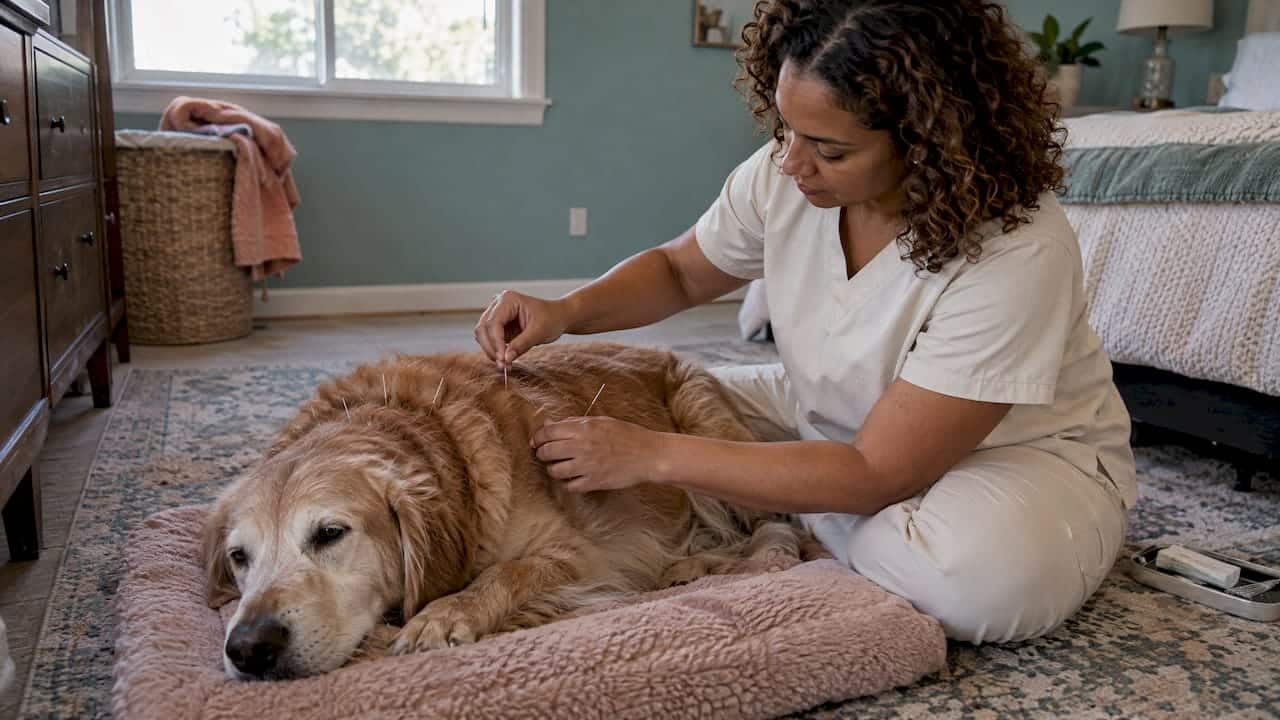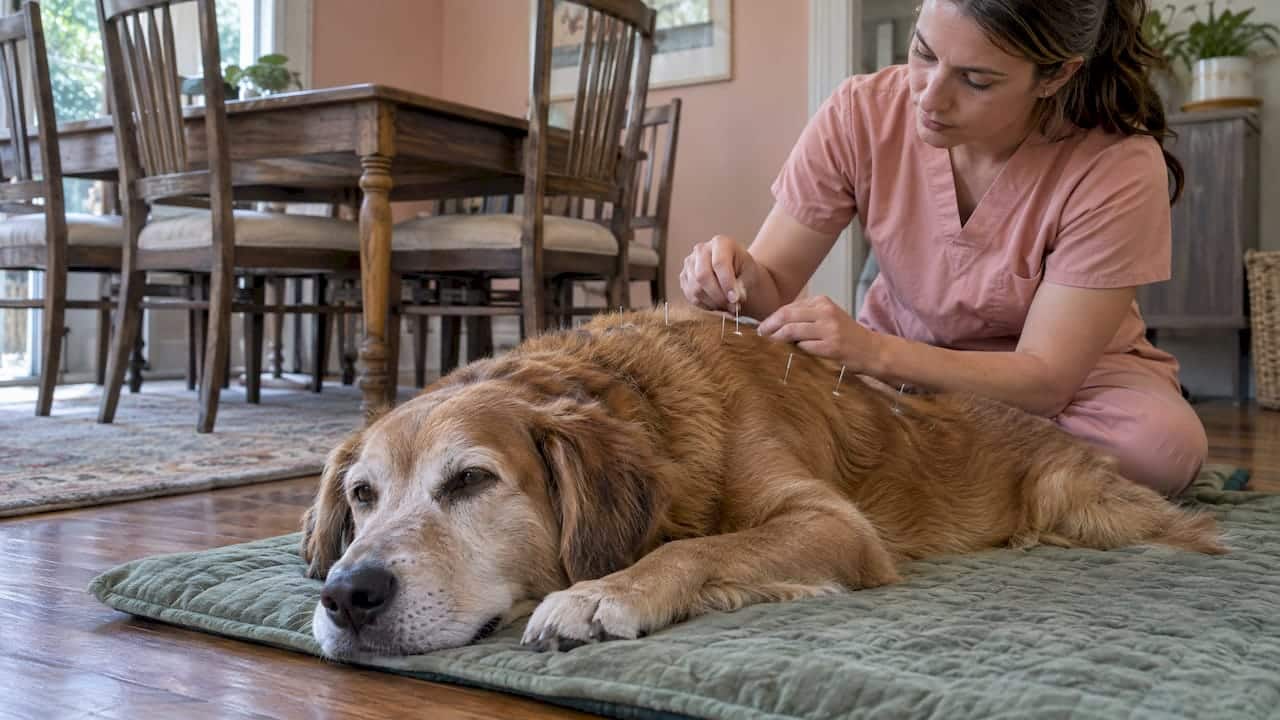
Acupuncture may help some constipated dogs as part of a plan your veterinarian has approved. It is not a substitute for finding out why your dog can’t go. The research is promising but early. The right order is a veterinary exam first, then acupuncture alongside conventional care.
If your dog is straining, circling, or hasn’t produced a normal stool in a day or two, you are probably worried and looking for something gentle. This guide covers what studies show, how a session works, what to avoid at home, and how we approach digestive support for senior and anxious dogs in South Tampa.
TL;DR
- Call your veterinarian if your dog hasn’t passed stool in two to three days, or sooner if there is vomiting, pain, or lethargy.
- Lab studies in dogs show that stimulating the point ST-36 can improve intestinal contractions and transit. Studies in actual constipated dogs are still limited.
- Not every acupuncture point helps. One canine study found most classic points had no effect on colon motility, and one point slowed it.
- Never give a human laxative, enema, or mineral oil at home without veterinary instruction.
- Acupuncture works best as a complement to diagnosis and treatment. Results often build over several sessions.
Table of Contents
- When constipation needs a vet before anything else
- What the research says about acupuncture and canine constipation
- How acupuncture is thought to help a constipated dog
- What an at-home session looks like
- Safety and who should not have acupuncture
- What not to do at home
- Who can perform acupuncture on a dog, and how many sessions to expect
- Beyond needles: food, herbs, and movement
- Acupuncture at home in South Tampa
- FAQ
- Sources
When constipation needs a vet before anything else
Constipation can be a simple, short-lived problem. It can also be the visible sign of something deeper, such as pain, dehydration, an obstruction, or a problem with the colon itself. That is why the first step is never a home remedy and never acupuncture alone.
One veterinary pet insurance guide says a dog who doesn’t poop for more than 24 to 48 hours, or who also vomits or seems lethargic, needs to see a veterinarian. It also notes that constipation is very manageable when it is assessed and treated early. A PetMD article reviewed by a veterinarian says constipation can become a medical emergency because it is so uncomfortable and can worsen if left untreated. It advises calling promptly if your dog shows pain, loss of appetite or thirst, vomiting, or lethargy, or hasn’t passed feces for two to three days.
In practice, call your veterinarian if you see any of these:
- Repeated straining with little or nothing produced
- Crying out or whimpering when trying to defecate
- A hard, swollen, or tender belly
- Vomiting, refusing food, or unusual tiredness
- No stool for two to three days
Senior dogs deserve extra attention here. Arthritis in the hips or spine can make the squatting posture painful, so a dog may hold it in. Reduced water intake and less movement add to the problem. If your older dog seems reluctant to posture, mention it at the exam, because treating that pain is part of treating the constipation.
What the research says about acupuncture and canine constipation
Here is the honest picture. Acupuncture has been studied for gut movement in dogs, and some results are encouraging. But much of the work looks at how the intestine behaves under controlled lab conditions, not at pet dogs recovering from constipation at home.
Evidence that supports it
A 2015 study found that electroacupuncture, and a needleless transcutaneous version, at the point ST-36 improved intestinal contractions, transit, and slow waves in dogs whose gut function had been impaired by rectal distension. The authors point to vagal (nerve-mediated) mechanisms. That is a plausible explanation for why stimulating a point on the leg can influence digestion.
Professional veterinary education material agrees that the digestive tract is a reasonable target. An Arthrex Vet Systems article on GI disease describes small animal gastrointestinal disease as the most conventionally accepted category for acupuncture among Western veterinarians, and says ST-36 is well tolerated and useful for some GI diseases. The Merck Veterinary Manual lists digestive disorders among the indications for which veterinarians may prescribe acupuncture.
Evidence that urges precision
Not every point does the same thing. A 2006 study in the Journal of Veterinary Medical Science tested several traditional points, including LI4, LI11, ST25, and BL25, in conscious dogs. None had significant effects on proximal colon motility, while stimulation at GV1 reduced it. The takeaway is not that acupuncture fails. It is that point selection matters, and a trained veterinary practitioner chooses points for the individual dog.

The same Arthrex article notes that ST-25, a point often used in human abdominal acupuncture, is not practiced in veterinary medicine because of the risk of abdominal infection. Needle placement in dogs is not simply copied from people.
The Merck manual also explains that results depend on the practitioner’s skill, the patient’s health and how long the problem has lasted, and the locations and type of stimulation used. For a dog with chronic or recurring constipation, that means a tailored plan, not a one-size protocol.
If you want to read more about gut support, our page on acupuncture evidence for dog GI problems and in-home care goes deeper.
How acupuncture is thought to help a constipated dog
Two explanations sit side by side, and we find both useful for owners.
The Western view. According to the Merck Veterinary Manual, acupuncture involves placing thin needles at specific points believed to activate sensory nerve fibers. A gentle technique stimulates mechanoreceptors rather than pain receptors, which is aimed at boosting the body’s own pain-modulating systems. For the gut, studies like the ST-36 work above suggest nerve pathways can influence how the intestines contract.
The Traditional Chinese Veterinary Medicine (TCVM) view. In TCVM, health depends on Qi flowing freely along Meridians, which you can picture as a highway system running through the body. When traffic backs up, signs show up. Constipation may be viewed as stagnation, a sluggish digestive system where movement has slowed, or as a dryness that needs to be balanced. Think of Yin and Yang as shade and sunlight: too much dryness and heat, or too little warmth and movement, can leave the bowel unable to do its work. Treatment aims to restore movement and balance.
You don’t need to choose between these frameworks. What matters is that they point to the same practical approach: a veterinarian who examines your dog, rules out dangerous causes, and uses needles, and sometimes diet and herbs, to support normal movement.

What an at-home session looks like
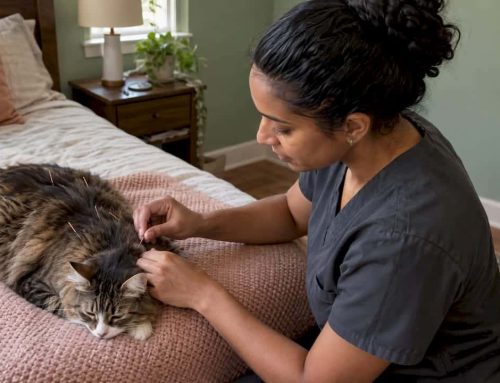
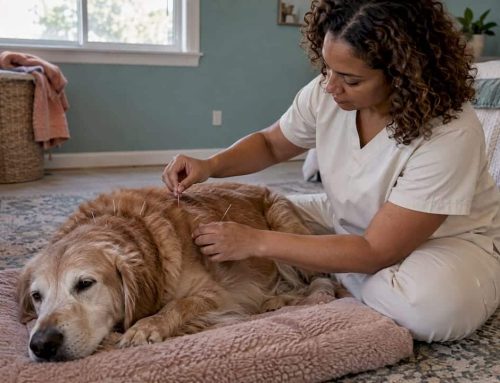
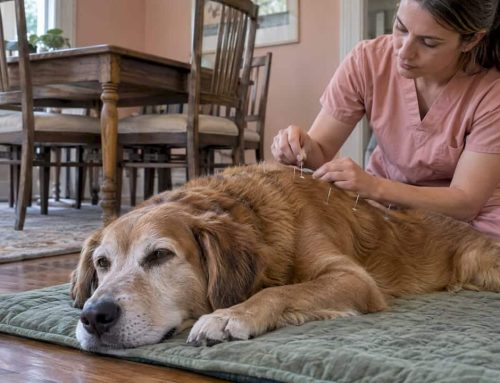
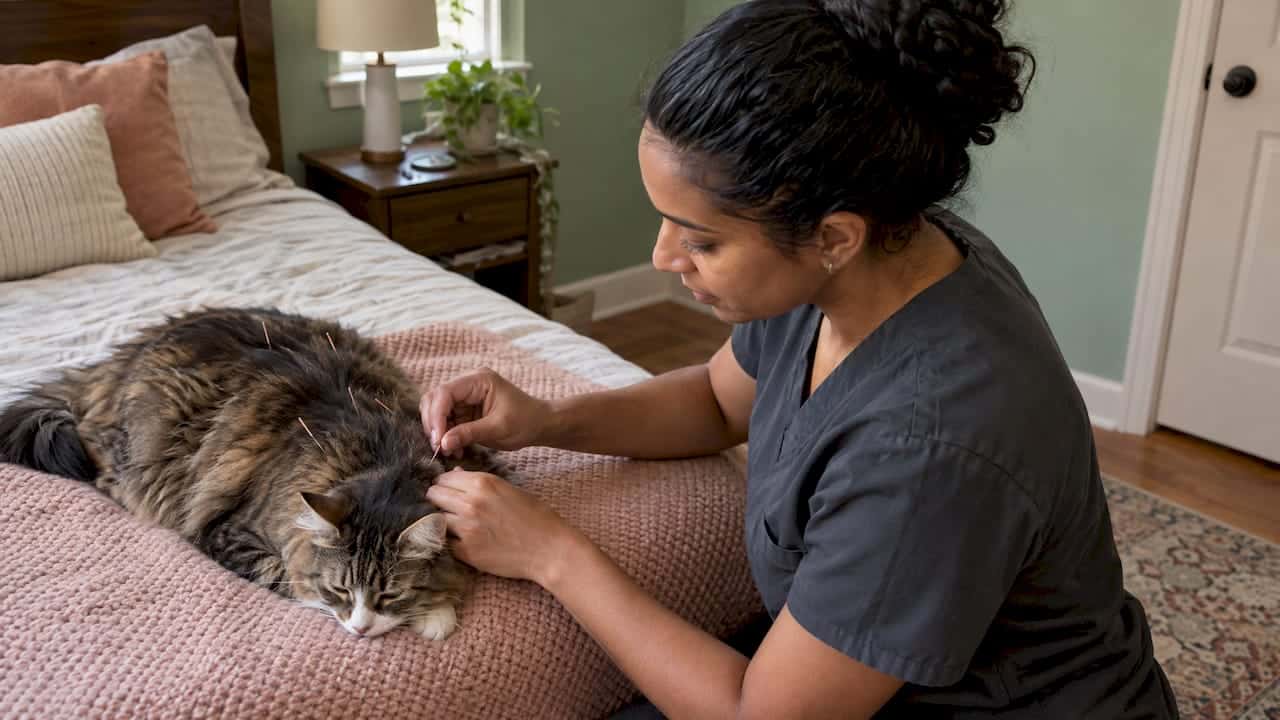
For many dogs, especially seniors with sore joints or dogs who shake in the waiting room, the car ride and clinic are part of the problem. Stress itself can upset digestion. At-home care lets your dog be treated on a familiar bed or favorite spot.
A typical first visit with us looks like this:
- History and exam. We go over diet, water intake, medications, mobility, and bowel habits, and look at what your regular veterinarian has already found.
- Plan. We tailor the approach to your dog’s health needs and your home setup.
- Needle placement. Very fine needles go into selected points while your dog rests. Many dogs relax or doze.
- Optional add-ons. Depending on your dog, we may use electroacupuncture, gentle acupressure, or laser therapy.
- Home guidance. You get simple steps for water, movement, and monitoring.
We work with your dog’s regular veterinarian so our care complements what is already in place.
Safety and who should not have acupuncture
The Merck Veterinary Manual says acupuncture is generally regarded as safe when performed correctly, and that appropriately trained veterinary professionals see few adverse effects. The risk of injury to a major organ or vessel is limited when the practitioner knows the anatomical landmarks.
The same source lists situations that call for caution or a different plan:
- A dog that can’t remain still
- High anxiety or aggression
- Bleeding disorders (coagulopathies)
- Immune compromise
- Areas of tumor or infection
This is one more reason a veterinary assessment comes first. Constipation with a mass, an infection, or a clotting problem needs a different path. If your dog is anxious, tell us. Our approach to calming a nervous dog is covered in acupuncture for dogs with anxiety, and a quiet home setting often makes sessions easier.
What not to do at home
When your dog is uncomfortable, it is tempting to reach for something from the medicine cabinet. Please don’t.
- No human laxatives or enemas. Veterinary Partner says human constipation products should not be used in pets without specific veterinary instruction because some are toxic. It also says enemas should not be attempted at home. They are best left to experienced staff, and for a dog whose colon is full and can’t pass stool they are painful and first need sedation.
- No mineral oil. An emergency and referral hospital specifically warns against it because of the serious risk of aspiration into the lungs, which can cause severe respiratory disease.
- No guessing at doses. Ask your veterinarian what is safe for your dog’s size, age, and conditions.
If the cause turns out to involve diet, your veterinarian will guide the changes. Any steady, gradual approach to feeding matters, and a vet-backed look at gut-friendly dog diets shows why digestive problems in either direction are best handled with professional input instead of trial and error.
Our perspective
We see many senior and disabled dogs whose digestive trouble is tangled up with pain, stiffness, and stress. A dog with sore hips may avoid squatting. A dog who dreads the car may be tense for days after a clinic visit. Treating the bowel alone misses the bigger picture.
That is why we bring care to the home and combine tools. Acupuncture, gentle rehabilitation, food therapy, and herbal therapy can each address a different piece, and we shape the plan around your dog and your living space. We always work alongside your regular veterinarian, so diagnosis and conventional treatment stay in place and integrative care adds to them.
Our goal is a more comfortable dog and a calmer household. When movement returns to the body, it often returns to the gut too.
Pet Acupuncture & Wellness
Who can perform acupuncture on a dog, and how many sessions to expect
Acupuncture is a medical procedure, so look for a licensed veterinarian trained in veterinary acupuncture, not a groomer, a human-medicine practitioner, or a kit bought online. Ask about their training and whether they will coordinate with your dog’s regular veterinarian. The Merck manual’s point that results depend on practitioner skill is the reason this matters.
How many treatments are needed depends on your dog. MetLife Pet Insurance lists constipation among the GI problems for which acupuncture has been used in dogs, and notes that results can be slow and may take many sessions. Chronic issues usually need a series with spacing adjusted as your dog responds. We explain typical schedules in how often your dog should get acupuncture.
While you wait for results, you can track things that help your veterinarian adjust the plan:
- Dates and appearance of each stool
- How much your dog drinks
- Appetite and energy
- Any straining or discomfort
Beyond needles: food, herbs, and movement
Constipation rarely has one cause, so we often combine approaches, always in coordination with your veterinarian.
- Food therapy looks at what your dog eats through a TCVM lens and tailors suggestions to the individual.
- Herbal therapy uses Chinese veterinary herbs under professional guidance, never as a casual add-on.
- Rehabilitation therapy helps stiff or weak dogs move more, which supports normal digestion and makes posturing easier.
- Telemedicine can help you decide what to do next between visits, though it has limits, which we cover in what pet telemedicine cannot do.
Acupuncture at home in South Tampa
We are a mobile practice serving South Tampa, built for senior, disabled, anxious, or chronically ill dogs and cats who struggle with clinic visits. We bring integrative care, including acupuncture, laser therapy, rehabilitation, herbal therapy, and food therapy, to your living room.
Our published pricing at our cost of services page includes an initial assessment and acupuncture with a technician from $430, electroacupuncture at $30, laser treatments at $45 to $120 per treatment, and a technician mobile fee of $60. Rehabilitation packages range from $85 to $918. To talk through your dog’s situation, start at pawvetpractice.com.
FAQ
Can acupuncture cure constipation in dogs?
Acupuncture is not a cure-all. Studies show that stimulating ST-36 can improve intestinal movement in dogs, and veterinarians use acupuncture as a complement for some digestive problems. Your veterinarian should first find out why your dog is constipated, and acupuncture then supports that plan.
How long should I wait before calling the vet?
Call if your dog hasn’t passed stool in two to three days, or sooner if there is vomiting, pain, loss of appetite, or lethargy. Some sources advise acting after 24 to 48 hours when other signs are present. When in doubt, call.
Is acupuncture painful for dogs?
A gentle technique targets sensory receptors rather than pain receptors, according to the Merck Veterinary Manual, and many dogs relax during treatment. Dogs who can’t stay still or are highly anxious may not be good candidates, so tell your veterinarian about your dog’s temperament.
Can I give my dog a laxative while waiting for an appointment?
No. Human laxatives, enemas, and mineral oil can be dangerous for dogs. Ask your veterinarian before giving anything, and let them tell you what is safe and how much.
Sources
- Needleless transcutaneous electroacupuncture improves intestinal function in dogs (PMC, 2015)
- Effect of Traditional Acupuncture on Proximal Colonic Motility in Dogs (J Vet Med Sci, 2006)
- Arthrex Vet Systems: GI disease and acupuncture
- Merck Veterinary Manual: Acupuncture in Veterinary Patients
- MetLife Pet Insurance: Acupuncture for Dogs
- Forbes Advisor: Constipation in Dogs
- PetMD: Dog Constipation, When to Call Your Vet
- Veterinary Partner: Constipation and Megacolon in Dogs and Cats
- When Your Pet Just Can’t Go: Constipation in Pets
- Vet-backed dog gut health diet guide