If your dog has a raw, shiny patch on a front leg that never seems to heal, you already know how wearing it is. Therapeutic laser can be one part of a lick granuloma plan. It is used to calm inflammation, ease discomfort and encourage the skin to heal, and it works best when your veterinary team is also finding and treating the reason your dog keeps licking. Here is how it works, what research reports, what sessions involve, and where acupuncture fits.
TL;DR
- A lick granuloma (acral lick dermatitis) is a chronic lesion from persistent licking or chewing, usually on a lower leg. It tends to return unless the trigger is found and managed.
- Laser is used as an add-on to medical care. In a 2021 sham-controlled trial, dogs treated with low-level laser showed significantly more hair growth over the lesion.
- Typical sessions last minutes, and the number of visits depends on the dog and the lesion. Plan on a series, not a single treatment.
- Acupuncture is reported to help some dogs, often alongside other treatment, and pairs naturally with laser.
- Both can be done at home in South Tampa, which spares an anxious or sore dog the car ride and waiting room.
Table of Contents
- What a lick granuloma is, and why it lingers
- How laser therapy is used on a lick granuloma
- What the research says
- What a laser plan can look like
- Where acupuncture fits
- The rest of the treatment plan
- Safety: who should talk to a veterinarian first
- What it costs with us
- Our perspective
- Care at home in South Tampa
- FAQ
- Sources
What a lick granuloma is, and why it lingers
A lick granuloma is a chronic, inflammatory lesion on one or more lower legs, caused by excessive and persistent licking or chewing. It is not a simple wound. The licking irritates the skin, the irritation itches or aches, and your dog licks more. Veterinarians call this the itch-lick cycle.
The frustrating part is that the exact origin is unknown. The same veterinary dermatology handbook notes that if the trigger is not identified and controlled, most cases recur. Triggers can include allergies, joint pain, nerve problems, infection or boredom and anxiety. One manufacturer’s veterinary page reports that about half of cases are traced to idiopathic or behavioral causes, and that most lesions also carry a deep bacterial infection that needs a long antibiotic course.
That is why a single treatment rarely solves it, and why you will hear about a team approach: your regular veterinarian for diagnostics and medication, plus supportive therapies that make the area more comfortable and help the tissue recover.

How laser therapy is used on a lick granuloma
The word “laser” covers two quite different things, and it helps to know which one your dog’s veterinarian means.
Surgical or ablative laser
CO2 laser removes the lesion by vaporizing tissue. The dermatology handbook describes advantages such as sterilizing the lesion, reducing postoperative pain and sealing nerve endings, and says it should be considered only once the underlying trigger has been identified and controlled. This is a procedure done under anesthesia in a hospital setting.
Therapeutic (cold or low-level) laser
Therapeutic laser, also called photobiomodulation, is the gentle option. No tissue is removed. Light is delivered to the lesion and surrounding skin, and it is used to stimulate wound healing and relieve inflammation, itch and pain. The thought is that light energy acts on mitochondria inside cells, which helps them produce the energy tissue needs to repair itself.
This is the version we can bring to your living room. Your dog stays on a favorite bed or in your lap, there is no sedation, and there is no hospital smell.
What the research says
Here is what has been reported so far, in plain terms.
- A controlled trial. In a 2021 randomized, double-blinded, sham-controlled study in Veterinary Dermatology, 13 dogs with lick granulomas received either real or sham laser treatment (laser plus blue and red LEDs) over ten visits across four weeks. All dogs also received antibiotics and trazodone. Hair growth increased significantly in the laser group, a visible sign that the skin was recovering.
- Clinical experience. Veterinary trade literature reports that CO2 laser and cold laser have helped in select cases, and that acupuncture around the affected area has been helpful in some dogs. The same article describes treatment as a slow process, likely taking several months for most patients, with a better outlook for dogs treated early.
- Depth of treatment. A veterinary proceedings paper notes that a class 4 laser can reach tissue 2 to 3 cm below the skin surface, which is relevant because lick granulomas often have deep tracts of inflamed tissue.
- Dosing is still being refined. A veterinary journal review explains that the best wavelengths, intensities and doses for pets are still being studied, which is why an experienced practitioner adjusts the plan to your dog rather than using one fixed recipe.
The honest takeaway: laser is a supportive tool studied as an add-on to conventional care, and the research community continues to build the evidence. Used that way, as one part of a plan, it offers a drug-free, comfortable way to help the tissue.
What a laser plan can look like
Published dosing guidance for lick granulomas, once the source of the problem is being treated, describes 1 to 3 J/cm² delivered several times a week until the wound is healed and hair is regrowing. Another reference adds that the beam is applied directly over the lesion and at least 1 cm beyond its edge.
In practice:
- Session length. Each laser session typically runs between five and 30 minutes, depending on the laser, the condition and your dog’s size.
- Frequency. Early on, visits are usually closer together, then spaced out as the skin improves. The schedule depends on the severity and how your dog responds.
- Eye protection. Everyone in the room, including your dog, wears protective goggles.
- Hair as a milestone. Fur returning over the patch is one of the clearest signs of progress.
We set expectations early: healing happens in weeks to months, not days. Dogs treated early generally have a better prospect than dogs with chronic, severe lesions, so do not wait for the spot to get worse.
Where acupuncture fits
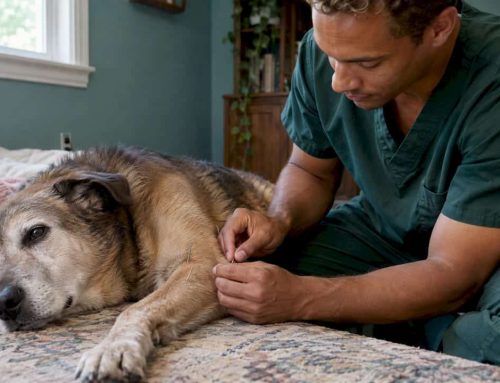
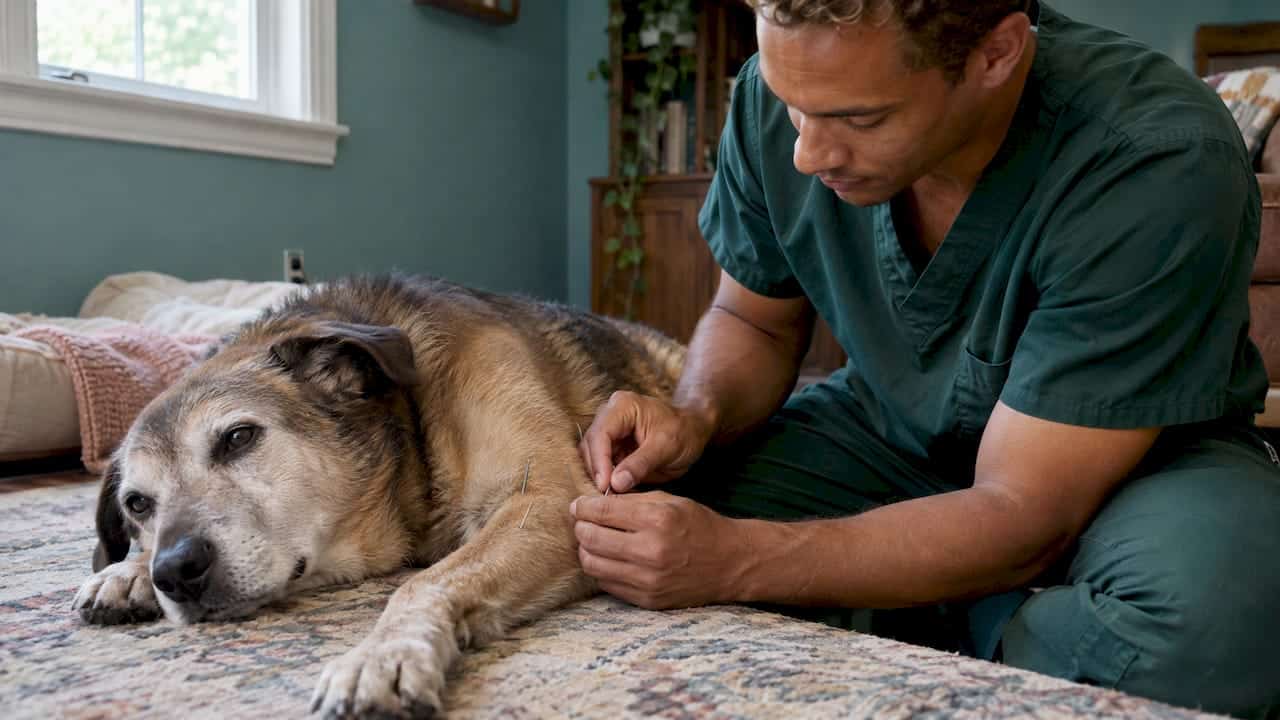
Many owners searching for laser also ask about acupuncture, and the two go well together. Veterinary acupuncture literature describes treating points around the lesion and also working on the body more broadly. One proceedings paper advises that for a granuloma on the wrist or hock, the shoulder and hips should always be treated too, and reports a Doberman whose seven-year hock lesion cleared after hip acupuncture. That is a single case report, but it illustrates a key idea in Traditional Chinese Veterinary Medicine.

Think of the body’s meridians as a highway system. A traffic jam in one place, such as a sore hip or stiff shoulder, can send trouble down the road to the paw. When a dog licks one spot for years, we ask what the rest of the body is telling us. Arthritis, nerve irritation or pain elsewhere can all be part of the story, and treating them may take pressure off the licking habit.
Our acupuncture services include electroacupuncture and acupressure, and we can add herbal therapy and food therapy to support the skin from the inside, always alongside what your regular veterinarian prescribes. If inflammation is a big part of your dog’s picture, you may also be reading about supporting inflammation control in dogs through daily routines. Ask your veterinarian before adding any supplement.
The rest of the treatment plan
Laser and acupuncture rarely work alone on a lick granuloma. A complete plan usually includes:
- Infection control. Secondary bacterial infection often needs two to three months, sometimes longer, of oral antibiotics. Cultures can guide the choice.
- Finding the trigger. Allergy workup, orthopedic and neurologic checks, and a look at your dog’s daily routine.
- Interrupting the licking. Barriers, protective wraps, enrichment and, when advised, medication for anxiety or compulsive behavior.
- Comfort care. Pain relief for joints or nerves, rehabilitation for stiff or weak dogs, and gentle exercise.
We work with your dog’s regular veterinarian so everyone is following the same plan. Our approach is built to complement conventional care, not replace it.
Safety: who should talk to a veterinarian first
Therapeutic laser is considered low risk when used correctly, but it is not right for every dog. Tell us or your veterinarian before treatment if your dog has any of these:
- A tumor, cancer or lymphoma. The MSD Veterinary Manual lists neoplasia, hyperactive thyroid, active bleeding and a pregnant uterus among the contraindications, and notes lymphoma and immunosuppressant medication as well. A lick granuloma that looks unusual, grows quickly or bleeds should be examined, and sometimes sampled, before any treatment.
- Age under one year. Higher-powered devices may stimulate premature closure of growth plates in animals under one year old.
- Pregnancy. Laser is not used over a pregnant abdomen.
Eyes are the main concern. Direct exposure can damage the retina, and burns are rare and usually come from improper use, such as too high a setting or not moving the laser. That is why goggles are worn and why a trained professional should run the device. The same source cautions that consumer at-home laser gadgets are not strong enough and lack the right wavelength, so book professional sessions instead. If you want to know what to ask first, our guide to questions to ask before dog laser therapy walks through them.
What it costs with us
Here are our published prices:
| Service | Published price |
|---|---|
| Laser treatment | $45 to $120 per treatment |
| Initial assessment and acupuncture with a technician | from $430 |
| Electroacupuncture | $30 |
| Technician mobile fee | $60 |
| At-home rehabilitation packages | $85 to $918 |
The full list is on our cost of services page. For a broader look at what a laser visit involves, see our guide to dog laser therapy costs.
Our perspective
A lick granuloma is rarely just a skin problem, and we do not treat it as one. When a dog has licked one spot for months, we see a pet who is uncomfortable, often in more than one place, and an owner who is tired and worried.
That is why we come to you. A dog that dreads the car, struggles on stairs or panics in a waiting room is harder to help, and stress itself can feed the licking. In your own home we can watch how your dog walks, where they rest and what sets the licking off, and we build the plan around that.
Laser fits that approach well. It is gentle, needs no sedation and can be done in a few minutes beside you. Combined with acupuncture, rehabilitation, herbal and food therapy where they suit your dog, it lets us support the tissue and the whole body together, in step with your regular veterinarian.
Progress is gradual, and we will celebrate the small signs with you: less licking, calmer skin, the first fuzz of new hair.
Pet Acupuncture & Wellness
Care at home in South Tampa
We bring integrative veterinary care to dogs and cats across South Tampa, with a focus on senior, disabled and anxious pets. For a lick granuloma, that can mean an initial assessment, therapeutic laser sessions, acupuncture, and coordination with your primary veterinarian.

See how our South Tampa pet laser therapy visits work, or contact us through our home page to book. If you are unsure whether your dog needs a visit, our telemedicine consultations are a good first step.
FAQ
Can laser therapy cure a lick granuloma?
Laser is used as a supportive treatment, not a stand-alone cure. Because the cause is often unknown and most cases come back if the trigger is not controlled, it works best alongside treating infection, pain, allergies or anxiety. Early treatment generally gives a better outlook.
How many laser sessions does a lick granuloma need?
It depends on the lesion and your dog. Published guidance describes sessions several times a week until the wound heals and hair regrows, and the 2021 trial used ten visits over four weeks. Many dogs need a longer course overall, so plan for weeks to months.
Does laser hurt my dog?
Therapeutic laser is generally felt as gentle warmth or nothing at all, and dogs are usually calm during it. Goggles protect eyes, and a trained professional keeps the device moving to avoid heat buildup. Tell us if your dog has had a skin reaction before.
Can acupuncture help a dog with a lick granuloma?
Veterinary literature reports acupuncture around the lesion and at points like the shoulder and hips has helped some dogs, usually as part of a wider plan. We often pair it with laser, especially when joint or nerve discomfort may be driving the licking.
Sources
- Acral Lick Dermatitis, Canine (Small and Large Animal Dermatology Handbook, UMN)
- Is low-level laser therapy useful as an adjunctive treatment for acral lick dermatitis? (Veterinary Dermatology, 2021)
- Acral lick granuloma: stopping the itch-lick cycle (DVM360)
- Low level laser therapy in dogs (DVM360 proceedings)
- Acupuncture for pain control (DVM360 proceedings)
- Laser therapy in veterinary medicine (IVC Journal)
- Lick Granuloma overview (ScienceDirect Topics)
- Laser Therapy For Dogs: Uses, Side Effects, and Alternatives (AKC)
- Photomedicine in Veterinary Patients (MSD Veterinary Manual)
- Acral Lick Granuloma (Zoetis)