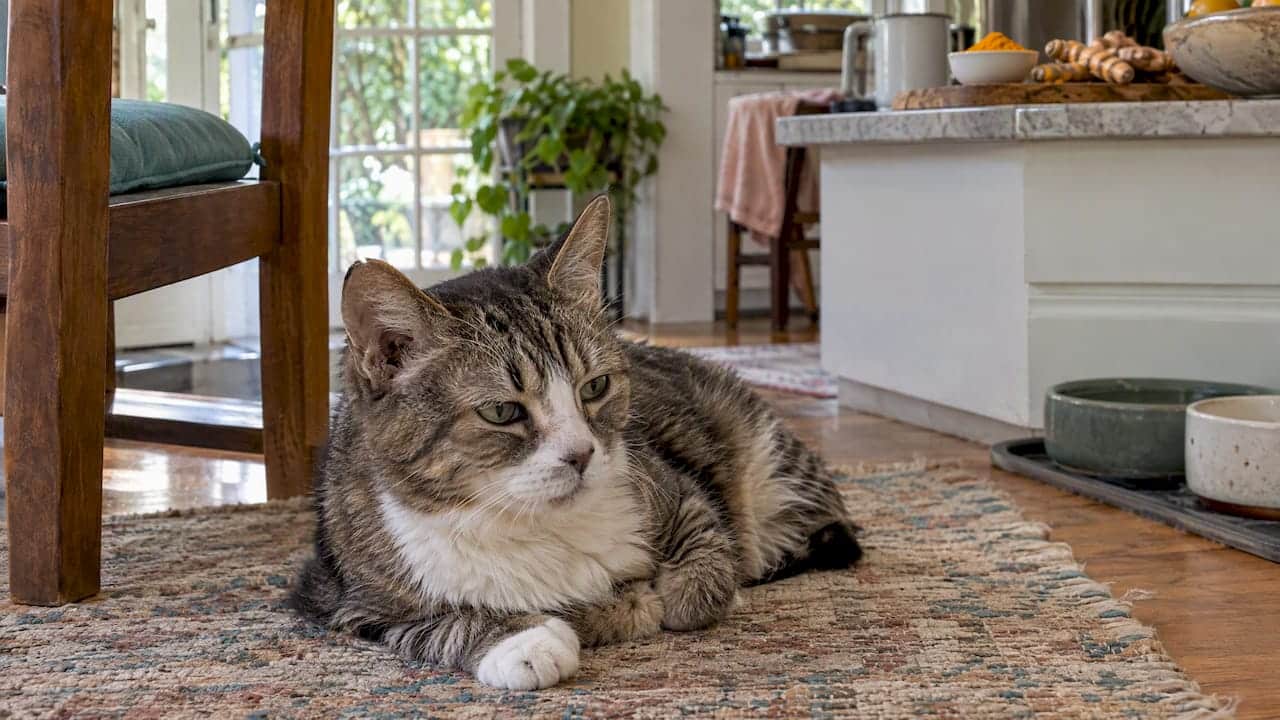
Yes, most cats that hate car rides can learn to tolerate them. Start by making the carrier a safe, familiar space and use slow desensitization rather than forcing exposure. Always secure the carrier so it cannot slide or tip, and never leave a cat alone in a parked car, even briefly. For cats with severe anxiety or motion sickness, a veterinarian can prescribe anti-nausea or calming medication to support your training.
TL;DR:
- Most cats can learn to tolerate car rides through gradual desensitization and positive reinforcement, even if they initially hate traveling.
- Using a crash-tested, secure carrier lined with familiar scent materials and covering it to block visual stimuli significantly reduces travel stress.
- Medications like maropitant for motion sickness or anxiolytics can support training but must always be prescribed by a veterinarian based on the cat’s health status.
- Short, incremental steps such as stationary engine time and brief drives, combined with patience and avoiding forcing the cat, are key to successful acclimation.
- For severely anxious or health-compromised cats, alternative options like pet strollers or at-home veterinary services often provide a better solution than forcing car trips.
Table of Contents
- Why Does My Cat Hate Car Rides?
- Carrier and Vehicle Safety: What to Buy and How to Secure It
- How Do You Get a Cat to Like Car Rides?
- Managing Motion Sickness and Severe Travel Anxiety
- Trip-Day Checklist and Quick Troubleshooting
- When to Call a Veterinarian or Feline Behaviorist
- Helping Your Cat Decompress After the Drive
- Alternatives to Driving a Reluctant Cat
- Making the Carrier Feel Safe, Not Just Tolerable
- Our Take: When Training Isn’t Enough
- Bring the Vet Visit Home Instead
- Sources
- FAQ
Why Does My Cat Hate Car Rides?
For most cats, the car is a rolling assault on every sense they rely on to feel safe. Cars produce unfamiliar vibration, engine noise, and sudden motion, and a moving vehicle gives a cat nowhere to hide, which triggers the same fear response a prey animal shows when cornered.
Many cats have also learned, through simple classical conditioning, that the car means something unpleasant is coming. If most trips end at the vet’s office, your cat associates the carrier and the car itself with needles, exam tables, and strange smells long before the engine even starts, according to Vetstreet’s guidance on car training. Motion sickness compounds the problem, since the inner ear disturbances that cause nausea look almost identical to fear responses from the outside.
Watch for these signs of cat travel anxiety during rides:
- Excessive drooling, panting, or lip smacking
- Vocalizing, growling, or hiding at the back of the carrier
- Dilated pupils and flattened ears
- Vomiting or loss of appetite before or after the trip
- Trembling or frozen, statue-like posture
Carrier and Vehicle Safety: What to Buy and How to Secure It
A carrier isn’t optional gear. It keeps a panicked cat from bolting under your feet while you drive, and it’s the single biggest factor in whether a trip stays calm or turns into an emergency.
The FelineVMA’s transportation position statement recommends placing the carrier on the vehicle floor behind the driver or passenger seat, or securing it with a seatbelt only if the carrier itself is crash-test certified. An uncertified carrier strapped in place can crush during a sudden stop, which defeats the purpose entirely.
Pro Tip: Choose a hard-sided carrier with a top-opening door. It lets you lift a frightened cat out without dragging her through a small front hatch, which is often the moment panic peaks.
Practical safety steps for every trip:
- Line the carrier with a towel or bedding that already smells like home
- Cover three sides with a light blanket to block visual stimulation
- Keep the cabin between 70 and 75°F before your cat even gets in
- Never place the carrier in direct sun through a window
For more on comfortable travel gear, American Bark Bliss’s carrier and accessory guide covers options worth comparing before you buy.
How Do You Get a Cat to Like Car Rides?
Desensitization works because it rewires the association one small, non-threatening step at a time instead of demanding your cat “get over it” in a single terrifying trip. The VCA’s guidance on feline travel anxiety confirms that short, repeated sessions paired with positive experiences reliably reduce fear responses over time, and jumping ahead too fast is the most common reason training stalls.
1. Make the carrier furniture, not a trap. Leave it out permanently in a quiet room, door open, with a favorite blanket inside. Feed meals near it, then inside it, so your cat starts choosing to enter on her own.
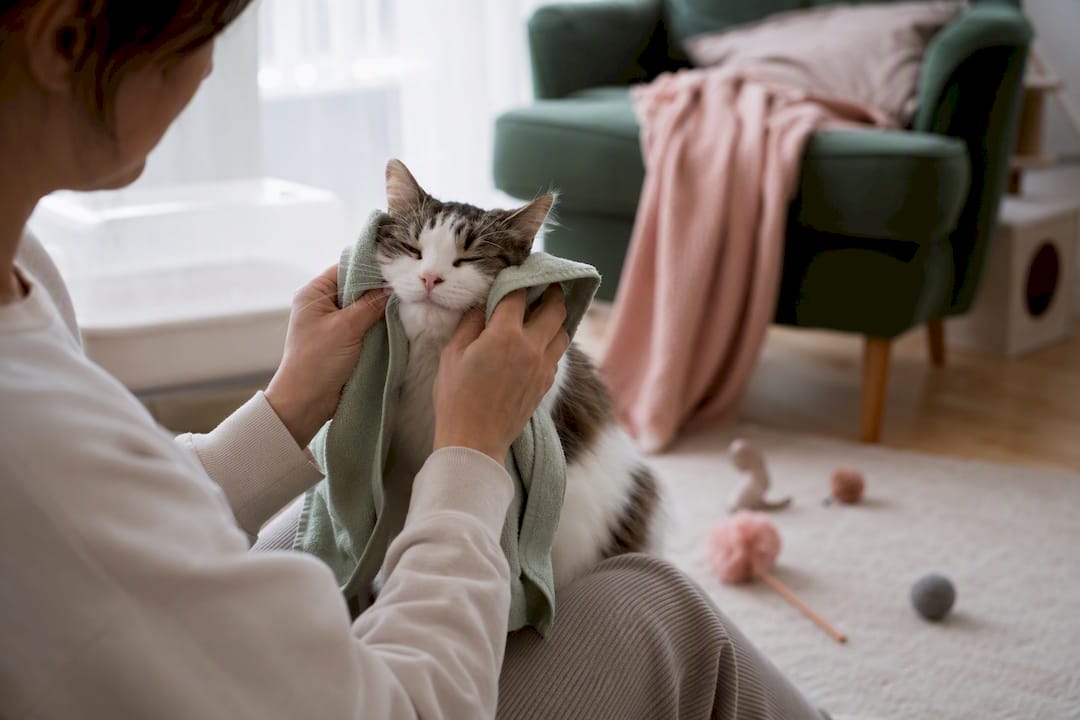
2. Practice the towel-scent trick. Rub a towel along your cat’s cheeks, where her scent glands are concentrated, then wipe that towel across the car seat and carrier interior. It’s a small step, but it makes an unfamiliar space smell like home before your cat ever sets a paw inside.
3. Move to the parked car. Carry the crate to the car, door open, engine off. Sit with your cat for two to five minutes, offer treats, then go back inside. Repeat daily until she’s relaxed.
4. Add the engine, stationary. Once step three feels routine, start the engine for 30 to 60 seconds while parked. No driving yet. Reward calm behavior heavily.
5. Drive to the end of the block and back. Keep the first drives under two minutes. Gradually extend distance only when your cat shows no stress signs at the current length.
6. Add real destinations. Once short drives feel neutral, take occasional trips to places that aren’t the vet, like a quiet parking lot with a view, so the car stops predicting bad news.
Pace matters more than calendar days. If your cat freezes, hides, or drools during a step, that’s your cue to repeat the previous stage rather than push forward. This follows the LIMA principle (least intrusive, minimally aversive), which is standard guidance in behavior work: forcing exposure or “flooding” a fearful cat almost always deepens the fear instead of resolving it.
Realistic timelines according to training resources for cat travel: mild carrier reluctance often improves within two weeks of daily short sessions, while cats with a strong, longstanding fear of the car may need four to eight weeks of consistent work. Keeping a simple log of session length, your cat’s reaction, and what reward you used helps you spot patterns and know when to slow down.
Managing Motion Sickness and Severe Travel Anxiety
Motion sickness and conditioned fear look almost identical from the passenger seat. Both produce drooling, lip smacking, and vomiting, which makes it hard to know which one you’re dealing with without ruling one out first.
According to the MSD Veterinary Manual’s overview of motion sickness, neurokinin-1 (NK-1) receptors play a central role in triggering nausea in cats. That’s why maropitant, an NK-1 antagonist, is the medication veterinarians reach for most often to control vomiting during travel. Antihistamines, by contrast, tend to be far less effective in cats than in dogs, so a vet is unlikely to recommend one for feline motion sickness.
For anxiety rather than nausea, veterinarians sometimes prescribe situational anxiolytics like gabapentin or trazodone alongside behavioral training. Both come with sedation trade-offs, and dosing needs to account for a cat’s age, weight, and any existing kidney or liver conditions, which is exactly why these medications require veterinary oversight rather than guesswork. Medication supports the training plan, but it isn’t a substitute for it.
Older cats or those with heart, kidney, or thyroid conditions need extra caution here. Ask your vet to weigh in before starting any new drug, even ones described as “mild.”
Trip-Day Checklist and Quick Troubleshooting
The morning of travel is not the time to improvise. A short routine removes guesswork and catches problems early.
- Withhold food for two to three hours before departure to reduce nausea risk.
- Pre-cool the car and keep the carrier out of direct sun.
- Secure the carrier on the floor, add bedding with your cat’s scent, and spritz a pheromone spray inside five minutes before loading.
- Bring high-value treats and a light towel in case you need to dim visual stimulation.
- If vomiting occurs, pull over safely, check your cat is otherwise alert, and mention it at your next vet visit even if it resolves on its own.
- If your cat panics mid-drive, don’t push through it. End the trip if possible, and return to an earlier desensitization step before trying again.
When to Call a Veterinarian or Feline Behaviorist
Some situations call for professional help rather than more solo practice at home. Watch for these red flags:
- Frantic escape attempts that risk injury to your cat or you
- Self-injury, such as biting at the carrier door or excessive scratching
- Loss of bladder or bowel control during travel
- Repeated vomiting on multiple trips
- No improvement after several weeks of consistent, gentle training
A veterinarian can rule out underlying medical causes, discuss prescription options, and, in urgent cases, plan safe sedation for a single necessary trip. Bring your training log and a clear description of what you’ve observed. It speeds up the visit and helps them tailor a plan instead of starting from scratch.
Helping Your Cat Decompress After the Drive
What happens in the twenty minutes after you get home matters almost as much as the drive itself. A cat who was frightened in the car doesn’t reset the moment the engine turns off, and treating the ride as “over” the second you’re in the driveway can undo some of the progress you just made.
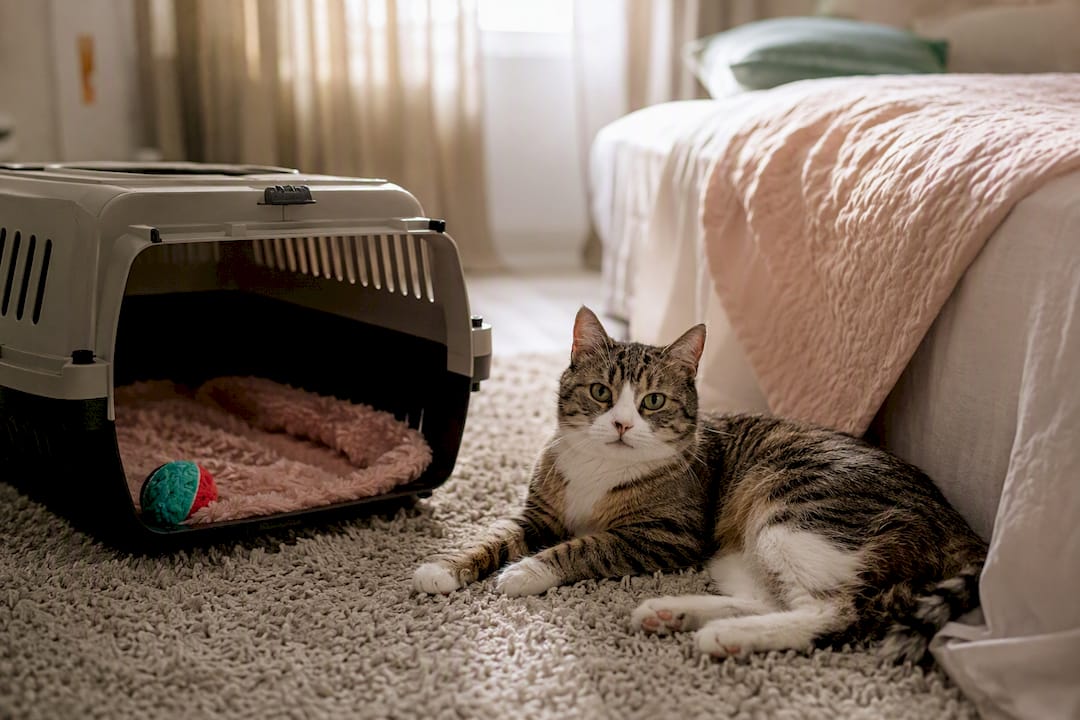
Let your cat exit the carrier at her own pace once you’re inside, rather than tipping her out or reaching in to grab her. Leave the carrier door open and set it in a quiet room so she can retreat back into it if she wants, since that familiar space is now a source of comfort, not a threat.
Offer a favorite treat or a short, low-key play session with a wand toy once she seems settled. This gives her something positive to associate with the end of the trip, which reinforces everything the desensitization sessions built. Avoid the urge to hover, pick her up, or fuss over her right away. Cats often recover faster with space and predictability than with reassurance that reads, to them, as more pressure.
Watch her behavior over the next hour. Reduced appetite or hiding for a short while is normal after a stressful trip. If she’s still hiding, refusing food, or seems unusually withdrawn after several hours, that’s worth a call to your vet rather than assuming she’ll bounce back on her own.
Alternatives to Driving a Reluctant Cat
Some cats never fully warm up to the car, and forcing regular trips onto a cat with severe, unresolved anxiety can do more harm than good, especially for seniors or cats with health conditions that make stress genuinely risky.
A pet stroller works well for cats who tolerate movement but panic specifically inside a vehicle, since it offers fresh air and visual stimulation without engine noise or road vibration. Backpack-style carriers with mesh viewing panels serve a similar purpose for short outings and can double as a familiar transport option once your cat has built positive carrier associations at home.
For cats who need to reach a specific destination but can’t tolerate a personal vehicle, pet-friendly taxi and rideshare services exist in many cities and are worth researching if standard car travel remains a consistent source of panic despite training.
The option that removes travel from the equation entirely, though, is bringing veterinary care to your cat instead of the other way around. For senior cats, disabled cats, or cats whose anxiety hasn’t responded to months of desensitization, at-home veterinary visits eliminate the carrier, the car, and the waiting room stress in one step. It’s not a workaround for every appointment, but it’s a legitimate option worth discussing with your vet when travel itself is the obstacle to good care.
Making the Carrier Feel Safe, Not Just Tolerable
A carrier that only appears before stressful trips will always read as a warning sign. Enrichment turns it into neutral, even pleasant, territory.
Synthetic feline facial pheromone sprays are commonly recommended as a supportive tool during training, since they mimic the scent cats leave when marking a space as safe, though they work best alongside behavior modification rather than in place of it, according to Catster’s reporting on car sickness in cats. Spray the carrier interior five to ten minutes before your cat goes in, giving the alcohol carrier time to dissipate.
Add a small, soft toy your cat already associates with resting or play, not a new one that introduces unfamiliar novelty during an already stressful moment. A worn t-shirt or blanket that smells like you does more for a cat’s sense of security than anything store-bought, since scent is the primary way cats read whether a space belongs to them.
Rotate in a few pieces of dry treats or a lick mat with a thin layer of wet food for longer trips, which gives your cat something to focus on besides the motion outside the window. Keep the setup consistent between sessions. A carrier that changes contents every time she enters it is harder for a cat to file away as “safe,” while one with the same blanket, same scent, and same toy each time builds a routine her nervous system can actually predict. Predictability, more than any single product, is what calms a cat down.
Our Take: When Training Isn’t Enough
Desensitization works for most cats, and it deserves to be the first thing you try. But we think the pet care industry sometimes oversells car training as a universal fix, when the honest answer is that some cats, particularly seniors, cats with chronic pain, or cats with a genuinely traumatic vet history, may never find the car tolerable no matter how patient the owner is.
That’s not a failure of training. It’s a mismatch between what a stressed body can handle and what a routine schedule demands. For those cats, we believe the more compassionate move is removing the car from the equation rather than continuing to grind through months of limited progress. Pet Acupuncture & Wellness built its mobile model around exactly this gap: bringing acupuncture, rehabilitation, and integrative therapy directly into a cat’s own home, where she’s never asked to associate a carrier or a car with pain in the first place. If your cat’s anxiety hasn’t budged after weeks of consistent work, that’s worth a conversation with your veterinarian about whether at-home care fits her situation better than another round of car training.
— Pet Acupuncture & Wellness
Bring the Vet Visit Home Instead
If your cat’s fear of the car has become a barrier to consistent veterinary care, particularly for a senior or medically fragile cat, at-home options remove the trigger entirely. Pet Acupuncture & Wellness offers mobile acupuncture for cats and dogs in South Tampa, along with in-home rehabilitation therapy for cats who struggle with both travel and mobility. Reach out to discuss whether integrative, at-home care could reduce your cat’s overall stress load, not just around car rides, but around veterinary care in general.
Sources
- Catvets
- Motion sickness in animals – MSD Veterinary Manual
- Teach your cat to love riding in the car – Vetstreet
FAQ
What Is the 3-3-3 Rule for Cats?
The 3-3-3 rule generally refers to helping a cat adjust to a new home: 3 days to decompress, 3 weeks to settle into routine, and 3 months to feel fully secure. It’s not a car-training framework, though the same patience principle applies to desensitizing a cat to travel.
Why Are Cats So Afraid of Car Rides?
Cats fear cars mainly due to sensory overload from engine noise and motion, a lack of hiding spots, and learned associations between the car and stressful destinations like the vet’s office. Motion sickness often compounds the fear because its physical symptoms mimic anxiety.
Are Car Rides Traumatic for Cats?
They can be for cats with no positive carrier experience or a history of car trips ending at the vet, but they don’t have to be. Gradual desensitization that pairs the carrier and car with rewards, described in the VCA’s guidance on travel anxiety, can turn a traumatic association into a neutral or even positive one over several weeks.
How Do I Get My Cat to Like Car Rides?
Start with carrier familiarity at home, then progress through parked-car sessions, stationary engine time, and short drives, rewarding calm behavior at every stage. Most mild cases improve within two weeks, while stronger fears can take four to eight weeks of consistent, short sessions.
Can Medication Help My Cat With Car Rides?
Yes, veterinarians sometimes prescribe maropitant for motion sickness or anxiolytics like gabapentin or trazodone for severe anxiety, but dosing depends on your cat’s age and health, so a prescription must come from a vet rather than an over-the-counter product.