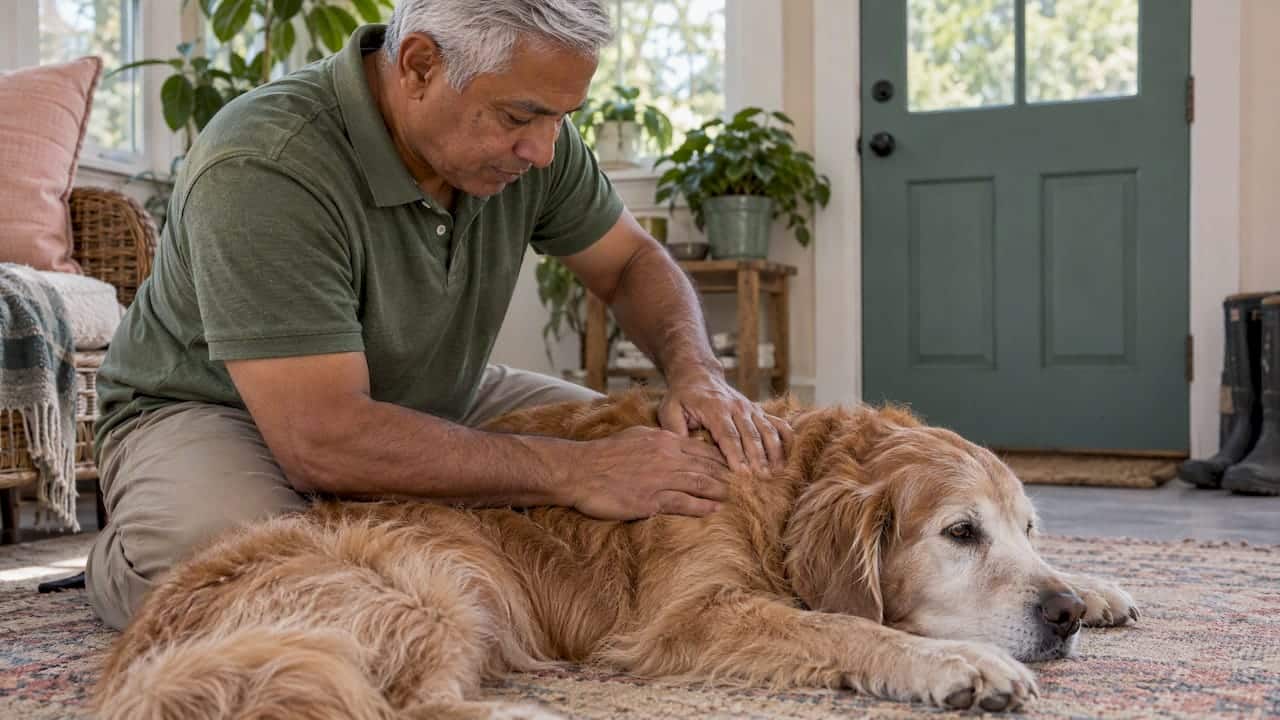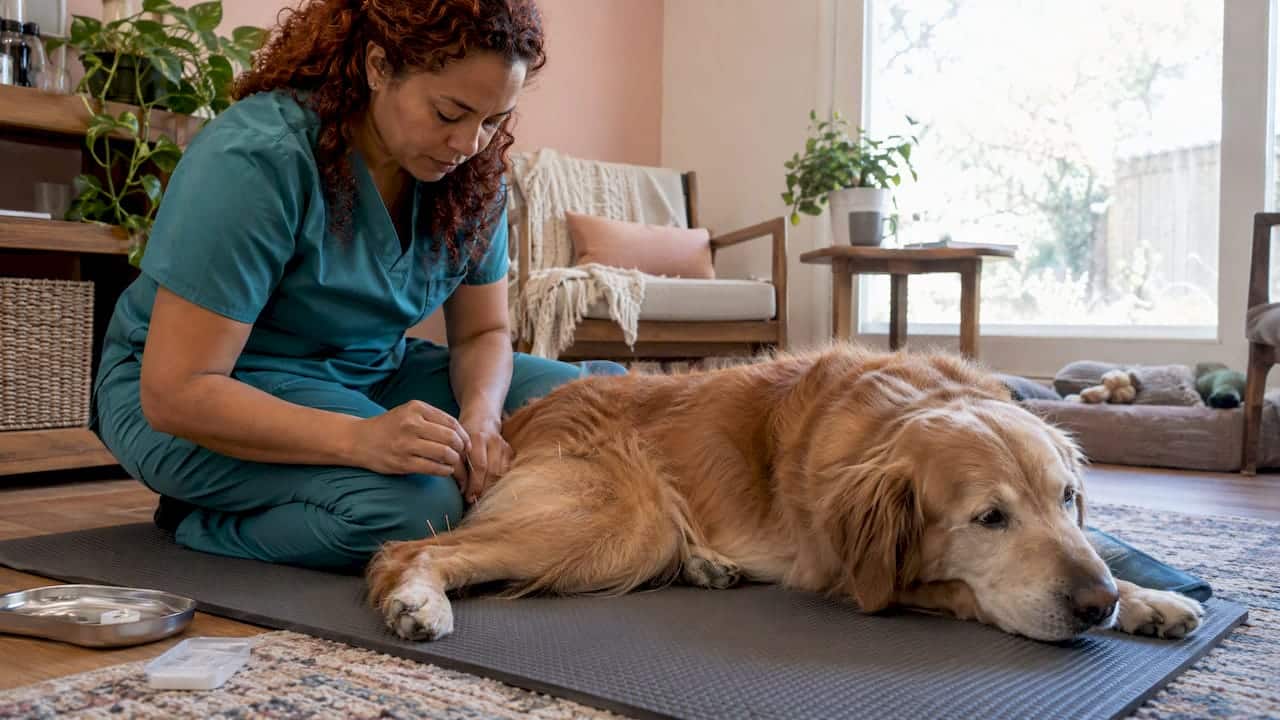
Senior dog home safety comes down to five changes you can start this afternoon: add traction to slick floors, block off stairs or install a ramp, switch to a supportive orthopedic bed, raise food and water bowls, and clear a consistent, obstacle-free path through the house. None of these require a contractor or a big budget. The strongest results come from a multimodal approach: your home environment, your dog’s exercise routine, and regular monitoring all working together rather than any single fix carrying the load. If you notice sudden gait changes, new pain, or a hard time rising, that’s a signal for a veterinary or in-home clinical visit, not a wait-and-see approach.
- Traction first. Runners, yoga mats, or rug pads on hardwood and tile.
- Stairs and steps. Baby gates or a ramp, whichever fits your dog’s confidence level.
- Orthopedic bedding. Supportive foam replaces the flat cushion your dog outgrew years ago.
- Elevated bowls. Less strain on the neck and spine at mealtime.
- Predictable pathways. Keep furniture, cords, and clutter out of your dog’s regular routes.
Key Takeaways
Senior dog home safety works best as a layered system: traction, mobility aids, and orthopedic support at home, paired with monitored exercise and professional rehab or acupuncture when pain or mobility loss progresses.
| Point | Details |
|---|---|
| Fix floors first | Non-slip runners and paw traction address the most common cause of senior dog falls. |
| Match aids to ability | Ramps suit weight-bearing dogs; slings and carts serve more advanced mobility loss. |
| Track simple metrics | Log sit-to-stand reps and walk distance weekly to catch decline early. |
| Watch for red flags | Sudden gait collapse, uncontrolled pain, or rapid appetite change need prompt veterinary attention. |
| Combine care types | Pet Acupuncture & Wellness pairs in-home assessment with acupuncture and rehab to address pain behind mobility loss. |
Table of Contents
- What Home Hazards Put Senior Dogs at Risk?
- Which Mobility Aids Actually Help Senior Dogs?
- How Should You Set Up Beds and Feeding Stations?
- How Much Exercise Does a Senior Dog Actually Need?
- How Do You Support a Dog With Vision or Hearing Loss?
- What Should You Track, and When Should You Call the Vet?
- What Matters Most When You’re Assessing Home Safety in Person?
- Bring Professional Support Into Your Dog’s Home Safety Plan
- Sources
- FAQ
What Home Hazards Put Senior Dogs at Risk?
Hardwood, tile, and laminate floors are the single biggest hazard for an aging dog. A senior dog’s paw pads lose some of their natural grip, and weaker hindquarters make every slip feel like a bigger event than it used to be. Veterinarians consistently point to traction aids, ramps, orthopedic beds, and elevated feeders as the highest-impact, lowest-cost fixes available to owners, and Florida’s tile-heavy homes make this doubly true.
Trip hazards deserve the same attention. Loose cords, area rugs with curled edges, and low coffee tables become real obstacles for a dog with declining depth perception. If you have a pool, a stair gate isn’t optional. Temperature matters too: aging dogs regulate heat and cold less efficiently, so keep beds away from air-conditioning vents and drafty doors.
- Lay non-slip runners along your dog’s main walking routes, not just near the food bowl.
- Trim nails regularly. Overgrown nails reduce paw traction on hard floors.
- Secure or bundle loose cords and remove low furniture from walking paths.
- Install a gate at stairs, the pool deck, or any drop-off.
- Keep the sleeping area away from vents, exterior doors, and direct sun through windows.
Pro Tip: Test your floors barefoot in socks. Anywhere you feel yourself sliding is exactly where your dog will slide too.
Which Mobility Aids Actually Help Senior Dogs?
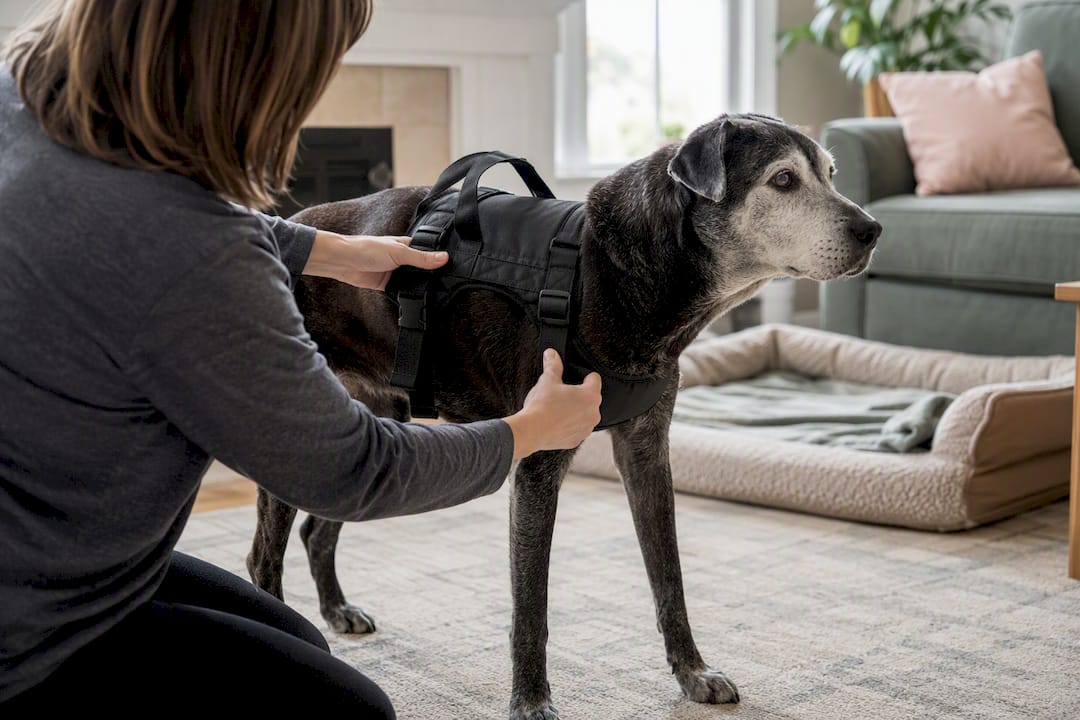
Not every mobility aid fits every dog, and choosing the wrong one can do more harm than good. A ramp works well for dogs who still bear weight confidently on all four legs but struggle with the impact of jumping. Look for a non-slip surface, a gentle slope (steeper ramps ask more of already-weak hips), and a stable base that won’t shift when your dog steps on.
Support harnesses and slings solve a different problem: helping you assist a dog through a specific movement, like getting into the car or navigating a single step down to the patio. Fit matters enormously. A harness with a rear-lift handle should sit just in front of the hips, not on the belly, or you risk putting pressure on the wrong joints. For dogs with more advanced hind-limb weakness, a wheelchair or cart can restore real independence, letting a dog walk, sniff, and stay social instead of being carried everywhere.
- Ramps suit dogs who can bear weight but shouldn’t jump.
- Slings and harnesses assist with specific transitions, like stairs or car entry.
- Carts work for dogs who’ve lost significant hind-end strength but still want to move.
- Always trial new equipment on a soft surface first, with you close by.
Pro Tip: If your dog resists a new mobility aid after a few calm, treat-filled trials, don’t force it. A rehabilitation clinician can custom-fit a solution before something like rehabilitation equipment becomes a source of stress instead of help.
How Should You Set Up Beds and Feeding Stations?
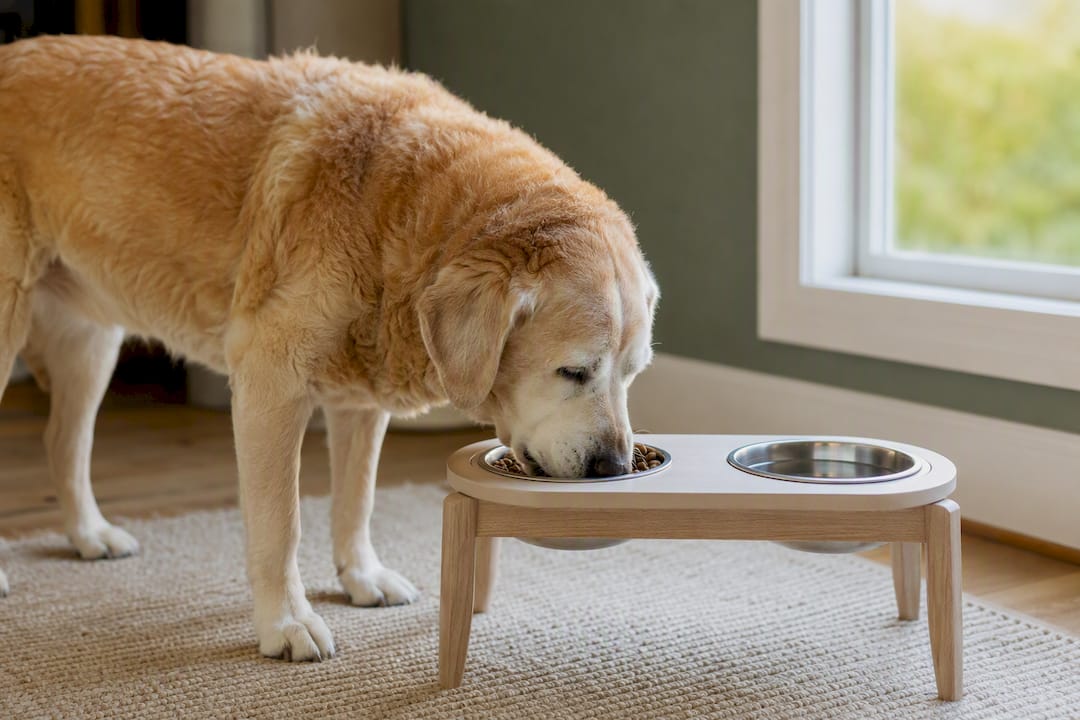
Bedding and feeding setup sounds minor until you watch a stiff-hipped dog struggle to rise from a flat cushion three times a day. An orthopedic bed with supportive foam and low, stable edges makes rising noticeably easier, since your dog doesn’t have to fight gravity and a saggy mattress at the same time.
Raised feeding stations matter almost as much. A bowl set at an appropriate height for your dog reduces strain on the neck and lower back during every meal, and it cuts down on spills that turn into new slip hazards.
- Choose a bed with supportive foam, not a flattened hand-me-down cushion.
- Raise bowls to reduce neck and back strain during eating and drinking.
- Add a nightlight along the route from the bed to the door.
- Consider washable waterproof liners under bedding if incontinence is starting to appear.
- Keep an indoor potty option, like washable puppy pads, nearby for overnight accidents.
How Much Exercise Does a Senior Dog Actually Need?
Senior dogs need less duration and more frequency. Small, frequent walks tend to preserve muscle and joint function better than longer walks that may leave your dog sore the next day. Start with five to ten minutes at a gentle pace, watch how your dog recovers over the following hours, and adjust from there.
- Track sit-to-stand reps. Count how many times your dog can rise from a sitting position in a minute; a declining number over weeks is worth mentioning to your vet.
- Watch gait over short distances. A slight hitch that appears only after ten minutes tells you more than a single stride ever could.
- Add controlled home exercises. Gentle stretches or supervised weight shifts, done consistently, build stability without overtaxing joints.
- Progress slowly. Increase walk time only after several stable days, not because your dog seems eager.
A structured therapeutic exercise program has been shown to bring measurable improvements in joint range of motion and muscle mass in dogs with osteoarthritis, and those gains often show up first in hip extension and thigh muscle circumference. That’s the kind of progress a rehabilitation program tracks with real measurements, not guesswork, often combining hydrotherapy, targeted exercise, laser therapy, or acupuncture across a series of visits.
Pro Tip: Keep a simple weekly log of walk time and sit-to-stand counts. Two weeks of data tells a vet more than a single bad day ever will.
How Do You Support a Dog With Vision or Hearing Loss?
A dog losing eyesight or hearing doesn’t need pity. It needs consistency. Keep furniture in the same place, always, since a dog navigating by memory and whisker sense gets disoriented fast when a chair moves six inches. Motion-sensor nightlights along hallways and high-contrast tape on the edges of steps give a dog with declining vision the visual cues needed to move confidently rather than freezing at the top of the stairs.
- Add motion-sensor nightlights to hallways and the path to the yard.
- Apply high-contrast tape to stair edges and steps down to the patio.
- Use scented or textured mats to mark key locations like the food bowl or bed.
- For deaf dogs, rely on hand signals, floor vibrations, or gentle touch cues instead of calling out.
What Should You Track, and When Should You Call the Vet?
Daily observation catches problems weeks before they become emergencies. Watch how your dog rises in the morning, whether gait looks steady over the first few steps, appetite level, and how often they’re asking to go outside. New lumps, wounds that aren’t healing, or a sudden change in any of these deserves a closer look.
A few numbers are worth writing down regularly: body weight, sit-to-stand repetitions, and how far your dog walks before slowing down. Periodic objective assessments like these help you and your vet see trends that a single visit would miss entirely, since ‘senior’ status isn’t tied to a birthday. It’s tied to function.
- Call promptly: sudden gait collapse or inability to rise.
- Call promptly: pain that doesn’t ease with rest.
- Watch closely: recurring urinary infections or worsening incontinence.
- Watch closely: a rapid drop in appetite over two or three days.
Roughly three short outings outperform one long walk for muscle preservation in many senior dogs, which is one reason in-home clinical visits are gaining traction. They let a clinician observe gait and behavior in the environment where problems actually show up.
What Matters Most When You’re Assessing Home Safety in Person?
A dog’s real mobility rarely shows up fully in a clinic exam room. Slippery tile, a favorite chair that’s too high, a hesitant turn near the stairs, these details only surface at home, which is exactly why in-home assessment changes the accuracy of what we recommend. Acupuncture and targeted rehab don’t replace a ramp or a traction runner. They complement it, addressing the pain and stiffness that make those home changes necessary in the first place.
— Pet Acupuncture & Wellness
Bring Professional Support Into Your Dog’s Home Safety Plan
Home fixes solve half the equation. The other half is managing the pain, stiffness, and mobility loss that make ramps and traction mats necessary at all, and that’s where Pet Acupuncture & Wellness fits into the picture differently than a standard clinic visit would. Instead of loading an anxious, arthritic dog into a car for a stressful trip to South Tampa, our team brings acupuncture, rehabilitation, and pain management directly into your home.
A typical first visit includes a full mobility assessment in your dog’s own environment, a look at the specific hazards and aids already in place, and a personalized plan that might combine acupuncture with a structured rehab program. Follow-up visits track measurable progress, not vague impressions, and adjust the plan as your dog improves or as new challenges appear. If your dog is struggling with stiffness, hind-limb weakness, or general discomfort, explore our rehabilitation therapy services and schedule an in-home evaluation to see what’s actually happening with your dog’s mobility, not just what the symptoms suggest from the outside.
Sources
- Therapeutic exercise study (Frontiers, 2026)
- Managing eyesight decline in aging pets (Texas A&M Vet Med)
- How to care for senior dogs, according to veterinarians (NBC News)
FAQ
What is the fastest way to improve senior dog home safety?
Start with non-slip runners on hard floors and a gate at any stairs. These two changes address the highest-risk hazards with minimal cost or effort.
How do I know if my dog needs a ramp or a wheelchair?
A ramp suits dogs who still bear weight well but struggle with jumping; a wheelchair or cart fits dogs with more advanced hind-limb weakness who need support to walk at all.
Is a heated bed safe for a senior dog?
Only with supervision and a low, timed setting. Keep any heat source away from direct skin contact and never leave a heated bed unattended for an aging dog with reduced sensation.
When should I call a vet about mobility changes?
Call promptly for sudden gait collapse, pain that doesn’t ease with rest, or a rapid drop in appetite. These signs warrant a veterinary or in-home clinical visit rather than waiting to see if they resolve.
Can acupuncture help with a senior dog’s mobility?
Acupuncture is often used alongside rehabilitation and home modifications to manage pain and stiffness. Pet Acupuncture & Wellness offers in-home acupuncture visits designed to complement, not replace, environmental safety changes.