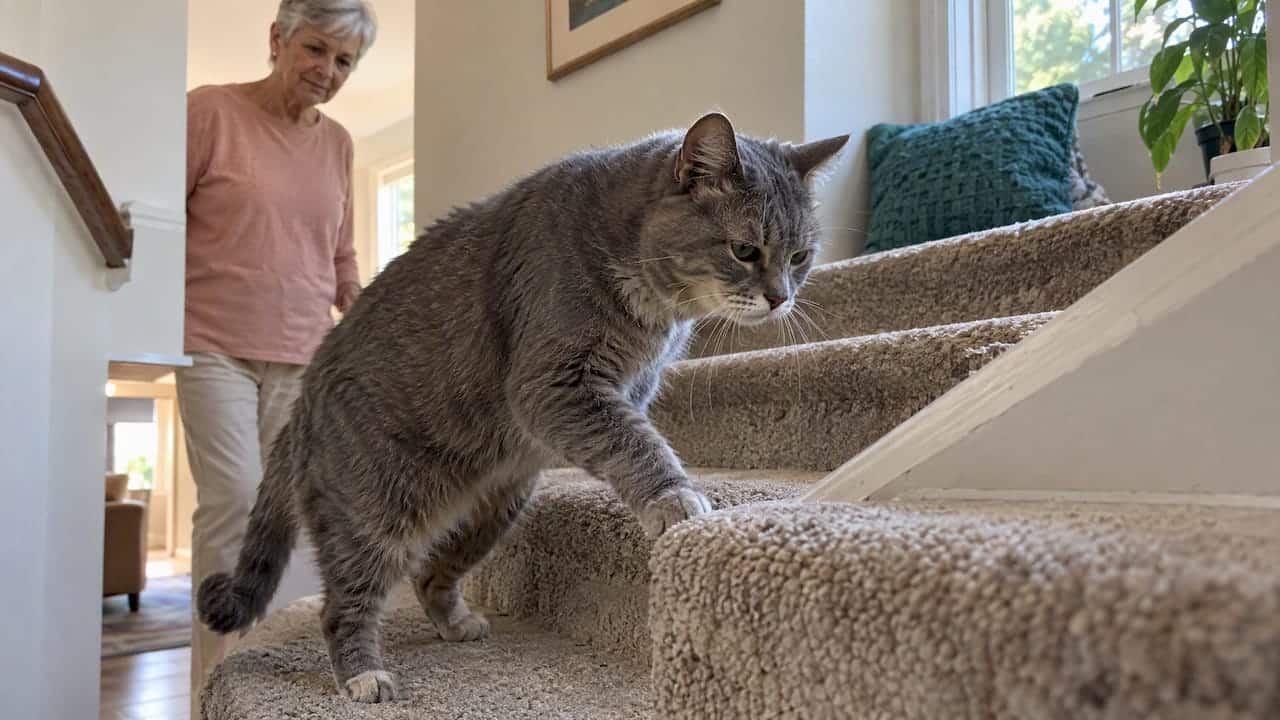
The safest short program pairs gentle passive range-of-motion (PROM) work, about 10–15 repetitions per joint, with brief, low-impact active exercises like controlled leash walks and sit-to-stands. Do PROM several times a day and tailor active sessions to your dog’s comfort and your veterinarian’s advice. Progress slowly, stop at any sign of pain, and check with your veterinarian or a rehabilitation specialist before you begin.
TL;DR:
- Move each joint through 10 to 15 comfortable repetitions, three times daily, supporting the limb above and below without forcing resistance.
- After passive movement feels easy, choose one to three short active exercises; low obstacles target knee and ankle flexion, while gentle inclines target hip flexion.
- Gradually add repetitions or minutes, not speed or obstacle height; if stiffness appears, maintain the level or reduce the workload.
- Stop and contact your veterinarian if your dog develops new limping, swelling, vocalizing, or greater stiffness; progressive lameness or wobbling warrants professional assessment.
- Exercise works best alongside pain control and weight management, while gradually increased moderate daily activity can support weight loss and muscle strength.
Table of Contents
- How do you do passive range-of-motion exercises on your dog?
- Which active exercises build strength and joint motion?
- What are the red flags that mean you should stop?
- How should you start, and how fast should you progress?
- What does a daily routine look like?
- Which equipment and clinical adjuncts help?
- When should you bring in a professional?
- Why a simple, steady program beats a fancy one
- How we can help with at-home rehab and tailored plans
- FAQ
- Sources
How do you do passive range-of-motion exercises on your dog?
Passive range of motion means you move your dog’s joint through a comfortable range while the muscles stay relaxed. Veterinary rehabilitation teams use it to prevent muscle loss, keep joints flexible, and ease discomfort. In a clinical study of overweight dogs with osteoarthritis, owners learned massage and PROM, then repeated it 10–15 times, three times a day.
Have your dog lie on a non-slip surface, ideally on the side opposite the leg you are working. Support the limb above and below the joint, then:
- Shoulder and elbow: Gently bring the foreleg forward and back, then bend and straighten the elbow.
- Carpus (wrist): Fold the paw toward the forearm and extend it again, slowly.
- Hip and stifle (knee): Cycle the hind leg like a slow bicycle pedal, bending and extending both joints together.
- Hock: Bend the ankle until you feel gentle resistance, then straighten.
Move at a pace that feels like a slow exhale. Never push past the point where you feel tension or your dog tenses up.
Follow your session with 10–15 minutes of gentle massage. Use long stroking motions, light effleurage along the muscles, and soft kneading over larger muscle groups, avoiding any swollen or sore joint.
Pro Tip: Do PROM when your dog is relaxed and a little sleepy, such as after a short walk. A calm dog gives you honest feedback about what feels comfortable.
Which active exercises build strength and joint motion?
Once PROM feels easy for your dog, short active exercises add strength and body awareness. These are the ones we reach for most with senior and arthritic dogs:
- Sit-to-stand: Ask for a sit, then a stand, using a treat to lure. Begin with three to five repetitions and keep the sits square, not tilted to one side.
- Short incline walks: Walk slowly up a gentle slope on a leash. Slow pace matters more than steepness.
- Low obstacles: Walk your dog over a pole or rolled towel laid on the floor, set low enough for your dog to step over comfortably.
- Supported hind-leg stand: Lightly hold your dog’s chest while the back legs bear weight for a few seconds.
- Cookie stretches: Hold a treat near the shoulder or hip so your dog turns the neck and spine gently on their own.
These choices are not arbitrary. Gait research in dogs with hip osteoarthritis found that walking over low obstacles increases flexion in the tarsal and stifle joints, while walking up an incline increases hip flexion. That lets you pick the drill that matches the joint you want to target.
Progress by adding a few repetitions or a few minutes, not by raising speed or height. Skip jumping, sharp turns, and fetch on hard ground. Small dogs need lower obstacles and shorter reaches, while large dogs may need a helper to steady their hindquarters.

What are the red flags that mean you should stop?
Exercise helps only when it stays comfortable. The Merck Veterinary Manual notes that regular, controlled exercise supports joint function and eases pain, but excessive strenuous exercise should be avoided. Pause and call your vet if you notice:
- New or worsening limping
- Increased stiffness after a session
- Whining, yelping, or pulling away
- Visible swelling or heat around a joint
- Reluctance to rise, or a worsening gait
Veterinary specialists point out that signs of pain during movement, such as slowness to rise, limping, or resistance to manipulation, call for a prompt re-evaluation of the plan.
Exercise should also match your dog’s disease stage. COAST staging grades osteoarthritis from 0 to 4 and pairs it with a layered plan that includes pain relief, exercise, diet, and weight management. If a red flag appears, stop, rest your dog, and ask your veterinarian whether pain medication needs a second look.
How should you start, and how fast should you progress?
Go slowly in the first weeks. A consistent order keeps sessions predictable for your dog:
- Walk slowly for a short time and add gentle massage to warm the muscles.
- Do PROM for 10–15 repetitions per joint.
- Choose one to three active exercises and keep each short.
- Finish with a calm, easy walk and a light stroke of the legs to cool down.
Rehab teams often ask owners to repeat PROM several times a day and keep active work daily, and clinic-based rehabilitation programs send home exercise plans built the same way. If stiffness shows up, hold at your current level or step back.
Pro Tip: Keep a short notebook of what you did and how your dog moved the next morning. Patterns show up quickly, and your vet will appreciate the notes.
What does a daily routine look like?
Here are two templates to adapt. Both assume your veterinarian has cleared your dog for exercise.
Morning maintenance (about 25 minutes):
- Give a short massage of the back and legs.
- Take a 10–15 minute leash walk at an easy pace.
Rehab session (a short session):
- Warm up with a short, slow walk.
- Do two active exercises, such as sit-to-stands and low obstacle walking, for 3 sets each with rest between.
- Cool down with a gentle stroke massage and a short, slow stroll.
Small dogs usually need fewer repetitions and lower obstacles, and a lap or bed can serve as the PROM surface. Large dogs benefit from a second person and a rug or yoga mat for grip. For dogs with limited mobility, do the PROM and massage, then add only one very gentle active move. Our guide to home exercises after surgery and our senior dog mobility exercises offer more templates.
Which equipment and clinical adjuncts help?
You do not need a gym. A few simple items make home work safer:
- Non-slip mats or runners: Cover slick floors so paws can grip during stands and walks.
- Ramps: Pick one with a gentle slope and a textured surface, and supervise every use.
- Balance pads or a folded towel: Add small wobble challenges once sit-to-stands are easy.
- Support sling or towel: Lift under the belly for dogs that tire quickly.
Our vet’s guide to dog rehabilitation equipment covers sizing in more depth. In the clinic you may also meet adjuncts. AAHA’s pain management guidelines describe cold therapy applied in the first 72 hours after stifle surgery as lowering pain and improving joint range of motion, and they discuss laser (photobiomodulation) as an add-on to rehab.
When should you bring in a professional?
Home work has limits, and knowing them protects your dog. Book a professional assessment if you see progressive lameness, if your dog is recovering from surgery, if there are neurologic signs such as dragging paws or wobbling, or if a few weeks of careful home work are not helping.
A rehabilitation assessment typically includes pain grading, joint measurements, a look at how your dog walks, and an individualized plan that can combine hands-on therapy, therapeutic exercise, and modalities. Trained rehabilitation clinicians also prescribe home exercise plans fitted to the pet. We bring this to your living room in South Tampa, and telemedicine can help us review your plan when travel is hard for an anxious or mobility-limited dog.
Why a simple, steady program beats a fancy one

In our view, the dogs who improve most are not the ones with the most exercises. They are the ones whose owners repeat a few gentle things reliably and notice small changes. Conventional advice often skips the unglamorous parts: pain control, weight, and honest red-flag rules. Exercise alone is less effective when those other pillars are ignored, and moderate daily activity helps with weight loss and muscle strength when it increases gradually.
Prioritize in this order: comfort first, then consistency, then variety. Watch how your dog rises from rest, because that moment tells you more than any chart. A short morning routine you actually keep will do more than an ambitious plan you drop in week two. If you are not sure where to start, begin with PROM and massage alone for the first week.
— Pet Acupuncture & Wellness
How we can help with at-home rehab and tailored plans

We build rehabilitation plans around your dog and your home, so exercises fit your floors, stairs, and routine. Our services include:
- Initial assessments and rehabilitation therapy
- Acupuncture and laser treatments
- Telemedicine consults and at-home rehab packages
Treating your dog at home spares them the stress of travel and makes it easier for you to keep up the plan. Learn more about rehabilitation therapy, check our cost of services, or ask us about booking an at-home visit. For more ways to keep your dog moving, this natural exercise guide has useful play ideas.
FAQ
How many repetitions of passive range of motion should I do?
Aim for 10–15 slow repetitions per joint. Clinical guidance describes repeating this three times daily to support recovery. Always stay within a range your dog finds comfortable.
Is it safe to stretch an arthritic dog’s joints?
Gentle, slow stretching is generally appropriate when it stays within comfort and your veterinarian has approved it. Stop if your dog tenses, pulls away, or vocalizes. Exercise should be tailored to the stage of the disease and the level of pain.
How often should my senior dog do active exercises?
How often to do active exercises depends on your dog’s comfort and condition. Start with short sessions and follow your veterinarian’s advice. Start with a few repetitions and short walks, then increase gradually if your dog moves comfortably the next day.
Can I combine home exercises with acupuncture or laser therapy?
Yes. Rehabilitation programs commonly pair exercise with modalities such as laser, and we often combine home routines with acupuncture or laser treatments. Ask us to review your plan so each piece supports the others.