
For most dogs with azotemic or proteinuric chronic kidney disease (CKD), a veterinary therapeutic renal diet fed at adequate calories is the single most important nutritional step you can take. The goal is never strict restriction at the cost of your dog eating less overall. Calories come first.
A few things to act on right now:
- Check your dog’s appetite today. If voluntary intake has dropped significantly below normal, call your vet before making any diet changes.
- IRIS staging guides the timing. Most veterinary guidelines recommend starting a renal diet at IRIS Stage 2 or higher, when azotemia is confirmed. Earlier intervention correlates with longer survival, according to research tracking dogs with CKD.
- Three pillars matter most: phosphorus restriction, moderated high-quality protein, and therapeutic EPA/DHA omega-3 supplementation.
- Wet food and hydration are not optional extras. They are part of the therapy.
Pro Tip: Warm canned renal food to just below body temperature before offering it. Many dogs with CKD have reduced appetite, and a slightly warmed meal is far more appealing than cold food straight from the fridge.
Table of Contents
- What does a kidney-friendly diet actually need to contain?
- Prescription diets vs. homemade meals: which is safer?
- How to transition your dog to a renal diet without triggering refusal
- Supplements and medications that support a renal diet
- What to do when your dog won’t eat
- How at-home integrative care supports your dog’s nutrition plan
- Key Takeaways
- What most owners get wrong about renal nutrition
- At-home renal nutrition support in South Tampa
- Useful sources
- FAQ
What does a kidney-friendly diet actually need to contain?
Nutrition for kidney disease dogs is built around a handful of nutrient targets that work together. Understanding them helps you read labels and have better conversations with your vet.
Phosphorus is the most critical dial to turn. The kidneys normally excrete phosphorus, and when they fail, phosphorus accumulates and accelerates kidney damage. Multiple studies confirm that phosphorus restriction stabilizes glomerular filtration rate (GFR) and improves survival. IRIS guidelines set stage-based serum phosphorus targets: roughly 2.7–4.6 mg/dL for Stage 2, 2.7–5.0 mg/dL for Stage 3, and 2.7–6.0 mg/dL for Stage 4. On a label, look for phosphorus listed in mg per 1,000 kcal when available, and avoid diets with organ meats or bone meal high on the ingredient list.
Protein is more nuanced than most owners expect. The goal is not the lowest protein possible. It is the right amount of high-quality, highly digestible protein to preserve lean muscle without generating excess uremic waste. Excessive restriction causes muscle wasting, which worsens outcomes. Consensus evidence suggests phosphorus restriction drives more of the survival benefit than protein restriction alone.
| Nutrient | Why it matters | Practical target |
|---|---|---|
| Phosphorus | Accumulates in CKD; accelerates nephron loss | Stage-based IRIS targets; restrict dietary sources |
| Protein | Uremic waste if excess; muscle loss if too low | Moderate, high-quality sources (egg, poultry) |
| Sodium | Hypertension risk in CKD | Mild restriction; avoid high-sodium treats |
| Potassium | Often low in CKD dogs (hypokalemia) | Supplement only by vet direction |
| EPA/DHA omega-3 | Reduces glomerular capillary pressure | Therapeutic dosing examples reported in literature (see below) |
| Water content | Supports kidney perfusion and waste excretion | Wet food preferred; add low-phosphorus broth |
Omega-3 fatty acids deserve special attention. Veterinary dietary guidelines report therapeutic dosing examples such as 40 mg/kg EPA and 25 mg/kg DHA daily, or alternate guidance suggesting 0.25 to 0.50 g/kg total n-3 PUFA. Omega-3 supplementation increases antioxidant needs like vitamin E. Most prescription renal diets include both.
Sodium should be mildly restricted, particularly if your dog has concurrent hypertension or proteinuria. Potassium often runs low in CKD dogs due to poor intake and increased losses. Supplementation is only appropriate under veterinary direction, since hyperkalemia in advanced CKD is also possible.
Hydration is therapy, not a bonus. Wet food typically contains 70–80% moisture versus 10% in dry kibble. For a dog whose kidneys are already struggling to concentrate urine, that difference in daily free water is clinically meaningful.
WSAVA consensus is clear: renal nutrition should be individualized by stage, proteinuria status, and body condition. There is no single formula that fits every dog.
Prescription diets vs. homemade meals: which is safer?
The honest answer is that prescription renal diets have a stronger evidence base, and homemade diets carry real risks unless formulated by a board-certified veterinary nutritionist (DACVN).
A study published in JAVMA evaluated published home-prepared renal recipes and found nutrient imbalances and elevated phosphorus in some. Only recipes formulated and tested by a DACVN reliably met NRC standards.
Therapeutic renal diets are associated with longer survival in dogs with CKD. A study of 116 dogs found that renal diet intake, higher body condition score (BCS), higher muscle mass score (MMS), and normal serum phosphorus at diagnosis were all independently linked to longer survival times.
Prescription diets offer:
- Precisely controlled phosphorus per 1,000 kcal
- Formulated EPA/DHA and antioxidant levels
- Palatability testing across multiple life stages
- Consistent caloric density for reliable dosing
When homemade may be considered:
- Palatability failure on all available prescription options
- Financial barriers that make commercial diets unsustainable
- Only when a DACVN formulates and monitors the recipe with regular lab work
A practical middle path exists. If your dog refuses every prescription option, a blended approach using canned renal diet mixed with a small amount of a palatable maintenance food, combined with a phosphate binder, can maintain phosphorus control while keeping calories up. This is a short-term bridge, not a permanent solution, and it needs veterinary oversight.
How to transition your dog to a renal diet without triggering refusal
Food aversion is a real risk in dogs with CKD, and a bad first experience with a new food can make future acceptance much harder. Go slowly.
- Days 1–3: Offer the new renal food alongside the current food in separate bowls. No mixing yet. Let your dog investigate.
- Days 4–7: Mix 10–15% renal food into the current diet.
- Week 2: Increase to 25–30% renal food.
- Week 3: Move to 50% renal food.
- Week 4: Target 75–90% renal food, with a small amount of the previous diet if needed for acceptance.
- Week 5–6: Full transition, or as close as your dog tolerates.
If your dog is nauseous or already eating poorly, do not push the transition. Veterinary guidance is explicit: prioritize calories first, and use antiemetics or appetite stimulants before insisting on a strict renal diet. A dog losing weight on a “perfect” renal diet is worse off than a dog maintaining weight on a less restricted one.
Palatability tactics that genuinely help:
- Warm canned food to just below body temperature
- Add a small amount of low-phosphorus, low-sodium broth
- Offer smaller, more frequent meals (3–4 times daily)
- Feed in a quiet, familiar spot away from household stress
Pro Tip: If your dog consistently eats the first few bites and then walks away, try offering an even smaller portion. Dogs with CKD often have early satiety or mild nausea, and a smaller bowl feels less overwhelming.
Supplements and medications that support a renal diet
Diet alone rarely covers everything a CKD dog needs. These are the most commonly used adjuncts, all requiring veterinary oversight.
Phosphate binders are added when dietary restriction alone cannot keep serum phosphorus within IRIS targets. They work by binding phosphorus in the gut before absorption, so they must be given with meals. Dietary restriction is recommended first, then phosphate binders may be added if serum phosphorus targets are not met, as described by Parker (2021). Common options include aluminum hydroxide, calcium carbonate, and lanthanum carbonate. Each has different monitoring requirements.
Omega-3 fatty acids are the supplement with the strongest evidence base in canine CKD. Therapeutic dosing examples from the literature include 40 mg/kg EPA and 25 mg/kg DHA daily. Because supplementation raises antioxidant demand, pairing fish oil with vitamin E is standard practice. Most prescription renal diets already include omega-3s; adding a separate supplement on top requires vet guidance to avoid excess.
| Supplement/Medication | Purpose | Key caution |
|---|---|---|
| Phosphate binders | Reduce phosphorus absorption | Give with meals; monitor serum phosphorus |
| Fish oil (EPA/DHA) | Renoprotective; reduces glomerular pressure | Increases vitamin E need; dose with vet |
| Capromorelin (Entyce) | Appetite stimulant | Prescription only; monitor weight |
| Mirtazapine | Appetite stimulant / antiemetic | Low dose in CKD; renal dosing adjustment |
| Maropitant (Cerenia) | Antiemetic | Prescription; useful pre-feeding |
| Ondansetron | Antiemetic | Prescription; useful for severe nausea |
| Potassium gluconate | Correct hypokalemia | Only if labs confirm low potassium |

Pro Tip: Check the senior dog supplement guide for a broader look at antioxidant and omega-3 options, but always confirm any addition with your vet before starting it in a CKD patient.
Avoid unsupervised supplement stacking. High-dose fish oil, untested herbal remedies, and over-the-counter kidney “support” products can interact with medications or worsen electrolyte imbalances. If you are curious about herbal adjuncts, a veterinarian trained in Traditional Chinese Veterinary Medicine (TCVM) can assess whether specific herbs are appropriate for your dog’s pattern of disharmony.
What to do when your dog won’t eat
Poor appetite in CKD dogs is common, and it compounds quickly. A dog that eats 40% of caloric needs for a week loses muscle mass fast, and muscle loss is independently associated with shorter survival.
Short-term options to try at home:
- Hand feeding small amounts directly
- Warming food and adding low-phosphorus broth
- Offering calorie-dense toppers approved by your vet
- Syringe feeding a small volume of blended canned renal food if your dog will tolerate it
When voluntary intake stays inadequate despite these measures, your vet may prescribe capromorelin or mirtazapine to stimulate appetite, or maropitant to reduce nausea before meals. These medications often make the difference between a dog who eats and one who does not.
Feeding tubes are a clinical tool, not a last resort. Parker (2021) notes that esophagostomy tubes (E-tubes) and gastrostomy tubes (G-tubes) can remain in place for months to years with proper maintenance, and early placement in patients failing to maintain intake reduces muscle wasting and simplifies medication administration. For Stage 3–4 CKD dogs with progressive weight loss, tube placement is worth discussing before a crisis, not after.
Feeding tubes are often placed too late. A dog that has already lost significant muscle mass is a much harder patient to stabilize than one whose tube was placed proactively when intake first became unreliable.
Home care for enteral tubes requires basic hygiene: clean the stoma site daily, flush the tube before and after each feeding, and watch for redness or discharge at the insertion site. Your vet or a mobile veterinary team can train you on this in a single visit.
How at-home integrative care supports your dog’s nutrition plan
The environment where your dog eats matters more than most owners realize. Stress suppresses appetite, and a dog who is anxious at a clinic may refuse food for hours afterward. At-home visits remove that variable entirely.
Pet Acupuncture & Wellness provides mobile integrative care in South Tampa that directly supports CKD nutrition management:
- Herbal adjuncts from TCVM, such as those supporting Kidney Yin or Yang patterns, may complement conventional renal management when selected by a trained veterinary herbalist. You can learn more about herbal therapy options available through the practice.
When a dog’s feeding environment is calm, familiar, and free of clinical anxiety, the chances of a successful diet transition increase substantially. Pairing a new renal diet introduction with an acupuncture session to ease nausea and a relaxed home feeding trial is a coordinated approach that simply works better than a clinic-based swap.
Pro Tip: Schedule your dog’s renal diet transition and any feeding-tube teaching during a single coordinated home visit. Doing both at once reduces owner stress, lets your dog stay in their comfort zone, and gives you real-time support if the first feeding attempt needs adjustment.
Integrative care does not replace your primary veterinarian. It works alongside conventional CKD management, filling the gaps that a 20-minute clinic visit cannot cover. For dogs who need physical therapy to preserve muscle mass alongside their nutrition plan, that coordination is part of what Pet Acupuncture & Wellness offers.
Key Takeaways
A therapeutic renal diet fed at adequate calories, combined with phosphorus control, omega-3 supplementation, and IRIS-guided monitoring, gives dogs with CKD the strongest nutritional foundation for a longer, more comfortable life.
| Point | Details |
|---|---|
| Calories before restriction | An unpalatable renal diet that causes weight loss harms more than a less restricted diet your dog actually eats. |
| Phosphorus is the priority | IRIS stage-based serum phosphorus targets guide diet selection and when to add phosphate binders. |
| Omega-3 dosing matters | Therapeutic examples include 40 mg/kg EPA + 25 mg/kg DHA daily; always confirm dosing with your vet. |
| Feeding tubes are a valid tool | Early E-tube or G-tube placement in dogs with inadequate intake reduces muscle wasting and simplifies medication. |
| Pet Acupuncture & Wellness | In-home nutritional evaluations, acupuncture for nausea, and tube training support CKD diet adherence in South Tampa. |
What most owners get wrong about renal nutrition
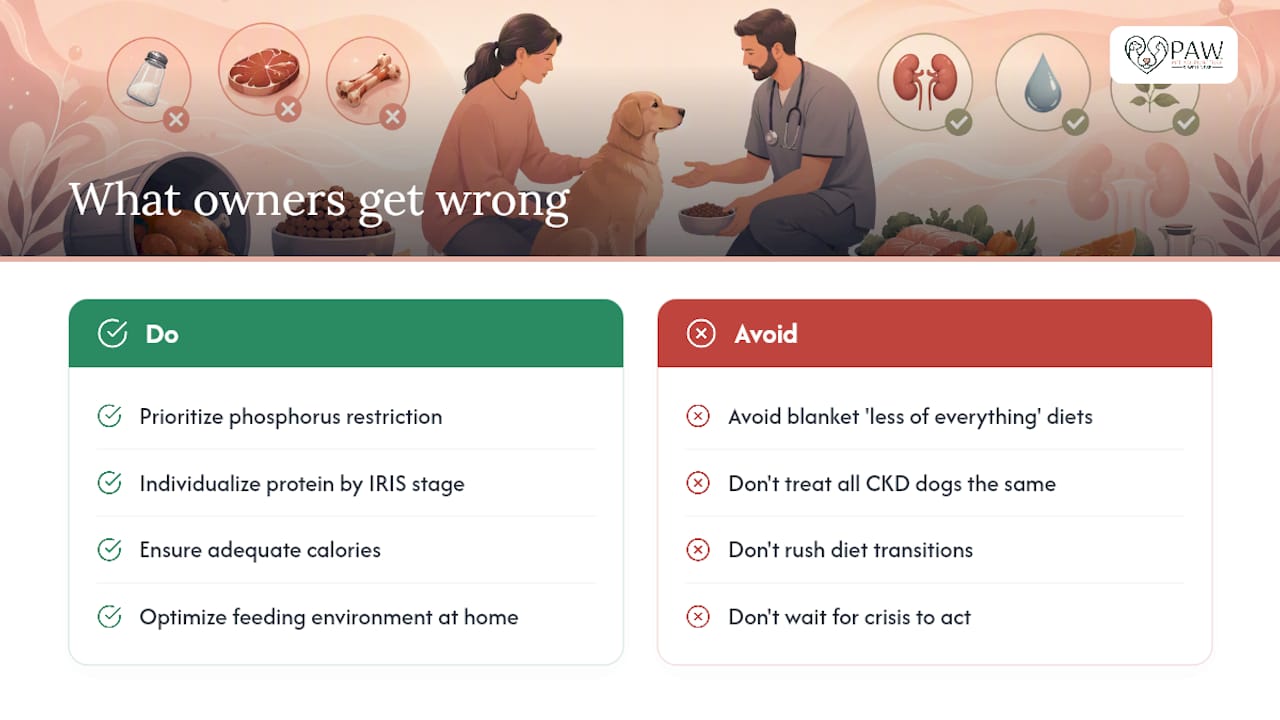
The conventional framing of kidney disease nutrition as “feed less protein, feed less of everything” is where most owners go wrong, and it is where the most harm happens. Restriction without adequate calories is not conservative management. It is malnutrition with extra steps.
What the research actually shows is that phosphorus restriction carries the clearest survival benefit, while protein restriction is more nuanced and stage-dependent. A dog in IRIS Stage 2 with a good appetite and stable BCS does not need the same aggressive restriction as a Stage 4 dog with uremic signs. Treating every CKD dog identically misses the point of individualized care entirely.
The other underappreciated truth is that feeding environment shapes outcomes. A dog who eats 90% of a moderately restricted renal diet at home, in a calm space, with an owner who knows how to warm the food and offer it at the right time, will almost always do better than a dog who eats 50% of a “perfect” diet because the transition was rushed or the clinic visit caused a food aversion. That is not a soft, feel-good observation. It is the clinical reality that makes at-home integrative care genuinely useful for CKD patients.
If your dog is losing weight, refusing food, or you are not sure whether the current diet is working, that is the moment to bring in coordinated support, not after a crisis.
At-home renal nutrition support in South Tampa
Managing a dog’s kidney disease diet is one of the most hands-on, day-to-day challenges a pet owner faces. Pet Acupuncture & Wellness brings the clinical support directly to your home in South Tampa, so your dog’s nutrition plan gets implemented in the environment where it actually has to work.
Services relevant to CKD nutrition include in-home appetite evaluations, acupuncture to ease nausea and support digestive Qi, feeding-tube placement training, rehabilitation to preserve muscle mass, telemedicine follow-ups for between-visit adjustments, and access to prescription diets through the practice pharmacy. Every visit is built around your dog’s comfort and your ability to maintain the plan long-term.
A first visit typically covers a full BCS and MMS assessment, a review of current diet and intake, and a supervised feeding trial or tube discussion if needed. Book an integrative veterinary care consultation to get a personalized renal nutrition plan your dog will actually follow.
Useful sources
These are the primary references used throughout this article. Bring the IRIS guidelines and the survival study to your next vet recheck.
- Nutritional and laboratory parameters affect the survival of dogs with chronic kidney disease – PMC
- Dietary Guidelines for Dogs with Chronic Kidney Disease (CKD) — Today’s Veterinary Practice
- Treatment of chronic kidney disease in dogs and cats — Today’s Veterinary Practice
- Safety and adequacy of home-prepared diets for renal disease — JAVMA
- Consensus recommendations for dietary therapy in glomerular disease — Journal of Veterinary Internal Medicine
- Dietary management of CKD — Today’s Veterinary Practice (PDF)
- Nutritional Management for Dogs and Cats with Chronic Kidney Disease — Parker (2021)
- WSAVA Congress specialist perspective on individualized renal management — VIN
FAQ
When should a dog with kidney disease start a renal diet?
Most veterinary guidelines recommend starting a therapeutic renal diet at IRIS Stage 2, when azotemia is confirmed. Earlier nutritional intervention correlates with longer survival.
Is low protein or low phosphorus more important in a kidney disease dog diet?
Phosphorus restriction carries the clearest survival benefit. Protein should be moderated but not severely restricted, since excessive protein reduction can cause muscle wasting and worsen outcomes.
Can I make homemade meals for a dog with kidney disease?
Homemade renal diets are risky without expert guidance. Published recipes frequently fail nutrient balance tests and may contain excess phosphorus. Only use a homemade diet formulated by a board-certified veterinary nutritionist (DACVN) with regular lab monitoring.
What treats are safe for dogs with kidney disease?
Low-phosphorus, low-sodium options such as small pieces of cooked egg white or plain cooked chicken breast are generally safer. Avoid organ meats, dairy, and commercial treats with high phosphorus content. Always confirm treat choices with your vet.
How does Pet Acupuncture & Wellness support dogs with kidney disease?
Pet Acupuncture & Wellness offers in-home nutritional evaluations, acupuncture to reduce nausea and support appetite, feeding-tube training, and telemedicine follow-ups in South Tampa, all coordinated to improve diet adherence and quality of life for CKD dogs.
This article provides general educational information and is not a substitute for veterinary medical advice. Always confirm dietary changes, supplement dosing, and treatment decisions with a licensed veterinarian familiar with your dog’s individual case.