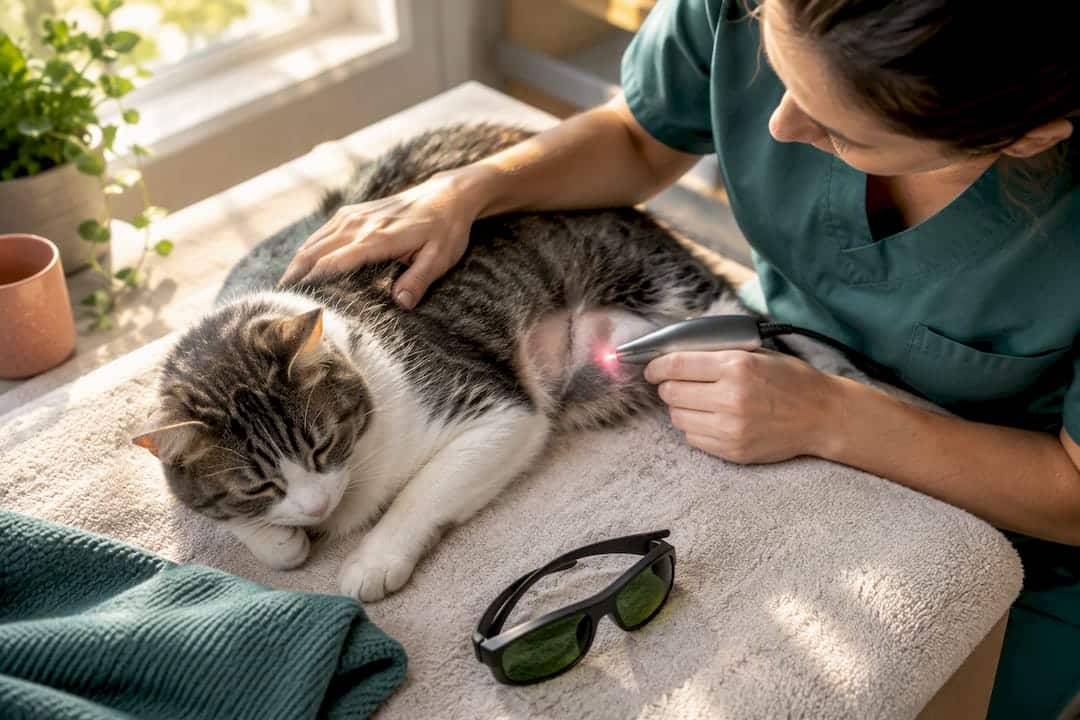
Laser therapy is a genuine, non-invasive way to ease the pain and inflammation of feline stomatitis, and Pet Acupuncture & Wellness uses it as part of a broader care plan alongside veterinary dental guidance and peer-reviewed research on the condition. It is not usually a cure on its own. Most cats with chronic gingivostomatitis still need a full dental assessment, and often extraction, to get lasting relief, with laser sessions supporting comfort along the way.
TL;DR:
- Laser therapy can reduce inflammation, improve circulation, and provide pain relief, but it often requires multiple sessions to see noticeable benefits.
- Most cats tolerate laser treatments well, especially when applied extraorally, with sessions lasting about 4 to 10 minutes per affected site.
- The evidence suggests laser therapy supports pain management and healing but is not a substitute for full-mouth tooth extraction in severe cases.
- Effective treatment depends on choosing a clinic with experienced veterinarians, clear protocols, and proper documentation of laser parameters and outcomes.
- Laser sessions typically cost between $45 and $120 each, with results varying based on laser type, protocol, and individual cat response.
Table of Contents
- What laser therapy is and how it eases oral inflammation
- What the evidence says about laser therapy for feline stomatitis
- What a typical treatment plan looks like
- Where laser therapy fits alongside extractions and advanced care
- Risks, drawbacks, and what treatment tends to cost
- How to choose a clinic for your cat’s laser treatment
- Our take on laser therapy for stomatitis
- How we deliver laser therapy at home
- Sources
- FAQ
What laser therapy is and how it eases oral inflammation
Veterinary laser therapy, sometimes called photobiomodulation or low-level laser therapy, uses light at specific wavelengths to calm irritated tissue from the outside in. Think of it like sunlight coaxing a plant to grow, except here the light is coaxing cells to reduce their own inflammatory signals and heal a little faster. Lower-power devices work gently over several minutes, while higher-power Class 4 lasers deliver more energy in less time, and both types show up in general practice depending on the clinic’s equipment and training.
The effect on your cat’s mouth comes down to a few things happening at once:
- Reduced inflammation: the light appears to calm proinflammatory activity in irritated tissue.
- Better circulation: treated areas often show improved blood flow, which supports healing.
- Pain relief: many cats seem more comfortable eating and grooming after a session.
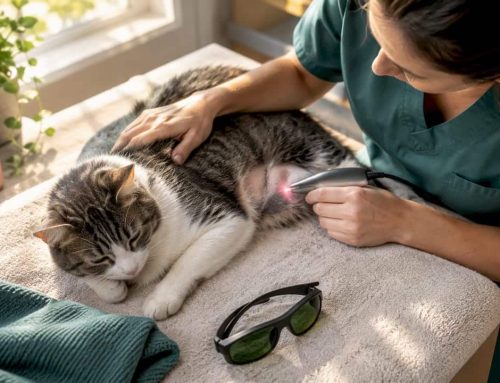
Clinics can apply the laser extraorally, through the cheek, or intraorally, directly on the lesions. For a stressed or head-shy cat, extraoral delivery is often gentler since it avoids opening the mouth altogether.
What the evidence says about laser therapy for feline stomatitis
The research on laser therapy for feline stomatitis is encouraging but still developing, and it helps to know both sides before you commit to a treatment plan. A 2024 study in Veterinary World tested 830 nanometer low-level laser light applied through the cheek in 24 cats and found the light penetrated buccal tissue and was detectable inside the mouth, supporting the idea that extraoral application can reach inflamed tissue without the stress of intraoral handling. The same study notes that clinical effectiveness through buccal tissue still needs more research before anyone can call it a proven treatment path on its own.
Broader clinical evidence on lasers in oral inflammatory disease tends to agree on the pattern: pain and early healing markers often improve, but long-term remission compared to surgery varies by condition and protocol. Reviews of feline chronic gingivostomatitis specifically continue to point to full-mouth tooth extraction as the mainstay treatment, with laser therapy positioned as an adjunct for pain control and post-surgical support rather than a replacement.
Most of these studies share the same limitations. Sample sizes are small, protocols vary from clinic to clinic and study to study, and follow-up periods are often too short to say much about lasting remission. That is not a reason to dismiss laser therapy. It is a reason to treat it as one useful tool among several, not a silver bullet.

What a typical treatment plan looks like
A laser session for feline stomatitis is usually short and calm, closer to a spa treatment than a medical procedure. Clinics commonly treat each affected area for around 4 to 10 minutes, moving between multiple sites in the mouth or along the cheek during a single visit. An initial series often runs two to three sessions per week for the first few weeks, then tapers to weekly or biweekly maintenance depending on how your cat responds.
Wavelengths used in practice commonly fall in the 800 to 900 nanometer range, chosen for deeper tissue penetration, and devices may run in continuous or pulsed modes depending on the target tissue and the clinician’s protocol. Sedation is rarely needed for extraoral application, since the cat simply rests while the handheld device is held against the cheek.
- Session length: typically 4 to 10 minutes per treated area.
- Frequency: two to three sessions weekly at first, then tapering.
- Delivery: extraoral for most anxious or sensitive cats, intraoral when lesions need direct targeting.
Pro Tip: Bring your cat’s favorite blanket or bed to a home laser session. Familiar scents help many cats settle faster than they would on a clinic table.
Where laser therapy fits alongside extractions and advanced care
Laser therapy earns its keep as a symptomatic tool: easing pain before surgery, supporting healing afterward, and offering ongoing comfort for cats whose age or health makes surgery risky. For many cats with feline chronic gingivostomatitis, though, full-mouth extraction remains the standard treatment, and laser therapy on its own is usually not enough to resolve refractory disease.
For cats that do not respond even after extraction and medical therapy, a clinical trial of uterine-derived mesenchymal stem cells found meaningful improvement in many cats with refractory disease, suggesting stem-cell therapy is a reasonable next step for the toughest cases. Laser therapy can still play a supporting role during that process, helping manage pain while more advanced treatment takes effect.

Risks, drawbacks, and what treatment tends to cost
Laser therapy is gentle, but it is not risk-free or universally effective. Both the operator and any bystanders need eye protection, and results depend heavily on using the right device class, wavelength, and training, since protocol precision is repeatedly cited as the reason some cats improve quickly while others see little change.
- Repeat visits: meaningful results usually require a series of sessions, not just one.
- Variable remission: some cats relapse and need ongoing maintenance treatment.
- Red flags: be wary of any clinic promising a cure or unable to describe its wavelength, fluence, or session plan in plain terms.
In the United States, laser treatments commonly run $45 to $120 per session, and some clinics bundle an initial assessment with the first treatment for a package rate.
How to choose a clinic for your cat’s laser treatment
The right provider makes all the difference between a treatment plan that actually helps and one that just adds appointments. Look for veterinary dental experience, a clearly stated protocol, and a device class and wavelength the practitioner can explain without hesitation.
- Ask which wavelength and fluence they plan to use for your cat’s specific lesions.
- Ask how many sessions they expect before reassessing progress.
- Ask whether they track outcomes with photos or pain scales over time.
- Ask how they coordinate with your primary veterinarian on the overall dental plan.
Pro Tip: Favor clinics that document each session’s parameters and outcomes. A practitioner who tracks progress in writing is one who is genuinely managing your cat’s care, not just running a machine.
Our take on laser therapy for stomatitis
Laser therapy gets sold sometimes as a stand-alone fix, and that oversells what the evidence supports. Used honestly, it is a comfort tool: real relief for a cat in pain, real support around surgery, but not a substitute for the dental assessment that identifies what is actually driving the inflammation in the first place. The cats who do best are usually the ones whose owners treat laser as one piece of a bigger plan, not the whole plan.
— Pet Acupuncture & Wellness
How we deliver laser therapy at home
We bring laser therapy to your cat in the place they already feel safe, which matters enormously for a cat dealing with a painful mouth. A typical visit may include an initial assessment, a treatment session, and a follow-up plan based on the cat’s response and the primary veterinarian’s dental recommendations.
- Initial visit: may include an assessment and first laser treatment.
- Follow-up plan: session frequency adjusted based on the cat’s comfort and progress.
- Coordination: treatment plans often align with the pet’s regular veterinarian’s dental recommendations.
Laser therapy pricing and package details are listed on our cost of services page, where you can see current rates before booking a home visit.
Sources
- Assessing the potential efficacy of 830-nanometer low-level laser therapy in cats: Extraoral applications
- Feline chronic gingivostomatitis current concepts in clinical management
- Clinical trial evaluating allogeneic uterine-derived mesenchymal stem cells for refractory feline chronic gingivostomatitis
- Photodynamic and laser therapies in veterinary dentistry (review/expert commentary)
FAQ
How much does laser therapy for cats cost?
Laser treatment sessions typically run $45 to $120 per session, depending on the number of areas treated and whether the visit is bundled with an initial assessment. Ask your provider whether their quote includes follow-up sessions or only the first visit.
What are two drawbacks of laser therapy?
Laser therapy usually requires a series of repeat sessions rather than a single fix, and results can vary since outcomes depend heavily on the wavelength, power, and operator training used. Some cats also see their symptoms return over time, requiring ongoing maintenance treatment.
Are lasers frustrating for cats?
Most cats tolerate laser therapy well, especially with extraoral delivery, which avoids opening the mouth and reduces handling stress. Sessions are short, typically 4 to 10 minutes per treated area, and rarely require sedation.
Can stem cell therapy be used to treat feline stomatitis?
Yes, a clinical trial of uterine-derived mesenchymal stem cells showed meaningful improvement in many cats with refractory disease that had not responded to extraction and medical therapy. It is generally considered for cats whose stomatitis persists after standard treatment rather than as a first-line option.
Does laser therapy replace the need for tooth extraction?
No, laser therapy is considered an adjunct, and full-mouth extraction remains the mainstay treatment for many cats with chronic gingivostomatitis. Laser sessions can ease pain before and after surgery, but they do not address the underlying disease the way extraction does.